Firing Order Explained: SBC, LS, Ford, Hemi and Diesel Orders
Firing order is the sequence an engine's cylinders fire in: the SBC, LS, Ford, Hemi, Duramax and Power Stroke orders, cylinder numbering, and what it changes.
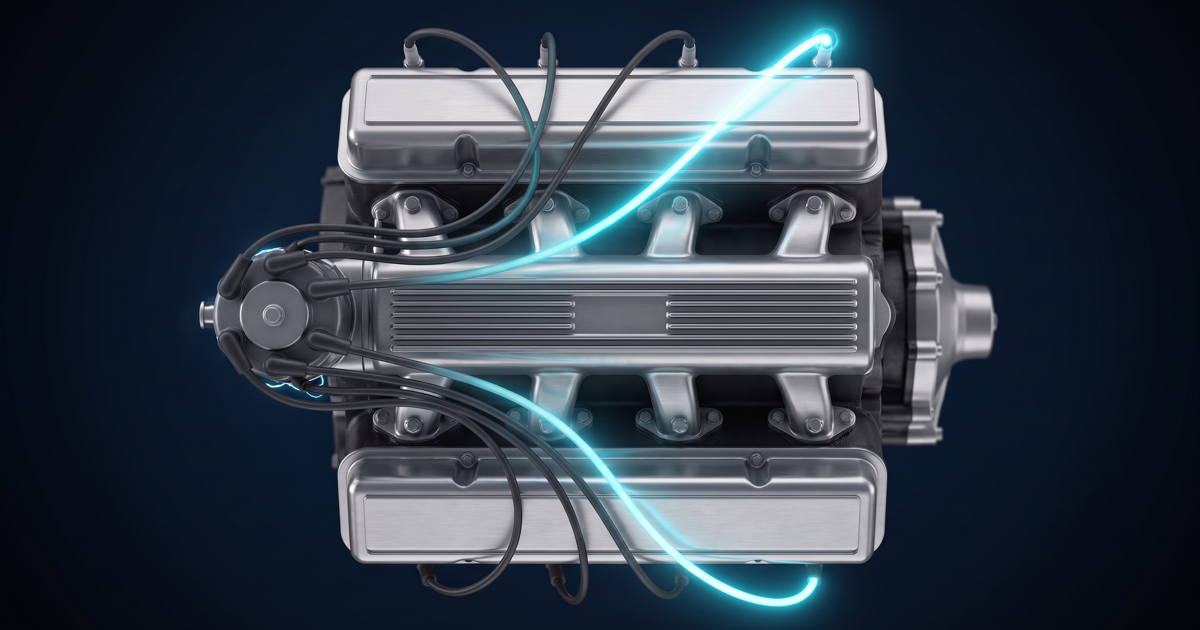
Every multi-cylinder engine fires its cylinders in a fixed sequence, and that sequence is its firing order. A small-block Chevy fires 1-8-4-3-6-5-7-2. A GM LS fires 1-8-7-2-6-5-4-3. A Fox-body 5.0 HO Mustang fires 1-3-7-2-6-5-4-8, a Coyote Mustang 1-5-4-8-6-3-7-2, and an older 302 1-5-4-2-6-3-7-8. You need the number whenever you wire a distributor, replace coil packs or swap a camshaft, and you need to know how that engine's maker numbers its cylinders before the number means anything.
This article has the common orders in one table with their sources, explains the numbering, and then answers the question the forums argue about: does firing order change power or sound? We tested it in our simulator by typing four different firing orders into the same V8. You can open that V8 with the LS order and hear it.
Key Takeaways
- Firing order is the sequence in which the cylinders of an engine fire. It is set by the crankshaft and camshaft (and, on older engines, the distributor), and the spark plug wires or coils must follow it.
- Common V8 orders: small-block and big-block Chevy, older Chrysler and Gen III Hemi 1-8-4-3-6-5-7-2; GM LS and LT 1-8-7-2-6-5-4-3; Ford 289/302 1-5-4-2-6-3-7-8; Ford 5.0 HO, 351W and 4.6/5.4 modular 1-3-7-2-6-5-4-8; Ford Coyote in the Mustang 1-5-4-8-6-3-7-2.
- The same digits mean different cylinders on different makes. GM and Chrysler gasoline V8s put odd cylinders (1-3-5-7) on the driver side; Ford numbers 1-2-3-4 down the passenger side and 5-6-7-8 down the driver side.
- In our simulator, changing a V8's firing order while keeping the 90° spacing changed its power by nothing at all: 297.251 hp for all four orders tested. It did change the rhythm of exhaust pulses down each bank, which the simulator routes to each bank's exhaust sound. The real reasons engineers choose an order (crankshaft vibration, bearing loads, cooling, intake distribution, exhaust pulse interaction) are effects this model does not simulate, so its zero is the order with those effects taken out.
- In the simulator, the spacing between firings changes more than the order does. On its V-twin, bunching the two firings from 360° apart to 180° apart raised the crank-speed ripple at idle by 54%.
On this page: Quick answer · Firing order table · Cylinder numbering · Small-block Chevy · LS and the 4/7 swap · Ford 302 vs 5.0 HO · Does it change power or sound? · Why engineers choose an order · Uneven firing · Try it · FAQ · How these numbers were made
Quick Answer: What Is a Firing Order
A firing order is the sequence in which an engine's cylinders reach their power stroke, written as cylinder numbers. In a four-stroke engine every cylinder fires once per two crankshaft turns, 720°, so an eight-cylinder engine fires one cylinder every 90° of crank rotation and a six every 120°. The order says which cylinder takes each of those slots.
The crankshaft's throw positions and the camshaft's lobe timing fix the order when the engine is built. You cannot change it by moving plug wires: wiring the plugs out of order sends the spark to cylinders that are not ready for it, and the engine runs badly or not at all. Changing a firing order for real means a camshaft ground for the new order, plug wires or coil wiring to match, and on an engine with electronic control, a matching calibration. A V8's crankshaft allows more than one order, so the crank itself can usually stay.
Firing Orders for Common Engines
| Engine | Firing order | Cylinder numbering | Source |
|---|---|---|---|
| Chevrolet small-block (Gen 1 and 2) and big-block (except 8.1 Vortec) | 1-8-4-3-6-5-7-2 | odd on driver side | Summit Racing |
| GM LS (Gen III and IV), LT (Gen V) and 8.1 Vortec | 1-8-7-2-6-5-4-3 | odd on driver side | Summit Racing |
| Chrysler Gen III Hemi (5.7, 6.1, 6.4) | 1-8-4-3-6-5-7-2 | odd on driver side | Summit Racing |
| Ford 289 and 302 (non-HO) | 1-5-4-2-6-3-7-8 | 1-4 passenger side* | OnAllCylinders |
| Ford 5.0 HO and 351 Windsor | 1-3-7-2-6-5-4-8 | 1-4 passenger side | Summit Racing |
| Ford 4.6 and 5.4 modular | 1-3-7-2-6-5-4-8 | 1-4 passenger side* | OnAllCylinders |
| Ford 5.0 Coyote (Mustang, 2011-2014 F-150) | 1-5-4-8-6-3-7-2 | 1-4 passenger side | Summit Racing |
| Ford 5.0 Coyote (2015 and later F-150) | 1-3-7-2-6-5-4-8 | 1-4 passenger side | Summit Racing |
| Ford 6.7 Power Stroke diesel | 1-3-7-2-6-5-4-8 | 1-4 passenger side | DieselHub |
| Ford 7.3 Power Stroke diesel | 1-2-7-3-4-5-6-8 | odd on passenger side | DieselHub |
| GM 6.6 Duramax diesel | 1-2-7-8-4-5-6-3 | see note | DieselHub |
| Dodge Viper V10 | 1-10-9-4-3-6-5-8-7-2 | not given by source | MaxxECU wiring guide |
| Most inline-fours | 1-3-4-2 (some 1-2-4-3) | front to back | Wikipedia |
| Most inline-sixes | 1-5-3-6-2-4 | front to back | Wikipedia |
* Ford's passenger-side 1-4 numbering is given on Summit Racing's 351 Windsor and Coyote pages and on DieselHub's 6.7 Power Stroke page; the pages cited for the 289/302 and modular orders give the order only.
Older Chrysler small blocks, AMC, Buick, Oldsmobile and Pontiac V8s also use 1-8-4-3-6-5-7-2, according to OnAllCylinders' firing order guide, though their distributors turn in different directions. The Duramax note: sources disagree on which bank carries the odd cylinders, so check the cylinder numbers cast or printed on the engine itself before you rely on the order.
How Cylinders Are Numbered
A firing order is only useful if you know which cylinder is "3". Makers number V8s two different ways, and the same string of digits means different cylinders on each.
GM and Chrysler number along the crankshaft, alternating banks: cylinder 1 is at the front of the driver side, 2 at the front of the passenger side, 3 behind 1, and so on, so the driver bank holds 1-3-5-7 and the passenger bank 2-4-6-8. Summit Racing's pages for the small-block Chevy, the LS and the Gen III Hemi all give this layout.
Ford numbers one bank and then the other: 1-2-3-4 front to back on the passenger side, 5-6-7-8 on the driver side, as on the 351 Windsor and the Coyote. The Wikipedia firing order article notes that Audi and Porsche number their V8s by bank too.
Diesels do not always follow their brand. The 7.3 Power Stroke was a Navistar design and puts the odd cylinders on the passenger side, according to DieselHub, while the later 6.7 Power Stroke uses Ford's 1-4 passenger-side layout. Before wiring anything on an engine you have not worked on before, find cylinder 1 on that engine.
Small-Block Chevy Firing Order: 1-8-4-3-6-5-7-2
The small-block Chevy, from the 265 through the 350 and 400, fires 1-8-4-3-6-5-7-2, with cylinder 1 at the front of the driver side and the distributor turning clockwise. The big-block 396, 427, 454 and 502 use the same order; the later 8.1 L Vortec big-block switched to the LS order, according to Summit Racing. Enough people type it as one number that "18436572" is a search term in its own right.
Read against the GM numbering, the order alternates mostly between banks: 1 (driver), 8 (passenger), 4 (passenger), 3 (driver), 6 (passenger), 5 (driver), 7 (driver), 2 (passenger). Two pairs fire back to back on the same bank, 8 then 4 on the passenger side and 5 then 7 on the driver side. That is a property of every cross-plane V8 and it is where the V8 burble comes from, as the section on uneven firing explains.
LS Firing Order and the 4/7 Swap
GM's LS engines changed the order to 1-8-7-2-6-5-4-3. It is the small-block order with cylinders 4 and 7 swapped, and 2 and 3 swapped. Hot rodders fit small-blocks with camshafts that make only the first of those swaps, 1-8-7-3-6-5-4-2, and call it the "4/7 swap".
GM's reason was the crankshaft. According to OnAllCylinders, reduced crankshaft torsional vibration was "the main reason GM adopted" the LS order, and the change also eased bearing loads and made the crank position sensor's reluctor wheel read more accurately. EngineLabs gives the same torsional-vibration reason, plus a cooling one from Comp Cams' Billy Godbold: the swap moves the pair of cylinders that fire back to back toward the front of the engine, near the water pump.
On power, the camshaft makers are cautious. Godbold told EngineLabs that "most of the smart guys will tell that there might be one percent difference if you get everything right." OnAllCylinders reports that gains of one or two percent are common and puts part of that down to cooler-running rear cylinders.
We put both orders into the simulator's 5.0 V8 and ran both on the dyno: 297.251 hp at 7,000 rpm and 445.157 N·m at 3,841 rpm for each, identical to the third decimal place, with identical idle. That zero comes from what the model leaves out. It treats the crankshaft as rigid and does not model torsional vibration, bearing loads, cylinder-to-cylinder cooling, how a plenum shares mixture between runners, or how exhaust pulses from neighbouring cylinders interact in the manifold. What it isolates is the order itself: with the same 90° spacing and none of those effects, the order moves no power. Whatever a real 4/7 swap gains, around 1% by the cam makers' own figures, comes through those effects.
Ford 302 vs 5.0 HO Firing Order
Ford's small-block V8 has two orders. The 289 and the regular 302 fire 1-5-4-2-6-3-7-8. The 5.0 HO (high output) Mustang engine and the 351 Windsor fire 1-3-7-2-6-5-4-8, and so do the 4.6 and 5.4 modular V8s and the 6.7 Power Stroke diesel. The Coyote 5.0 in the Mustang uses a third order, 1-5-4-8-6-3-7-2.
Ford's stated reason for the HO change is sound. OnAllCylinders reports that Ford's engineers made the switch "to improve the intake manifold sound quality", while noting that forums have argued for years about whether bearing loads were the real motive. A 302 being converted to an HO camshaft, or the reverse, needs its plug wires reordered to match.
Does Firing Order Change Power or Sound?
To answer this directly, we took the simulator's 5.0 L V8, which uses GM numbering and the small-block Chevy order, and typed in three more firing orders: the LS order, an order that alternates banks on every firing, and an order that fires all of one bank before the other. We ran each on the dyno and idled each for 30 seconds.
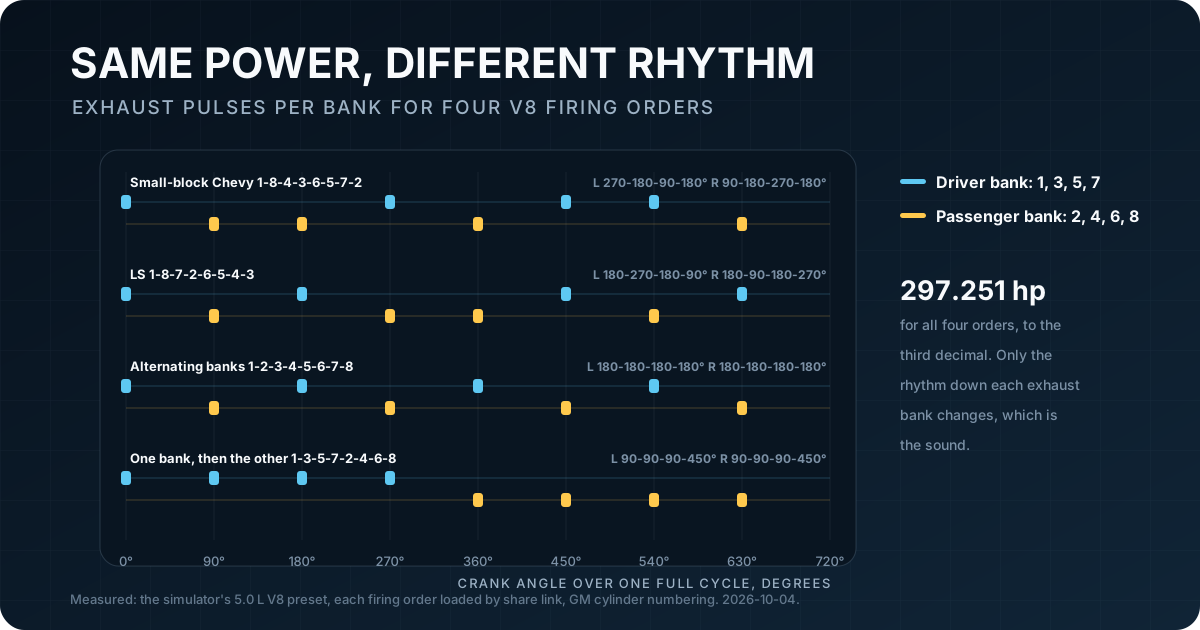
| Firing order on the 5.0 V8 | Peak power | Peak torque | Idle variation | Driver bank (1-3-5-7) intervals | Passenger bank (2-4-6-8) intervals |
|---|---|---|---|---|---|
| Small-block Chevy 1-8-4-3-6-5-7-2 | 297.251 hp | 445.157 N·m | 0.356% | 270-180-90-180° | 90-180-270-180° |
| LS 1-8-7-2-6-5-4-3 | 297.251 hp | 445.157 N·m | 0.356% | 180-270-180-90° | 180-90-180-270° |
| Alternating banks 1-2-3-4-5-6-7-8 | 297.251 hp | 445.157 N·m | 0.356% | 180-180-180-180° | 180-180-180-180° |
| One bank, then the other 1-3-5-7-2-4-6-8 | 297.251 hp | 445.157 N·m | 0.356% | 90-90-90-450° | 90-90-90-450° |
Power, torque and idle are the same for every order. With the firings still 90° apart, the crankshaft receives the same eight pushes per cycle, only from different cylinders, and in a model without crank vibration or exhaust pulse interaction that makes no difference to what comes out of the flywheel. We repeated the test on the simulator's inline-four (1-3-4-2 against 1-2-4-3) and inline-six (1-5-3-6-2-4 against 1-2-3-4-5-6) with the same result: 116.39 hp and 193.47 hp, unchanged.
What does change is what each exhaust manifold hears. The small-block and LS orders give each bank the same uneven rhythm, gaps of 90, 180, 270 and 180 degrees, starting at a different point in the cycle. That rhythm is the cross-plane V8's burble. An order that alternates banks gives each bank an even 180°, the rhythm of a flat-plane V8. Firing one bank and then the other gives three quick pulses and a long silence on each side. The simulator routes each bank's pulses to that bank's exhaust in its sound, so in the simulator these four orders sound different while making identical power. A real cross-plane crankshaft cannot fire the alternating order, and it cannot fire 1-3-5-7-2-4-6-8 as written either; the simulator lets you type both, which makes them thought experiments. A real engine given a different order would also change the vibrations the model leaves out.
Why Engineers Choose a Firing Order
If the order does not change power in the model, why does every engine have a particular one? Because of the effects a rigid-crank model ignores. The sources above give these:
- Crankshaft torsional vibration. Every firing twists the crankshaft slightly. The order decides where along the crank those twists land and how they add up, and GM's LS change was mainly about reducing them.
- Main bearing loads. Two neighbouring cylinders firing one after the other load the main bearing between them twice in quick succession. Luke Bandt of Howards Cams told EngineLabs that bearing wear "will look a lot nicer" after a 4/7 swap on a high-power engine.
- Cooling. On the small-block Chevy, cylinders 5 and 7, which fire back to back at the rear of the driver side, tended to run hotter, according to OnAllCylinders. The 4/7 swap moves the back-to-back pair nearer the water pump and its cooler coolant.
- Intake distribution. "There's always a lot of mixture robbing in a plenum," engine builder Kenny Duttweiler told EngineLabs: the order changes which cylinder draws from the plenum just after its neighbour, and so how evenly they fill.
- Exhaust pulses. The order sets which cylinders' exhaust pulses meet in each manifold and when, which is also why Ford could describe its 5.0 HO change as a sound change.
On an inline-four the crankshaft leaves only two possible orders, 1-3-4-2 and 1-2-4-3, because cylinders 1 and 4 always move together. On a V8 the crank allows several, and the camshaft picks one.
Even and Uneven Firing: V-Twins, Crossplane Bikes and the V8 Burble
In the simulator, the spacing between firings changes more than their order does. An engine with evenly spaced firings gets an evenly spaced series of pushes on the crankshaft. Bunch them together and the crank speeds up and slows down more within each cycle.
Harley-Davidson's 45° V-twin is the famous uneven engine. Both connecting rods share one crankpin, so, as Jalopnik explains, the two pistons fire 315° apart and then wait 405° for the next pair. That spacing is the "potato-potato" sound. We took the simulator's 1,340 cc 45° V-twin, which fires 405° and 315° apart like the Harley, and tested four spacings at its 1,000 rpm idle.
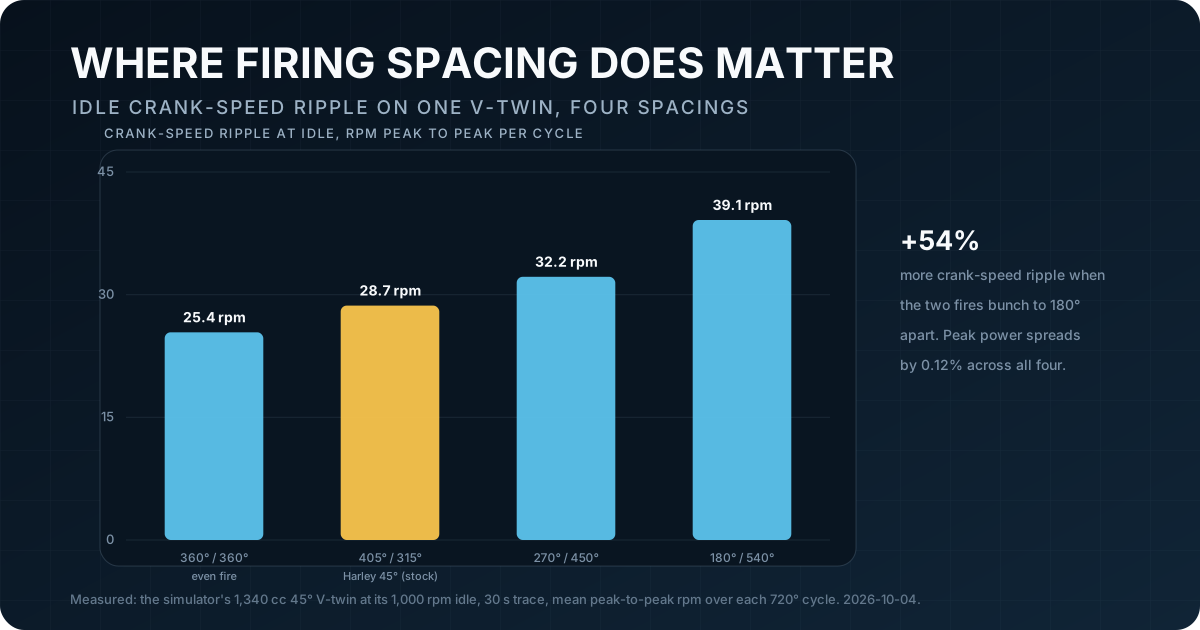
| Firing spacing | Crank-speed ripple at idle (peak to peak per cycle) | Peak power |
|---|---|---|
| 360° / 360° (even) | 25.4 rpm | 58.88 hp |
| 405° / 315° (Harley 45°, stock) | 28.7 rpm | 58.93 hp |
| 270° / 450° | 32.2 rpm | 58.92 hp |
| 180° / 540° | 39.1 rpm | 58.95 hp |
Peak power barely moves: 58.88 to 58.95 hp, a spread of 0.12%. The crank speed swings 54% more within each cycle when the two firings are 180° apart instead of 360°. That is torsional unevenness at the crankshaft; the shaking a rider feels on a real V-twin also comes from the reciprocating imbalance of the pistons, which this model does not compute. The Harley's own 405/315 spacing sits close to even, 13% above it.
Yamaha went the other way on purpose. The 2009 YZF-R1, the first production motorcycle with a crossplane crankshaft, fires its four cylinders at "an uneven firing interval of 270-180-90-180 degrees". Yamaha explains that the crank layout cancels the inertial torque of the pistons, so that what reaches the rear tyre is "torque that is produced purely from the combustion force", which riders feel as better traction out of corners.
The cross-plane V8 is uneven too, but per bank rather than overall. The engine as a whole fires every 90°, smoothly. Each bank of four, though, fires at gaps of 180, 90, 180 and 270 degrees, as the Wikipedia crossplane article puts it, and when each bank's exhausts merge into one pipe that uneven rhythm becomes the burble. Our article on cross-plane vs flat-plane V8s measures the difference that makes to the sound.
Try It in the Simulator
Open the 5.0 V8 with its small-block Chevy order and start it. The firing order sits in the spec panel as a text field; type a new order, press enter, and the engine fires in that order immediately. Rev it and listen, then type the LS order and compare. Then try the alternating-bank order, which gives each bank the even rhythm of a flat-plane V8. Run the dyno on each and the peak figures come out identical.
Two notes. The 5.0 uses GM numbering, so a Ford order typed into it gives the pattern that order makes on GM cylinders, not what a real Ford sounds like. And the field accepts any order, including ones no real crankshaft can fire. For uneven spacing, open the 45° V-twin, which fires 405° and 315° apart like a Harley; the spec panel shows its firing intervals but does not let you edit them.
Frequently Asked Questions
What is a firing order?
A firing order is the sequence in which an engine's cylinders fire, written as cylinder numbers. A small-block Chevy's 1-8-4-3-6-5-7-2 means cylinder 1 fires first, then 8, then 4, and so on, one every 90° of crankshaft rotation. It is fixed by the crankshaft and camshaft, and the spark plug wires or coils have to follow it.
What is the firing order of a small-block Chevy 350?
1-8-4-3-6-5-7-2. Cylinder 1 is at the front of the driver side, the odd cylinders run down the driver side and the even cylinders down the passenger side, and the distributor turns clockwise. Every Gen 1 and Gen 2 small-block and the 396, 427, 454 and 502 big-blocks use the same order.
What is the LS firing order?
1-8-7-2-6-5-4-3, used by every GM LS (Gen III and IV) and LT (Gen V) V8. It is the small-block Chevy order with cylinders 4 and 7, and 2 and 3, swapped. GM adopted it mainly to reduce crankshaft torsional vibration and bearing loads.
What is the Ford 302 firing order?
The standard 289 and 302 fire 1-5-4-2-6-3-7-8. The 5.0 HO and 351 Windsor fire 1-3-7-2-6-5-4-8. Ford numbers cylinders 1-2-3-4 down the passenger side and 5-6-7-8 down the driver side. A 302 can carry either camshaft, so confirm which one it has before wiring it.
What does 18436572 mean?
It is the small-block Chevy firing order written as one number: 1-8-4-3-6-5-7-2. Chrysler's small blocks and Gen III Hemi, and many older AMC, Buick, Oldsmobile and Pontiac V8s, use the same sequence.
Does firing order affect horsepower?
Very little. In our simulator, four different firing orders on the same V8 made exactly the same power, 297.251 hp, in a model without crank vibration, cooling differences or exhaust pulse interaction. On real engines, Comp Cams' Billy Godbold puts a firing order change at "one percent difference if you get everything right", and OnAllCylinders reports one to two percent gains as common, partly from cooler-running rear cylinders.
Does firing order change the sound?
Yes. The order decides when each exhaust bank receives its pulses. A cross-plane V8's order gives each bank an uneven rhythm, the familiar burble, while an order that alternates banks gives each bank an even rhythm, closer to a flat-plane V8. Ford described its 5.0 HO order change as a sound improvement. In our simulator, which routes each bank's pulses to its own exhaust sound, the orders sound different while measuring identical power.
Can you change an engine's firing order?
Yes, with a camshaft ground for the new order, as in the popular 4/7 swap for small-block Chevys. Moving the plug wires alone does not change the firing order; it only sends spark to the wrong cylinders. The crankshaft limits which orders are possible.
How These Numbers Were Made
Every simulator figure in this article comes from one headless run of the simulator on 2026-10-04. For the order test we took three stock presets, the 5.0 L V8 (GM-style numbering), the 2.0 L inline-four and the 3.0 L inline-six, and entered each firing order through the same share link the Try It section uses, so the measured engine is the one the link opens. Each order got a full-throttle dyno sweep, 45 points from idle to redline, and a 30-second idle trace at 240 samples per second after 20 seconds of settling. The idle variation is the standard deviation of engine speed over that trace divided by its mean. The per-bank intervals come from the angles at which the simulator fires each cylinder, split by the bank each cylinder sits on.
For the spacing test we changed the firing angles of the 1,340 cc 45° V-twin directly, because firing angles are not carried in a share link, and measured the peak-to-peak engine speed over each 720° cycle at idle, averaged over the 30-second trace. Peak power comes from the same dyno sweep. The simulator models the crankshaft as rigid. It has no torsional vibration, no bearing loads, no cylinder-to-cylinder cooling and no intake distribution between cylinders, and its gas exchange does not respond to when neighbouring exhaust pulses arrive, so it cannot show why engineers prefer one order over another; it shows that the order alone, with those effects removed, does not change output, and how the order and the spacing change the rhythm of the exhaust and the crank. The real-world firing orders in the table are from the sources listed, not from the simulator.
About this article
Written by the team that builds the simulator and maintains its crankshaft, firing and exhaust-routing models. The firing orders, cylinder numbering and manufacturer reasons come from the parts suppliers, trade press and manufacturer sources listed below. The power, idle, ripple and per-bank figures are the simulator's and are labelled as such.
Sources and Further Reading
- Summit Racing: Early Chevy V8 firing order (retrieved 2026-10-04)
- Summit Racing: Late model GM V8 firing order (retrieved 2026-10-04)
- Summit Racing: Chrysler Gen 3 Hemi firing order (retrieved 2026-10-04)
- Summit Racing: Ford 351 Windsor firing order (retrieved 2026-10-04)
- Summit Racing: Ford 5.0L Coyote firing order (retrieved 2026-10-04)
- OnAllCylinders: Engine firing orders and rotation guide (retrieved 2026-10-04)
- OnAllCylinders: Chevy small block firing orders and firing order swaps (retrieved 2026-10-04)
- OnAllCylinders: Why Ford changed the 5.0L H.O. firing order (retrieved 2026-10-04)
- EngineLabs: Understanding the 4/7 swap (retrieved 2026-10-04)
- EngineLabs: Firing order swaps, what's best for your engine (retrieved 2026-10-04)
- DieselHub: 7.3 Power Stroke, 6.7 Power Stroke and 6.6 Duramax L5P (retrieved 2026-10-04)
- MaxxECU: Dodge Viper V10 wiring (retrieved 2026-10-04)
- Jalopnik: Why do Harley-Davidsons vibrate so much? (retrieved 2026-10-04)
- Roadracing World: 2009 Yamaha YZF-R1 uneven firing order (retrieved 2026-10-04)
- Yamaha Motor: Introducing a cross-plane crankshaft power unit (retrieved 2026-10-04)
- Wikipedia: Firing order and Crossplane (retrieved 2026-10-04)