Inline-6 vs V6: We Built Both at 3.0 Litres and Measured Them
Two three-litre sixes on identical physics, one inline and one 60° V. Peak power lands 1.1% apart, and with every other variable held equal the layout is worth 0.02 hp. What it does decide: balance, packaging and boost.

Ask which is better, an inline-six or a V6, and you get the same two sentences back: the straight-six is smoother, the V6 fits in more cars. Both are true. Neither tells you whether picking one costs you anything on the dyno, which is what you wanted to know.
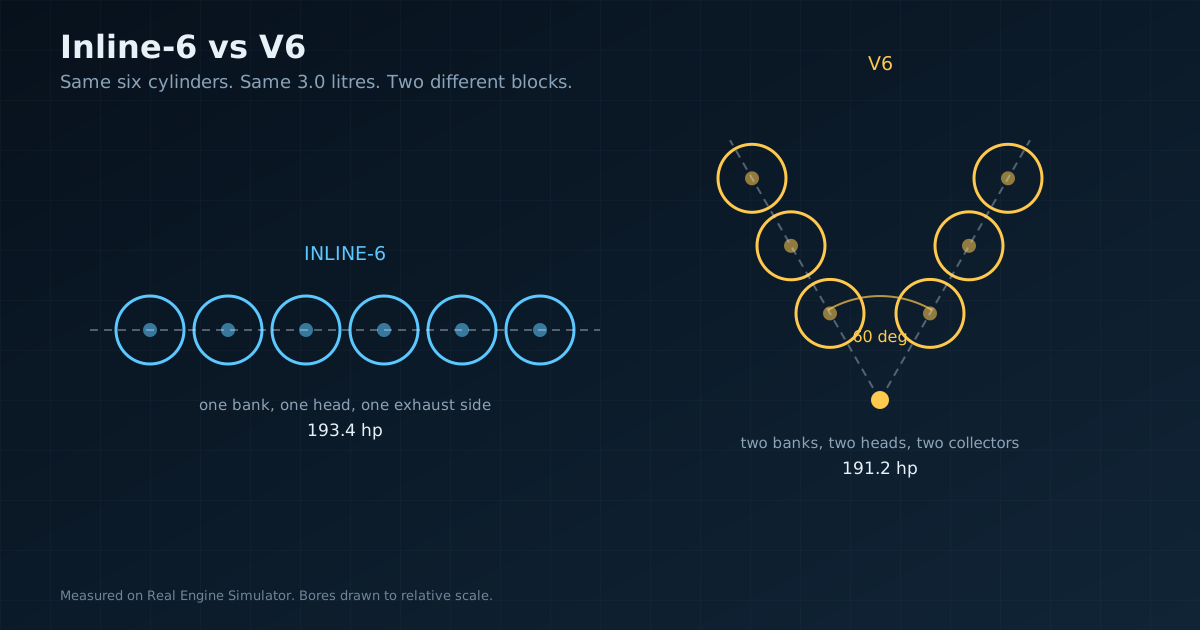
So we built both and measured them the same way, on one 28-step sweep each. Two 3.0-litre sixes on the same simulated physics, sharing a combustion model, a friction figure and a volumetric efficiency curve; one inline, one a 60° V. Then we stripped away every difference except the bank angle.
Key Takeaways
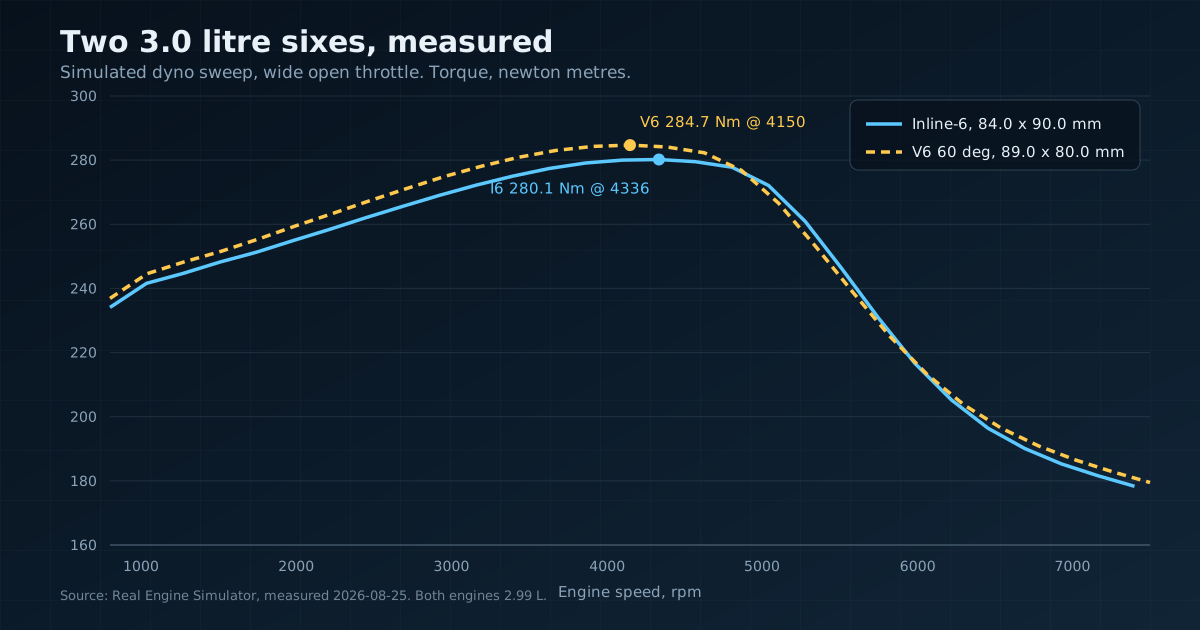
- Our 3.0 L inline-six measured 193.4 hp @ 5,279 rpm and 280.2 N·m @ 4,336 rpm. Our 3.0 L 60° V6 measured 191.2 hp @ 5,107 rpm and 284.7 N·m @ 4,150 rpm — 1.1% apart on power, 1.6% on torque, in opposite directions.
- That gap is bore and stroke, not layout. The inline engine is undersquare (84.0 × 90.0 mm), the V6 oversquare (89.0 × 80.0 mm).
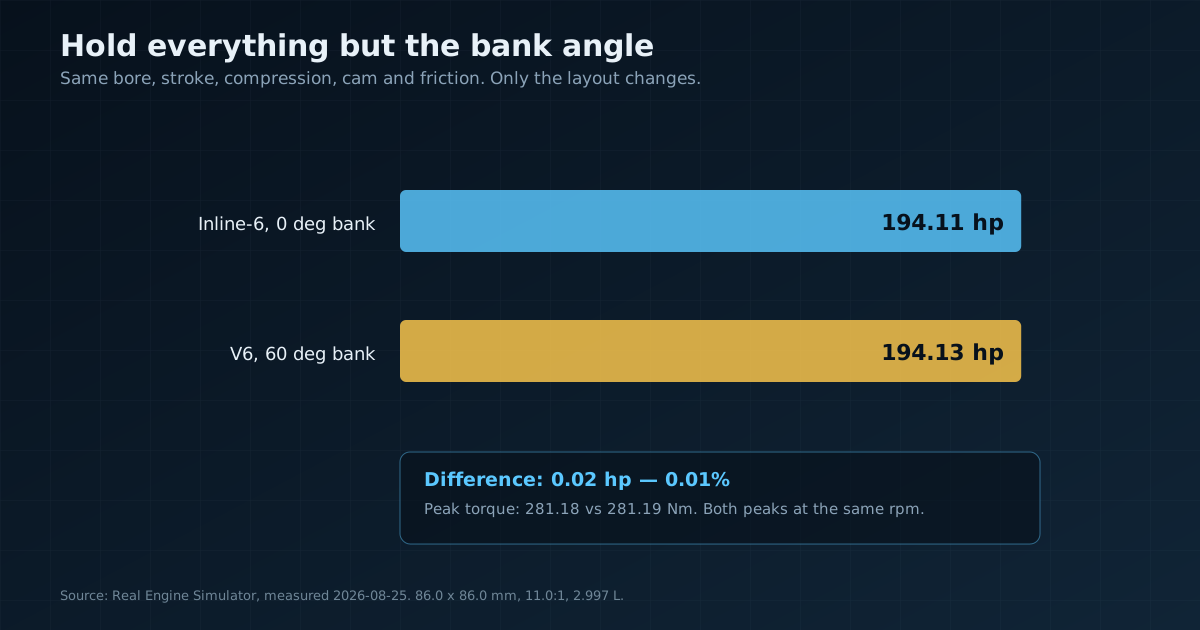
- With bore, stroke, compression, cam timing and friction held identical and only the bank angle changed, the two engines produced 194.11 hp and 194.13 hp — a difference of 0.02 hp, or 0.01%.
- Layout is not a power lever. It decides balance, block shape and turbo placement.
- The straight-six's balance advantage is real and specific — free forces sum to zero until the sixth order — but it is the one claim on this page our simulator cannot measure, and we say so rather than dress it up.
On this page: Quick answer · The two engines · The controlled test · Balance · Firing order · Packaging · Turbocharging · The comeback · Which should you want · FAQ · How these numbers were made
Quick Answer: Which Makes More Power?
Neither, at matched displacement. Our two three-litre sixes finished within 1.1% of each other on peak power. The small gap that does exist comes from bore and stroke, geometry that says nothing about whether the cylinders sit in one row or two.
Bank angle is the included angle between the two cylinder banks of a V engine: 0° means the cylinders sit in one row and the engine is an inline. Bore is the cylinder's diameter and stroke is how far the piston travels, and their product with cylinder count sets displacement.
| Inline-6 3.0 | V6 3.0, 60° | |
|---|---|---|
| Bore × stroke | 84.0 × 90.0 mm | 89.0 × 80.0 mm |
| Displacement | 2.993 L | 2.986 L |
| Compression ratio | 11.0:1 | 11.2:1 |
| Redline | 7,400 rpm | 7,500 rpm |
| Firing order | 1-5-3-6-2-4 | 1-4-2-5-3-6 |
| Peak power | 193.4 hp @ 5,279 rpm | 191.2 hp @ 5,107 rpm |
| Peak torque | 280.2 N·m @ 4,336 rpm | 284.7 N·m @ 4,150 rpm |
Read the last two rows. The V6 makes more torque and makes it lower down. The inline takes peak power by two horsepower, 172 rpm further up. If the layout were driving this, one column would take both.
The Two Engines We Measured
We did not build either engine for this article. Both ship as stock presets in the simulator (i6_3L and v6_3L), tuned separately against the kind of engine each represents, so the pair samples how builders lay these engines out. We measured them at 11.0:1 and 11.2:1 compression, exactly as they ship.
The inline-six is undersquare: a 90 mm stroke against an 84 mm bore. Classic straight-six recipe, and it lands close to a real one: BMW's B58 runs 82 mm × 94.6 mm at 11.0:1 with a 7,000 rpm redline (Wikipedia, BMW B58, retrieved 2026-08-25). Our preset sits within a couple of millimetres on both axes and shares the compression ratio.
The V6 goes the other way: 89 mm bore, 80 mm stroke, oversquare, revving 100 rpm higher. A shorter stroke means a bigger bore for the same swept volume, which means more valve area and less piston speed per rpm.
Those two choices separate the curves. The bank angle does not.
The Controlled Test: Change Only the Bank Angle
To find out how much of the gap belongs to the layout, we deleted every other difference. Same bore, same stroke, same compression ratio, redline, cam timing, friction and volumetric efficiency. One square 86.0 × 86.0 mm six at 11.0:1, built twice: once with a 0° bank angle, once at 60°.
| Peak power | Peak torque | |
|---|---|---|
| Inline-6, 0° bank | 194.11 hp @ 5,279 rpm | 281.18 N·m @ 4,336 rpm |
| V6, 60° bank | 194.13 hp @ 5,279 rpm | 281.19 N·m @ 4,336 rpm |
| Difference | 0.02 hp (0.01%) | 0.01 N·m |
Our finding: with every other variable pinned, the bank angle is worth two hundredths of a horsepower. Both engines peak at the same rpm, to the sample.
The swap test says it from the other direction. Give the inline engine the V6's bore and stroke and it makes 194.0 hp. Give the V6 the inline engine's and it drops to 190.6 hp. The numbers travel with the geometry, straight across the layout boundary.
One reading of this result cuts against us. A thermodynamic model holds no opinion about where a cylinder sits, so part of this null result describes the model rather than the engine. The next section is where we hand you the tools to judge that.
Balance: The Claim We Cannot Measure
The straight-six's reputation rests on balance, and the cause is geometry. Wikipedia's straight-six article states it:
"The primary balance is due to the front and rear trio of cylinders moving in pairs (albeit 360° out of phase), thus canceling out the rocking motion present in a straight-three engine." (Wikipedia, Straight-six engine, retrieved 2026-08-25)
"The secondary balance is due to the crank throws being arranged in three planes offset at 120°, resulting in the non-sinusoidal forces summing to zero for all free forces until the sixth order."
Free forces summing to zero until the sixth order beats "smoother", because you can check it. The same source notes that V6, straight-four and V8 engines all "experience significant secondary dynamic imbalance, resulting in engine vibration." Secondary imbalance shakes the engine at twice crank speed. The piston covers more ground on the way down from top dead centre than on the way back up, and that asymmetry is what shakes it.
Our simulator does not model this. It turns cylinder pressure into crank torque and treats rotating mass as inertia. The counterweights you can see in the 3D view are there to look at; they cancel nothing. So the most-cited advantage of the inline-six sits in the blind spot of every figure on this page, all of which describe gas and friction. If you came to find out which engine shakes less, the answer is the inline-six, and it comes from the crank throws rather than from us.
That limitation frames the 0.02 hp result. Layout does nothing thermodynamically, which hands the entire difference to balance, packaging and plumbing. Those are the three you feel from the driver's seat.
Firing Order and Why They Sound Different
Both engines fire six times per two crank revolutions, spaced every 120°. The difference is the route those pulses take out of the block.
The inline-six sends all six down one exhaust side, into one manifold, in the order 1-5-3-6-2-4. The V6 splits them into two banks of three, each with its own collector, firing 1-4-2-5-3-6, so each bank sees an event every 240° of crank rotation and the two banks interleave.
The difference sits in the exhaust gas dynamics, not the crank, and it explains why the two layouts keep distinct voices even at matched bore and stroke. Run the inline-six, then the 60° V6, and switch between the two tabs. The simulator synthesises its audio from firing events, so you are hearing the pulse train the physics produced rather than a recording.
Packaging: The Trade That Decides It
Six bores in a row make a long engine. The same six in two banks of three make a short, wide one. The whole trade sits there, and it belongs to the chassis more than to the engine.
A long engine has to sit longitudinally, which commits you to rear or all-wheel drive, a long bonnet and a front axle line that clears the crank nose. A V6 lies across a transverse front-drive bay, sits lower and leaves crush space. When volume cars moved to front-wheel drive, engineers picked the V6 because the inline-six would not fit.
Width is the bill for that. As emissions hardware crowds the bay, the V6 gives ground: "as emissions equipment becomes more important their width now starts to count against them for packaging" (Hagerty, retrieved 2026-08-25).
Why the Straight-Six Suits a Single Turbo
One head, one exhaust side, one manifold, one turbo. The path from valve to turbine is short and the pulses arrive evenly spaced. A V6 either takes two smaller turbos, one per bank, or runs a crossover pipe to feed a single one, paying for the choice in pipe length, heat lost on the way to the turbine, and the cost of a second housing.
That plumbing is why so many of the tuning world's favourite blocks are straight-sixes, and it shows up when you boost one. Turbocharged, the same 3.0 inline in our roster measures 385.5 hp @ 7,000 rpm and 544.0 N·m @ 4,656 rpm, close to double the naturally aspirated figures from a block of identical displacement. The details of how that happens are in our guide to how a turbocharger works, including why a wastegate creeps and why compression ratio sets a hard ceiling on boost.
Why the Inline-6 Came Back
For twenty years, outside BMW, the straight-six looked finished. Modular architecture brought it back: one cylinder size, one bore spacing, one combustion chamber, scaled to three, four or six cylinders down a shared production line.
- Mercedes' M256 is a 2,999 cc straight-six making 230–320 kW (313–435 PS) and 450–520 N·m. It replaced the M276 V6 and is the company's first petrol straight-six since the M104 (Wikipedia, Mercedes-Benz M256, retrieved 2026-08-25).
- Despite carrying a 48 V starter-generator, the M256 is lighter than the V6 it replaced (Hagerty, retrieved 2026-08-25).
- BMW's B58 now appears in 41 models, including the Toyota Supra, Morgan Plus Six and Ineos Grenadier, in outputs from 213 to 324 kW (BMWBlog, 2025-09-30).
- Mercedes framed the straight-six as the centre of its engine strategy rather than a niche revival, pairing it with 48 V electrification across the range (evo, retrieved 2026-08-25).
Peak power appears in none of those justifications. Manufacturers went back for refinement, manufacturing commonality, turbo packaging and weight, which is the list our measurement predicts. The layout was never going to sell them horsepower.
So Which Should You Want?
- Rear-drive, and you care how the engine feels at 2,000 rpm → inline-six. The balance argument is real and it is the layout's genuine advantage.
- Transverse bay, low bonnet line, compact car → V6. Not a compromise on output, just a different box.
- Planning a big single-turbo build → inline-six, for the exhaust path more than anything else.
- Choosing on the dyno sheet → choose on something else. At matched displacement the two layouts are worth 0.01% to each other, and the bore and stroke you pick move the curve far further than the bank angle ever will.
Both engines sit in the simulator, along with the sliders that produced every number above. Change the bore and the torque peak moves. Change the bank angle and nothing happens. That second experiment takes fifteen seconds, and it carries the whole argument of this article. If you want to go further, the build wizard will lay out a six of your own bore and stroke.
Run the inline-six · Run the V6 · Browse the full roster
Frequently Asked Questions
Is an inline-6 more powerful than a V6?
Not because of its layout. Measured at matched displacement with every other variable held equal, our two engines finished 0.02 hp apart. Real-world differences between specific engines come from bore and stroke, compression, cam timing and induction. The inline-six in our test makes 1.1% more peak power than the V6, and swapping their bore and stroke carries that advantage across with it.
Why are inline-6 engines smoother than V6s?
Because of how the crank throws are arranged. In a straight-six the front and rear trios of cylinders move in pairs 360° out of phase, which cancels the rocking motion. The throws also sit in three planes offset at 120°, so free forces sum to zero until the sixth order (Wikipedia, Straight-six engine, retrieved 2026-08-25). A V6 has no equivalent cancellation and carries significant secondary imbalance.
Why did manufacturers switch to V6s in the first place?
Packaging. A V6 is short enough to sit across a front-wheel-drive engine bay and low enough for a modern bonnet line. The straight-six's length forces a longitudinal installation, which the volume-car market abandoned.
Can you turbocharge an inline-six more easily?
Yes. That is one of the layout's real advantages. All six exhaust pulses leave through one manifold on one side of the engine, so a single turbo mounts close to the head with a short gas path. A V6 needs twins or a crossover pipe. Our turbocharged 3.0 inline measures 385.5 hp and 544.0 N·m against 193.4 hp naturally aspirated.
Is a straight-six the same as an inline-six?
Yes. Both names describe the same layout, six cylinders in a single row on one crankshaft. "Straight-six" is more common in British usage, "inline-six" in American.
How These Numbers Were Made
Test setup. Every figure labelled measured here came off the simulator's dyno. We measured each engine over a wide-open-throttle sweep from idle to redline in 28 steps, with fuel metering unlimited and the rev limiter ignored so the sweep reads the engine instead of the limiter. The controlled pair ran the same methodology: 4 variables pinned across both builds, 1 changed. Sampling waits for manifold pressure to settle before it records a point. The step size scales with rpm to hold roughly 12° of crank rotation per substep. Coarser than that and the burn lands in a different substep as the phase precesses, which alone can move a peak-power reading by double figures.
The model runs cycle by cycle: Wiebe heat release on Otto-cycle thermodynamics, torque taken from cylinder pressure through the crank slider, manifolds handled as lumped filling-and-emptying volumes. It leaves out vibration, engine mounts and noise transmission into a cabin, and it stops at separate collectors rather than modelling bank-to-bank exhaust interference. Read the 0.02 hp result inside those walls. It describes gas exchange and friction, which is also the part of the question a real dyno answers.
Real-world figures for the B58, M256 and the inline-six revival carry inline citations and belong to their sources. Where a number is ours, the text says measured.
Every run above reproduces from the presets shipped in the simulator: i6_3L, v6_3L and turbo_i6_3L. Load any of them, open the dyno, and you should land on the same curve. If you do not, we want to know. The simulator's dyno runs every engine in the same fixed air, so its figures are already reference-day numbers. The dyno correction calculator explains what that means and how to compare one with a real dyno sheet.
About this article
Written by the Engine Simulator Team, who build and calibrate the physics engine behind these numbers. We publish the model's limits beside its results, because a simulated figure is worth nothing without them.
Editorial policy. Every measured figure in this post is regenerated from the shipped presets and fact-checked against the simulator's own peaks file before publication. When a reader shows us a number is wrong, we correct the post and say what changed. Found one? Send it to us or contact the team. For the model's full scope and its known gaps, read how we build the simulator and what it gets wrong.
Want the same treatment applied to induction instead of layout? We ran a turbocharger and a supercharger on the same block in Roots vs centrifugal superchargers. The cycle both of these engines run is broken down in how a four-stroke engine works, and the cycle they do not run is in two-stroke vs four-stroke.