How Does a Jet Engine Start? Step by Step
A jet engine starts by spinning its compressor, adding ignition and fuel, then accelerating to governed idle. The sequence, the gauges, and the failure modes.
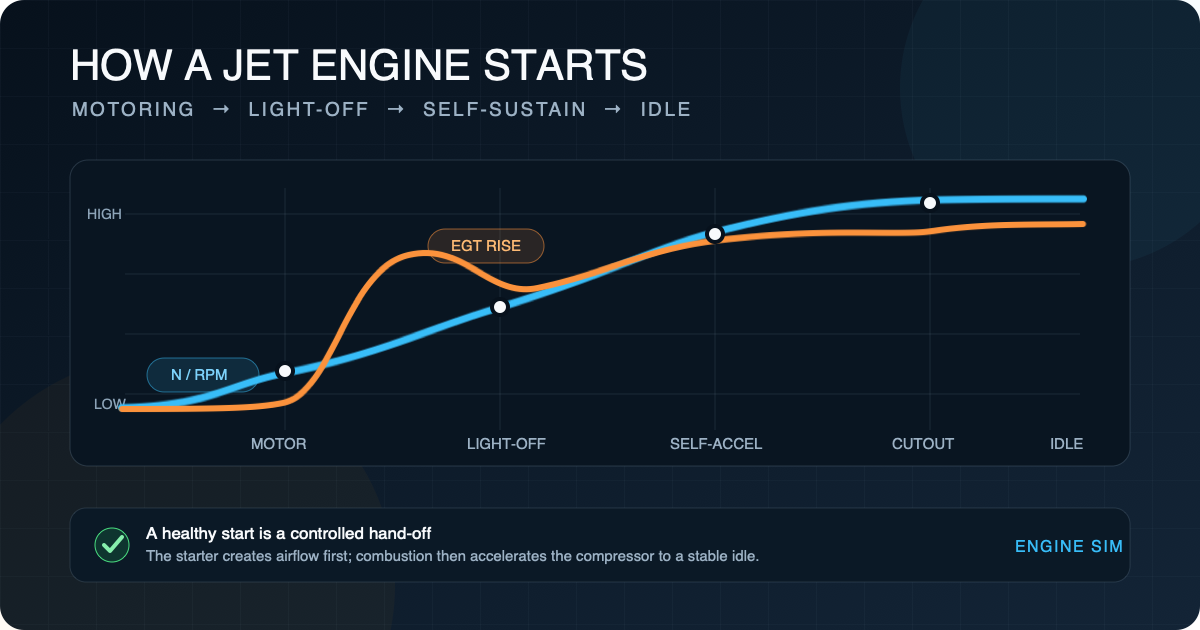
A jet engine can pull an aircraft through the sky, but at rest it cannot start itself. The stationary compressor provides almost no airflow; without compressed air, fuel cannot burn stably; without combustion, the turbine cannot drive the compressor. Starting breaks this loop by handing the work from an outside power source to the turbine.
Quick Answer: How Does a Jet Engine Start?
A starter spins the compressor to establish airflow. The operator or controller selects ignition, then introduces fuel once the engine-specific cranking condition is met. Light-off, the first successful combustion, raises exhaust temperature and adds turbine power. The engine then passes self-sustaining speed; the starter normally keeps assisting until its specified later cutout speed, and the engine continues to governed idle.
Ordering matters: fuel without enough airflow or ignition can collect unburned; too much fuel for the airflow can overheat the turbine; a weak starter may produce light-off but not idle. The FAA's current Aviation Maintenance Technician Handbook—Powerplant, Chapter 5 says the starter must provide initial airflow and help the engine reach self-sustaining speed.
Why Does a Jet Engine Need a Starter?
Once running, a gas turbine closes its own power loop: compressor pressure, combustion heat, and expanding gas turn a turbine connected back to the compressor. NASA Glenn's compressor explainer shows why every turbine engine must raise inlet-air pressure before the combustor.
At zero RPM, the turbine has no hot gas to extract work from while the compressor still needs torque. An electric starter or starter-generator may use batteries or electrical ground power. An air-turbine starter uses compressed air from an auxiliary power unit (APU), a pneumatic ground-start cart, or cross-bleed from a running engine. Each method creates compressor airflow for controlled light-off.
The APU usually solves the same smaller-scale problem with a battery-powered electric starter. Once running, it can supply electrical and pneumatic energy to start a main engine.
The source, cranking speed, starter limit, and switch sequence are aircraft-specific. This post explains the physics and is not an operating procedure; use an approved checklist and trained personnel on real hardware.
The Six-Step Jet Engine Start Sequence
1. The Starter Gets an Energy Source
Electrical power may drive a small engine directly; larger engines often use compressed air to spin an air-turbine starter geared to the core. A slow spool produces weak airflow, so the FAA Airplane Flying Handbook's turbine transition chapter emphasizes adequate start power and close monitoring of temperature and acceleration.
2. The Compressor Begins to Turn
The starter rotates the compressor before fuel burns, moving air through the combustor and turbine. On a two-spool turbofan it normally turns the high-pressure core, commonly indicated as N2; fan speed, N1, responds differently. A single-spool turbojet has one compressor-turbine assembly. Pre-light-off cranking establishes airflow; after light-off, continued starter assistance increases airflow for stable burning and cooling.
3. Ignition Is Armed
High-energy igniters provide a spark when an ignitable mixture reaches the combustor. Some systems sequence them automatically; others require a separate selection. Some engines use continuous ignition in particular conditions. The logic is type-specific.
4. Fuel Enters and Light-Off Occurs
At the specified cranking condition, fuel enters and the spark establishes a continuous flame. NASA's combustor overview places this between compressor and turbine: high-pressure air mixes with fuel and creates hot gas to turn the turbine. A prompt EGT, ITT, or equivalent temperature rise normally confirms light-off, but the starter must still support acceleration.
5. Starter and Turbine Accelerate Together
Combustion raises turbine torque and core speed. Growing airflow lets the fuel control add fuel while managing temperature and compressor stability. The operator or controller watches speed, temperature, fuel flow, and oil pressure. A flame without continued acceleration is not a successful start.
6. The Starter Cuts Out and the Engine Reaches Idle
The turbine first reaches a speed where it can continue accelerating without being driven solely by the starter. The starter normally remains engaged to an engine-specific cutout point above that milestone, then disengages while the engine continues to governed idle. Temperature often eases as airflow grows. A complete start requires all indications to be normal against manufacturer-defined limits.
What Gauges Matter During a Jet Start?
Names differ, but these indications tell the story:
| Indication | What it reveals during start |
|---|---|
| Core speed (N2, Ng, or N on many engines) | Confirms starter rotation, minimum fuel-on speed, continuing acceleration, and arrival at idle |
| Fan/low-spool speed (N1, where fitted) | Shows low-spool response; it is not interchangeable with N2 on a multi-spool engine |
| EGT, ITT, TIT, or TOT | Confirms light-off and exposes an over-temperature trend |
| Fuel flow | Confirms metering and helps explain a missing, slow, or excessively hot light-off |
| Oil pressure | Confirms that lubrication pressure develops as the engine turns |
| Starter or pneumatic indication | Confirms starter engagement, available start energy, and eventual cutout |
The FAA Pilot's Handbook of Aeronautical Knowledge, Chapter 7 covers turbine construction, instruments, and hot/hung starts. The aircraft manual defines what each gauge must show and when.
What Can Go Wrong During Start?
| Abnormal start | What it means | What the instruments tend to show |
|---|---|---|
| No light-off | The intended flame never establishes after fuel and ignition are selected | Fuel may be indicated, but there is no expected temperature rise or combustion-driven acceleration |
| Wet start | Fuel enters without successful ignition and unburned fuel accumulates in or downstream of the combustor | No normal light-off; evidence depends on the engine and installation |
| Hot start | Temperature exceeds the engine's start limit because heat release is too high for the available airflow | Fast EGT/ITT/TOT rise, often with inadequate spool acceleration |
| Hung start | The engine lights but acceleration stagnates below self-sustaining idle | Temperature and fuel flow may be present while core speed stops increasing normally |
A no-light-off can become a wet start if fuel continues entering. A rapid approach to the temperature limit is an impending-hot-start cue; an actual hot start exceeds that engine's defined start limit. The FAA describes hung or false starts as failures to accelerate properly to idle, with insufficient starting power among the possible causes.
These are recognition cues, not troubleshooting instructions. Cutoff, motoring, cooldown, inspection, and restart actions vary; follow the specific AFM/POH and engine manual.
FADEC vs Hydromechanical Starting
A hydromechanical control schedules fuel with pumps, governors, valves, and pressure signals. The mechanisms and signals designed into it bound its protection, which leaves the crew more responsibility on some installations.
A FADEC reads speed, temperature, pressure, lever position, and other inputs, then commands fuel and may coordinate ignition and starter logic. It can limit start fuel or react to abnormal trends. It reduces workload without making every start identical or fault-proof.
Our two J85 presets are a teaching comparison, not two certified real-world J85 installations. They share the same simulated gas path. The hydromechanical preset exposes more of the raw fuel-scheduling risk, while the fictional FADEC retrofit adds digital limiting and hot-start protection.
Try the Start Sequence Safely in the Simulator
Open the hydromechanical J85. For a clean simulated run, press STOP if the spool is turning, set the POWER LEVER (PLA) to 0%, select GOV, confirm the fuel cock is closed, and wait for N to stop. If you previously edited the preset, switch to another engine and back first.
Press START; it engages the simulated starter and igniters. Watch N rise as the compressor creates airflow. At 13% N or higher, open the fuel cock and watch for light-off: EGT rises, the spool accelerates, and the event log narrates the handoff. The modeled starter torque ends at 38% N, and the governed idle target is 46% N.
Then press STOP and repeat with the FADEC retrofit J85. Its normal-start milestones are the same, but its digital control meters and protects fuel differently. Slow the time scale to 0.25× if you want to study the gauges.
Those 13%, 38%, and 46% figures are simulator-preset settings only, not J85 instructions or transferable limits. The simulator is the safe place to explore its virtual fault controls without risking hardware; results depend on the exact starting state and control settings.
Jet Engine Starting FAQs
What is light-off in a jet engine?
Light-off is the first successful burn in the combustor. Temperature rise confirms combustion, but a complete start requires continued acceleration through self-sustaining speed to governed idle.
Why not add fuel as soon as the starter turns?
Very low compressor speed may provide too little airflow to stabilize flame and cool the turbine. Each engine therefore has a defined fuel-introduction condition.
Do jet-engine igniters run all the time?
Not necessarily. They start the flame and may be selected continuously in certain conditions. Established jet combustion is continuous and needs no spark per cycle.
What spins first on a turbofan?
The starter commonly drives the high-pressure core, making N2 the primary start indication. Fan N1 responds through gas-path coupling. Single-spool engines, including the simulated J85, lack that distinction.
Can a jet engine restart without a starter?
Some engines can windmill within an approved in-flight restart envelope; others need starter assistance. The envelope and procedure are aircraft-specific.
Is a hot start the same as a compressor stall?
No. A hot start is a start-temperature problem, usually involving too much heat release for the available airflow. A compressor stall or surge is an aerodynamic breakdown of compressor flow. A poor start can involve both, but they describe different failures.
Sources and Further Reading
- FAA-H-8083-32B, Aviation Maintenance Technician Handbook—Powerplant, Chapter 5: Engine Starting Systems
- FAA-H-8083-3C, Airplane Flying Handbook, Chapter 15: Transition to Turbopropeller-Powered Airplanes
- FAA-H-8083-25C, Pilot's Handbook of Aeronautical Knowledge, Chapter 7: Aircraft Systems
- NASA Glenn Beginner's Guide to Propulsion: Compressors
- NASA Glenn Beginner's Guide to Propulsion: Combustor