What Is Vapor Lock? Symptoms, Causes and How to Fix It
Vapor lock is gasoline boiling in the fuel line, so the engine starves on a full tank. Symptoms, the temperature it starts at, roadside fixes, permanent cures.
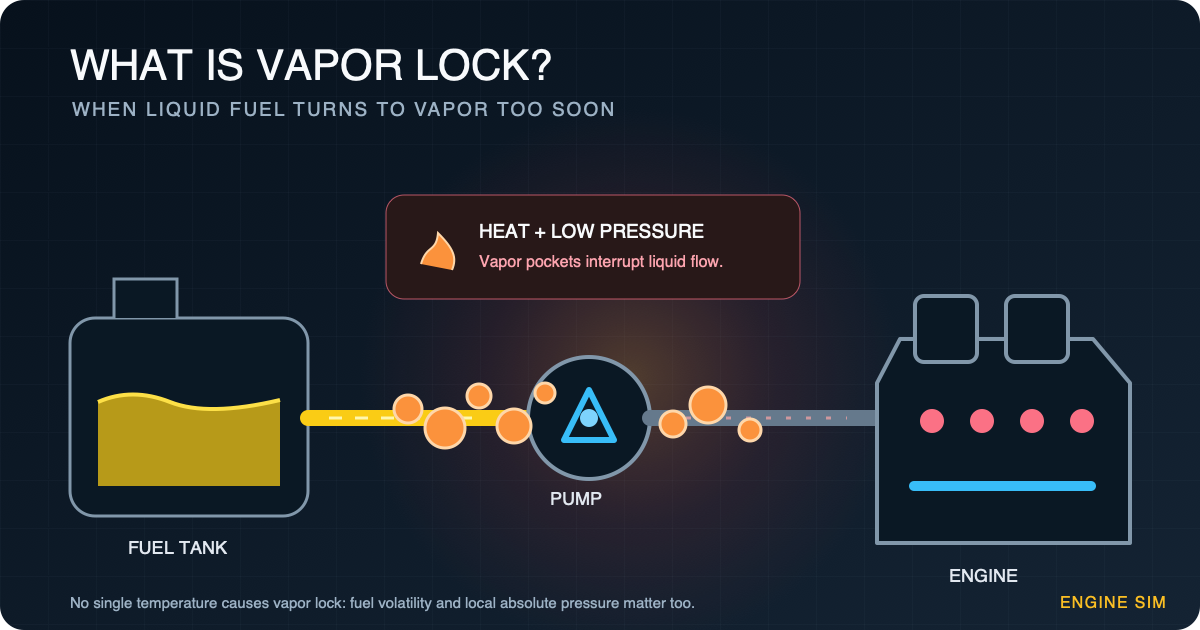
A carbureted car runs fine all morning, sits in traffic on a hot afternoon, coughs, surges, and dies. The tank is half full. Twenty minutes on the shoulder with the hood up and it starts as if nothing happened. That is vapor lock, and the twenty minutes are the diagnosis: the fuel did not run out, it turned to gas in the line and the pump could not move gas.
You can watch the same failure in our simulator. Load the 1340 cc V-twin on a 45 °C day, start it, and the fuel schematic flags VAPOR LOCK while the engine still idles. Drag the ambient slider past 52 °C and it stops within a few seconds. This article covers what the fault is, how it feels from the driver's seat, what causes it, the temperature it starts at in real fuel and in the model, and what actually fixes it.
Key Takeaways
- Vapor lock is gasoline vaporizing inside the fuel line, pump, or carburetor before it reaches the engine. Bubbles displace liquid, the pump loses its prime, and the engine starves while the tank is full.
- The symptoms are hot-day symptoms: surging and hesitation after the engine bay heats up, a stall in slow traffic, and a refusal to restart for ten to thirty minutes after a hot shutdown. Cooling cures it every time, which is the clue.
- Three things drive it, and the FAA's fuel-system handbook names all three: fuel temperature, low pressure at the pump inlet, and turbulence. A mechanical pump pulling warm fuel through a long line under suction is the worst case.
- There is no single temperature. Pump gasoline is a blend, and the US specification rates its hot-fuel margin by season: the six vapor-lock protection classes run from 35 °C for the coldest-weather fuel to 60 °C for the hottest. The simulator draws its line at 313 K (40 °C), the winter end of that band: the VAPOR LOCK chip lights at the first reading above it, the modelled pump derates to nothing at 325 K (52 °C), and every gasoline engine we ran dies at that reading. Diesel and LPG never trip it.
- Fuel injection with an in-tank pump nearly retired the fault. The pump pushes cool fuel under a few bar of pressure instead of pulling warm fuel under vacuum, and boiling needs low pressure. Carbureted engines with an engine-mounted pump still get it.
On this page: Quick answer · What happens in the line · Symptoms · Causes · Temperature · How to fix it · Carbureted vs fuel injected · Diesel · Look-alike faults · Try it in the simulator · FAQ · How these numbers were made
Quick Answer: What Is Vapor Lock
Vapor lock, spelled vapour lock in British English and sometimes written as one word, is a fuel-delivery failure in which gasoline boils inside the fuel line, the pump, or the carburetor bowl before it reaches the engine. The vapor takes up far more room than the liquid it came from, so a pump designed to move liquid pushes compressible gas instead and delivers little or nothing. The engine leans out, surges, loses power, and stalls, and it will not restart until the fuel system cools enough for the vapor to condense.
It happens when the fuel is hot, the pressure around it is low, or both. Heat comes from the exhaust manifold, the block, and a shut-down engine soaking in its own warmth. Low pressure comes from the suction side of a pump, from a restricted filter, or from altitude. Carbureted engines with an engine-mounted mechanical pump have all three conditions at once, which is why the fault belongs mostly to classic cars, small engines, boats, and piston aircraft. Modern port and direct injection pressurize the whole line from an in-tank pump and rarely see it.
What Happens Inside the Fuel Line
Water boils at one temperature. Gasoline does not. Pump gasoline is a blend of dozens of hydrocarbons, and the lightest of them, butane and pentane, boil near or below room temperature on their own. In the blend they stay liquid because the heavier components hold them down, up to a point. Warm the blend and its vapor pressure rises. Drop the pressure around it and the lightest fractions flash into vapor at whatever temperature they happen to be. The measure that matters is the fuel's vapor pressure against the local pressure in the line, and that is why the same tank of fuel can be fine at the pump outlet and boiling at the pump inlet.
The inlet is the weak point. A pump draws fuel by lowering the pressure on its suction side, so the fuel is hottest and the pressure lowest at exactly the same spot: a mechanical pump bolted to a warm block, pulling through a line that runs past the exhaust. The FAA's engine fuel-system handbook names "the lowering of the pressure on the fuel, high fuel temperatures, and excessive fuel turbulence" as the three general causes, and adds the aircraft case that isolates the pressure term: climb, and ambient pressure falls, so fuel that was warm at takeoff "retains enough heat to boil easily at high altitude" without getting any warmer.
Once vapor forms it does two things. It displaces liquid in the line, so the volume the pump moves per stroke contains less fuel. And in a diaphragm or vane pump it compresses on the pressure stroke and expands on the suction stroke instead of leaving, so the pump loses its prime and moves almost nothing. The SAE test method for fuel-pump vapor lock exists because this loss of pumping capacity is measurable, repeatable, and the thing a manufacturer has to design against.
Vapor Lock Symptoms
The symptoms are ordinary fuel starvation. What makes them vapor lock is when they happen: only hot, and only after the engine bay has had time to heat the fuel system.
- Surging and hesitation under light throttle after twenty or thirty minutes of driving, as if the tank were nearly empty. The engine picks up, falters, picks up again.
- Loss of power on a hill or under load in hot weather, with the temperature gauge reading normal.
- A stall in slow traffic on a hot day, when there is no airflow through the engine bay to carry heat away.
- Hard or impossible hot restart ten minutes after shutdown. The engine cranks normally and does not fire, or fires and dies. Immediate restarts and cold starts are fine.
- Normal running after it cools. Twenty minutes with the hood up, and the fault is gone until the next hot run.
- Low or erratic fuel pressure on a gauge during the fault, and a glass filter bowl with bubbles or an air gap in it.
None of these on its own proves vapor lock. A coil or ignition module that fails hot gives the same stall and the same recovery after cooling, and so does a weak pump or a blocked tank vent. The section on look-alike faults below sorts them. A fuel-pressure gauge read during the fault is the test that separates them, and "it restarts when it cools" is the clue that tells you which test to run.
What Causes Vapor Lock
Heat soak after shutdown
The engine stops, airflow stops, fuel flow stops, and the exhaust manifold and block are still at full temperature. Heat migrates into the stationary fuel in the pump, the line, and the carburetor bowl, with nothing moving through to carry it away. The fuel system is hotter ten minutes after shutdown than it ever was while running, which is why hot restarts fail when the drive itself was fine.
Hot weather, slow traffic, and sustained load
High ambient temperature takes away the margin the fuel started with. Slow traffic removes the airflow that cooled the engine bay at speed. A long climb or a trailer raises exhaust temperature. A marginal system that has never vapor locked can do it on the one afternoon that stacks all three.
Fuel lines and pumps routed near heat
A steel line clipped along the exhaust manifold, a rubber hose lying against the block, a mechanical pump bolted to the engine: each one puts fuel in contact with a heat source. Aftermarket headers that run closer to the original line routing are a common trigger on cars that never had the problem before.
Low pressure at the pump inlet
Anything that lowers pressure on the suction side lowers the boiling point of the fuel there. A partly blocked filter, a kinked or collapsed hose, a blocked tank vent that lets the tank pull a vacuum as it empties, and a worn pump all do it. These faults also starve the engine on their own, so they both cause vapor lock and mimic it.
Volatile fuel in warm weather
Refiners blend gasoline by season. Winter fuel is blended to vaporize easily for cold starting, and the US specification lets its vapor pressure run to 103 kPa (15.0 psi) against 54 to 62 kPa (7.8 to 9.0 psi) for the summer classes (Chevron, Motor Gasolines Technical Review, table 1.1a, retrieved 2026-09-13). The US EPA caps summer vapor pressure at 9.0 psi, 7.8 psi in some areas, from June to mid-September to cut evaporative emissions, and allows E10 blends 1.0 psi on top; the same cap is what keeps summer fuel from boiling in a hot engine bay. A car filled with winter fuel and driven hard in an April heatwave is running fuel the specification never intended for that day.
Altitude
Atmospheric pressure falls with altitude, and with it the boiling point of every fraction in the fuel. A vented carbureted system at 2,500 m has less margin than the same system at the coast with the same fuel at the same temperature. The FAA handbook's altitude case above is this effect on its own, with heat held constant.
At What Temperature Does Vapor Lock Happen
There is no single number for real fuel, and anyone who gives you one without naming the fuel, the pressure, and the altitude is guessing. Gasoline is a blend with a boiling range rather than a boiling point: a tenth of it has boiled by 50 to 70 °C depending on the season's class, and the last of it near 225 °C (Chevron, table 1.1a), so what a hot engine bay does is strip the light ends out of the line first. A low pressure at the pump inlet or a high altitude moves the onset lower still.
Fuel specifications turn that into a seasonal number. ASTM D4814, the US gasoline standard, rates hot-fuel handling by the temperature at which a gasoline forms twenty volumes of vapor per volume of liquid at atmospheric pressure, written T(V/L = 20). Chevron's technical review calls it "the property that correlates best with vapor lock and other hot fuel handling problems (hard starting or no starting after a hot soak, and poor throttle response)" and gives its normal seasonal range as 35 to 60 °C. The standard sets six protection classes, each a minimum T(V/L = 20), and assigns one to every region and month:
| ASTM D4814 vapor lock protection class | minimum T(V/L = 20) |
|---|---|
| 1 (hottest conditions) | 60 °C (140 °F) |
| 2 | 56 °C (133 °F) |
| 3 | 51 °C (124 °F) |
| 4 | 47 °C (116 °F) |
| 5 | 41 °C (105 °F) |
| 6 (coldest conditions) | 35 °C (95 °F) |
Read the table as the fuel's margin. A class 6 winter gasoline is only guaranteed to hold below 35 °C; a class 1 summer fuel holds to 60 °C. Fill a car with winter fuel and drive it into a 35 °C afternoon and the specification's margin is already gone before the engine bay adds its own heat. The correlation was built on carbureted cars with suction pumps, and the same review notes it holds for later fuel-injected engines on hydrocarbon-only gasoline, with a downward adjustment for ethanol blends.
The simulator draws a line, because a model has to, and it draws it at 40 °C, between classes 5 and 6 of that table: the winter-fuel end of the band. Its fuel system, the same one for every crank engine on the roster, gates gasoline on the ambient temperature:
| reading | what the model does | what you see |
|---|---|---|
| up to 313 K (40 °C) | nothing | normal running |
| above 313 K | the VAPOR LOCK chip lights, the fuel schematic turns red, and the pump's capacity derates linearly toward zero at 325 K | the engine keeps running: the modelled pump has more headroom than the derate can take away |
| 325 K (52 °C) and above | pump capacity reaches zero | every gasoline engine we ran stalls within a few seconds, and none will restart |
We measured it. Holding the 1340 cc V-twin wide open at 2,125 rpm and raising the ambient 1 K at a time, brake torque reads 109.8 N·m at 313 K, 100.7 at 324 K, and the engine is being motored by the dyno at 325 K. The 7.0 L V8 at 4,638 rpm reads 647.6 N·m at 293 K, 506.0 at 324 K, and dies at 325. The 163 cc utility single, the two-stroke 250, and the 18-cylinder radial do the same thing at the same reading. The 2.0 L diesel and the LPG four run through 330 K without stalling, because the gate is gasoline only.
Two caveats about that table. First, ambient temperature in this model reaches the air path as well as the fuel system, so the torque lost between 40 and 51 °C is thinner air, not fuel: the pump's supply ratio reads 1.00 at every one of those readings. The model gives up more to the heat than a real engine does, and part of the V8's loss is knock. Real air at 52 °C is about 10% less dense than at 20 °C, the ratio of the two absolute temperatures, and a real engine's power follows it before any fuel trouble; the dyno correction calculator puts a number on that for any day.
Second, the model's pump is generous. A gasoline preset's pump is rated at 120 L/min against a wide-open burn of 8.2 L/h on the V-twin and 96 L/h on the V8, so the derate between 40 and 52 °C never bites and the fault arrives as a cliff at 52 °C rather than the gradual starvation a real marginal system shows. The chip at 40 °C is the model's warning band; the stall at 52 °C is its limit.
How to Fix Vapor Lock
On the roadside
Pull over somewhere safe, switch off, and open the hood so the engine bay can shed heat. Then wait. Ten to thirty minutes is usually enough for the vapor in the line to condense and the pump to regain its prime. Do not open, disconnect, or pour water over a hot fuel system: gasoline vapor near an exhaust manifold is a fire, and a cracked carburetor bowl or a split hose from thermal shock turns a nuisance into a tow. If the engine still will not start once everything is cool to the touch, the fault is something else.
Permanent fixes, in the order a mechanic tries them
- Restore the original heat management. Missing heat shields, a deleted carburetor spacer, and an insulating sleeve someone removed are the first things to check on a car that recently started vapor locking.
- Reroute the fuel line away from heat. Move it off the exhaust side, sleeve it with reflective insulation, and keep the run between tank and pump short and free of the sharp bends and steep rises the FAA handbook lists beside heat as the routing faults that breed vapor.
- Add a phenolic or wood carburetor spacer. It breaks the heat path from the intake manifold to the float bowl and is the cheapest effective fix on many classic cars.
- Move the pump to the tank. An electric pump mounted low and near the tank pushes fuel under positive pressure instead of pulling it under suction, which removes the low-pressure half of the problem. This is the single change that made vapor lock rare on modern cars, and it works retrofitted.
- Add a return line. Continuous flow back to the tank keeps fresh, cool fuel moving through the line and carries any vapor that forms back to the tank where it can vent harmlessly.
- Use the right fuel for the season. Buy summer-grade fuel once it is available and avoid winter fuel left in the tank into warm weather. Aviation and marine operators have fuel specifications for exactly this reason.
- Fix the pressure faults. Replace a restricted filter, a collapsed hose, a blocked tank vent, and a tired pump. Each one lowers inlet pressure and each one starves the engine in a way that looks like vapor lock.
Have fuel pressure and flow measured while the fault is present before buying parts. A hot-failing ignition module costs the same twenty minutes to recover and none of the fixes above will touch it.
Vapor Lock in Carbureted vs Fuel-Injected Engines
A carbureted engine of the 1950s to the 1980s typically has an engine-driven diaphragm pump pulling fuel through a long line from the tank at low pressure, feeding a vented float bowl that sits on top of a hot intake manifold. Every element of that layout favors vapor: warm fuel, low pressure, a suction path, and a bowl open to the atmosphere. Percolation, where the bowl itself boils after shutdown, is the same physics one component downstream.
Fuel injection changed the layout. An electric pump sits in or beside the tank, immersed in cool fuel, and pushes it forward through a closed line at a few bar for port injection and far higher at the rail on direct injection. Pressure raises the boiling point of every fraction in the fuel, the pump never sees suction, and an immersed pump runs cooler. Many systems also return fuel to the tank continuously, so nothing sits and cooks. The EPA's 1995 technical overview of reformulated gasoline said the same: "Problems with vapor lock have diminished greatly in recent years as EPA has required the use of lower-volatility fuels in the summer and as manufacturers have improved the design of their fuel systems, notably by increasing the use of in-line, high-pressure fuel pumps."
Fuel-injected engines are not immune. A returnless system that lets fuel heat-soak in the rail, an aftermarket pump mounted high and hot, or a marginal pump on a car parked over hot pavement can all vapor lock, and in-tank pumps still cavitate when the tank is nearly empty and the fuel is warm. But vapor lock should be near the bottom of the list for a modern car that stalls hot, below ignition, sensors, and the pump itself.
Does Diesel Vapor Lock
Not in the gasoline sense. Diesel fuel is far less volatile. The US DOE lists a typical low-sulfur diesel's flash point at 74 °C against about −43 °C for gasoline (Alternative Fuels Data Center, fuel properties, retrieved 2026-09-13). Conventional diesel flash points run from 52 to 96 °C and the fuel does not begin to vaporize until about 149 °C (Wikipedia, Diesel fuel, retrieved 2026-09-13). The temperatures that boil gasoline in a line do nothing to diesel, and Wikipedia's vapor lock article puts it as diesel engines "almost never" suffering it. What a diesel's suction side can do is draw air through a loose fitting or a worn lift pump, which starves the engine in the same way and gets called vapor lock at the roadside. The fix is the leak.
Diesel's temperature problem is at the other end of the thermometer. Below the fuel's cloud point, paraffin wax comes out of solution and clogs the filter, and untreated diesel turns to a gel that cannot flow at about −15 to −19 °C (Wikipedia, above). The simulator models this as the mirror of the gasoline gate: a diesel preset flags COLD GEL below 263 K (−10 °C) and its pump derates to zero at 251 K (−22 °C), a band that brackets the real gel point. Load the 2.0 L diesel on a −23 °C morning and it will not start; at 252 K it still does. Winter diesel blends and additives lower both points, which is why the fuel changes with the season just as gasoline does.
Vapor Lock vs Percolation, Flooding, and a Hot Ignition Fault
| Fault | What is happening | Typical clue |
|---|---|---|
| Vapor lock | Fuel boils in the supply line or pump and displaces liquid, so delivery falls | Starvation symptoms only when hot; clears after cooling; low fuel pressure during the fault |
| Carburetor percolation | Fuel boils in the float bowl after shutdown and pushes through the jets into the manifold | Fuel smell after shutdown and a rich, slow hot restart; can also empty the bowl and starve |
| Flooding | Too much liquid fuel reaches the intake and cylinders | Wet plugs, strong fuel smell, and a mixture too rich to light |
| Weak pump or blocked filter | Liquid fuel pressure or flow is short at all temperatures | The fault shows cold as well as hot, and a pressure test shows it |
| Heat-sensitive ignition fault | A coil, module, sensor, or connector stops producing spark or a crank signal when hot | Fuel pressure stays normal while spark or the engine-speed signal disappears |
Vapor lock and percolation both come from hot fuel. Vapor lock starves the engine upstream; percolation floods it from the bowl. They want different fixes, and a fuel-pressure gauge and a look at the plugs tell them apart.
Try It in the Simulator
Open the 1340 cc V-twin at 318 K, a 45 °C afternoon. Start it. The engine idles normally, and in the data drawer the fuel schematic already shows VAPOR LOCK in red with the event log's line about fuel boiling in the lines. The engine runs because the model's pump still has capacity to spare at this reading.
Now drag the AMBIENT TEMP slider up. Nothing changes until the readout reaches 325 K (52 °C), and then the idle collapses: 994 rpm at 324 K, 363 rpm at 325 K, zero at 326 K. Press START again: the starter spins it, nothing burns, and it stops the moment you let go. Drag the slider back below 325 K and it starts and idles as before. That is the whole fault: hot, starved, cooled, running.
Two comparisons. Load the fuel-injected 2.0 L four and repeat: it reads zero at the 325 K reading where the V-twin was still winding down at 363 rpm, and it dies at the same temperature, because the model has one fuel system for every gasoline engine and no separate carburetor. Then load the 2.0 L diesel at the same 45 °C and drag the slider to the top. It never flags and never stalls. Diesel does not vapor lock; take it down past 263 K instead and watch COLD GEL light, then to 251 K and watch it stop.
The model is deliberately simple here. It has no fuel temperature of its own, so ambient stands in for under-hood temperature, and its pump is oversized. The schematic shows where the fault is, and the contrast with engine knock holds: knock is combustion going wrong inside the cylinder, and vapor lock is fuel never arriving. The four-stroke cycle that the fuel feeds is unchanged by either.
Frequently Asked Questions
What does vapor lock mean?
Vapor lock means gasoline has vaporized inside the fuel line, pump, or carburetor before reaching the engine, and the vapor is blocking liquid fuel from flowing. The engine starves as if the tank were empty. It clears when the fuel system cools and the vapor condenses back to liquid.
What are the symptoms of a vapor locking engine?
The engine surges and hesitates as if running out of fuel, loses power under load, and stalls, all after it has been running long enough to get hot. The most common form is a hot restart that cranks normally and will not fire ten minutes after shutdown, then starts perfectly half an hour later.
At what temperature does gasoline vapor lock?
There is no single temperature. The US gasoline specification rates a fuel's hot-fuel margin by the temperature at which it forms 20 volumes of vapor per volume of liquid, from 35 °C for the coldest-season class to 60 °C for the hottest, and low pressure at the pump inlet or high altitude moves the onset lower. Our Real Engine Simulator flags vapor lock at the first reading above 313 K (40 °C) and stalls every gasoline engine it runs at 325 K (52 °C); those are the model's numbers, and your car's fuel, pump, and routing set its own.
Is vapour lock the same as vapor lock?
Yes. Vapour lock is the British spelling of the same fault: fuel vaporizing in the line, pump, or carburetor and starving the engine. This article uses the US spelling throughout, and every symptom, cause, and fix applies under either name.
Can a fuel-injected car vapor lock?
Rarely. An in-tank electric pump pushes cool fuel under 3 to 4 bar through a closed line, and pressure raises the fuel's boiling point. It can still happen with an aftermarket pump mounted hot and high, a returnless rail that heat-soaks, or a nearly empty tank of warm fuel. For a fuel-injected car that stalls hot, check ignition, sensors, and the pump before blaming vapor lock.
Does diesel vapor lock?
No. Diesel's flash point is 52 °C or higher and it does not begin to vaporize until about 149 °C, so it does not boil in a hot fuel line. Air drawn in through a suction-side leak can mimic the symptoms and is sometimes called vapor lock. Diesel's own temperature fault is gelling in the cold, which the simulator models below 263 K.
How do you fix vapor lock quickly?
Stop safely, switch off, open the hood, and wait ten to thirty minutes for the fuel system to cool. Do not open or pour water on a hot fuel system. For a permanent fix, insulate and reroute the fuel line away from the exhaust, fit a carburetor spacer, move the pump to the tank so it pushes instead of pulls, add a return line, and use summer-grade fuel in warm weather.
Can vapor lock damage an engine?
Usually not. The engine leans out and stalls rather than breaking anything. Prolonged lean running under heavy load can raise combustion temperatures, and the real risks are losing power in traffic or on takeoff, and fuel vapor near a hot exhaust. Treat it as a fault to fix.
Is vapor lock the same as the engine overheating?
No. The coolant temperature gauge can read normal throughout a vapor lock, because the fuel system is absorbing heat locally from the exhaust and the block rather than the engine as a whole running hot. An overheating engine can cause vapor lock by heating the bay, but the two faults have different gauges and different fixes.
How These Numbers Were Made
Every simulator figure in this article comes from one headless run of the simulator on 2026-09-29, a repeat of the 2026-09-13 run made once ambient temperature reached the model's air path. The probe held each engine wide open at its torque-peak rpm on the dyno and raised the ambient 1 K at a time from 293 to 330 K, reading brake torque and the fuel system's supply ratio over the last 0.15 s of each 1.5 s step. A second pass started each engine cold at fixed ambients from 293 to 330 K and recorded whether it fired and whether it was still running six seconds later. A third idled each engine from 293 K up at 1 K per 2 s and recorded the reading at which it stopped. Eight presets ran: the V-twin, the utility single, the 2.0 L four, the 7.0 L V8, the two-stroke 250, the R-2800 radial, and the diesel and LPG fours as controls.
The gate itself is two lines in the fuel-system model: gasoline flags vapor lock above 313 K, and the pump's capacity scales by one minus the excess over 313 K divided by 12 K, reaching zero at 325 K. Diesel mirrors it below 263 K. The deep links in this article open a preset at a chosen ambient temperature, clamped to the slider's 240 to 330 K range, and we checked in a browser that each linked state loads, runs, flags, and stalls as described.
About this article
Written by the team that builds the simulator and maintains its fuel-system model, with the real-world sections drawn from the FAA, EPA, SAE, and Chevron sources listed below. The simulator numbers are the model's and are stated as such; the real-world temperatures are the fuel specifications', and the article says which is which at every point.
Sources and Further Reading
- FAA Aviation Maintenance Technician Handbook, Powerplant, Chapter 2: Engine Fuel and Fuel Metering Systems (PDF, retrieved 2026-09-13)
- US EPA: Gasoline Reid Vapor Pressure (retrieved 2026-09-13)
- US EPA (1995): Technical Overview of Reformulated Gasoline and Engine Performance (retrieved 2026-09-13)
- SAE 2004-01-0991: Establishment of a Test Method for Fuel Pump Vapor Lock (retrieved 2026-09-13)
- Chevron: Motor Gasolines Technical Review, chapter 1, tables 1.1a and 1.1b (PDF, retrieved 2026-09-13)
- ASTM D4814: Standard Specification for Automotive Spark-Ignition Engine Fuel (retrieved 2026-09-13)
- US DOE Alternative Fuels Data Center: Fuel Properties Comparison (retrieved 2026-09-13)
- Wikipedia: Vapor lock (retrieved 2026-09-13)
- Wikipedia: Diesel fuel (retrieved 2026-09-13)