What Is Engine Knock? Causes, Sounds, and How to Stop It
Engine knock is fuel detonating before the flame front arrives, a metallic ping that hammers pistons. What causes knock, what it damages, and how to stop it.
Experienced mechanics react to one engine sound on the spot: a sharp, metallic rattle under load, like marbles in a tin can. That is engine knock, and it is one of the few engine noises that can be destroying hardware while you listen to it.
Knock is also one of the most misunderstood topics in motoring, wrapped up in octane myths, premium-fuel marketing, and confusion with three or four unrelated noises. This post covers what happens inside the cylinder.
Quick Answer: What Is Engine Knock?
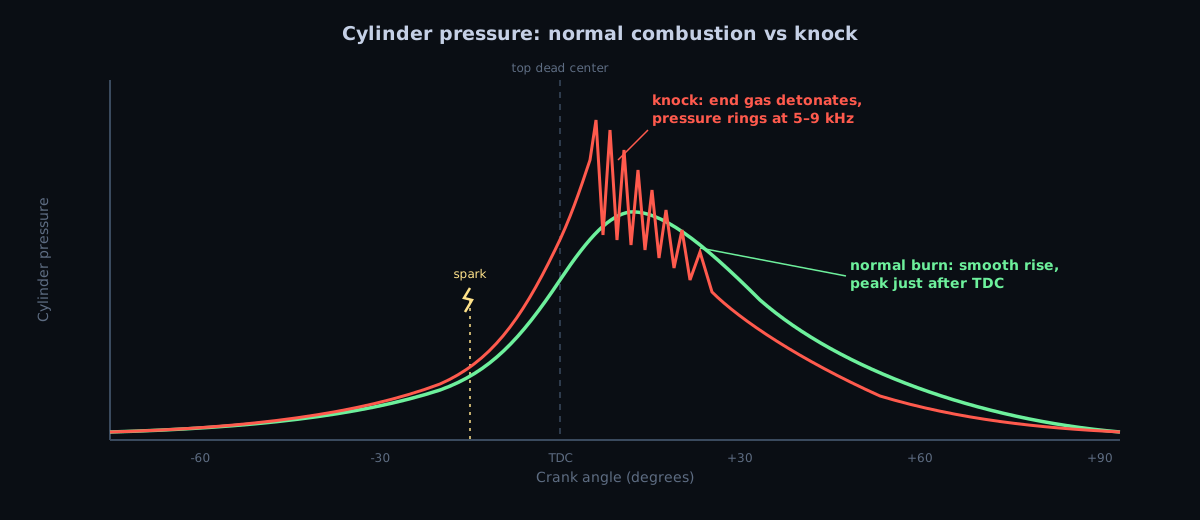
Engine knock (also called detonation or pinging) is the spontaneous explosion of the unburned air-fuel mixture in the cylinder before the normal flame front reaches it. Instead of a smooth, controlled burn sweeping across the chamber, the last pocket of mixture, the "end gas", gets compressed and heated past its autoignition point and detonates all at once.
The resulting pressure waves bounce around the combustion chamber at several kilohertz, ringing the engine block like a bell. That ringing is the "ping" you hear.
Brief, light knock is survivable. Sustained, heavy knock can destroy a piston in minutes.
What Happens in the Cylinder
Normal combustion is a fast, orderly burn rather than an explosion. The spark plug lights the mixture, and a flame front travels across the chamber at 20–40 m/s, taking a few milliseconds to consume the charge while pressure rises smoothly.
While that flame front travels, it compresses and heats the unburned gas ahead of it. The end gas is in a race: get consumed by the flame, or get hot enough to ignite itself first. If autoignition wins, the remaining mixture burns around a hundred times faster than the flame front, in effect all at once, producing a local pressure spike and shock waves that slam into the piston crown and cylinder walls.
The chamber's geometry sets the frequency of the resulting ring: 5–9 kHz for passenger-car bores, which is the band a knock sensor listens to.
Knock vs Pre-Ignition
Two terms get mixed up constantly:
- Knock (detonation) happens after the spark fires. The end gas detonates during an otherwise normal burn. It depends on load and timing, and the ECU can manage it.
- Pre-ignition happens before the spark. A hot spot (glowing carbon deposit, overheated spark plug tip) lights the charge far too early, and the piston then compresses an already-burning mixture. This is far more destructive and much harder to control; severe cases ("super-knock" in small turbo engines) can crack a piston in a single event.
Knock is a controlled burn ending badly. Pre-ignition is the burn starting at the wrong time.
What Causes Engine Knock?
Anything that pushes the end gas closer to autoignition before the flame arrives:
Fuel Octane Too Low
Octane rating measures resistance to autoignition and nothing else. It is not "power" and not "cleanliness." An engine designed for premium running on regular reaches end-gas autoignition conditions sooner.
Too Much Ignition Advance
Firing the spark earlier raises peak pressure and temperature, which helps efficiency right up until the end gas cannot take it. Tuners push this lever when chasing power, and the ECU pulls it back first when knock appears.
High Compression Ratio or Boost
Both raise the charge's starting pressure and temperature, moving the whole cycle closer to the autoignition cliff. Turbocharged engines are knock-limited and high-compression engines demand premium fuel for this reason.
Heat
Hot intake air, hot coolant, glowing carbon deposits, a long pull up a mountain grade: all raise end-gas temperature. Knock on a hot day with a heat-soaked intercooler is a classic.
Lugging the Engine
Low RPM plus high load is prime knock territory: cylinder pressures are high, and the slow engine speed gives the end gas more time to autoignite before the flame front arrives. Your owner's manual tells you to downshift on hills for this reason.
What Knock Damages
The shock waves strip away the protective boundary layer of gas that insulates metal surfaces, exposing them to full combustion temperature while hammering them mechanically. The classic casualties, in rough order:
- Piston ring lands: cracked by pressure spikes.
- Piston crowns: surface erosion that looks sandblasted, eventually melted or holed.
- Head gaskets: fire-ring failure at the hottest cylinder.
- Rod bearings: battered by the impulsive loads.
Light knock is often inaudible inside a modern, well-insulated car. By the time you can hear it over the radio, it is not light.
How to Stop Engine Knock
If you hear pinging right now, work down this list:
- Run the octane your owner's manual specifies. Wrong fuel is the single most common cause, and one tank of the right grade usually clears it.
- Stop lugging. Downshift on hills and under load; keep RPM in the engine's comfortable midrange instead of forcing high load at low speed.
- Fix heat problems. Check coolant level, radiator condition, and (on turbo cars) the intercooler. A heat-soaked or restricted intercooler is a classic knock source on hot days.
- Address carbon deposits. If knock persists on the correct fuel, deposits raising compression and forming hot spots are next on the list. Top-tier detergent fuel or an intake cleaning helps.
- Get it diagnosed. Sustained, audible knock after all of the above means the ECU's protective margin has run out. Have the knock sensor, EGR system, and cooling system checked before damage accumulates.
How Modern Engines Prevent Knock
A modern engine runs a closed feedback loop around knock:
- Knock sensors: piezoelectric vibration sensors bolted to the block (in effect microphones for the chamber's ringing frequency), checked against each cylinder's firing window.
- Adaptive ignition retard: detect knock, pull timing on that cylinder a few degrees, then creep it back. Your engine does this constantly. The same car makes a bit more power on premium fuel because the ECU advances until it finds the knock edge.
- Direct injection: spraying fuel into the cylinder cools the charge through evaporation, buying several effective octane points.
- Cooling strategy: intercoolers, cooled EGR, piston oil squirters, all aimed at end-gas temperature.
Hear Knock Happen Without Risking a Real Engine
Our free in-browser engine simulator models knock physically: push a high-compression engine hard with aggressive timing and the end gas lets go. You hear the ping, and the on-screen event log calls out knock onset and severity in real time as you cross the threshold. It is a cheaper way to develop an ear for it than your own ring lands. For the full picture of each stroke first, start with how a four-stroke engine works.
Engine Knock FAQs
Is occasional light knock harmful?
Engines tolerate brief, light knock under transient conditions. Manufacturers calibrate them to ride near the knock edge for efficiency, and the ECU retards timing within a couple of cycles. Sustained or audible knock means something is wrong: wrong fuel, failing sensor, deposits, or overheating.
Does premium fuel give more power?
Only if your engine can use it. A knock-limited engine (turbocharged or high-compression) gains real power on higher octane because the ECU advances timing further. An engine designed for regular gains close to nothing. Octane is knock resistance, not energy content.
Why do diesel engines "knock" at idle without damage?
Diesel clatter is the normal combustion mode. Diesel fuel is injected into hot air and autoignites by design. The characteristic rattle is the rapid pressure rise after ignition delay, not runaway end-gas detonation. The sound is in the same family; the mechanism is different.
Can knock happen at idle or light throttle?
Rarely, because cylinder pressures are too low. Knock lives under load: accelerating, climbing, towing, or lugging in too high a gear. If you hear pinging at idle, suspect something mechanical (or pre-ignition) instead.
What does knock sound like?
Metallic pinging, tinking, or a marbles-in-a-can rattle, rising with load and disappearing when you lift off. It is distinct from the deep "rod knock" of a worn bearing, which tracks RPM rather than load. The shared name has confused car forums for decades.
Related Reading
- The 4 Strokes of an Engine: Intake, Compression, Power, Exhaust
- Otto Cycle Explained: Live P-V Diagram and Efficiency Formula
- What Is Vapor Lock? Symptoms, Causes and How to Fix It
- How a Turbocharger Works (Boost, Lag, and Wastegates)
- Jet Engine vs Rocket Engine: Which Is More Powerful?
- AI in Engines: Can ChatGPT, Claude, or Gemini Run One?