AI in Engines: Can ChatGPT, Claude, or Gemini Run One?
LLMs like ChatGPT, Claude, and Gemini cannot run an engine, yet AI is already deep inside one. Where machine learning lives in a production engine, and where LLMs help.
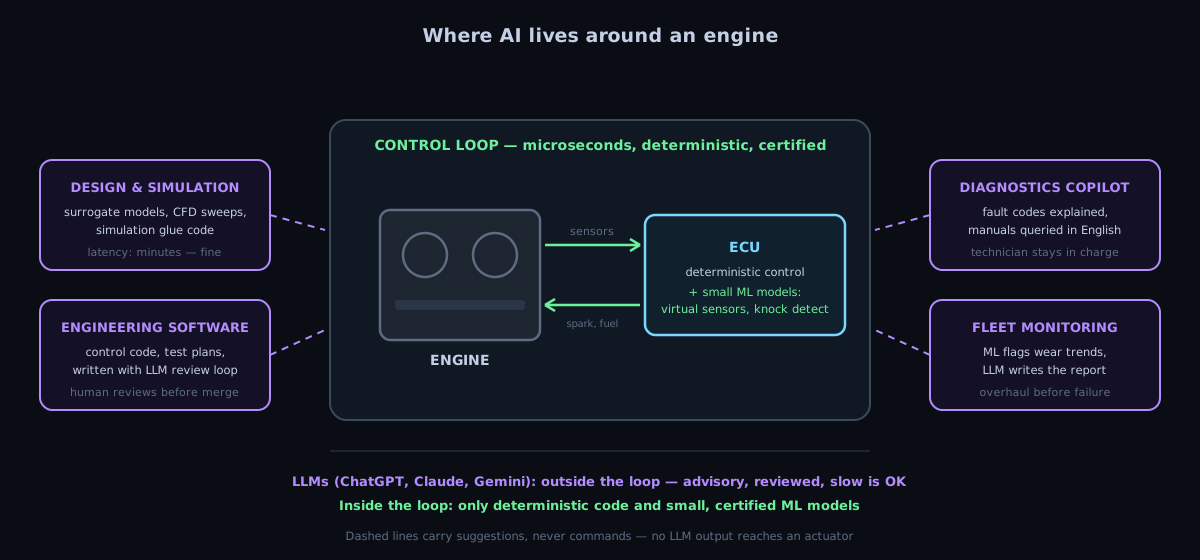
Ask an engineer whether AI belongs in an engine and you get two different answers, depending on which AI they think you mean.
If you mean machine learning, statistical models trained on sensor data, it has been in there for years. If you mean large language models like ChatGPT, Claude, or Gemini, the answer is more interesting: they will probably never touch the combustion itself, yet they are changing almost everything around it.
This post separates the hype from the hardware.
Quick Answer: What AI Does in Engines
No production engine is controlled by an LLM. Combustion control demands deterministic, microsecond-precise timing that LLM inference cannot deliver or be certified for. Classical machine learning already runs inside production engine controllers as virtual sensors, knock detection, and calibration models, while LLMs assist around the engine: diagnostics, documentation, design, and code.
Two Different Kinds of "AI"
The phrase "AI in engines" smuggles two technologies into one sentence:
- Classical machine learning: small, fast, specialized models (neural networks, Gaussian processes, decision trees) trained on engine data to do one job. Predictable size, predictable latency, testable against a spec.
- Large language models: ChatGPT, Claude, Gemini. Enormous general-purpose models that reason in text, with brilliant breadth. Inference takes hundreds of milliseconds, results vary between runs, and they can state wrong things with confidence.
That difference in character decides where each one is allowed to live.
Where Machine Learning Already Lives Inside Engines
Virtual Sensors
Some quantities an ECU needs are too expensive or too slow to measure directly: NOx concentration, exhaust temperature at specific points, in-cylinder pressure. Models trained on test-bench data (sometimes neural networks, often simpler regressions layered on physics) estimate them in real time from sensors the engine already has. The model replaces a physical part.
Knock and Misfire Detection
Production knock control listens to a vibration sensor and decides, within the same combustion cycle, whether that 5–9 kHz ring was detonation or valve noise. Production systems still lean on band-pass filtering and adaptive thresholds, but trained classifiers are the active research-to-production path, since pattern recognition at millisecond scale is the job small ML models do best. (For what knock is, see our engine knock explainer.)
Calibration
A modern engine map is a stack of high-dimensional tables: spark advance, injection timing, boost targets across each speed/load/temperature combination. Calibrating those by hand takes thousands of dyno hours, so manufacturers fit surrogate models, often Gaussian processes, that learn the engine's response surface from limited test runs and let optimization fill in the rest. ML does not run in the car here; it designed the numbers that do.
Predictive Maintenance
Jet engines stream terabytes of sensor data per fleet per day, and manufacturers like Rolls-Royce and GE Aerospace run ML on it to spot bearing wear, blade erosion, and performance drift long before a human would. An engine that schedules its own overhaul is the most commercially successful "AI in engines" story so far.
Why Can't an LLM Control an Engine?
The control loop that decides spark timing runs on hard real-time deadlines: an engine at 6,000 RPM completes a full crank degree in under 30 microseconds. Three properties disqualify LLMs outright:
- Latency. LLM inference takes tens to hundreds of milliseconds on a data center GPU. At 6,000 RPM an engine completes a full four-stroke cycle every 20 milliseconds. Whole cycles pass before a single token arrives, and dozens before an answer is complete.
- Unverifiable behavior. Identical inputs can produce different outputs, and even when they do not, you cannot trace why an output happened. Safety standards for engine software (ISO 26262 in automotive, DO-178C in aviation) demand evidence that each requirement is implemented, tested, and traceable, an assurance case nobody knows how to build for billions of opaque weights.
- Hallucination. A language model that occasionally invents a plausible-but-wrong answer is an annoyance in a chat window and a thrown rod in a control unit.
Faster models do not fix this. Control loops need functions, not conversations.
Researchers have run neural networks and reinforcement learning in engine control on test benches, with HCCI combustion control a favorite subject, but that work uses small, fixed networks rather than language models, and it remains research rather than production. One more conflation to head off: "AI in cars" headlines are almost always about driver assistance and autonomy, a separate stack from the engine controller.
What LLMs Are Good For Around Engines
Step one layer out of the control loop, where deadlines are human-scale and a wrong answer can be caught, and LLMs turn useful.
Diagnostics Copilots
A technician facing a fault code used to dig through service manuals and technical bulletins. Diagnostic platforms now let them ask in plain language ("P0301 on a cold start, what's most likely?") and get an answer synthesized from documentation, with the source cited. Aviation maintenance is moving the same way: querying thousands of pages of engine manuals conversationally.
Engineering Documentation and Test Plans
Calibration reports, test procedures, requirements documents, change summaries: engine programs generate mountains of structured text, and LLMs draft and cross-check it well. The engineer reviews; the model types.
Design Exploration
LLMs do not replace CFD or FEA, but they orchestrate it: setting up parameter sweeps, summarizing results, writing the glue code between tools. Paired with fast neural surrogates that approximate expensive simulations, design iterations that took weeks compress into days.
Writing the Software Itself
Engine simulation and control tooling is code, and writing code under review is one of the things LLMs do well. The free engine simulator this blog belongs to, with its real-time combustion physics, knock model, and turbojet spool dynamics, was built by a developer working with an LLM coding assistant. The physics came from textbooks; the model turned them into working software at several times solo speed.
In-Car Voice Assistants (Not Engine Control)
Mercedes, Volkswagen, and others have shipped ChatGPT-powered voice assistants. Those assistants talk about the car: navigation, trivia, settings. The assistant and the engine controller live on opposite sides of a firewall, and that separation is deliberate.
ML vs LLMs in Engines: The Scorecard
| Job | Classical ML | LLMs (ChatGPT, Claude, Gemini) |
|---|---|---|
| Real-time combustion control | In production (virtual sensors, knock detection) | No: latency, determinism, certification |
| Engine calibration | Standard practice (surrogate models) | Assists with tooling and analysis |
| Predictive maintenance | Deployed fleet-wide in aviation | Summarizes and explains the findings |
| Technician diagnostics | Limited | Strong: natural-language manual search |
| Design and simulation | Surrogate models accelerate CFD | Orchestrates tools, writes code |
| Documentation | None | Strong, with human review |
AI in Engines FAQs
Is any production car engine controlled by AI?
By LLMs, no. By machine learning, yes in a narrow sense: trained models run inside production ECUs as virtual sensors and detection algorithms. The control structure around them, the decision logic, remains deterministic, engineered software.
Could a future LLM be certified for engine control?
The certification frameworks require behavior you can trace to requirements and test against them, which conflicts with how LLMs work at a structural level. The realistic path: LLMs help engineers design and verify deterministic controllers, possibly including small distilled networks, which then get certified the traditional way.
Do Mercedes and VW use ChatGPT to run their engines?
No. Their ChatGPT integrations are voice assistants for navigation, general questions, and cabin controls. Engine control runs on separate, certified hardware that the assistant cannot touch.
Can AI design an engine?
Not on its own, but it accelerates the humans who do. Neural surrogates stand in for expensive CFD and combustion simulations during optimization, generative tools explore geometry under constraints, and LLMs write the scaffolding code and documentation around the process. Each result still passes through physics-based verification before metal gets cut.
What's the most impactful AI use in engines today?
Predictive maintenance in aviation, by a wide margin. ML models monitoring jet engine telemetry catch failures early and cut unscheduled downtime. That monitoring now underpins "power by the hour" maintenance contracts, a sales model Rolls-Royce pioneered in 1962 and ML-based health monitoring has made far easier to price and scale.
Can an LLM help me understand how engines work?
Yes, with the usual advice to verify anything load-bearing. Pairing one with an interactive tool helps more: our engine simulator lets you test what you have learned by starting, revving, and breaking a virtual engine, with an event log explaining each state change in plain language. Start with how a four-stroke engine works.