A gearbox simulator
you can see inside.
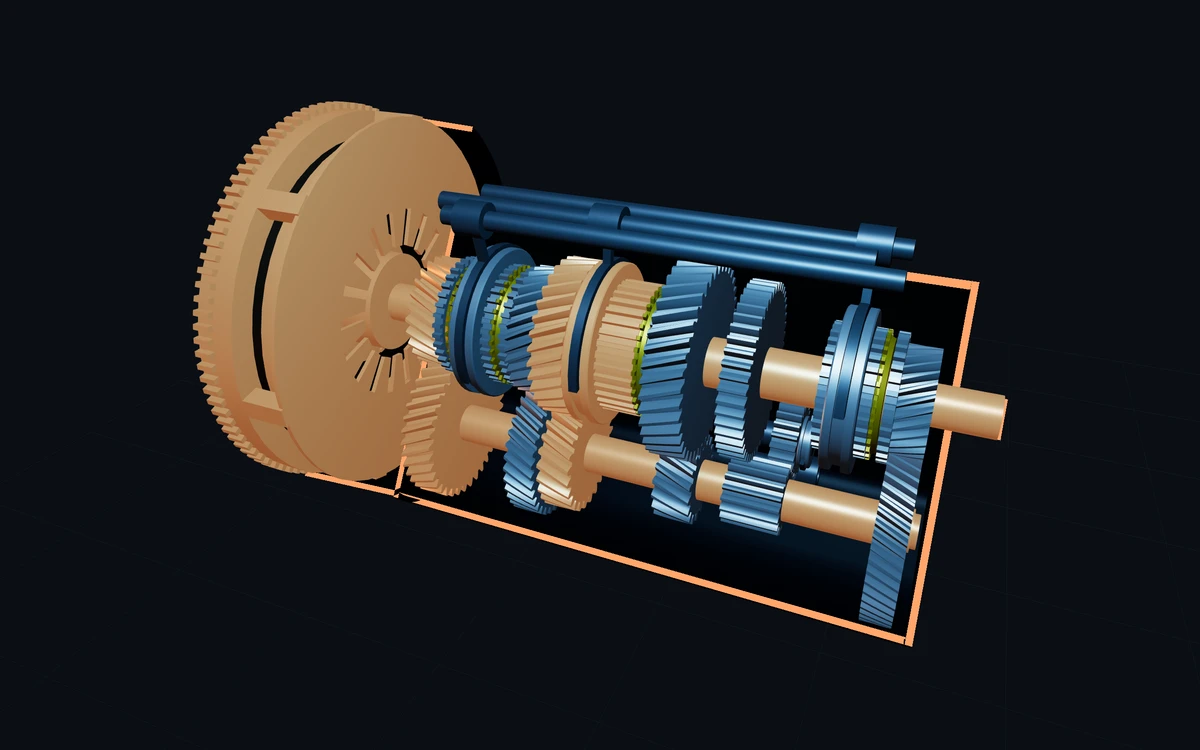
- Clutch. Bites with the pedal 60% of the way down
- Blocker ring. Matches speeds on a 7° cone before the dog teeth lock
- Input gear. 25 teeth: a 1,250 Hz whine at 3,000 rpm
- Reverse idler. No synchro, so it grinds if the car still rolls
You drive a see-through transmission turned by a real engine simulation: a 5-speed manual, an 8-speed automatic or a CVT. Watch the synchro rings match speeds before the dog teeth lock, the automatic's clutches hand the drive from gear to gear, and the CVT's belt climb its pulleys. The gears whine as they turn and grind when you get a shift wrong.
5 + R manual · 8-speed automatic · CVT · no install, no sign-up
- engines that can drive it
- 35
- gearboxes to drive: manual, automatic and CVT
- 3
- fixed-step physics tick
- 240 Hz
- installs, downloads or sign-ups
- 0
What's inside a manual gearbox?
A manual gearbox holds three shafts and a row of gear pairs. The input shaft takes the engine's drive through the clutch, the layshaft (countershaft) carries it underneath, and the mainshaft sends it to the wheels. The forward pairs stay in mesh; a sliding sleeve locks one gear to the mainshaft, and that gear is the one you are in.
- Clutch and damper. Connects the engine to the gearbox or lets it go. Springs in the disc soak up firing pulses.
- Input shaft. Turns with the clutch disc and carries the drive into the box.
- Layshaft (countershaft). Runs below the mainshaft and carries the gears for 1st, 2nd, 3rd, 5th and reverse.
- Mainshaft (output). Carries the gears you choose between and turns the propshaft. In 4th it locks straight to the input shaft.
- Constant-mesh gear pairs. Stay in mesh. The mainshaft gear of each pair spins free until a sleeve locks it.
- Synchro hubs and sleeves. The hub turns with the mainshaft; its sleeve slides sideways to lock the gear on either side.
- Blocker (baulk) rings. Rub a gear to the shaft's speed on a brass cone and hold the sleeve back until the speeds match.
- Dog teeth. Short teeth on the side of each gear. The sleeve slides over them to lock the gear to the shaft.
- Shift forks and rails. The lever moves a rail, and its fork slides a sleeve. An interlock lets one rail move at a time.
- Reverse idler. Slides into mesh between two gears to turn the output backwards. It has no synchro.
How does a manual gearbox work?
A manual gearbox, or manual transmission, trades speed for torque through gear pairs you choose by hand. Press the clutch to disconnect the engine, move the lever, and a sleeve locks a different gear to the output shaft. A low gear multiplies torque for pulling away; a high gear keeps the engine at low rpm when you cruise.
The power path
- Engine
- Clutch
- Input shaft
- Constant-mesh pair
- Layshaft
- Selected gear pair
- Sleeve on the dog teeth
- Mainshaft
- Final drive
- Wheels
In 4th the sleeve locks the input shaft straight to the mainshaft: a ratio of 1.00, with no gear mesh in the path. The other forward gears pass through two meshes and lose about 1% at each.
Torque multiplication
A gear pair multiplies torque by the factor it divides speed. 1st turns 100 N·m at the input into 322 N·m at the mainshaft, after friction in its two meshes, and the final drive multiplies it again by 3.9 in the default car.
The ratios in this gearbox
| Gear | Ratio | km/h per 1,000 rpm | N·m out per 100 in |
|---|---|---|---|
| 1 | 3.29 | 9.4 | 322 |
| 2 | 1.89 | 16.3 | 186 |
| 3 | 1.27 | 24.3 | 125 |
| 4 | 1.00 | 30.9 | 100 |
| 5 | 0.78 | 39.5 | 77 |
| R | 3.78 | 8.2 | 367 |
Tooth counts chosen to fit the ratios Toyota published for its W58 five-speed. Road speeds for the default car: the Inline-6 3.0L, 1,450 kg, final drive 3.9.
What does synchromesh do?
Synchromesh brings the gear you are selecting to the speed of the shaft before the dog teeth meet. A brass blocker ring rubs on a cone on the gear, and the friction speeds the gear up or slows it down. Until the speeds match, the ring holds the sleeve back, so the teeth cannot clash.
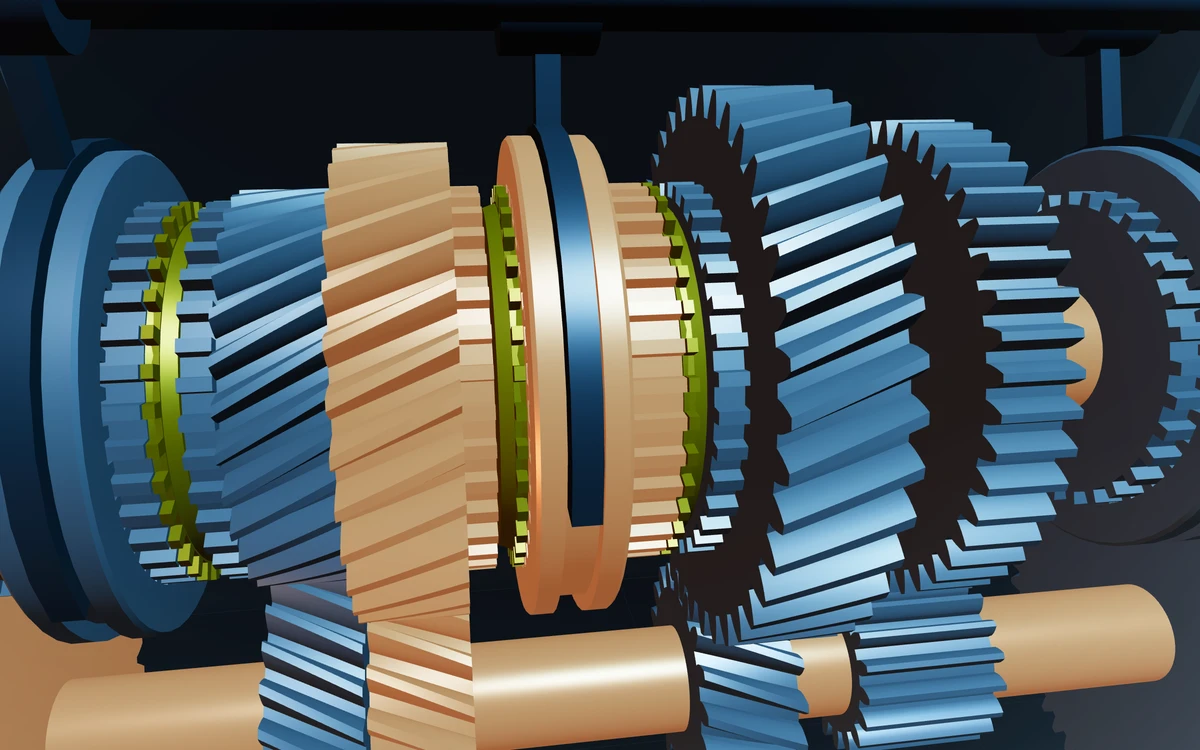
Cone friction does the work. The sleeve presses the ring onto a 7° cone. Friction torque is μ·F·R / sin α, so the shallow cone multiplies the push about 8 times. The 1st–2nd synchro stacks two cones for the widest speed gaps.
The blocker ring holds the sleeve until the speeds match. The sleeve's chamfered teeth push the ring to turn aside, and cone friction holds it in place. Here the cone out-torques the chamfers 2.0 to 4.1 times over.
You cannot force a healthy ring. Both torques grow with the same push, so a harder push syncs the cone faster and still holds the sleeve until the speeds match. Sync time is inertia × speed gap ÷ cone torque: a firm 400 N at the sleeve syncs a 1→2 at 6,000 rpm in about 0.2 s, and a quarter of that push takes four times as long.
The five phases of a shift
- neutralThe sleeve sits centred on its hub, held by a spring-loaded detent.
- presyncThe sleeve pushes the blocker ring onto the gear's cone.
- blockedThe ring's chamfered teeth stop the sleeve while cone friction closes the speed gap.
- unblockingThe speeds meet, the ring turns aside, and the sleeve slides on.
- engagedThe sleeve locks over the gear's dog teeth and the gear drives the shaft.
Watch the sleeve readout under the gearbox at the top of this page: it shows these phases live.
Why do gears grind?
Gears grind when the sleeve reaches the dog teeth while the two sides still turn at different speeds, so the teeth clash instead of sliding in. In a synchromesh gearbox that happens where there is no synchro (most reverse gears), when the clutch drags, or when a worn ring can no longer hold the sleeve back.
Reverse has no synchro. The reverse idler slides straight-cut teeth into mesh, and it needs the car and the input shaft stopped first. After you press the clutch at idle, the input shaft takes about a second to spin down; touching 1st stops it at once.
A dragging clutch keeps the engine coupled to the input shaft, so the synchro must change the engine's speed too. The simulator's rings are healthy, so a clutchless shift blocks and waits instead.
A worn ring has lost friction: its cone torque falls below the chamfers' torque, the ring stops blocking, and each shift into that gear crunches until the speeds meet.
The grind you hear is teeth skipping over teeth. Its pitch is the number of teeth times the speed difference, so it falls as the speeds come together.
Sliding mesh vs constant mesh vs synchromesh: what's the difference?
Sliding-mesh, constant-mesh and synchromesh gearboxes differ in how you engage a gear. A sliding-mesh gearbox slides whole gears into mesh. A constant-mesh gearbox keeps every pair in mesh and locks one to its shaft with a dog clutch. A synchromesh gearbox adds a synchroniser to each dog clutch, so the speeds match before the teeth meet.
| Type | How a gear engages | Who matches the speeds | In this simulator |
|---|---|---|---|
| Sliding mesh | A whole gear slides along a splined shaft into mesh with its partner. | The driver: double declutch, or stop first. | Reverse: the idler slides into mesh. |
| Constant mesh | All pairs stay in mesh. A dog clutch locks the chosen gear to its shaft. | The driver, though dog teeth take a speed difference that gear teeth cannot. | Every forward gear pair. |
| Synchromesh | Constant mesh, plus a synchroniser on each dog clutch. | The blocker ring and cone, before the teeth can meet. | 1st to 5th, through three synchro sleeves. |
The simulator's manual has all three ideas in one box: reverse slides into mesh, the forward pairs stay in constant mesh, and synchro sleeves match their speeds.
How does an automatic transmission work?
An automatic transmission changes gear by itself. Planetary gear sets make the ratios, and clutches and brakes inside the box choose one by holding or joining parts of the sets. A torque converter stands in for the manual's clutch, and a control unit picks the gear from road speed and throttle.
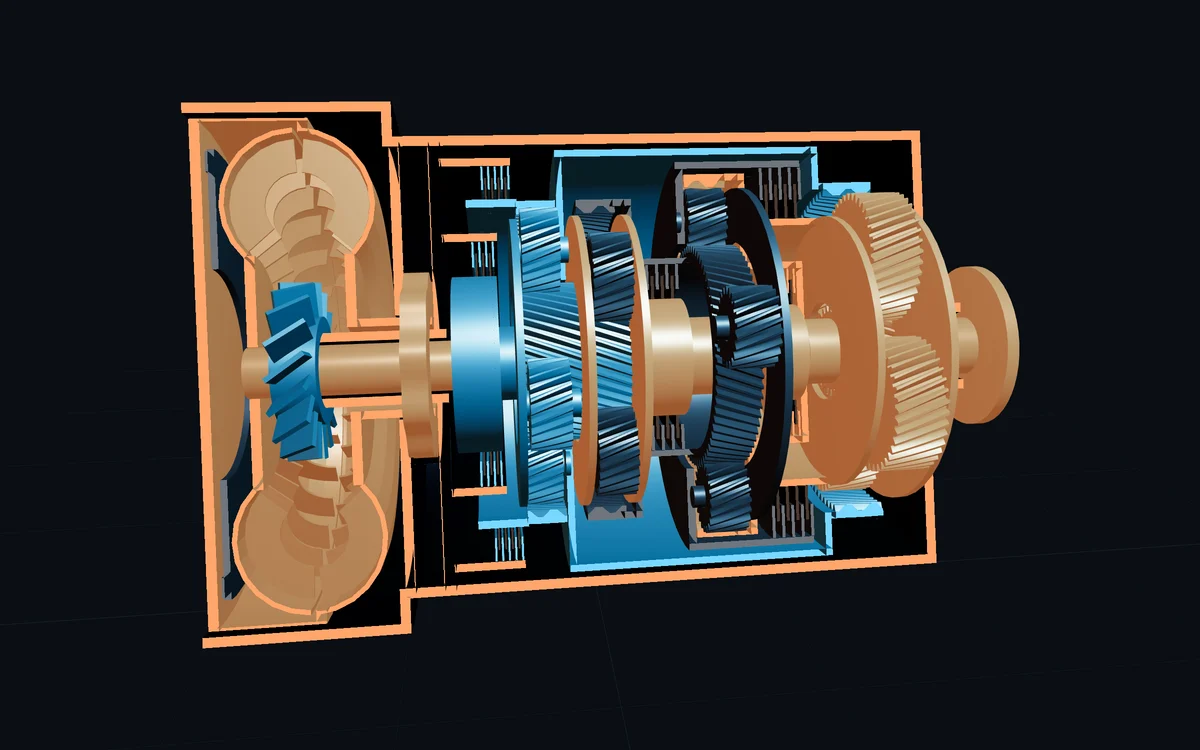
- Torque converter. Couples the engine to the gearbox through oil and multiplies torque while pulling away.
- Oil pump. Driven by the converter's impeller at engine speed; its pressure applies the clutches and brakes.
- Brake A. Plates that hold sun gears 1 and 2 still against the case.
- Brake B. Plates that hold ring gear 1 still against the case.
- Planetary set 1. Locked by brakes A and B in 1st, so its carrier holds ring gear 4 still.
- Planetary set 2. Its carrier is the input shaft; in 1st its gears turn without load.
- Clutch E. Joins ring gear 2 and sun gear 3 to ring gear 3 and sun gear 4.
- Planetary set 3. Its carrier reaches the output only through clutch D; in 1st it turns without load.
- Clutch C. Joins the input shaft to ring gear 3 and sun gear 4.
- Clutch D. Joins carrier 3 to carrier 4, the output.
- Planetary set 4. In 1st it makes the whole 4.714 reduction: sun driven through clutch C, ring held, carrier out.
- Output shaft. Carrier 4's shaft, with the park gear, turning the final drive.
Four planetary sets, five shift elements. The simulator's automatic follows the ZF 8HP scheme and ratios. Fixed links tie its four planetary sets into one gear train. Brakes A and B hold parts of it to the case, and clutches C, D and E lock parts together. Closing three of the five makes each gear: eight forward ratios from 4.714 to 0.667, a spread of 7.07, plus reverse.
Clutch-to-clutch shifts. Every shift between neighbouring gears opens one element and closes another, and the control unit times the handover. In an upshift the closing element first takes over the load (the torque phase), then slips while it pulls the engine down to the new gear's speed (the inertia phase). Each ratio is 1.19 to 1.50 times the next, against the manual's 1.27 to 1.74, so each upshift drops the revs less.
The control unit picks the gear. It reads road speed and the pedal against a shift map: with a light foot it shifts up early, with a heavy one it holds each gear to higher revs. Floor it and the box kicks down, skipping gears where one swap gets there: 8th shares two closed elements with 6th, 4th and 2nd, so it drops to any of them in a single shift. In M you pick the gear with + and −.
Shift elements closed in each gear
| Gear | A | B | C | D | E | Ratio |
|---|---|---|---|---|---|---|
| 1 | closed | closed | closed | open | open | 4.714 |
| 2 | closed | closed | open | open | closed | 3.143 |
| 3 | open | closed | closed | open | closed | 2.106 |
| 4 | open | closed | open | closed | closed | 1.667 |
| 5 | open | closed | closed | closed | open | 1.285 |
| 6 | open | open | closed | closed | closed | 1.000 |
| 7 | closed | open | closed | closed | open | 0.839 |
| 8 | closed | open | open | closed | closed | 0.667 |
| R | closed | closed | open | closed | open | −3.317 |
ZF 8HP scheme and ratios. A and B are brakes, C, D and E are clutches; ● closed.
How does a planetary gear set work?
A planetary gear set has a sun gear at the centre, planet gears on a carrier around it, and a ring gear with teeth on the inside. Hold one of the three, drive another, and take the output from the last: the six combinations give reductions, overdrives and reverse. Lock any two together and the set turns as one block.
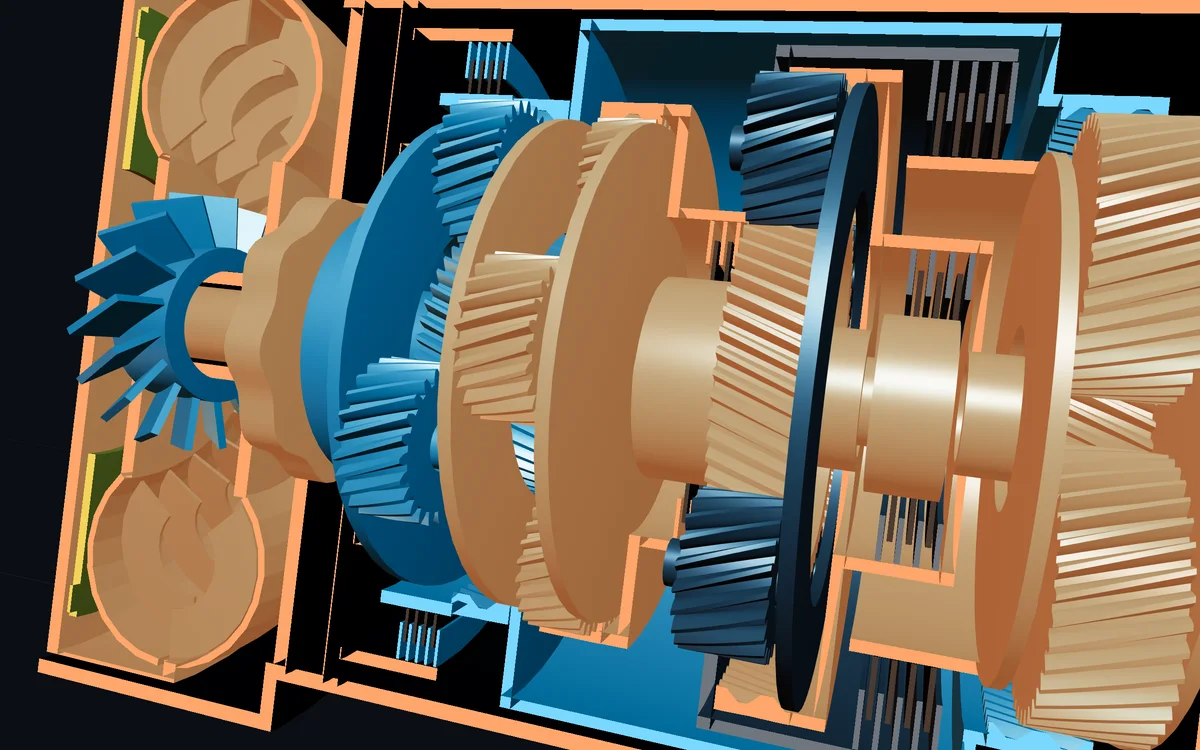
- Sun gears 1 and 2. One part: brake A holds it, so set 2's sun stands still and takes the reaction.
- Planet gears. Turn on pins in the carrier and walk round the held sun.
- Carrier 2. The input: the turbine shaft drives it and it carries the planets round.
- Ring gear 2. The set's output in 2nd, turning 1.5 times as fast as the carrier.
- Planetary set 1. Locked by brakes A and B: it stands still and holds ring gear 4.
- Brake B. Holds ring gear 1 still against the case.
- Clutch E. Closed in 2nd: passes ring gear 2's drive on to sun gear 4.
- Planetary set 3. Clutch E locks its sun to its ring, so it turns as one block without load.
- Lock-up clutch. Closing in 2nd: it slips while it takes the drive over from the oil.
Six combinations on a 48-tooth sun and a 96-tooth ring
| Row | Held | Input → output | Ratio | Output turns |
|---|---|---|---|---|
| 1 | Ring | Sun → carrier | 3.000 | Slower, same way |
| 2 | Sun | Ring → carrier | 1.500 | Slower, same way |
| 3 | Sun | Carrier → ring | 0.667 | Faster, same way |
| 4 | Ring | Carrier → sun | 0.333 | Faster, same way |
| 5 | Carrier | Sun → ring | −2.000 | Slower, backwards |
| 6 | Carrier | Ring → sun | −0.500 | Faster, backwards |
Set 1 of the simulator's automatic. Ratio is input speed over output speed.
One equation sets every row. The teeth tie the three speeds together: 48 × sun speed + 96 × ring speed = 144 × carrier speed. Hold one member still and the other two turn in a fixed proportion, which is the ratio. Hold the carrier, and the sun and ring must turn opposite ways: that gives reverse.
Lock two members and the set turns as one. The planets stop spinning on their pins, and the whole set turns at the input's speed: a ratio of 1.
Inside the automatic. In 1st, brakes A and B hold set 1 still, and set 4 works as row 1: its 28-tooth sun takes the input, its ring stays held through set 1, and its carrier drives the output at 1 + 104 ÷ 28 = 4.714. In 6th the three clutches lock every set into one block. In 8th, brake A holds set 2's sun, the input turns its carrier, and its ring overdrives at 0.667: row 3, since set 2 has set 1's teeth.
The simulator colours every member as it drives, holds, slips or spins free, so you can see what turns and what stands still in each gear.
How does a torque converter work?
A torque converter joins the engine to an automatic gearbox through oil. The engine spins a pump that throws oil at a turbine on the gearbox's input shaft, and a stator between them turns the returning oil so it pushes the pump along. Until the turbine nearly catches up, it gets more torque than the engine puts in.
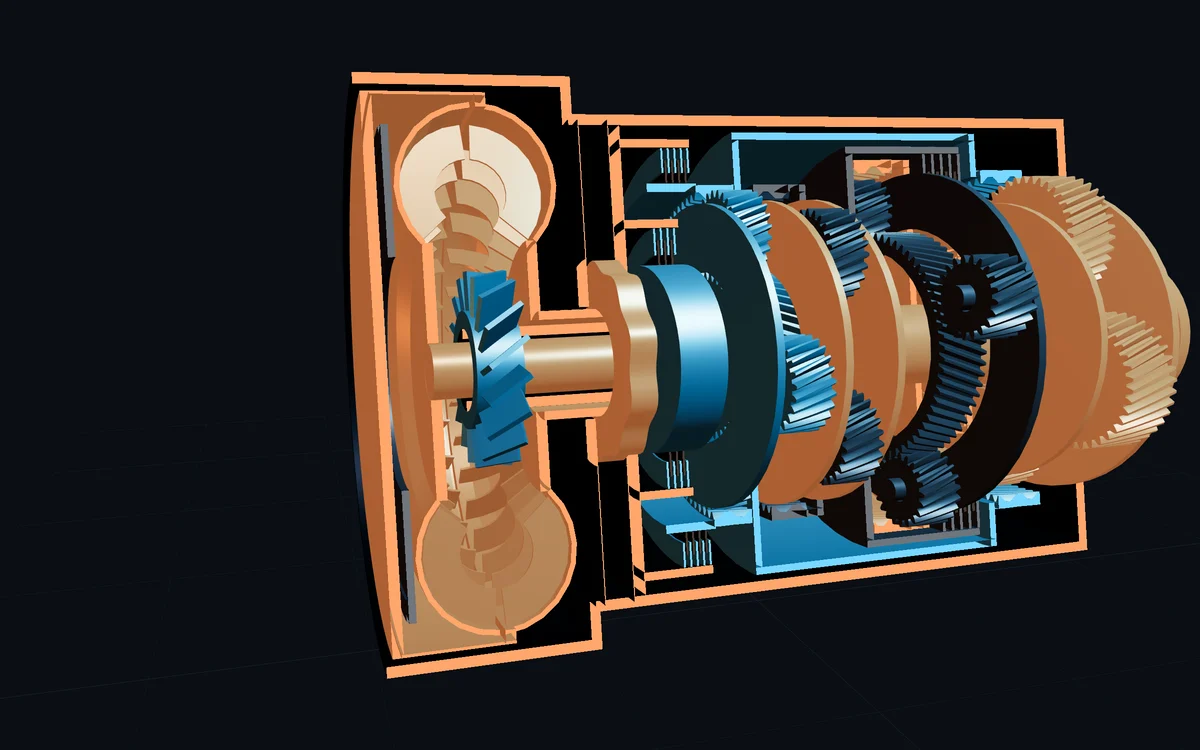
- Impeller. Joined to the cover and turned by the engine; its vanes fling oil at the turbine.
- Turbine. Turned by the oil from the impeller; it drives the gearbox's input shaft.
- Stator. A one-way clutch holds it still while it turns the oil coming back from the turbine: that multiplies torque.
- Lock-up clutch. Clamps the turbine to the cover from 2nd gear, once the turbine spins fast enough; open here.
- Oil pump. Driven by the impeller's hub; its pressure applies the clutches and brakes.
Stall. Hold the brake in D and floor the gas. With the default engine the brakes hold the car, the turbine stands still, and the engine climbs until the pump soaks up all its torque: that is the stall speed. A big enough engine overpowers the brakes and spins the driven wheels instead. The torque ratio peaks at stall, at 1.8 in the automatic, so 100 N·m from the engine reaches the gearbox as 180 N·m. Through 1st gear's 4.714 as well, the engine's torque leaves the gearbox 8.5 times larger, before the final drive.
Creep. At idle the pump still throws a little oil at the turbine. In D that is enough to creep most cars forward once you lift off the brake, and the same slip lets the engine idle in gear at a standstill without stalling.
Coupling point. As the turbine catches up, the multiplication fades. Above 88% of the pump's speed the oil strikes the back of the stator's blades, the stator freewheels on its one-way clutch, and the converter works as a plain fluid coupling: torque out equals torque in.
Lock-up. A fluid coupling needs slip to pass torque, and slip turns power into heat. From 2nd gear, once the turbine spins fast enough, a lock-up clutch eases the pump and turbine together and the revs drop a notch. It opens again when the turbine slows or you kick down. The CVT starts through a converter too, multiplying up to 1.9 times.
How does a CVT work?
A CVT, or continuously variable transmission, has no fixed gears. A steel belt runs between two pulleys, each made of two cones that squeeze together or spread apart. Squeeze one pulley and the belt rides out to a larger radius while it sinks into the other, so the ratio can take any value across its range.
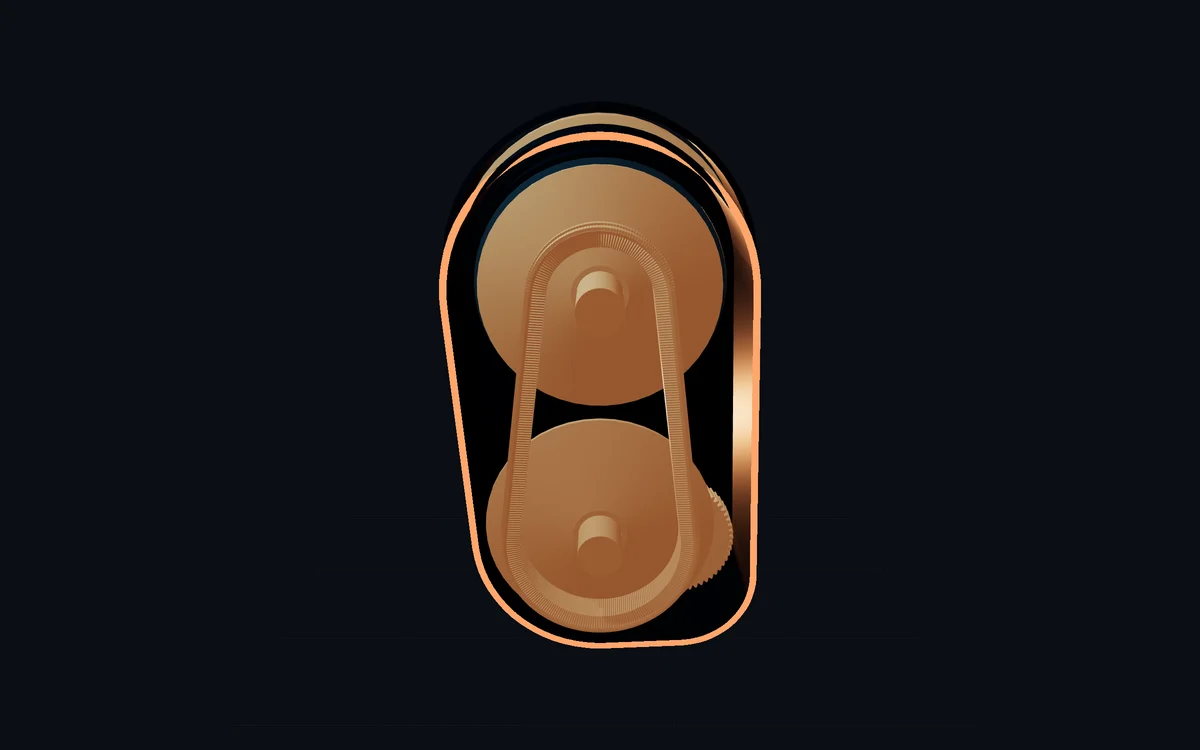
- Primary pulley. Turned by the engine through the converter and the forward clutch; its movable half, cut away here, slides to set the belt's radius.
- Secondary pulley. Drives the wheels; this is its movable half, on the opposite side to the primary's.
- Push belt. 400 steel elements on two packs of thin steel rings; the primary pulley pushes them round to the secondary.
- Final drive wheel. Turned by the pinion on the secondary shaft; it drives the differential.
- Secondary shaft. Carries the secondary pulley, the park gear and the pinion to the final drive.
A belt that pushes. Each pulley is two cone halves with 11° faces: one fixed, and one that oil pressure slides along the shaft. The two sliding halves sit on opposite sides, which keeps the belt in line as the ratio changes. The belt is 400 steel elements threaded on two packs of thin steel rings, and the drive pulley pushes the elements around the loop. From launch to overdrive the ratio spans a factor of 7.0, the coverage Jatco publishes for its CVT8.
Squeeze sets the torque. Friction between the cones and the elements carries the drive, so the pulleys clamp the belt hard. To pass the belt's rated 250 N·m on the smallest radius with a 30% margin, they must squeeze it with about 59 kN, the weight of six tonnes. The oil pump that makes that pressure costs power. Too little squeeze and the belt slips. This box is built for that rating, so an engine well past it, like the V8 7.0L Pushrod, slips the belt at full throttle in Traditional or Max efficiency mode.
Why the revs stay flat. In Max efficiency mode your pedal sets an engine speed, and the controller moves the pulleys to hold it. Floor it and the engine jumps to its peak-power speed and stays there while the car accelerates and the belt climbs the drive pulley. The revs flare first and the speed follows: the rubber-band feel.
Fake steps. Drivers missed the rise and fall of gear changes, so many CVTs fake them. Traditional mode here steps through seven fixed ratios on a shift map, like an automatic. Flip between the modes and listen: the steps sound familiar, and Max efficiency keeps the engine where it makes its power.
Standing still. The ratio can change only while the pulleys turn, because the belt moves to a new radius as it runs in and out of them. The controller therefore heads back to the lowest ratio as you slow down. Stop hard and the ratio can end just short of it, then finish the move once the car rolls again: real CVTs share that limit. A torque converter handles the launch, locking up from 18 km/h, and a small planetary set in front of the pulleys gives reverse.
Manual vs automatic vs CVT: what's the difference?
A manual has fixed gear pairs you choose with a clutch pedal and a lever. An automatic has fixed ratios too, but picks them itself, switching clutches and brakes inside planetary gear sets behind a torque converter. A CVT has no fixed ratios: its belt and pulleys can hold the engine at one speed while the car accelerates.
| Compared | Manual | Automatic | CVT |
|---|---|---|---|
| Forward ratios | 5, fixed | 8, fixed | Any, across its range |
| Ratio spread | 4.2 | 7.1 | 7.0 |
| Step between ratios | 1.27 to 1.74 | 1.19 to 1.50 | None |
| Pulling away | A friction clutch under your left foot | A torque converter | A torque converter |
| Changing ratio | You, with the clutch, the lever and the synchros | The control unit, opening one clutch or brake as it closes another | The controller, sliding the pulley halves |
| Revs as you speed up | Climb, then drop at each shift | Climb, then drop in smaller steps | Can hold steady while the speed climbs |
| In this simulator | Toyota W58 ratios, synchromesh, a sliding-mesh reverse | The ZF 8HP scheme and ratios | A push belt with the coverage and torque rating of Jatco's CVT8 |
This is the real gearbox physics stepping in your tab, driven by a script. Open the simulator to see the gearbox as a live 3D animation and take the controls yourself.
What can you try in the gearbox simulator?
You can do anything a driver does with the pedals and the lever, and watch the gearbox respond. In the manual, launch on the bite point, double declutch or over-rev the engine with a money shift. In the automatic, stall the converter or kick down; in the CVT, hold the revs flat. Then replay it in slow motion.
- Manual
Launch without stalling
The clutch bites with the pedal 60% of the way down, carrying a tenth of its torque. Feed it up with a little throttle and the car creeps away; dump it at idle in 1st and the engine stalls. On a keyboard, hold Shift to slow the clutch.
Try it - Manual
Shift without the clutch
The synchros manage it at a cost: with the clutch up, the ring drags the whole engine to the new speed and the lever blocks more than five times longer. Lift off first, or the loaded dog teeth hold the old gear in.
Try it - Manual
Double declutching (double clutching)
Blip the throttle in neutral between two presses of the clutch. The blip spins the input shaft up to the lower gear's speed, leaving the synchro almost nothing to do. Nothing is scripted: the input shaft has a speed of its own, so the trick works.
Try it - Manual
Rev-match a downshift (heel and toe)
Blip before the clutch comes back up, so the engine meets the lower gear's speed. Miss it and the clutch drags the engine up, braking the car. Heel-and-toe is the same blip with your right foot also on the brake.
Try it - Manual
The money shift
Reach for 4th from 5th, land in 2nd and let the clutch up: the wheels drive the engine past its redline. At 160 km/h, 2nd gear means 9,800 rpm for the default Inline-6 3.0L, against a 7,400 rpm redline, and the simulator flags the over-rev.
Try it - Manual
Replay the last shift in slow motion
Scrub back through your last shift, or run the whole simulation at a tenth of real time. The whine drops in pitch with the picture, because its pitch comes from the simulated shafts.
Try it - Automatic
Stall the torque converter
Hold the brake in D and floor the gas. The car stays put, the turbine stands still, and the stator multiplies the engine's torque 1.8 times. Keep it short in a real car: the oil takes all that power as heat.
Try it - Automatic
Feel the lock-up
Pull away at part throttle and watch the converter from 2nd on. Once the turbine spins fast enough, the lock-up clutch eases shut: the revs drop a notch and the converter stops slipping. Kick down and it opens again.
Try it - Automatic
Pick the gears yourself in M
Move the selector to M and tap + or − to choose among the 8 gears. The gearbox refuses a downshift that would over-rev the engine, and at the limiter it holds your gear instead of shifting up.
Try it - Automatic
Kick down
Cruise in 8th and floor the pedal. The control unit drops to the lowest gear the redline allows, and it can reach 6th, 4th or 2nd in a single shift, because each is one element swap away.
Try it - CVT
Launch a CVT with the revs flat
Pick the CVT, choose Max efficiency and floor it from rest. The revs jump to the engine's peak-power speed and hold there while the car gathers speed and the pulleys trade sizes. Switch to Traditional to feel its fake steps.
Try it
How does the gearbox simulation work?
The engine is the same cycle-by-cycle model as the engine simulator. A solver steps the clutch, shafts, synchros and car together with it, at least 960 times a second. The 3D gearbox draws the angles the solver computes, and the sound comes from the same shaft speeds.
- An exact driveline solver. Crank, clutch, damper, input shaft, gears, mainshaft, tyre and car form one chain, and the solver finds its exact answer at each step, with no iteration. A locked clutch holds with zero creep, and no step creates energy.
- A synchro model from the literature. Each synchro weighs cone torque against the chamfers' indexing torque, after Irfan, Berbyuk and Johansson (Cogent Engineering, 2018).
- A clutch with a torsional damper. Four stages of springs between the facings and the hub wind up under drive and soak up firing pulses.
- Whine from tooth counts. Pitch is tooth count times shaft speed: the 25-tooth input gear at 3,000 rpm sings at 1,250 Hz.
- Built for school laptops. The physics runs on the processor at 240 steps a second, and the 3D view has a lighter mode for weak graphics chips, so it runs on a Chromebook.
Gearbox questions, answered.
In a manual car there is none: gearbox is the British and Indian word, transmission the American one. Engineers also use transmission for the whole driveline, from the clutch through the gearbox and propshaft to the differential, and keep gearbox for the box of gears.
Each number is a gear ratio, lowest first. You pull away in 1st, which multiplies torque the most, and each higher gear trades torque for road speed. Here 1st is 3.29:1, 4th is direct drive at 1:1, and 5th is a 0.78:1 overdrive that keeps the revs down at speed. R reverses the output through an idler gear.
Textbooks list sliding mesh, constant mesh, synchromesh and epicyclic (planetary). The first three are manual gearboxes that differ in how you engage a gear. An epicyclic gearbox, the kind inside an automatic, holds parts of planetary gear sets with clutches and brakes instead. This simulator has all four: a manual that combines the first three, and an 8-speed automatic on four planetary sets. It also has a CVT, which the list leaves out.
It depends on the car. A manual is simple and light, and leaves every gear to you. An automatic with many close ratios, 8 here, shifts without cutting the drive and copes with high torque. A CVT keeps the engine at its most efficient speed, which suits small cars, but its belt limits torque: this simulator's is rated for 250 N·m.
An automatic has a fixed set of gears, 8 in this simulator, and changes between them by switching clutches and brakes inside planetary gear sets. A CVT has no gears: a steel belt runs between two pulleys that change their working size, so the ratio can take any value across its range. In an automatic the revs climb and drop with each shift; a CVT can hold them steady while the car accelerates.
The revs and the road speed stop rising together. Press the pedal and a CVT lets the engine jump to the speed that makes the power you asked for, then holds it there while the pulleys change the ratio and the car catches up. You hear the revs first and feel the speed later, like a rubber band stretching before it pulls. Many CVTs fake gear steps to hide it, and the simulator has both: Traditional steps and Max efficiency.
An engine makes useful torque across a limited rpm band, and it turns one way. The gearbox keeps the engine inside that band at any road speed: low gears multiply torque to pull away, high gears keep the revs down when you cruise, and reverse turns the output backwards.
Synchromesh means each gear has a synchroniser, a cone clutch and blocker ring that bring the gear to the shaft's speed before the teeth engage, so you can shift without double declutching. Manual cars made today have it on their forward gears; reverse often has none, which is why it grinds.
For road skills, practise in a PC driving simulator such as BeamNG.drive or Assetto Corsa with a clutch pedal and an H-pattern shifter. This gearbox simulator covers what happens inside the box: the bite point, stalls, shifts and rev-matching, with the gearbox open so you see why each one works or fails.
It is free, with no download and no account. It runs in your browser tab: the physics on your processor and the 3D view on your graphics chip.
Yes. On a phone the controls become a dock: the pedals, plus an H-gate you drag with your thumb in the manual or a P-R-N-D-M selector in the automatic and the CVT. On a Chromebook or laptop you can drive from the keyboard: W and S for gas and brake, Space for the clutch, 1 to 5, R and N for the lever, P, R, N, D and M for the selector, and + and − in M.
Any of the 35 engines from the engine simulator that come with a road vehicle, from the Utility Single 163cc to the Diesel V16 60L. The car changes with the engine: its weight, wheels and drag come from that engine's vehicle. The manual also takes that vehicle's final drive and clutch, while the automatic and the CVT bring their own final drives, 3.15 and 5.65. Propeller engines, turbojets and Wankel rotaries fall back to the default Inline-6 3.0L.
It teaches what your left foot and hand do in a stick shift: finding the bite point, stalling and recovering, shifting up and down, rev-matching and double declutching, and why each one works. It does not teach road driving: steering, traffic, hill starts or the feel of a real pedal. Learn the mechanics here, then practise in a real car with an instructor.
Engine Simulator
The engine turning this gearbox comes from the engine simulator, which runs 46 engines cycle by cycle: pistons, radials, Wankel rotaries and turbojets. You get a live dyno, real start procedures and failures you can cause, free, in the same browser tab.
Ready to find the bite point?
Pick an engine, press the clutch and feel for the bite. Free, in your browser, right now.