Roots vs Centrifugal Supercharger: Boost Curves Compared
Two crank-driven blowers, two pressure laws. Measured torque, belt drag and charge heat on one 6.2 V8 — plus the A/B that says which difference matters.
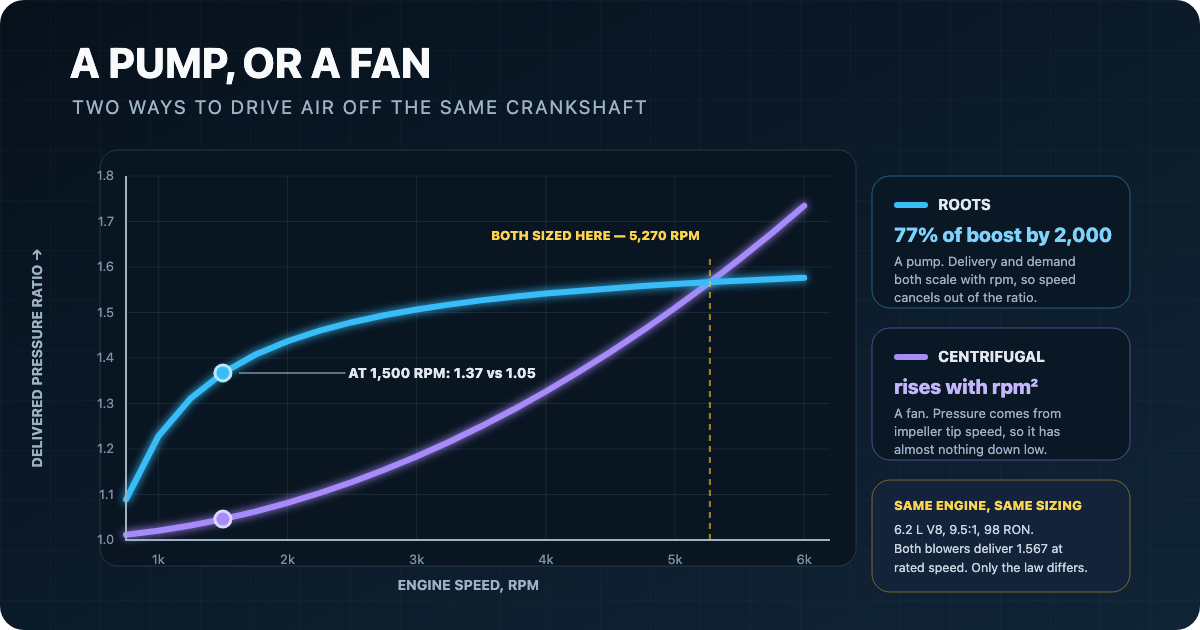
Two superchargers can be bolted to the same engine, geared to the same crankshaft, and sized to deliver exactly the same pressure at the same rpm — and still behave nothing alike. One is already three quarters of the way to full boost by 2,000 rpm and runs flat from there. The other gives you almost nothing until the tachometer is past halfway.
That difference is not tuning. It is which machine you bought, and it shows up in the arithmetic before it shows up on a dyno.
Key Takeaways
- A Roots blower is a pump: it displaces a fixed volume per turn, so its pressure ratio is roughly flat with engine speed. Measured on a 6.2 V8, it made +33% torque over naturally aspirated at 1,500 rpm where the as-sized centrifugal made +4%.
- A centrifugal blower is a fan: pressure comes from impeller tip speed, so it rises with the square of rpm. It gave up the bottom end and took peak power — 559 hp against the Roots' 534 hp.
- The two torque curves crossed at ≈4,660 rpm. Below that the pump wins; above it the fan does.
- The centrifugal's top-end win is not its pressure law. Re-run with the Roots' efficiency and boost cap, the centrifugal peaked at 510 hp — losing everywhere. It wins at the top because it compresses more efficiently, which earns it a higher knock ceiling.
- Belt drag inverts: the Roots takes 2.0 kW at 1,000 rpm where the centrifugal takes 0.16 kW, but at 6,000 rpm the centrifugal takes 40.9 kW against 31.6 kW.
On this page: Quick answer · The two machines at a glance · How each one makes pressure · Which makes more torque · What the belt takes back · Which heats the charge more · Is it really the pressure law? · What they sound like · Which should you fit · Try it in the simulator · FAQ · How these numbers were made
Quick Answer: Roots or Centrifugal?
Choose a Roots (or twin-screw) if you want torque immediately and you drive below 4,500 rpm. Choose a centrifugal if you want peak power, a cooler charge, and you are willing to rev for it. The crossover on the engine measured here sits at about 4,660 rpm; where it falls on any given engine depends on where the blower is sized, not on which one is "better".
The rest of this page is the measurement behind that sentence. It includes one controlled test that separates the two machines' pressure law from their efficiency. Those two get blamed for each other constantly.
The Two Machines at a Glance
| Roots (positive displacement) | Centrifugal (dynamic) | |
|---|---|---|
| Best for | Low-rpm torque, instant response | Peak power, top-end pull |
| How it makes pressure | Displaces a fixed volume per revolution | Accelerates air with an impeller; velocity becomes pressure |
| Pressure vs engine speed | Roughly flat above ~2,000 rpm | Rises with the square of rpm |
| Typical drive ratio (as modelled) | 2.5:1 | 7:1 |
| Adiabatic efficiency (as modelled) | 0.60 | 0.70 |
| Torque at 1,500 rpm, WOT | 655 N·m (+33% vs NA) | 513 N·m (+4% vs NA) |
| Peak torque | 768 N·m @ 4,186 rpm | 765 N·m @ 4,778 rpm |
| Peak power | 534 hp @ 6,200 rpm | 559 hp @ 6,200 rpm |
| Belt power at 1,000 rpm | 2.02 kW | 0.16 kW |
| Belt power at 6,000 rpm | 31.6 kW | 40.9 kW |
| Knock ceiling earned | 1.567 bar | 1.679 bar |
| Audible signature | ~1.0 kHz moan at 6,000 rpm | ~7.0 kHz shriek at 6,000 rpm |
Every figure in the right two columns is a simulator measurement, not a manufacturer claim. The method: one engine, a 6.17 L 9.5:1 V8 on 98 RON, idling at 750 and red-lined at 6,200. It was swept at wide-open throttle over 47 points, with unlimited fuel and the rev limiter disabled. Held-rpm probes of three seconds each supplied the charge-state readings and the figures quoted at round engine speeds. Both blowers were sized by the same code path at the same rated speed (5,270 rpm), so nothing was hand-tuned to favour either. The simulator's calibration is described at the end.
How Each One Makes Pressure
The Roots wins the bottom end because engine speed cancels out of its arithmetic, and the centrifugal loses it for the same reason it wins the top.
A Roots blower is two meshing rotors that trap air at the inlet and carry it around to the outlet. It moves a fixed volume per revolution. Geared to the crank, it therefore delivers air at a rate proportional to engine speed — and the engine's appetite is also proportional to engine speed. Both sides scale with rpm, so rpm cancels. What is left is a pressure ratio that barely moves. That is the blue line on the chart at the top of this page: steep off idle, then a shelf.
Two setups appear in this article, and they are worth naming. The chart above shows the matched-ratio pair. Both are sized to deliver 1.567 at 5,270 rpm, so only the law separates the curves. Everywhere else the centrifugal is the as-sized one. It earns a higher 1.679 ratio, for the reason the efficiency section gives.
A centrifugal blower has no trapped volume. It is a small compressor wheel — mechanically much the same thing as the compressor half of a turbocharger — that flings air outward and converts velocity into pressure. The pressure it can raise depends on how fast the impeller tips are moving. That is why makers talk about tip speed rather than displacement. ProCharger describes the pressure a centrifugal unit develops as a function of impeller tip speed, which is itself a product of wheel diameter and rpm (ProCharger, retrieved 2026-08-23). Velocity squared appears in the kinetic energy of that air, and the pressure rise follows it. Double the speed, quadruple the pressure rise.
Written out, sized to deliver the same ratio PR at a rated speed, with n as the fraction of rated speed:
centrifugal:   ratio = 1 + (PR − 1) · n²
roots:         ratio = 1 + (PR − 1) · [1 + k · (1 − 1/n)]
The Roots expression has no n in the leading term at all — the k · (1 − 1/n) correction is leakage. A positive-displacement machine has running clearances between its rotors and its case, and air pushes back through them. That backflow is driven by pressure difference, not by speed, so as a fraction of what the blower is moving it shrinks as revs rise. Hence the knee just off idle and the shelf above it.
The delivered fraction of full boost, measured:
| Engine speed | Roots | Centrifugal |
|---|---|---|
| 1,000 rpm | 40% | 4% |
| 1,500 rpm | 65% | 8% |
| 2,000 rpm | 77% | 14% |
| 3,000 rpm | 89% | 32% |
| 4,000 rpm | 95% | 58% |
| 5,270 rpm (rated) | 100% | 100% |
Verdict: the Roots owns everything below rated speed, by construction rather than by tune.
Which Makes More Torque, and Where?
The Roots wins from idle to 4,660 rpm; the centrifugal wins above it and takes peak power by 25 hp.
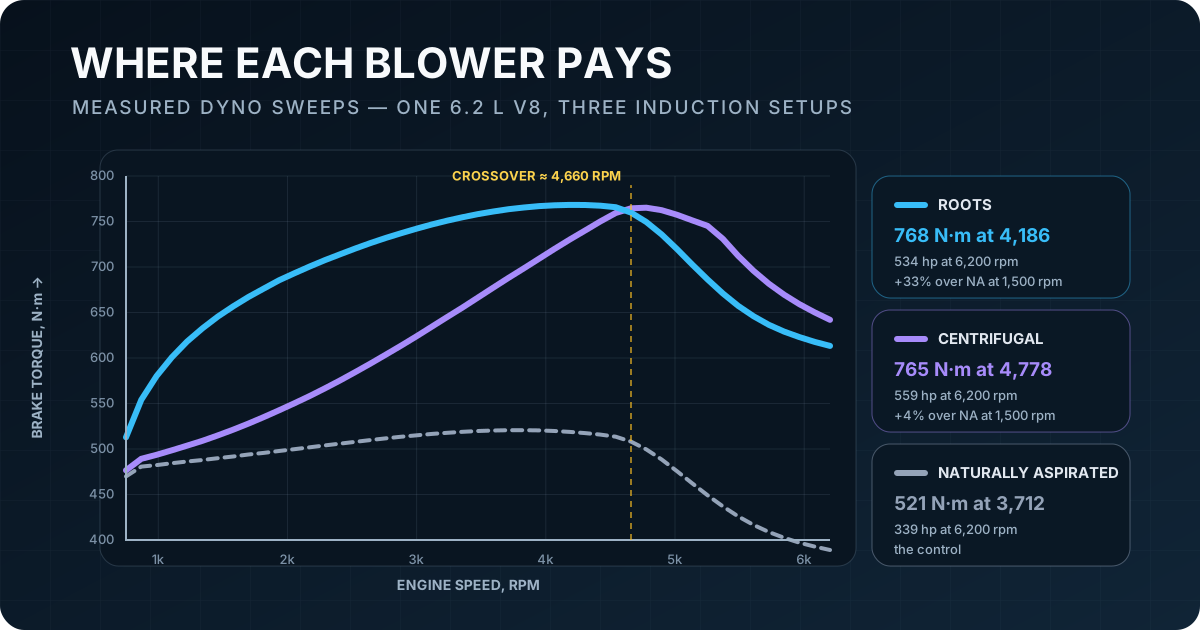
Naturally aspirated, this engine makes 521 N·m at 3,712 rpm and 339 hp. Fit the Roots and torque at 1,500 rpm goes from 493 to 655 N·m, a third more, at a manifold pressure of 1.368 bar. Fit the centrifugal instead and the same 1,500 rpm point reads 513 N·m at 1.055 bar — it is barely boosting yet.
By 4,500 rpm they have nearly converged (766 against 758 N·m). Past the crossover the centrifugal keeps climbing, while the Roots is already against its ceiling. The two peaks land in different places: 768 N·m at 4,186 rpm for the pump, 765 N·m at 4,778 rpm for the fan. Almost the same number, 600 rpm apart, which is the difference you feel from the driver's seat.
The nuance worth stating plainly: the centrifugal is never worse than naturally aspirated. It is only less better, low down. A blower that does nothing at 1,500 rpm also costs you almost nothing there. That is the next section.
Verdict: Roots below ~4,660 rpm, centrifugal above it — a gap of 4.7% at peak power, against nearly 29 percentage points down low.
What Does the Belt Take Back?
The centrifugal is nearly free at low rpm and the most expensive of the two at redline. The Roots is the reverse.
A crank-driven blower is not free air. It is an air compressor bolted to the crankshaft, and compressing air takes shaft work — which comes off the same brake torque the blower is trying to increase. This is the fundamental difference from a turbocharger, which pays for its air in exhaust backpressure rather than belt drag.
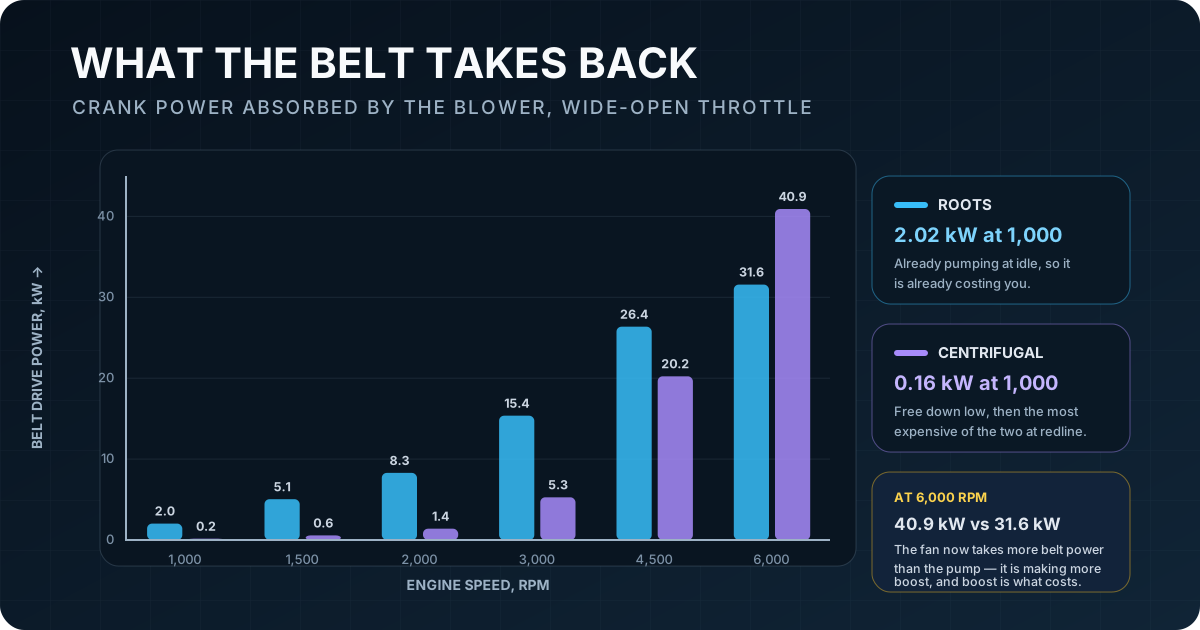
At 1,000 rpm the Roots is already drawing 2.02 kW — about 2.7 hp, or 3.3% of the engine's brake output at that speed — because it is already making 1.23 bar. The centrifugal draws 0.16 kW, about a twelfth as much, because it is making almost no pressure to speak of.
At 6,000 rpm the ranking flips. The centrifugal takes 40.9 kW (54.9 hp, 9.9% of brake output) against the Roots' 31.6 kW (42.3 hp, 8.1%). The fan is now costing more than the pump — not because it is less efficient, but because it is making more boost, and the work of compression scales with the pressure you are asking for.
Verdict: centrifugal below about 4,000 rpm, Roots above it. The belt-cost crossover sits close to the torque one, for the same reason.
Which Heats the Charge More?
The Roots, at any equal pressure ratio — and that heat is what sets its boost ceiling.
Compressing air heats it. Some of that heat is unavoidable. The rest is waste, and adiabatic efficiency is the measure of how much waste there is.
A classical Roots blower has no internal compression at all. The rotors carry air at inlet pressure round to the outlet. There the higher manifold pressure blows back into the pocket, and that backflow is the compression. It is thoroughly irreversible, which is precisely why it wastes so much.
Twin-screw units compress air inside themselves. Their rotors close down along their length, so the air is squeezed before it ever reaches the outlet. That is why they sit higher on efficiency, and why the biggest factory blowers use them. Eaton's modern TVS rotating groups run twin four-lobe rotors with a 160-degree twist (Eaton, retrieved 2026-08-23). Its R2300 group is rated to a typical maximum of 18,000 rpm and a peak pressure ratio of 1.8. It flows 2,745.4 kg/hr, corrected to 100 kPa and 25 °C inlet (Eaton, retrieved 2026-08-23).
Discharge temperature from a 293 K inlet, at the two efficiencies modelled here:
| Pressure ratio | Roots (η 0.60) | Centrifugal (η 0.70) | Difference |
|---|---|---|---|
| 1.2 | 319.1 K | 315.4 K | 3.7 K |
| 1.4 | 342.3 K | 335.2 K | 7.1 K |
| 1.6 | 363.2 K | 353.2 K | 10.0 K |
| 1.8 | 382.3 K | 369.5 K | 12.8 K |
That gap is not cosmetic, because hot charge is what starts engine knock. End-gas temperature is the thing a knock model watches, so the machine that heats harder is allowed less boost before it detonates. On this engine — 9.5:1, 98 RON, a 72%-effective intercooler — the ceilings come out at 1.567 bar for the Roots and 1.679 bar for the centrifugal. Nobody chose those numbers; they fall out of the same calculation with a different efficiency in it.
Strip the intercooler and both collapse to 1.141 and 1.165 bar. The cooler is doing far more work than the efficiency difference is.
One inversion worth catching: at 6,000 rpm the centrifugal's compressor discharge is the hotter of the two, 376.1 K against 360.8 K, despite being the more efficient machine. Read that against the table above and it looks impossible — 1.679 bar at 0.70 efficiency should give about 360 K, the same as the Roots.
The resolution is that manifold pressure is not the pressure the impeller is working at. Past rated speed the centrifugal's square law keeps climbing. At 6,000 rpm the wheel is running a pressure ratio near 1.88, while the boost control holds the manifold down to its 1.679 cap. The heat goes with the wheel, not with the manifold.
The Roots barely shows this, because its law is flat. Its uncapped ratio at 6,000 rpm is 1.576 against a 1.567 cap, so there is almost nothing to throw away.
That is a real cost of over-spinning a centrifugal, and it is invisible on a boost gauge.
Verdict: centrifugal, and the reward is roughly 0.11 bar of extra boost ceiling on this engine.
Is the Centrifugal's Top End Really Its Pressure Law?
No — and this is the result that inverts the usual explanation. Give the centrifugal the Roots' efficiency and boost cap, and it loses at every single engine speed.
The two machines above differ in three ways at once: pressure law, adiabatic efficiency, and the boost ceiling that efficiency earns them. That is a fair comparison of the products, but it cannot tell you which difference did the work. Isolating the law needs a fourth configuration: the centrifugal's n² pressure law, with the Roots' 0.60 efficiency, the Roots' 1.567 bar cap, and the Roots' 1.567 design ratio. One variable — the law — and nothing else.
| Configuration | Peak torque | Peak power | Torque at 1,500 rpm |
|---|---|---|---|
| Naturally aspirated | 521 N·m @ 3,712 | 339 hp | 493 N·m |
| Roots, as sized | 768 N·m @ 4,186 | 534 hp | 655 N·m |
| Centrifugal, as sized | 765 N·m @ 4,778 | 559 hp | 513 N·m |
| Centrifugal, Roots' η and cap | 712 N·m @ 4,660 | 510 hp | 509 N·m |
The law-only centrifugal peaks at 510 hp against the Roots' 534, and it is behind at the top of the rev range too — 598 N·m against 622 N·m at 6,000 rpm. Held to the same efficiency and the same ceiling, the flat-delivery machine is better everywhere.
So the centrifugal's real-world top-end advantage is purchased with efficiency, not with its speed law. It compresses more cleanly, earns 0.11 bar more boost before knock, and spends that allowance where its law lets it reach: the top. The n² curve is the price it pays for the efficiency, not the source of its advantage.
That reframes the usual advice. "Centrifugals make more peak power" is true. But the reason is not that boost rises with rpm. It is that a fan wastes less heat than a pump, and a machine that wastes less heat is allowed more boost before it knocks.
Verdict: the pressure law explains the shape of each curve. Efficiency explains which one is higher.
What Do They Sound Like?
A Roots moans; a centrifugal shrieks. The frequency is arithmetic, not character.
The tone a blower makes is its rotating elements passing the housing: lobe count (or vane count) times blower revolutions per second. Everything else follows from the gearing, and the two machines are geared very differently because they need different things. A Roots only has to displace volume, so it runs about 2.5:1. A centrifugal has to reach tip speed, so it is geared far harder — 7:1 in the model here.
Those drive ratios are not modern inventions. In 1930 the NACA tested a Roots-type blower on a Liberty engine at four drive ratios: 1.615, 1.957, 2.4 and 3.0 times engine speed. The aim was to hold sea-level carburettor pressure at ever greater altitudes (Schey and Gove, NACA-TR-327, 1930; retrieved 2026-08-23). A positive-displacement blower was already geared in that band a century ago. The reason is the one this article opened with: it is sized by volume, not by tip speed.
At 6,000 crank rpm, with four lobes on the Roots (what a modern helical unit runs) and ten vanes on the centrifugal impeller:
Roots:        2.5 × 6000 = 15,000 rpm = 250 rev/s × 4 lobes  = 1.0 kHz
Centrifugal:  7.0 × 6000 = 42,000 rpm = 700 rev/s × 10 vanes = 7.0 kHz
One lands in the middle of the exhaust note, where there is plenty of energy to mask it. The other lands in the most sensitive region of human hearing with nothing up there to hide behind. That is the entire reason the two sound as different as they do, and it is why a blown drag car and a blown street car are recognisable from a street away.
Verdict: taste, not performance — but it is a real 7× difference in frequency, not a vibe.
So Which Should You Fit?
Decide on where you use the engine, not on peak power:
- Roots or twin-screw if the engine spends its life below about 4,500 rpm: a road car, a truck, anything driven on torque. You are buying response, and you pay for it in belt drag at idle, a hotter charge, and a slightly lower boost ceiling.
- Centrifugal if the engine is revved: track use, drag racing, anything where the last thousand rpm is where you live. You are buying peak power and a cooler charge, and you pay for it by having a nearly naturally aspirated engine below 3,000 rpm.
- Neither, consider a turbo, if you do not want to spend crank power at all — a turbocharger takes its energy from exhaust you were throwing away, at the cost of lag and backpressure. Note that a turbo compressor is a centrifugal machine, so it shares the tip-speed law and, along with it, the surge behaviour that centrifugal compressors have and positive-displacement blowers do not.
One correction to a common shorthand: the Hellcat is usually cited as the archetypal "Roots" muscle car, and it is not one. Stellantis specifies the 6.2 supercharged HEMI's blower as a twin-screw 2,380 cc/rev unit, with integral charge coolers and an electronic bypass. Boost is regulated to 80 kPa (11.6 psi), rising to 14.5 psi on the 2.7-litre Redeye unit (Stellantis Media, retrieved 2026-08-23). Twin-screw is positive displacement, so it behaves like the Roots in this article: flat delivery, torque from idle. But it compresses internally, so it sits nearer the centrifugal on efficiency. It is the middle of the two columns above, which is why it is on the car.
That placing is inferred, not measured. It follows from where each machine squeezes the air, and from Eaton's own account of its rotors. The simulator models a Roots and a centrifugal; no twin-screw was run.
Try It in the Simulator
The engine measured throughout this article is a preset, and the blower type is one dropdown away.
- Open the supercharged 6.2 V8. It ships with the Roots fitted.
- Start it and run the dyno. Note the shape: torque is already high at the left-hand edge of the sweep and the curve is a shelf, peaking around 4,200 rpm.
- Switch the blower type to centrifugal in the spec panel, or load the same engine with the centrifugal already fitted.
- Run the dyno again. Same displacement, same compression, same fuel. But the left-hand edge has dropped back to roughly the naturally aspirated line. The peak has slid about 600 rpm up the range, and peak power is higher than it was.
- Now watch the charge readout while you blip the throttle in neutral. On the Roots, manifold pressure is up near 1.37 bar almost as soon as the engine is off idle. On the centrifugal it tracks engine speed, sitting close to 1.05 bar down low and only reaching full pressure near the top.
Step 5 is the check you can repeat: the same engine, the same throttle, the same rpm — and about 0.31 bar of difference, all of it down to which machine is bolted to the front.
The boost panel also reads out compressor discharge temperature and belt drive power live, which is where the charge-heating and belt-drag figures above come from.
Frequently Asked Questions
Is a twin-screw a Roots?
No. Both are positive-displacement machines, and both give you flat boost from low rpm, but they compress in different places. A Roots carries air round at inlet pressure and lets the manifold blow back into the pocket. A twin-screw squeezes the air inside the rotor pack, before it reaches the outlet. That is why twin-screws waste less heat, and why factory high-output engines use them. For how it drives, group a twin-screw with the Roots. For how hot it runs, group it nearer the centrifugal. That placement is inferred from the internal-compression difference rather than measured: the simulator models a Roots and a centrifugal, and no twin-screw was run.
Why do supercharged engines run low compression?
Because boost and compression both raise end-gas pressure and heat, and knock is set by the two together. The 6.2 V8 measured here runs 9.5:1 rather than the 11:1 you might find naturally aspirated, and that is what makes room for roughly 1.5 bar of manifold pressure. The same trade is why turbocharged engines are built low — and the boost ceiling calculated for these two blowers (1.567 vs 1.679 bar) is the same calculation running with a different compressor efficiency.
Does a centrifugal supercharger have lag?
Not in the turbocharger sense. It is geared directly to the crank, so its speed is known the instant engine speed is known and there is no spool-up delay at fixed rpm. What it has is a speed dependence: it makes little boost at low rpm regardless of how long you wait. Open the throttle at 1,500 rpm and the boost you get is the boost that speed allows — but you get it immediately.
Which supercharger gives the most peak power?
On the engine measured here, the centrifugal, by 25 hp (559 vs 534). But that lead is not won by its pressure law. A controlled test holding both machines to the same efficiency and the same boost cap has the centrifugal losing at every engine speed. It wins in practice because it wastes less heat, and so is allowed more boost before it knocks.
Can you fit a supercharger to any engine?
Not usefully. The limit is knock margin. An engine with high compression on ordinary fuel has almost no headroom left, so adding boost makes it detonate before it makes real power. The simulator refuses the fit outright when the calculated ceiling falls too close to atmospheric. That is a real answer, not a missing feature. It is also why nearly every factory blown engine is built at 8.5:1 to 9.5:1.
How These Numbers Were Made
The measurements are simulator output, not bench data, and it matters which is which:
-
Physical principles hold on real hardware. That covers the two pressure laws, the role of tip speed, the fact that a Roots does no internal compression, and the link between charge temperature and knock.
-
The specific figures — 768 N·m, 4,660 rpm, 1.567 bar, 40.9 kW — are this simulator's calibration of a 6.17 L, 9.5:1, 98 RON V8. They are internally consistent and measured identically for both machines, which is what makes the comparison meaningful. They are not a claim about any particular real engine.
-
Efficiencies of 0.60 and 0.70 are the model's stand-ins for a classical Roots and a centrifugal impeller. Real hardware varies by unit and by how hard it is worked. The centrifugal figure is close to measured practice. The NACA ran a J-33 turbojet's centrifugal compressor across its speed range and recorded an adiabatic temperature-rise efficiency of 0.701 at its 11,500 rpm design speed, at a peak pressure ratio of 3.98 (Beede, Kovach and Creagh, NACA-RM-SE8C15, 1948; retrieved 2026-08-23). That is a much larger machine at a much higher pressure ratio than anything here. It anchors the order of magnitude, not the exact number.
The same report also shows that efficiency falling away with speed: 0.747 at 6,000 rpm, 0.701 at 11,500, and 0.617 by 13,400. A real centrifugal's efficiency depends on how hard it is spun. The model holds it constant, which is a simplification the source itself makes visible.
The 0.60 Roots figure is the weaker of the two. It is a fair guess for a machine that does no squeezing of its own, not a measured figure.
-
Method: wide-open throttle, unlimited fuel, rev limiter disabled, 47-point sweeps with each point allowed to settle before sampling, plus 3-second held-rpm probes, which supplied charge state and the figures quoted at round engine speeds. Knock intensity read 0.000 at every probe on both machines, since each was sized against its own ceiling.
Sources and Further Reading
- Eaton, TVS supercharger technology overview — rotor geometry, four-lobe 160° twist
- Eaton, TVS R2300 specifications — 18,000 rpm max, 1.8 peak pressure ratio, corrected airflow
- Eaton, TVS X3100 rotating group announcement (2022) — three-lobe high-twist rotor moving 30% more air than the R2650
- Stellantis Media, 2019 Dodge Challenger / Challenger SRT fact sheet — 2,380 cc/rev twin-screw, boost regulated to 80 kPa
- ProCharger, supercharger technology — centrifugal impeller tip speed and pressure
- Vortech Superchargers, technical FAQ — centrifugal drive and sizing practice
- Schey and Gove, The Effect of Supercharger Capacity on Engine and Airplane Performance, NACA-TR-327 (1930) — a Roots blower tested at 1.615, 1.957, 2.4 and 3.0 times engine speed
- Beede, Kovach and Creagh, Performance of J-33-A-21 Turbojet-Engine Compressor I, NACA-RM-SE8C15 (1948) — a centrifugal compressor measured at 0.701 adiabatic efficiency at design speed
Related Reading
- Supercharger vs turbocharger: which makes more power? — the same 6.2 V8 with a turbo fitted beside both blowers, and what each takes from the crank
- How a turbocharger works: boost, lag and wastegates — the exhaust-driven alternative, and why its compressor obeys the same tip-speed law
- What engine knock is, and what actually causes it — the limit that decides how much boost either blower is allowed
- Compressor stall versus surge — a failure mode centrifugal machines have and positive-displacement blowers do not
- How a four-stroke engine works — the induction stroke both machines are filling
- Browse every engine in the simulator — filter by induction to see which presets run blowers, turbos or neither