Two-Stroke vs Four-Stroke Engine: What Actually Differs (Measured)
A two-stroke fires every revolution, so it should make twice the power at equal displacement. It doesn't — measured here at 1.89x to 2.35x, and the reason is not what most explanations say.
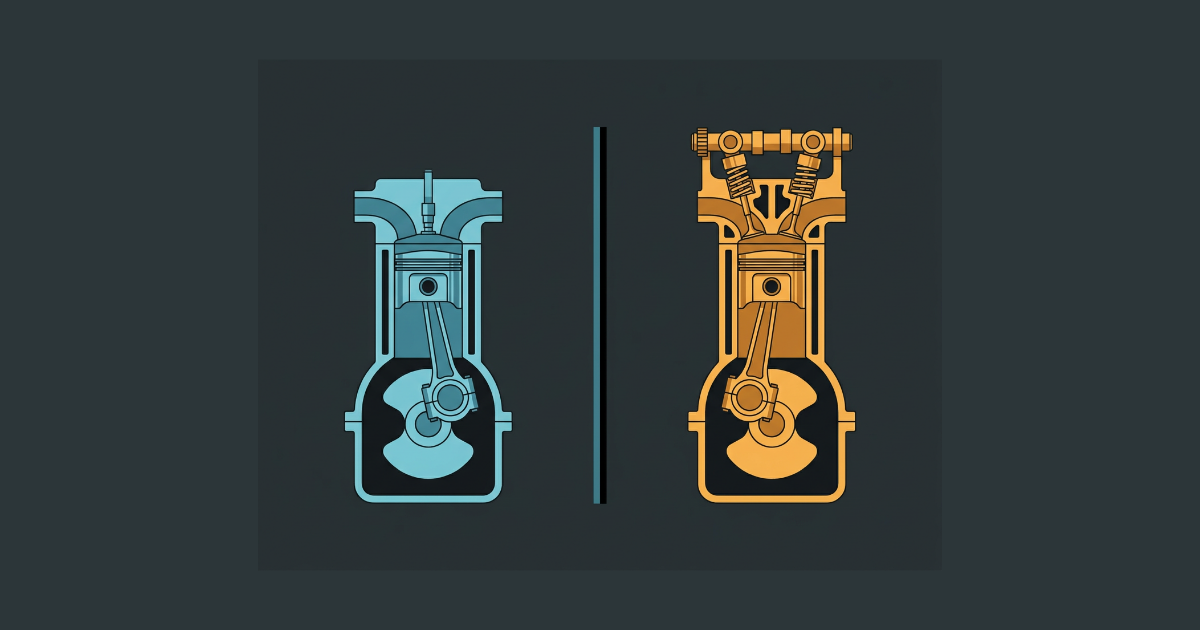
A two-stroke engine fires once every crank revolution. A four-stroke fires once every two revolutions — half as often, from an identical cylinder. The textbook shorthand is that a two-stroke should therefore make roughly twice the power. It is close, but never exact, and the gap between "roughly" and "exactly" is where the entire mechanism actually lives.
Most explanations stop at "it loses some charge out the exhaust port." That is true, but it is not the whole story, and it is not even the most interesting part of it. This is a controlled measurement — one cylinder, one variable flipped — with the real number the shortfall comes from.
Key Takeaways
- Flipping one preset from two-stroke to four-stroke, with bore, stroke, compression ratio and everything else held identical, measured a power ratio of 2.35x on a 249 cc single, 2.19x on a 748 cc triple, and 1.89x on a 6,974 cc diesel six — never the naive 2.0x, and never in the same direction of error.
- The reason is not primarily lost charge. Measured brake mean effective pressure — the actual work done per cycle per unit of swept volume — comes out within 0.7% between the two-stroke and four-stroke versions of the 249 cc cylinder. The two-stroke's cylinder is not doing more work per stroke. It is just doing it twice as often.
- A two-stroke's real compression only starts once the exhaust port closes, so its trapped compression ratio is far below the number on a spec sheet — measured at 6.97:1 on a cylinder whose geometric ratio is quoted as 10.6:1.
- Loop-scavenged premix two-strokes measured 22–31% higher fuel consumption per unit of work than the identical four-stroke cylinder — real thirst, real unburned fuel out the pipe. A uniflow diesel two-stroke measured no such penalty, because it injects fuel after the ports close.
- Port timing is the powerband: sweeping exhaust-port opening angle on the 249 cc single moved peak-torque rpm by over 800 rpm, and trapped compression ratio moved monotonically from 5.62:1 to 9.28:1 across the same sweep.
On this page: Quick answer · The difference · The controlled test · Why the two-stroke falls short of 2x · Trapped vs geometric compression · The fuel cost · The uniflow diesel exception · Port timing is the powerband · Why two-strokes largely disappeared · Try it in the simulator · FAQ · How these numbers were made
Quick Answer: Two-Stroke vs Four-Stroke?
A two-stroke completes intake, compression, power and exhaust in one crank revolution; a four-stroke needs two. At equal displacement, a two-stroke fires twice as often and should — in the simplest telling — make roughly double the power. Measured here across three real presets, the actual ratio ranged from 1.89x to 2.35x, and the shortfall is dominated by a short, port-gated compression stroke rather than by lost charge alone. The two-stroke's quality of work per cycle — measured directly as brake mean effective pressure — is nearly identical to the four-stroke's. It just gets to do that work twice as often.
The Difference Between a Two-Stroke and a Four-Stroke Engine
The difference between a two-stroke and a four-stroke engine is how many crank revolutions one combustion cycle takes, and everything else follows from that. A four-stroke spends one full revolution pumping: the piston draws in charge on the way down and pushes exhaust out on the way up, through poppet valves a camshaft opens and closes. A two-stroke has no pumping revolution. Ports cut into the cylinder wall open when the piston is near the bottom of its stroke, the fresh charge pushes the burnt gas out through them, and the engine fires again on the very next stroke.
Four things differ as a result:
| Two-stroke | Four-stroke | |
|---|---|---|
| Fires every | 1 revolution | 2 revolutions |
| Gas exchange | Ports in the cylinder wall, opened by the piston | Poppet valves, opened by a camshaft |
| Fresh charge moved by | Crankcase (loop-scavenged) or a blower (uniflow) | The piston's own intake stroke |
| Lubrication | Oil mixed into the fuel, on a crankcase-scavenged engine | A separate wet sump |
The rest of this article measures what each of those costs and pays: the first row is why a two-stroke should make twice the power, the second is why it does not quite, the third is why a premix two-stroke burns more fuel, and the fourth is why it smokes.
The Controlled Test: One Cylinder, Two Cycles
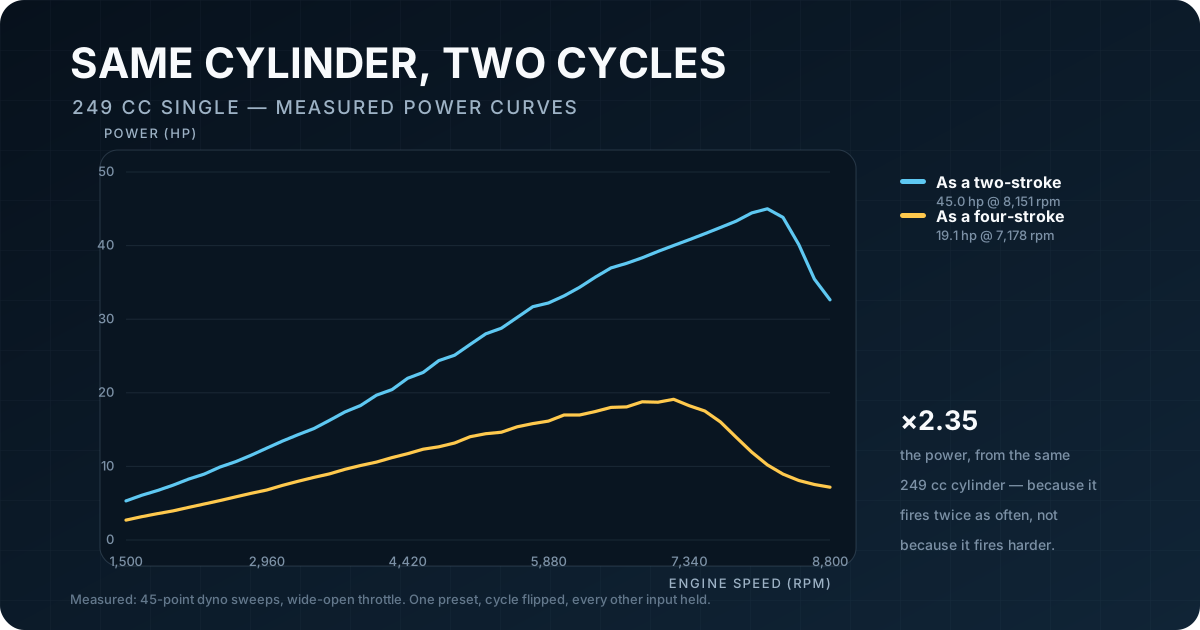
The fairest way to isolate the cycle from everything else an engine's spec sheet varies — bore, stroke, cylinder count, compression ratio — is to take one real preset and flip exactly one field: cycle: "2S" to "4S". Nothing else in the configuration changes. Every number below is a simulator measurement from 45-point wide-open-throttle sweeps, not a published specification for any real engine.
| 249 cc single | 748 cc triple | 6,974 cc diesel six | |
|---|---|---|---|
| Two-stroke, peak power | 45.0 hp @ 8,151 | 36.6 hp @ 3,907 | 229.6 hp @ 2,100 |
| Four-stroke, peak power | 19.1 hp @ 7,178 | 16.7 hp @ 3,907 | 121.3 hp @ 2,066 |
| Power ratio | ×2.35 | ×2.19 | ×1.89 |
None of the three lands on the naive 2.0x, and they do not even agree on which side of it they fall. The single beats 2x; the diesel six falls well short of it. Something other than "twice the firing frequency" is deciding the outcome, and it decides differently on different engines.
Why the Two-Stroke Falls Short of 2x
The usual explanation — unburned charge lost out the exhaust port before it closes — is real (see below), but it is not the dominant term here. The dominant term is measurable directly: brake mean effective pressure, the actual work each cylinder delivers per unit of swept volume per cycle, using each cycle's own correct divisor (T·2π/Vd for a two-stroke that fires every revolution, T·4π/Vd for a four-stroke that fires every other one).
| 249 cc single | 748 cc triple | 6,974 cc diesel six | |
|---|---|---|---|
| BMEP, two-stroke | 10.16 bar | 5.70 bar | 8.07 bar |
| BMEP, four-stroke | 10.09 bar | 5.24 bar | 8.53 bar |
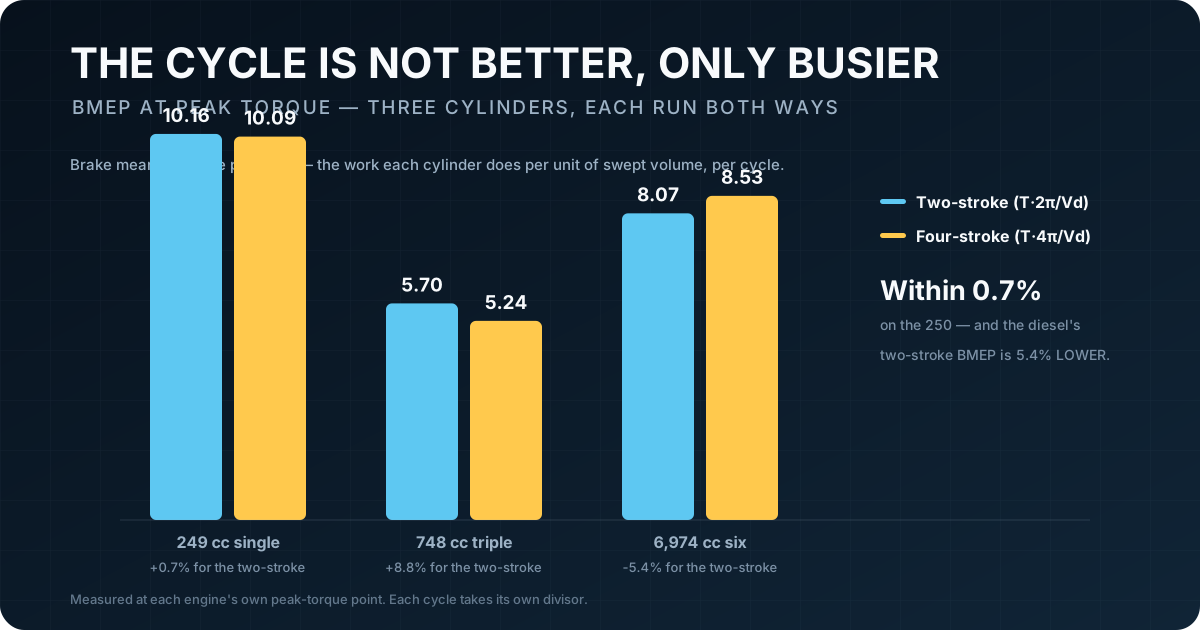
On the single, BMEP is within 0.7% between the two cycles — the cylinder is doing essentially the same quality of work either way. On the diesel six, the two-stroke's BMEP is actually 5.4% lower than the four-stroke's, and it still makes 89% more power, purely by getting twice as many cycles per unit time.
This reframes the whole question. A two-stroke is not a four-stroke that does more work per stroke. It is very close to a four-stroke that does the same work per stroke, twice as often. The reason the ratio falls short of exactly 2x, then, is not primarily charge loss — it is that "twice as often" assumes the two-stroke's compression and power strokes are as effective as the four-stroke's, and they are not quite, because of what happens to the compression stroke.
Trapped vs Geometric Compression Ratio
A four-stroke's compression stroke runs the full distance from bottom dead centre to top dead centre, with the valves shut the whole way. A two-stroke's cannot: the exhaust port stays open for a chunk of the stroke near bottom dead centre, so real compression only begins once that port closes. The geometric compression ratio printed on a spec sheet — swept volume plus clearance volume, divided by clearance volume — describes the full-stroke ratio a four-stroke actually uses. It significantly overstates what a two-stroke's charge experiences.
Measured on the three presets:
| Geometric CR | Trapped CR | Exhaust port opens | |
|---|---|---|---|
| 249 cc single | 10.60:1 | 6.97:1 | 96° after TDC |
| 748 cc triple | 7.30:1 | 5.91:1 | 116° after TDC |
| 6,974 cc diesel six | 18.70:1 | 14.88:1 | 118° after TDC |
The single's spec-sheet 10.6:1 is doing real compression work over only 6.97:1 worth of stroke. That gap — not fuel loss — is most of why the two-stroke's BMEP is not simply higher than the four-stroke's: it has less effective compression stroke to build cylinder pressure over.
The Fuel Cost of a Premix Two-Stroke
The classic two-stroke penalty is real, it is just a separate effect from the power ratio above. A crankcase-scavenged engine draws its intake charge — fuel already mixed in — through the crankcase and up through transfer ports into the cylinder. Whatever charge does not get trapped before the exhaust port closes goes straight out the pipe, fuel included.
Held at a fixed rpm, wide-open throttle, metered fuel:
| Power | Fuel consumed | BSFC | |
|---|---|---|---|
| 249 cc, two-stroke @ 6,000 rpm | 24.8 kW | 11.93 L/h | 359 g/kWh |
| 249 cc, four-stroke @ 6,000 rpm | 12.3 kW | 4.51 L/h | 273 g/kWh |
| 748 cc, two-stroke @ 4,000 rpm | 27.0 kW | 15.24 L/h | 420 g/kWh |
| 748 cc, four-stroke @ 4,000 rpm | 12.4 kW | 5.73 L/h | 344 g/kWh |
The two-stroke versions burn 31% and 22% more fuel per unit of work than the identical cylinder as a four-stroke. That is the real cost the "smoky two-stroke" reputation is about, and it is a genuinely separate number from the power ratio above — a two-stroke can be nearly as efficient per stroke (the BMEP result) while still being thirstier per unit of work delivered, because a meaningful fraction of every intake charge never gets the chance to burn at all.
The Uniflow Diesel Exception
Not every two-stroke pays that fuel penalty, and the reason is a genuinely different architecture. A uniflow two-stroke — the layout large marine and locomotive two-stroke diesels use, exhaust valves at the top of the cylinder, intake ports low down fed by a mechanical blower — injects its fuel after the ports have closed. Whatever charge short-circuits straight through during scavenging is plain air, not a fuel-air mixture. The blower spends real work moving that excess air, but none of it was ever going to burn.
Measured on the diesel six at 1,800 rpm, wide-open throttle:
| Power | Fuel consumed | BSFC | |
|---|---|---|---|
| 6,974 cc, uniflow two-stroke @ 1,800 rpm | 163.4 kW | 53.49 L/h | 275 g/kWh |
That figure sits in ordinary four-stroke diesel territory, not the elevated numbers the premix two-strokes above show. It is the mechanical reason the largest, most efficient piston engines ever built — giant uniflow marine two-stroke diesels, documented at 50–52.5% thermal efficiency — are two-strokes rather than four-strokes: at that scale the twice-as-many-power-strokes advantage comes essentially for free, because there is no premixed fuel to lose out the port.
Port Timing Is the Powerband
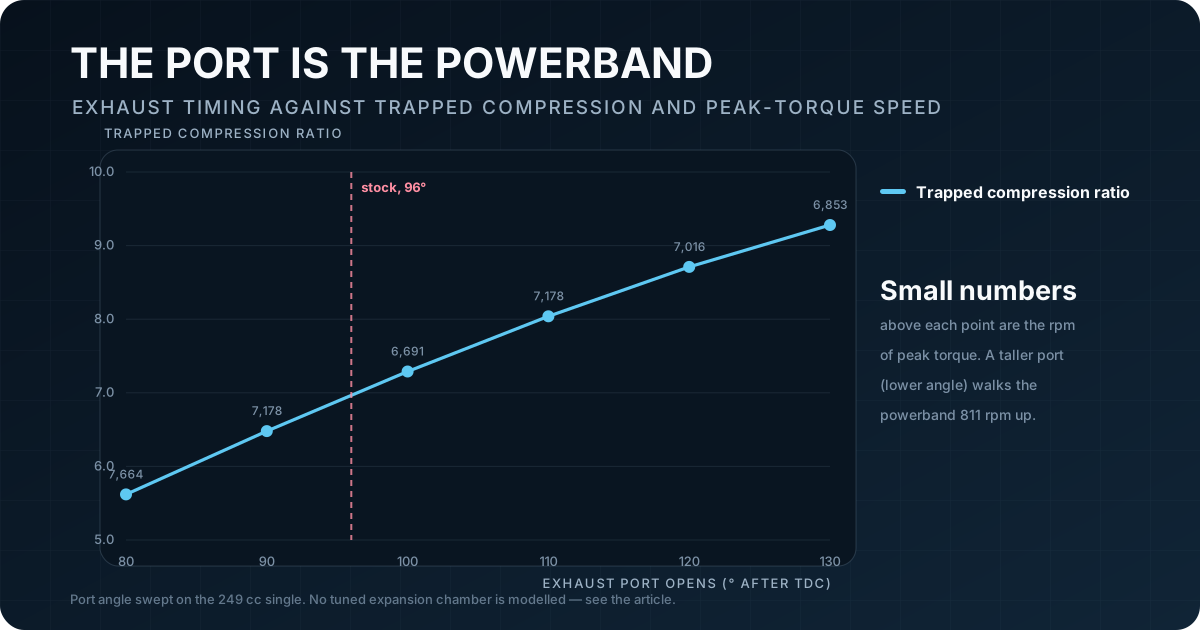
The angle at which the exhaust port opens is arguably the single most consequential number on a two-stroke's spec sheet, and it is directly editable in the simulator's build tools. A low angle after top dead centre is a tall, early-opening "race" port: blowdown starts sooner, the trapped compression stroke is short. A high angle is a mild, late-opening port: a longer trapped stroke, more low-end torque, less top-end.
| Port opens (° ATDC) | Trapped CR | Peak power | Peak torque, and where |
|---|---|---|---|
| 80 | 5.62 | 40.2 hp | 36.8 N·m @ 7,664 rpm |
| 100 | 7.29 | 45.6 hp | 41.1 N·m @ 6,691 rpm |
| 130 | 9.28 | 48.2 hp | 43.4 N·m @ 6,853 rpm |
Trapped compression ratio rises monotonically and predictably across the sweep. The rpm of peak torque moves too, walking the powerband up or down the range as port timing changes. That is the actual physical lever a two-stroke tuner pulls when they talk about "porting."
One honest limitation. This simulator does not model a tuned expansion chamber — the resonant exhaust pipe that a real racing two-stroke uses to reflect an escaping charge back into the cylinder before the port closes. Real two-stroke tuning trades a tall port's early blowdown against exactly that returned charge; without a pipe model, this sweep can only show the trapped-CR side of that trade, not the recovery a real pipe provides. The powerband-shifting result above is real and reproducible; the absolute power numbers at the tallest port angles likely understate what a properly piped engine would recover.
Why Two-Strokes Largely Disappeared from Roads
If a two-stroke can genuinely out-produce an equal-displacement four-stroke, why do so few road vehicles use one? Two separate reasons, both visible in the measurements above:
- Emissions. A premix loop-scavenged two-stroke's short-circuited fuel goes straight out the tailpipe, unburned, and US federal regulation now controls exhaust and evaporative emissions from these small nonroad spark-ignition engines directly, with a second phase of standards estimated to cut combined hydrocarbon and NOx emissions from handheld two-stroke equipment by roughly 70% against the earlier Phase 1 rule.
- Part-throttle behaviour. A crankcase-scavenged engine's throttle typically sits ahead of the crankcase. Closing it starves the whole scavenging process, rather than simply reducing airflow the way a four-stroke's throttle plate does. That is a large part of why two-strokes are peaky and unpleasant to ride gently — and it is the opposite of the wide-open-throttle condition every number on this page was measured at.
Two-strokes never disappeared from the applications where neither problem bites: motocross and small handheld equipment run wide open or fully off, and large marine diesels solve the fuel problem architecturally with uniflow scavenging and direct injection, exactly as measured above.
Try It in the Simulator
- Open the 250 cc two-stroke single. Run the dyno and note the peak — 45.0 hp at 8,151 rpm.
- There is no four-stroke twin of this exact preset shipped in the roster, but the 499 cc four-stroke single is a close real-world comparison at almost exactly double the displacement: it peaks at 27.8 hp — noticeably less than the smaller two-stroke, at a lower 5,076 rpm.
- In the two-stroke's spec panel, look for the port-timing row and try moving it toward a taller (lower-angle) or milder (higher-angle) setting. Watch the dyno curve's peak-torque rpm shift, matching the sweep above.
- Run the fuel gauge on the two-stroke at a held high rpm and compare the consumption rate against the four-stroke thumper at a comparable load — the two-stroke's is visibly higher, exactly as the BSFC table above shows.
Frequently Asked Questions
Does a two-stroke really make twice the power of a four-stroke?
Not exactly, and not consistently. Measured here by flipping one cylinder between the two cycles with everything else held fixed, the ratio ranged from 1.89x to 2.35x across three different engines — sometimes above the naive 2x, sometimes below it. The dominant reason is not lost fuel; it is that the two-stroke's compression stroke is shortened by the open exhaust port, which this article measures directly as trapped compression ratio.
Why do two-stroke engines smoke and smell different from four-strokes?
A crankcase-scavenged two-stroke needs its lubricating oil mixed directly into the fuel, since there is no separate oil sump feeding the crankcase the way a four-stroke has — the crankcase itself is doing intake duty. That oil burns (or partially burns) along with the fuel-air charge, and some of it, along with unburned fuel, exits straight out the exhaust port during the overlap period before it closes. That is both the visible smoke and the characteristic smell.
Is a two-stroke diesel more efficient than a two-stroke petrol engine?
Measured here, yes, and by a wide margin — 275 g/kWh for the uniflow diesel six against 359–420 g/kWh for the two premix petrol engines. The mechanism is architectural, not incidental: the uniflow diesel injects fuel after the ports close, so whatever short-circuits during scavenging is plain air. A premix petrol two-stroke has no equivalent — its fuel is already in the charge before the ports ever open.
What does "trapped compression ratio" mean and why does it matter?
It is the compression ratio a two-stroke's charge actually experiences, measured from the moment the exhaust port closes rather than from bottom dead centre. Because a two-stroke's exhaust port stays open for part of the stroke near bottom dead centre, its real compression starts partway up, not at the bottom — so the geometric ratio printed on a spec sheet (which assumes full-stroke compression, the way a four-stroke actually works) significantly overstates it. Measured here at 6.97:1 trapped against a 10.60:1 geometric figure on the same cylinder.
Why did two-stroke engines mostly disappear from motorcycles and cars?
Two compounding reasons measured or described on this page: unburned premixed fuel short-circuiting out the exhaust port made emissions compliance very difficult, and a two-stroke's part-throttle behaviour is poor because the throttle typically sits ahead of the crankcase, starving the entire scavenging process rather than simply reducing airflow. Applications that run at a fixed high throttle (motocross, handheld tools) or that solve the fuel problem architecturally (large marine uniflow diesels) kept the format.
How These Numbers Were Made
- Physical principles hold on real hardware: firing frequency, the port-gated compression stroke, the crankcase-scavenging fuel-loss mechanism, and the uniflow diesel's fuel-after-port-closure architecture.
- The measured figures — the power ratios, the BMEP comparison, the trapped compression ratios, the BSFC figures, the port-timing sweep — are this simulator's output for the three named presets, measured identically across every comparison. They are not manufacturer specifications.
- A known limitation applies to the absolute BSFC figures. This simulator's petrol fuel consumption reads roughly 10–25% optimistic and its diesel consumption roughly 30–40% pessimistic against real engines, a documented calibration gap. The ratios between two cases measured identically — two-stroke against four-stroke on the same cylinder — are the reliable part of this article; the absolute grams-per-kilowatt-hour figures are simulator calibration, not claims about real engines.
- Method: 45-point wide-open-throttle dyno sweeps, each point settled before sampling. Fuel consumption measured with rpm held fixed under load — a free-revving engine at redline sits on its rev limiter with fuel cut, which would understate consumption.
Sources and Further Reading
- Two-Strokes Only, Resources & Calculators — the trapped/geometric compression-ratio distinction: "Because the exhaust port is open during the initial part of the upward stroke, no compression occurs until the piston closes the port crown," and port timing's role in setting the powerband
- Crankcase scavenged two-stroke engines, US Patent RE39,506 — the short-circuit mechanism: fresh fuel-air charge follows the exhaust stream out of the cylinder during scavenging, the cause of a carburetted two-stroke's characteristic fuel and hydrocarbon loss
- MAN Energy Solutions, MAN B&W Two-Stroke Engines — manufacturer documentation of uniflow two-stroke marine diesel thermal efficiency in the 50–52.5% range, among the highest of any combustion engine built
- 40 CFR Part 1054, Control of Emissions from New, Small Nonroad Spark-Ignition Engines and Equipment — the US federal regulation governing small two-stroke engine emissions
- EPA, Final Rule for Phase 2 Emission Standards for New Nonroad Spark-Ignition Nonhandheld Engines — the regulatory pressure that pushed carburetted two-strokes out of handheld and lawn equipment
- Cycle World, "Tuned Exhaust For the Two-Stroke," November 1964 — the expansion chamber's operating principle: reflected pressure waves push escaping charge back into the cylinder before the port closes, and chamber length is tuned to the target rpm's exhaust pulse frequency, not to displacement
Related Reading
- How a four-stroke engine works — the cycle every comparison on this page is measured against
- What is engine knock, and what actually causes it — the same combustion model both cycles here share
- How a turbocharger works — forced induction is available on either cycle in the simulator, including a uniflow two-stroke diesel
- Eight engine experiments for the classroom — the same fires-per-revolution comparison as a reproducible lab exercise, alongside seven others
- Browse every engine in the simulator — filter by cycle to see every two-stroke and four-stroke preset side by side