How Does VTEC Work? Variable Valve Timing on the Dyno
How VTEC works: two cam profiles, a hydraulic pin, and a switch at the rpm where the two torque curves cross. Measured on a 2.0 L four, and how VVT-i differs.
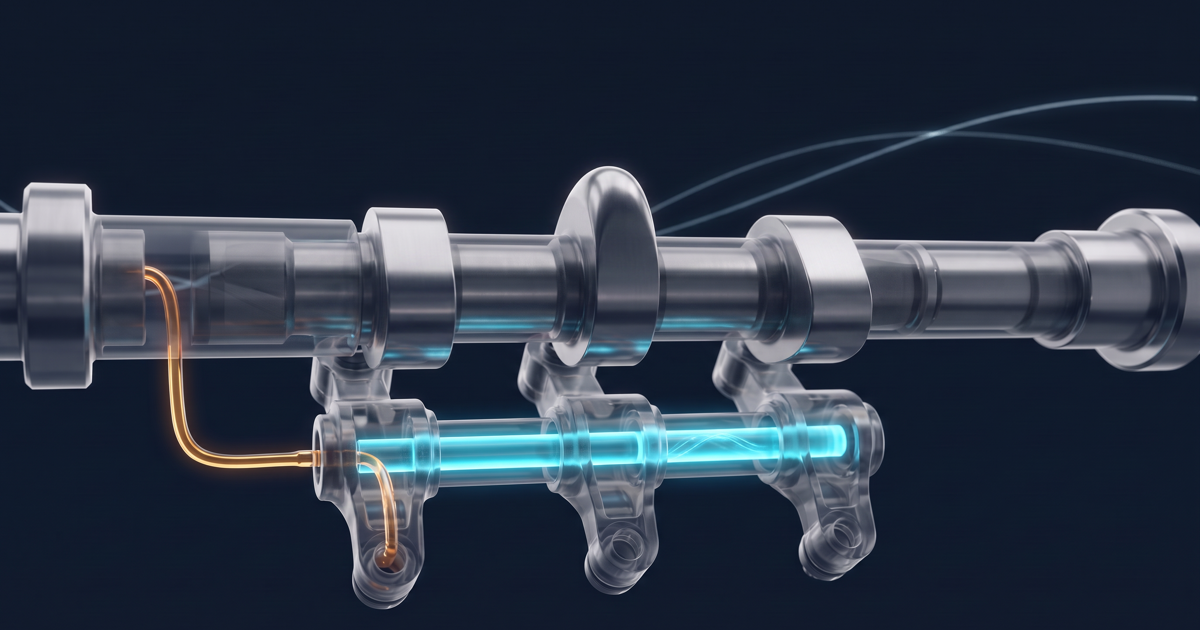
A camshaft has to suit both ends of the rev range. A short, low-lift cam fills the cylinders well at low rpm and runs out of breath near redline. A long, high-lift cam breathes at 7,000 rpm and gives up torque and idle quality at 1,500. In 1989 Honda put both on one camshaft and switched between them with oil pressure. They called it VTEC. Put the switch point in the right place and the engine gets the low cam's torque below it and the high cam's power above it, with no step in between.
We built that engine in our simulator and ran it on the dyno three ways: low cam only, high cam only, and both with a switch. The two-cam 2.0 L four is one link away, and the measured curves are below.
Key Takeaways
- VTEC stands for Variable Valve Timing and Lift Electronic Control. Early versions carry three cam lobes per pair of valves: two mild outer lobes for low rpm and a wilder centre lobe for high rpm. At low rpm the three rocker arms move separately. Above the switch point, the engine computer sends oil pressure to a pin that locks them together, and the centre lobe drives both valves.
- The first production VTEC engine was the 1.6 L B16A in the 1989 Integra, at 160 PS and 7,600 rpm. Honda's own figure is 100 PS per litre. Honda puts its switch "around the 4,800–5,200 rpm range".
- The right switch point is where the low-cam and high-cam torque curves cross. In our measurement on a 2.0 L four they cross at 4,005 rpm, the model switches at 4,020, and the switched engine stays within 0.45 N·m of whichever single cam is stronger at every one of 61 dyno points.
- Peak power goes from 99.6 hp on the low cam alone to 141.4 hp with the switch. The high cam alone makes the same peak but gives up 13% of the torque below 4,000 rpm. The switch keeps both halves.
- VVT-i, VANOS and most "variable valve timing" systems shift the cam's timing without changing its lift or duration. VTEC changes the profile itself. Honda's i-VTEC does both.
On this page: Quick answer · What VTEC stands for · Why one cam is a compromise · Where VTEC switches · The dyno test · Is there a VTEC kick? · VTEC vs VVT · Try it · FAQ · How these numbers were made
Quick Answer: How Does VTEC Work
VTEC gives each pair of valves two cam profiles and lets the engine choose between them. In Honda's original design the camshaft has three lobes per pair of intake valves. The two outer lobes are mild, with short duration and low lift, and each drives one valve through its own rocker arm. The centre lobe is aggressive, with long duration and high lift, and its rocker arm sits between the other two and, while it is unlocked, moves on its own without opening anything.
At low and middle rpm a hydraulic pin inside the rockers is pulled back by a return spring, the three rockers are separate, and the valves follow the mild lobes. When the engine reaches the switch point, the engine computer opens a spool valve, oil pressure pushes the pin through all three rocker arms, and they move as one. The centre arm always follows the tallest lobe, so now both valves open further and stay open longer. Below the switch point the pin retracts and the mild lobes take back over.
That gives the engine two personalities on one camshaft. The mild profile idles smoothly and fills the cylinders well at low speed, where the gas is slow and a long valve opening would let charge leak back out. The aggressive profile keeps the valves open long enough to fill the cylinders at high speed, where the gas has momentum and needs more time.
What Does VTEC Stand For
VTEC is Honda's abbreviation for Variable Valve Timing and Lift Electronic Control. Honda's history page for the B16A describes it as a system that "switches between different intake and exhaust valve open/close timing and lift profiles for the low- to mid-rpm range and the high-rpm range". The three words in the name are the three things it changes: timing (when the valve opens and closes), lift (how far it opens), and the electronic control that decides when.
The first production car to carry it was the Integra XSi, announced in Japan on 19 April 1989, with the B16A: a 1.6 L DOHC four making 160 PS at 7,600 rpm and 15.5 kg·m at 7,000 rpm, which Honda presents as 100 PS per litre. The CR-X and Civic got the same engine that September. Honda's US press office lists it at 160 horsepower at 7,600 rpm and 111 lb-ft at 7,000.
The B16A switched both the intake and the exhaust profiles. In the 2000s Honda paired VTEC with continuous cam phasing and sold the combination as i-VTEC. Each version keeps the same three parts: two profiles, a pin, and a switch.
Why One Camshaft Cannot Do Both Jobs
A camshaft sets three things for each valve: how long it is open (duration, in crank degrees), how far it opens (lift), and when the opening happens relative to the piston. On a fixed cam all three are a single choice made at the factory for every rpm the engine will ever see.
The trouble is that the air in the intake does not behave the same way at every rpm. At 1,500 rpm the charge moves slowly. If the intake valve stays open long after the piston starts coming back up, the piston pushes some of the fresh charge back into the manifold before the valve closes. At 7,000 rpm the charge is moving fast enough that it keeps flowing into the cylinder after bottom dead centre, and closing the valve early would cut that off. A long cam is right for the second case and wrong for the first. A short cam is the reverse.
Honda's own summary of the problem, in its VTEC technology overview: "Traditionally, high-revving four-valve-per-cylinder engines sacrificed low-rpm torque to produce high-revving horsepower." Honda's engineers wrote in their 1991 SAE paper on the NSX engine that switching both timing and lift improved "maximum output at high rpm, and also improved the low rpm range, such as idling stability and starting capability." Overlap makes the single-cam problem worse. A long cam holds the intake and exhaust valves open together for longer around top dead centre, which lowers manifold vacuum and gives the lopey idle that hot-rodders like to hear and daily drivers do not.
The Otto cycle puts a ceiling on what each cylinder-full of air can do. The cam decides how full the cylinder gets, so at any rpm it sets how close the engine comes to that ceiling.
At What RPM Does VTEC Kick In
It depends on the engine, and Honda moved it with every generation. The published switch points from Honda's own press material:
| Engine | Switch point | Source |
|---|---|---|
| B16A, 1989 Integra / CR-X / Civic | about 4,800–5,200 rpm | Honda global |
| 1992 Civic Si / EX | about 5,000 rpm | Honda US |
| 1993 Prelude | 4,800 rpm | Honda US |
| Integra GS-R | 4,400 rpm | Acura |
| Integra Type R | 5,700 rpm | Acura |
| 2006 Civic Si (K20 i-VTEC) | 5,800 rpm | Honda US |
The Integra pair is the clearest lesson. The Type R's high cam has 0.9 mm more intake lift and 10° more intake duration than the GS-R's, by Acura's own figures, and its switch point is 1,300 rpm higher. A wilder high cam stays weaker than the low cam up to a higher rpm, so the point where it overtakes moves up, and Honda's switch point moved with it.
Hondata, the Honda tuning firm, states the rule in one sentence: "The VTEC crossover point is determined by overlaying the low and high cam torque curves." Switch where the two curves cross. Switch earlier and the engine runs the high cam where it is still weaker. Switch later and it holds onto the low cam after the low cam has started to fade. Either way there is a dip, and you feel it as a step.
VTEC on the Dyno: Low Cam, High Cam, and the Switch
To see the crossover we took the simulator's 2.0 L inline-four and gave it a mild low cam: 240° of intake duration and 8.3 mm of lift. Then we fitted the second profile with the simulator's VTEC-style switch, left at its defaults: 288° and 12.9 mm. That low cam is milder than the preset's stock 260° cam, which makes 116.4 hp; we chose it so the two profiles sit far enough apart to see. We ran three wide-open dyno sweeps from 1,000 rpm to the 7,200 redline, 61 points each: the low cam alone, the high cam alone, and the two with the switch. The switch rpm was left for the model to place, and the model puts it where the two cams' breathing curves cross: 4,020 rpm.
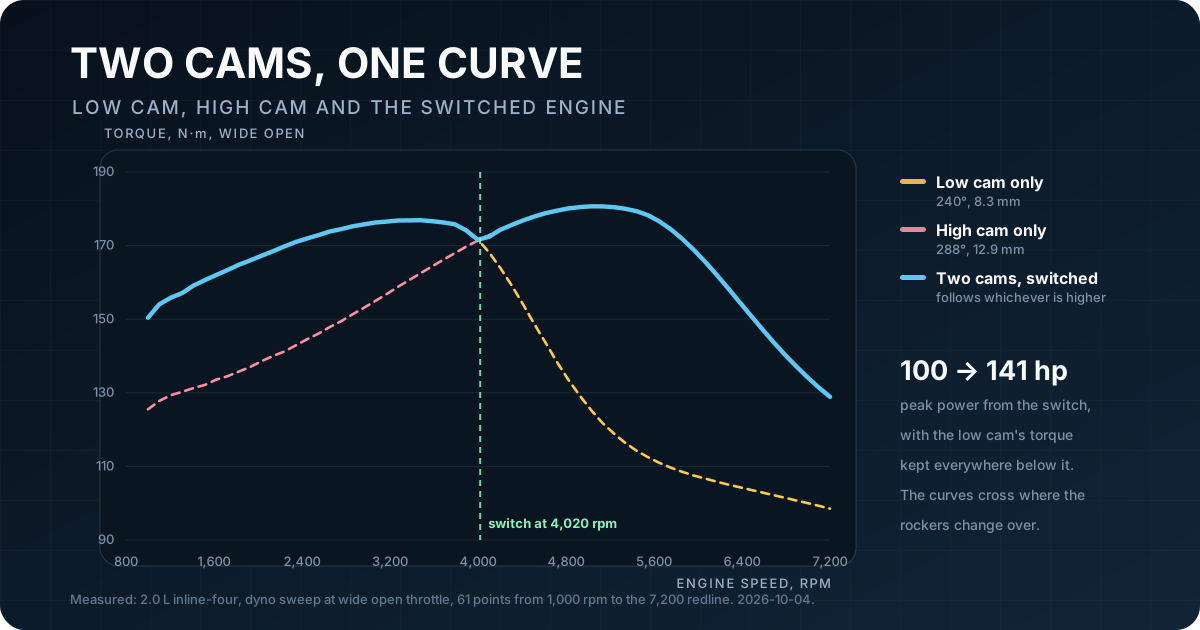
The two single-cam curves cross at 4,005 rpm and 171.4 N·m. Below that the low cam is stronger: at 1,000 rpm it makes 150.4 N·m against the high cam's 125.5, about 20% more. Above it the high cam is stronger, and the gap grows fast. At 5,030 rpm the high cam makes 180.7 N·m, its peak, while the low cam has fallen to 125.2. At the 7,200 rpm redline it is 128.9 against 98.5.
The switched engine rides the top of both. At every one of the 61 points its torque is within 0.45 N·m of whichever single cam is higher there, and the largest gap sits inside the 300 rpm band where the model blends the two profiles.
| Setup | Peak power | Peak torque | Mean torque 1,000–4,000 rpm | Mean torque 4,000–7,200 rpm |
|---|---|---|---|---|
| Low cam only (240°, 8.3 mm) | 99.6 hp at 7,200 | 176.9 N·m at 3,480 | 169.3 N·m | 119.4 N·m |
| High cam only (288°, 12.9 mm) | 141.4 hp at 5,960 | 180.7 N·m at 5,030 | 146.8 N·m | 165.8 N·m |
| Both, switched at 4,020 rpm | 141.4 hp at 5,960 | 180.7 N·m at 5,030 | 169.3 N·m | 165.7 N·m |
The low cam's power figure needs a note. Its torque falls so fast above 4,000 rpm that its power curve goes almost flat and the highest reading lands on the redline, so the low cam's power curve has a plateau where a peak would be.
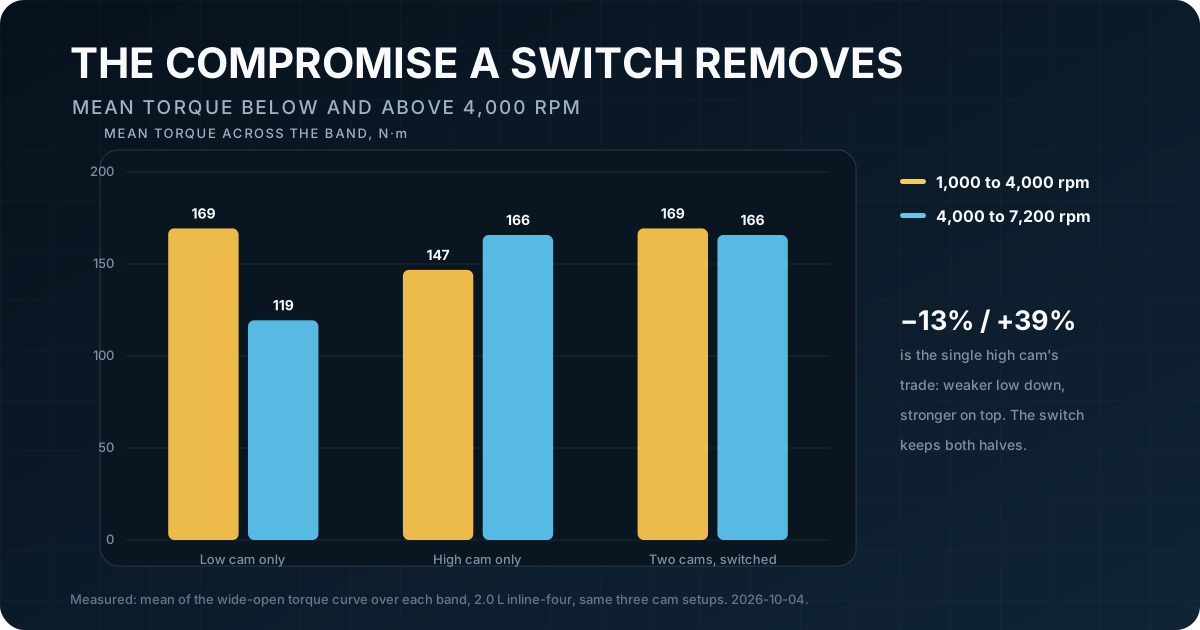
The bar chart is the compromise in two numbers. Choosing the high cam alone trades 13% of the low-rpm torque for 39% more at high rpm. In the model that is the trade a single big cam forces, and it matches the reputation race cams have for feeling flat pulling away from a junction. The switched engine pays neither cost: its low half matches the low cam and its high half matches the high cam to within a tenth of a newton-metre. Averaged over the whole rev range, its power is 24% above the low cam's and 4% above the high cam's.
Against a single big cam on a full-throttle sweep, 4% is the size of the gain. Below the switch point the big cam alone would leave this engine 13% short, and that is the part of the rev range a road car uses most.
Is There Really a VTEC Kick
Honda's own curves say the torque does not jump. In the press factbook for the 1995 Integra Type R, Honda's torque-characteristic figure puts the VTEC changeover at 5,700 rpm, exactly where the low-cam and high-cam curves intersect, and the published power curve shows no step there. What changes is the slope: on our reading of that curve, the torque rises fastest just after the switch and climbs about 8% from the switch to the peak at 7,500 rpm. Honda also designed the sound around the moment. The 2006 Civic Si's intake has "a specially tuned resonance chamber designed to emphasize the VTEC switch point", in Honda's words.
Our measurement agrees on the shape. At the default switch the curve is falling gently at 3,790 rpm (the low cam is past its peak) and rising again by 4,410 (the high cam is climbing to its own), with the same torque on both cams at the crossing. The engine that was starting to fade pulls harder again, for another 3,000 rpm, and the intake note changes with it; the simulator plays that change too. The model's rise after the switch, from 172.4 N·m at 4,100 rpm to the 180.7 N·m peak, is about 5% against the factbook's 8%, and the method section explains why the model understates it.
A badly placed switch does make a kick, and a hole before it. We moved the switch by hand and ran the dyno again. Switched early, at 3,000 rpm, the high cam takes over while it is still the weaker of the two, and torque sags by up to 19.6 N·m (11%) around 3,200 rpm. Switched late, at 5,000 rpm, the engine stays on the fading low cam for 1,000 rpm too long: torque falls 26% below the correctly switched curve at 4,820 rpm, then jumps 22% in the next 200 rpm when the high cam arrives. That jump is the kick people describe, and on this engine it is the sign of a switch set too late. Hondata describes one more dip on i-VTEC engines, caused by timing: the cam phaser takes about three tenths of a second to rotate to its high-rpm angle, and the engine makes less than its best power until it gets there.
VTEC vs Variable Valve Timing: VVT-i, VANOS and i-VTEC
"Variable valve timing" covers a few different ideas, and VTEC is one of them.
Cam phasing keeps the same cam profile and turns the whole camshaft relative to the crankshaft. Toyota's VVT-i, introduced in 1995, does this "by continuously changing the open/close timing of the intake valve", across up to 60 crank degrees. BMW's VANOS started on the M50 in 1992 with two positions on the intake cam, and its later double version moves both cams continuously. Phasing moves when the valve opens and closes. The valve still opens the same distance for the same number of degrees.
Profile switching changes the lift and duration themselves, in steps. VTEC does this. BMW's Valvetronic and similar variable-lift systems vary the lift continuously instead, which lets them take over part of the throttle's job.
i-VTEC combines switching and phasing. Honda describes it as "the variable cam lift and duration of VTEC along with Variable Timing Control", in which oil pressure in the cam sprocket advances or retards the intake cam; on the 2006 Civic Si that range is 50°. Profile switching handles the high-rpm breathing, and phasing tunes the overlap for economy and emissions in between.
The economy case is modest and real. The US government's fueleconomy.gov puts the potential efficiency gain of variable valve timing and lift at 3–4%. Our measurement is about full-throttle torque, so it says nothing about part-load economy either way.
Try It in the Simulator
Open the 2.0 L four with both cams and the switch. Start it and press RUN DYNO. The torque curve you get is the switched curve from the chart above, with its change of slope just past 4,000 rpm. Rev it by hand and watch the gauge chip change from LOW CAM to HIGH CAM as it passes the switch point, and listen for the intake note changing with it.
Then compare. The low cam alone runs out of breath above 4,000 rpm. The high cam alone is soft below it. Both are one dyno run each.
To build your own, open the CAMSHAFT group in the spec panel (the spec groups need a free account) on any four-stroke piston engine and press FIT SECOND CAM PROFILE (VTEC-STYLE). Three editable rows appear: high-cam duration, high-cam lift and the switch point. Leave the switch point alone and the simulator places it at the crossing. On the linked engine, set it to 5,000 rpm and run the dyno again to see the hole and the late kick from the measurement above, or to 3,000 for the early sag.
Frequently Asked Questions
What does VTEC stand for?
VTEC stands for Variable Valve Timing and Lift Electronic Control. It is Honda's system for switching each pair of valves between a mild cam profile for low and middle rpm and an aggressive one for high rpm, using an oil-pressure pin that locks the rocker arms together.
How does VTEC work in simple terms?
The camshaft has two kinds of lobe: mild ones for everyday driving and a tall one for high rpm. Below the switch point the valves follow the mild lobes. Above it, oil pressure pushes a pin that locks the rocker arms together, so the valves follow the tall lobe, open further and stay open longer, and the engine breathes like it has a race cam.
At what rpm does VTEC kick in?
It depends on the engine. Honda puts the original B16A's switch around 4,800–5,200 rpm, the Integra GS-R's at 4,400, the Integra Type R's at 5,700 and the 2006 Civic Si's K20 at 5,800. The correct point is where the low-cam and high-cam torque curves cross, so a wilder high cam moves it higher.
Does VTEC add horsepower?
VTEC lets an engine carry a high-rpm cam without paying for it at low rpm. In our measurement, adding the switched high cam to a 2.0 L four raised peak power from 99.6 to 141.4 hp while keeping the low cam's torque below 4,000 rpm. A single big cam would have made the same peak but lost 13% of the low-rpm torque.
What is the difference between VTEC and VVT?
Most VVT systems, such as Toyota's VVT-i and BMW's VANOS, rotate the camshaft to change when the valves open and close but keep the same lift and duration. VTEC switches to a different cam profile with more lift and duration. Honda's i-VTEC combines profile switching with continuous cam phasing.
Is there a VTEC kick?
There is a change of feel, but a correctly placed switch does not make the torque jump. The engine changes over where both cams make the same torque, so on a dyno the curve changes slope: it stops fading and climbs again. A switch placed too early produces a real dip instead, and the change in intake sound adds to the impression of a kick.
Does VTEC save fuel?
Variable valve timing and lift can improve efficiency by about 3–4%, according to the US government's fueleconomy.gov. The performance versions, like the B16A and the Type R engines, are tuned mainly for power.
How These Numbers Were Made
Every simulator figure in this article comes from one headless run of the simulator on 2026-10-04. The engine is the stock 2.0 L inline-four preset with its intake cam set to 240° of duration and 8.3 mm of lift. The second profile was fitted through the same share link the Try It section uses, and the measured engine was built from what that link decodes to, so the article and the link describe one configuration. With the high-cam duration, lift and switch point left at their defaults, the model fits a 288° high cam with 12.9 mm of lift and places the switch at 4,020 rpm. The "high cam only" run uses that same 288° / 12.9 mm profile as the engine's only cam. Each setup ran one dyno sweep at wide-open throttle, 61 points from 1,000 rpm to the 7,200 rpm redline, and two more sweeps forced the switch to 3,000 and 5,000 rpm. A repeat of the switched sweep with knock taken out of the model (fuel octane set to 200) gave identical numbers, so knock plays no part in any curve here.
The model's switch blends the two cams' breathing curves over 300 rpm centred on the switch point, with no hysteresis. A real VTEC engine switches on oil pressure with a load condition and a small hysteresis band. Three limits matter. First, the model caps how much a longer cam can raise the engine's peak breathing, so a high cam's gain at the top is likely understated; the rise from the switch to the peak, about 5% here, is the number most affected. Second, the model's idle barely notices the big cam: manifold pressure at idle moved from 0.18 to 0.21 bar with the 288° cam where a real engine with that much overlap would idle rough. We do not publish an idle comparison for that reason. Third, the simulator changes intake duration and lift only; it has no separate exhaust profile and no cam phasing, so i-VTEC's timing half is outside it.
About this article
Written by the team that builds the simulator and maintains its camshaft and valvetrain model. The switch points, the engine figures and Honda's factbook curves come from Honda's and Acura's own press, history and factbook pages; the VVT-i description is Toyota's; the VANOS and Valvetronic history comes from a BMW enthusiast publication. All are listed below. The torque curves are the simulator's and are labelled as such wherever they appear.
Sources and Further Reading
- Honda Global: B16A, Honda's innovative engine with VTEC (retrieved 2026-10-04)
- Honda press factbook, Integra 1995 (Type R): torque characteristic and performance curve (Japanese, retrieved 2026-10-04)
- Honda News (US): VTEC (retrieved 2026-10-04)
- Acura News: Acura VTEC Technology (retrieved 2026-10-04)
- Acura News: 1998 Acura Integra Type R, Powertrain (retrieved 2026-10-04)
- Honda News (US): 2006 Honda Civic Powertrains (retrieved 2026-10-04)
- SAE 910008: Development of the Variable Valve Timing and Lift (VTEC) Engine for the Honda NSX (retrieved 2026-10-04)
- Toyota: Toyota Develops New VVT-i Engine Technology (1995) (retrieved 2026-10-04)
- The Bimmer Pub via Automotive Tech Info: VANOS variable valve timing (retrieved 2026-10-04)
- Hondata: VTEC Crossover (retrieved 2026-10-04)
- OnAllCylinders: Lift, Duration, LSA and other cam terms (retrieved 2026-10-04)
- fueleconomy.gov: Advanced Engine Technologies (retrieved 2026-10-04)