What Is Engine Braking? We Measured It on Gasoline and Diesel
Engine braking is the drag an engine puts on a car in gear when you lift off. How it works, whether it is bad, and why trucks need Jake brakes, measured.
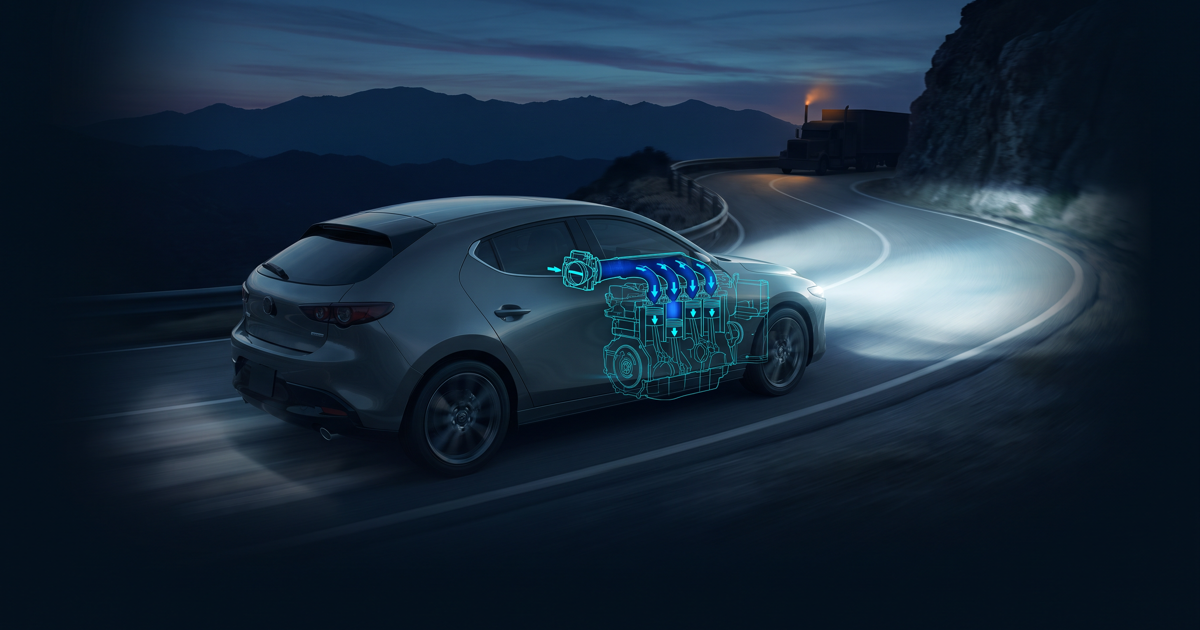
Take your foot off the accelerator in gear and the car slows down before you touch the brake pedal. That drag is engine braking. You feel it most in a low gear on a downhill, and truck drivers live by it on long grades. It comes from two places inside the engine: the pistons pulling against a throttle you have just shut, and the friction of turning the engine over.
We measured both in our simulator, on a 2.0 L gasoline four, a 7.0 L V8 and two turbodiesels, first with the engine held at fixed speeds on the dyno and then in a car and a 30-tonne truck coasting in gear. You can load the 2.0 L four and try it in a minute.
Key Takeaways
- Engine braking is the retarding torque an engine puts on the wheels when you lift off the accelerator in gear. The wheels drive the engine instead of the other way round, and the engine resists.
- In a gasoline engine a large share of it is pumping loss. Shut the throttle and the pistons pull against a near-vacuum in the intake manifold: 0.07 bar absolute in our model's 2.0 L four, deeper than the 0.17 to 0.34 bar a real engine's vacuum gauge implies. In the model the pumping share at 3,000 rpm is 11.5 of 38.2 N·m (30%); the rest is friction.
- Most modern injected engines also cut the fuel on the overrun. In our model, an engine that keeps burning fuel on a shut throttle brakes about a third less: 24.9 N·m against 38.2 at 3,000 rpm with the fuel switched off.
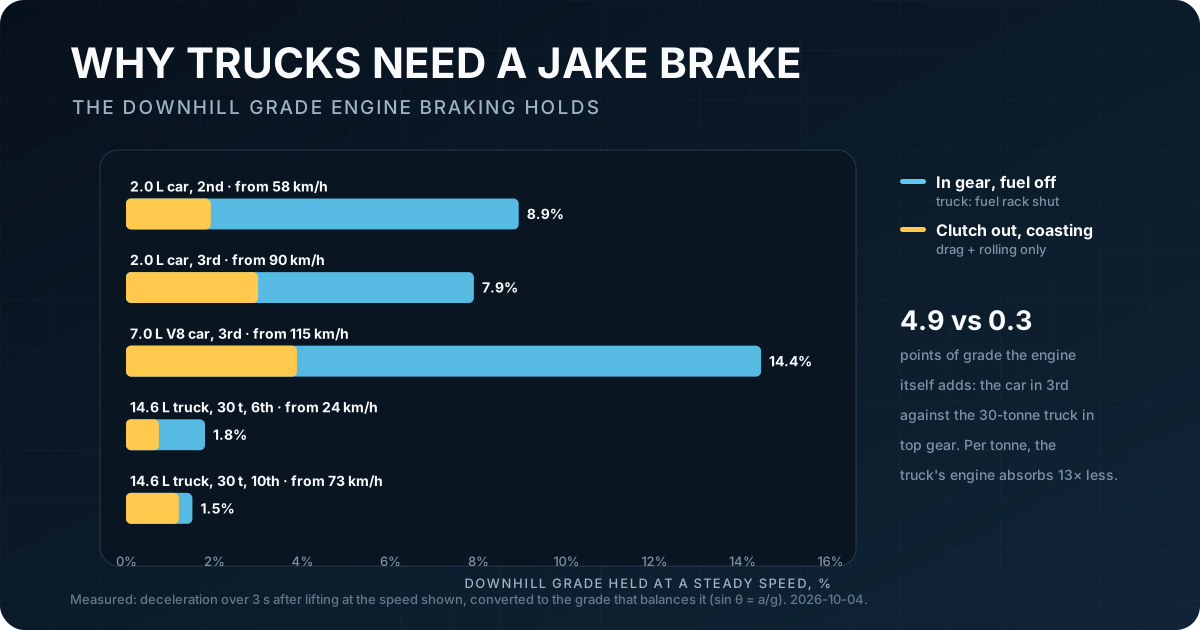
- A lower gear brakes harder. With the fuel off, our model's 2.0 L car slows hard enough in 3rd from 90 km/h to hold a 7.9% downhill grade at steady speed, against 3.0% coasting with the clutch out.
- In our measurement diesels brake in the same per-litre band as gasoline engines: less pumping, as much friction or more. Trucks still need compression-release ("Jake") brakes because of mass: per tonne, our 30-tonne truck's engine absorbs about a thirteenth of what the car's does, and in top gear it adds only 0.3 points of grade over coasting.
On this page: Quick answer · How it works · How strong it is · Does it use fuel? · Is it bad? · Diesels and Jake brakes · Road signs · Automatics, hybrids and EVs · Try it · FAQ · How these numbers were made
Quick Answer: What Is Engine Braking
Engine braking is the slowing force you get when you lift off the accelerator while the car is in gear and the clutch is engaged. The wheels keep turning the engine through the gearbox, but the engine is no longer producing power, so it takes energy out of the car instead. That energy goes into two things: pumping air against the closed throttle, and friction in the pistons, bearings and valvetrain.
It works best in a low gear, because the gearbox multiplies the engine's resistance on the way to the wheels. That is why driving instructors and highway signs tell you to change down before a long descent: the engine carries part of the braking load and the brakes stay cool for when you need them.
How Does Engine Braking Work
A gasoline engine controls its power with a throttle plate, as the four-stroke cycle article shows on the intake stroke. Close the plate and the air supply to the cylinders is choked off, but the pistons keep moving because the wheels are driving them. On every intake stroke each piston pulls against a manifold that holds almost no air. In our model's 2.0 L four the manifold settles at 0.07 bar absolute on the overrun, against about 1.0 bar outside. The piston has to work against that pressure difference on every intake stroke, and that work is the pumping loss.
The second part is friction. Piston rings rub on the bores, the crankshaft turns in its bearings, the camshaft opens valves against their springs. It grows with engine speed, because rings travel further per second the faster the engine turns.
To separate the two we held the 2.0 L four at fixed speeds on the simulator's dyno with the throttle shut, and read the torque it took to turn it. Then we repeated the run with the throttle wide open and the fuel off, which keeps the friction and removes the vacuum. The ignition switch stands in for an overrun fuel cut throughout, because the simulator's engines have none.
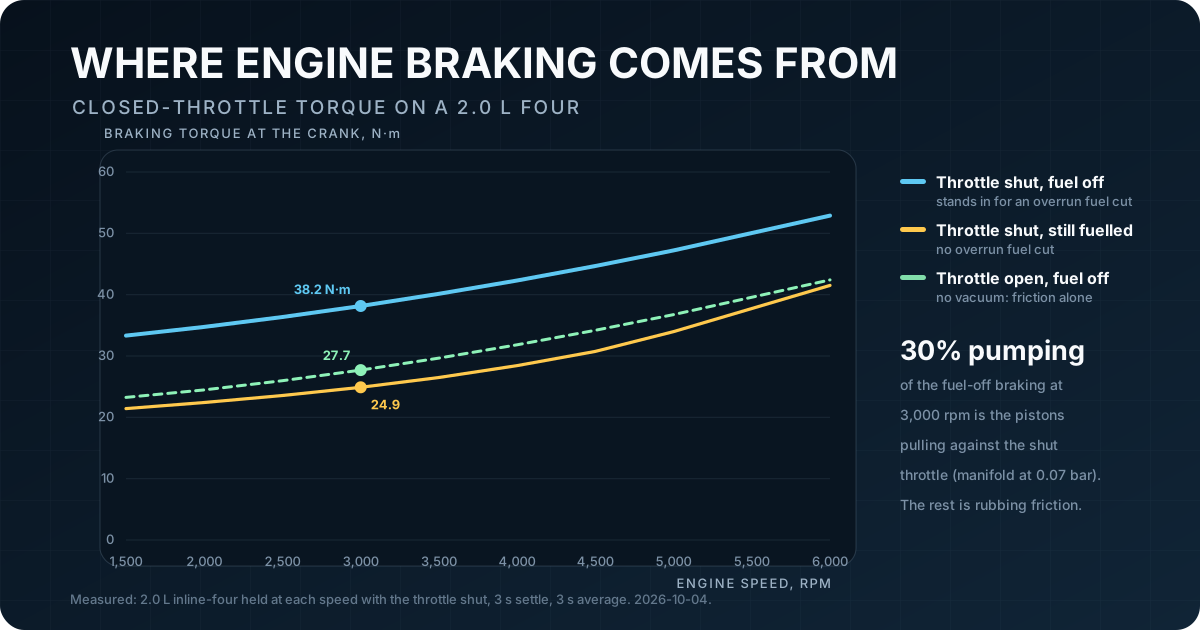
In the model at 3,000 rpm, with the throttle shut and the fuel off, the engine absorbs 38.2 N·m. Of that, 11.5 N·m is pumping, which works out to 0.73 bar of pumping mean effective pressure, and 26.6 N·m is friction. Open the throttle, keep the fuel off, and the total falls to 27.7 N·m. The closed throttle adds 38% to the engine braking of this engine at this speed.
The table compares all four engines with the fuel off at 2,000 rpm, the highest speed the truck engine reaches, with the torque also expressed per litre (as mean effective pressure) so engines of different size compare directly.
| Engine at 2,000 rpm | Braking torque | Friction | Pumping | Pumping share | Total per litre | Friction per litre |
|---|---|---|---|---|---|---|
| 2.0 L gasoline four | 34.8 N·m | 23.2 | 11.5 | 33% | 2.19 bar | 1.46 bar |
| 7.0 L gasoline V8 | 107.7 N·m | 67.2 | 40.6 | 38% | 1.93 bar | 1.20 bar |
| 5.9 L turbodiesel six | 79.3 N·m | 68.8 | 9.7 | 12% | 1.69 bar | 1.47 bar |
| 14.6 L truck turbodiesel | 242.6 N·m | 199.3 | 41.3 | 17% | 2.09 bar | 1.72 bar |
The gasoline engines' pumping share is two to three times the diesels'. Per litre, the totals still land in one band, 1.69 to 2.19 bar, because the diesels' friction is as high or higher. The diesel section below comes back to why.
Real engines agree on the shape and differ on the depth. MOTOR magazine's vacuum-gauge guide says a healthy engine idles at 17 to 21 inches of mercury of vacuum and that a throttle snapped shut from full throttle should read 20 to 25 inches, and that the faster the engine spins against a closed plate, the higher the vacuum goes. Twenty to 25 inches is about 0.17 to 0.34 bar absolute, so our model's 0.07 bar is deeper than a real manifold gets, and its pumping figure reads high; the method section puts a number on that. The direction of the split matches engine research. A 2021 study of mechanical losses in Diagnostyka summarizes earlier work on running engines as pumping making up "15–30% of the total mechanical losses for diesel engines and up to 50% for gasoline engines".
How Strong Is Engine Braking
Torque at the crank tells you what the engine resists. What you feel is how fast the car slows. We put the engines back in their vehicles, accelerated in a chosen gear to between 4,250 and 4,970 rpm (1,550 to 1,640 for the truck), lifted off, and measured the speed lost over the next three seconds. Then we did it again with the clutch pressed in, coasting, so that only air drag and rolling resistance slow the vehicle.
A deceleration is easiest to picture as a hill. If a car slows at 0.77 m/s² on the flat, as the model's 2.0 L did in 3rd, it would hold a steady speed on a downhill steep enough that gravity pulls it forward at exactly that rate. The chart turns each measured deceleration into that grade.
| Vehicle and gear | Speed at the lift | Coasting, clutch out | In gear, fuel off | In gear, still fuelled |
|---|---|---|---|---|
| 2.0 L car, 1,300 kg, 2nd | 58 km/h | 1.9% | 8.9% | 6.3% |
| 2.0 L car, 3rd | 90 km/h | 3.0% | 7.9% | 6.1% |
| 2.0 L car, 4th | 131 km/h | 5.0% | 8.9% | 7.6% |
| 7.0 L V8 car, 1,650 kg, 2nd | 84 km/h | 2.6% | 17.8% | 12.7% |
| 7.0 L V8 car, 3rd | 115 km/h | 3.9% | 14.4% | 10.7% |
| 14.6 L truck, 30,000 kg, 6th | 24 km/h | 0.7% | 1.8% (rack shut) | |
| 14.6 L truck, 10th | 73 km/h | 1.2% | 1.5% (rack shut) |
All figures are the model's. "Fuel off" is the ignition switched off, which stands in for an overrun fuel cut; the truck ran with its fuel rack shut, where the model's governor still adds a little fuel.
The car in 3rd gains almost five points of grade from its engine: 7.9% in gear against 3.0% coasting. The V8 gains more than ten. Change down from 3rd to 2nd and both gain more again: the lifts started at almost the same engine speed, and the lower ratio multiplies the same engine torque into more force at the wheels. At 131 km/h in 4th the car's coasting figure is already 5.0%, because air drag rises with the square of speed and starts doing much of the work on its own.
In top gear the 30-tonne truck holds 1.5% with its engine against 1.2% coasting, so the engine adds 0.3 points of grade, and a 6% mountain descent is twenty times that.
Does Engine Braking Use Fuel
Most modern fuel-injected engines stop injecting while they engine-brake. When you lift off in gear above a set engine speed, the engine computer cuts the injectors, a function called deceleration fuel cut-off. A Volkswagen patent describes it as the normal case: "During a coasting phase, the fuel supply is usually interrupted and the internal combustion engine is not fired." The injectors come back on as the engine slows toward idle, or when you touch the accelerator. Coasting in neutral is the opposite: the engine is disconnected from the wheels and has to burn fuel to keep itself idling.
The fuel cut also makes the engine brake harder. Our simulator's piston engines keep firing on a shut throttle, the way a carbureted engine without a fuel cut-off would, and in that state the 2.0 L four absorbs 24.9 N·m at 3,000 rpm. Switch the fuel off and it absorbs 38.2 N·m, about 50% more. The small amount of combustion the engine still manages at 0.07 bar of manifold pressure pushes back against the braking. In the coast-down the same difference shows up as the gap between the "fuel off" and "still fuelled" columns: 7.9% against 6.1% for the car in 3rd.
Is Engine Braking Bad for Your Engine or Transmission
Not in normal use. For the engine, engine braking is a light load: it is being turned with no combustion pressure on the pistons, and the forces involved are a fraction of what it sees under power. Our model's 2.0 L absorbs 38 N·m on the overrun at 3,000 rpm, and its full-throttle torque peaks near 180 N·m. The clutch, gearbox and driveshafts carry the same torque in the other direction, and they are built for far more. That part is our reasoning from the numbers; we found no manufacturer statement aimed at passenger cars.
What does hurt is a careless downshift. Dropping into a gear that would put the engine over its redline forces the engine to spin faster than it was designed to, and on a manual it can slip or overheat the clutch on the way. The New York commercial driver's manual warns about the automatic-transmission version of this: "Forcing an automatic transmission into a lower gear at high speed could damage the transmission." Change down at a speed where the lower gear keeps the engine below redline and the downshift itself stops being a risk.
What engine braking saves is your brakes. Friction brakes turn the car's energy into heat, and on a long descent they can get hot enough to lose grip. The same manual describes the failure: "If the brakes become too hot, they may start to 'fade.' This means you have to apply them harder and harder to get the same stopping power." It tells truck drivers to "downshift before starting down the hill", into a gear "usually lower than the gear required to climb the same hill", and to use the engine "as the principal way of controlling your speed". The same physics applies to a car on a long descent, with smaller loads.
Engine Braking in a Diesel, and Why Trucks Need a Jake Brake
A diesel controls its power by the amount of fuel it injects, and the classic diesel has, in the Diagnostyka study's words, no "throttle body in the intake". Its intake stays near atmospheric pressure, or above it under boost, whatever your foot is doing, so most of the pumping loss against a shut throttle is missing. In our model that loss is 33 to 38% of the gasoline engines' braking at 2,000 rpm. (We use "diesel" here for the classic layout; some modern diesels carry an intake throttle for emissions control, which this article does not cover.)
The measurement adds two corrections. First, a turbodiesel's pumping is not zero. With no fuel going in, air still flows through the engine, and the turbine in the exhaust holds the exhaust manifold above the intake: in our 5.9 L six at 3,000 rpm, 1.63 bar in the exhaust against 1.24 in the intake. The pistons push against that difference on every exhaust stroke, which gives 12 to 17% of the diesels' braking. Second, the model's diesels have as much friction per litre as its gasoline engines or more: 1.47 and 1.72 bar at 2,000 rpm against 1.46 and 1.20. Put together, their totals per litre (1.69 and 2.09 bar) sit in the same band as the gasoline engines' (2.19 and 1.93). The diesel torque article covers the same two engines under power.
What sets a truck apart is the load. Our 2.0 L car carries 650 kg per litre of engine, and the 30-tonne truck carries 2,055 kg per litre. Its engine also turns slower, and braking power is torque times speed. Put together, the car's engine absorbs 13.6 kW per tonne at 4,000 rpm with the fuel off and the truck's absorbs 1.06 kW per tonne at 1,500 rpm, about a thirteenth as much. Take 30 tonnes down a 6% grade at a steady 80 km/h and gravity feeds in about 390 kW. Air drag and rolling resistance take about 85 kW of that at this speed, which leaves about 300 kW for the brakes and the engine. With the fuel off, our model's truck engine absorbs about 32 kW at 1,500 rpm and 51 kW at 2,000, between a tenth and a sixth of what the hill demands.
That gap is what a compression-release engine brake, often called a Jake Brake after the Jacobs company that made it famous, is for. An ordinary diesel gives most of its compression work straight back: Jacobs' own product sheet notes that with the brake off "the absorbed power during compression is returned to the piston by the rebound of the expansion cycle." With the brake on and no fuel going in, it "opens the exhaust valves near the top of the compression stroke, releasing the highly compressed air through the exhaust system." The energy spent compressing that air is thrown away instead of returned, and every cylinder becomes an air compressor working against the wheels.
The size of the difference is large. Heavy Duty Trucking's reading of the Jacobs performance chart puts a compression-release brake on a 15 L engine at about 244 hp of retarding power at 1,200 rpm and about 630 hp at 2,200 rpm. Our model's 14.6 L truck engine, with the fuel off and no engine brake fitted, absorbs about 68 hp at 2,000 rpm. Jacobs claims the brake "provides 85% of the vehicle's braking needs" and slows a loaded truck from 90 to 70 km/h in 30% less time and distance than the wheel brakes alone.
An exhaust brake is the simpler alternative, common on pickups and medium trucks: a butterfly valve in the exhaust closes when you lift off, the pistons push against the trapped back pressure, and the engine slows. It works on the same principle as the turbine back pressure in our measurement, made much stronger. On the Jacobs chart its retarding power runs at roughly a third to a half of a compression-release brake's at the same engine speed.
What Does "No Engine Brake" Mean
The "no engine brake" or "engine brake prohibited" signs at the edge of towns are about noise. A compression-release brake dumps compressed air into the exhaust at the top of every compression stroke, and on a truck with a poor or missing muffler that makes the loud machine-gun bark the signs are aimed at. Ordinary engine braking in a car or a truck makes no special noise and is not what the signs mean.
The rules we found behind the signs say so. The University of Tennessee's municipal advisory service notes that Tennessee cities may regulate, but not prohibit, engine compression brakes, as long as the ordinance follows the federal truck-noise standards, and it recommends muffler inspections. Colorado's sign guidance uses signs that read "Truckers Engine Brake Mufflers Required" and "Noise Ordinance Enforced", and admits the department allows them "despite the lack of evidence that they are effective in reducing engine brake noise." The CDL manual tells drivers to learn where the devices may be used "because these devices can be noisy". The same manual adds one safety rule: on slippery roads, leave the engine brake off, because it can make the driving wheels skid.
Engine Braking in Automatics, Hybrids and EVs
An automatic gearbox engine-brakes too. With the torque converter unlocked, the fluid coupling between engine and gearbox slips, and our torque converter article covers why it behaves differently when the wheels drive the engine. The selector's low ranges are there for descents: the CDL manual's advice for automatics is that "you can select a low range to get greater engine braking when going down grades".
Hybrids and electric cars do the same job with the motor. Lift off and the motor runs as a generator, slowing the car and charging the battery instead of turning the energy into heat in the engine. Toyota's hybrids add a "B" position that, in Toyota's words, "enhances the regenerative braking effect" for long descents, the electric version of choosing a lower gear.
Try It in the Simulator
Open the 2.0 L four, start it, select first gear and accelerate. Change up to 3rd and hold the accelerator down past 4,000 rpm, then let go completely and watch the speed fall. Do it again and press the clutch at the moment you lift, and the speed falls far more slowly; the difference is the engine braking. Watch the MAP reading in the gauges settle at around 0.07 bar, the vacuum the pistons are pulling against.
The simulator keeps the fuel on during a lift, so what you feel is the "still fuelled" column of the table: in 3rd the model holds 6.1%, against 7.9% in our fuel-off run, which stands in for a car with an overrun fuel cut. For the extreme cases, try the 7.0 L V8, which brakes hard in 2nd, and the 14.6 L truck engine in its 30-tonne truck, which barely slows at all in top gear.
Frequently Asked Questions
What is engine braking?
Engine braking is the slowing force you get when you lift off the accelerator with the car in gear. The wheels keep turning the engine, which is no longer making power, so it resists through pumping losses against the closed throttle and internal friction. It slows the car without using the brake pedal.
How does engine braking work?
When you close the throttle, the pistons keep moving but the throttle plate chokes off their air supply, so they pull against a strong vacuum in the intake manifold on every intake stroke. That pumping work, plus the friction of the pistons, bearings and valvetrain, takes energy from the car. In our model's 2.0 L four at 3,000 rpm, about 30% of the braking torque is pumping and 70% is friction; a real engine's shallower overrun vacuum would put the pumping share somewhat lower.
Is engine braking bad for your car?
Not in normal use, on our reading of the forces: engine braking loads the engine and drivetrain far less than full power does, and it saves wear on the brakes. We found no carmaker statement on the point. The real risk is a downshift into a gear that would over-rev the engine, which can damage the engine, the clutch or an automatic gearbox, so change down at a speed where the lower gear keeps the engine below redline.
Does engine braking use fuel?
On most modern fuel-injected cars, no. The engine computer stops injecting while you engine-brake above a set engine speed, which is called deceleration fuel cut-off. Coasting in neutral uses more, because the engine has to burn fuel to idle.
Is it better to engine brake or use the brakes?
Use both. On a long or steep descent, a lower gear lets the engine carry part of the load so the brakes stay cool and keep their full grip for when you need to stop. Truck drivers are trained to use the engine as the main way of controlling speed downhill and the brakes as a supplement.
Do diesel engines have engine braking?
Yes, but less of it from pumping, because a classic diesel has no throttle in the intake and its intake stays near atmospheric pressure or above. In our model the diesels' friction per litre is as high as the gasoline engines' or higher, so their total engine braking per litre lands in the same band. Heavy trucks still add compression-release or exhaust brakes because their weight per litre of engine is several times a car's.
What is a Jake brake?
A Jake brake is a compression-release engine brake, named after Jacobs Vehicle Systems. With the fuel off, it opens the exhaust valves near the top of each compression stroke and releases the compressed air, so the energy used to compress it is not returned to the piston. On a 15 L truck engine it can absorb several hundred horsepower, many times the engine's ordinary engine braking.
Why do some roads say no engine braking?
The signs target the noise of compression-release brakes on trucks with poor mufflers, which make a loud barking sound. Ordinary engine braking in a car is quiet and not what the signs are about. The rules we found behind them regulate muffler condition or noise levels and stop short of banning the brakes.
Can you engine brake in an automatic?
Yes. Lifting off in an automatic gives some engine braking through the torque converter. Selecting a low range on the selector holds a lower gear for more braking on long descents, which is what commercial driver training recommends for automatics.
How These Numbers Were Made
Every simulator figure in this article comes from one headless run of the simulator on 2026-10-04. Four stock presets ran: the 2.0 L inline-four, the 7.0 L pushrod V8, the 5.9 L turbodiesel six and the 14.6 L truck turbodiesel six. In the first test each engine was started, idled, then held at a fixed speed on the dyno with the throttle (or, on the diesels, the fuel rack) shut, and we averaged brake torque, friction torque, manifold pressures and pumping mean effective pressure over three seconds after a three-second settle. We ran each speed three ways: throttle shut and still fuelled, throttle shut with the ignition switched off to stand in for a fuel cut-off, and, on the gasoline engines, throttle wide open with the ignition off.
In the second test each engine drove its preset's own vehicle: the 2.0 L a 1,300 kg compact, the V8 a 1,650 kg muscle car, the truck engine a 30,000 kg semi with ten gears. We accelerated at full throttle up through the gears to the chosen gear at 4,000 rpm or a little above (1,550 rpm for the truck), then lifted off, lifted off and cut the ignition, or pressed the clutch, and measured the average deceleration over the next three seconds. The grade is the slope whose gravity component equals that deceleration.
Three limits matter. The model's manifold pressure on the overrun reads lower than a real engine's, about 0.07 bar against the 0.17 to 0.34 bar that a real engine's vacuum reading implies, because it has no backflow through valve overlap; at 0.25 bar the 2.0 L's pumping would fall by about 2 N·m and its total by about 5%, which would put its pumping share near 26% instead of 30%. The simulator's piston engines have no overrun fuel cut-off, so we used the ignition switch for that arm. There is no compression-release brake, exhaust brake or retarder in the model, so every truck figure here is the engine alone. The coast-downs start straight from a full-throttle pull, so the turbo truck carries some leftover boost into the first second of each one, and the grade figures treat a three-second average deceleration as if it were steady.
About this article
Written by the team that builds the simulator and maintains its intake, friction and drivetrain models. The real-world mechanisms and figures come from the sources listed below. The torque, deceleration, grade and power-per-tonne figures are the simulator's, from the run described above.
Sources and Further Reading
- MOTOR: Vacuum Gauge and Transducer Testing (July 2006) (retrieved 2026-10-04)
- Romero, Henao and Ramírez (2021): Experimental study of mechanical losses of a single-cylinder spark-ignited engine, Diagnostyka 22(3) (PDF, retrieved 2026-10-04)
- Volkswagen AG patent EP1479895B1 (deceleration fuel cut-off) (retrieved 2026-10-04)
- Jacobs Vehicle Systems: Compression Release Engine Brake, bulletin 6482469 (PDF, retrieved 2026-10-04)
- Heavy Duty Trucking: Engine Brakes 101, Part I (retrieved 2026-10-04)
- New York State DMV: Commercial Driver's Manual, Section 2 (PDF, retrieved 2026-10-04)
- University of Tennessee MTAS: Regulating Jake Brakes (retrieved 2026-10-04)
- Colorado DOT: Engine Brake/Noise Ordinance Sign Guidance (2025) (PDF, retrieved 2026-10-04)
- Toyota UK Magazine: How to drive a Prius Plug-in Hybrid efficiently (retrieved 2026-10-04)