How a Torque Converter Works (And Why It Can Be Quicker Than a Clutch)
A converter multiplies torque before the car even moves. Measured on real gearboxes in the simulator: 2.10x at a dead stop, a coupling point at 2.4 seconds, and automatics beating manuals off the line.
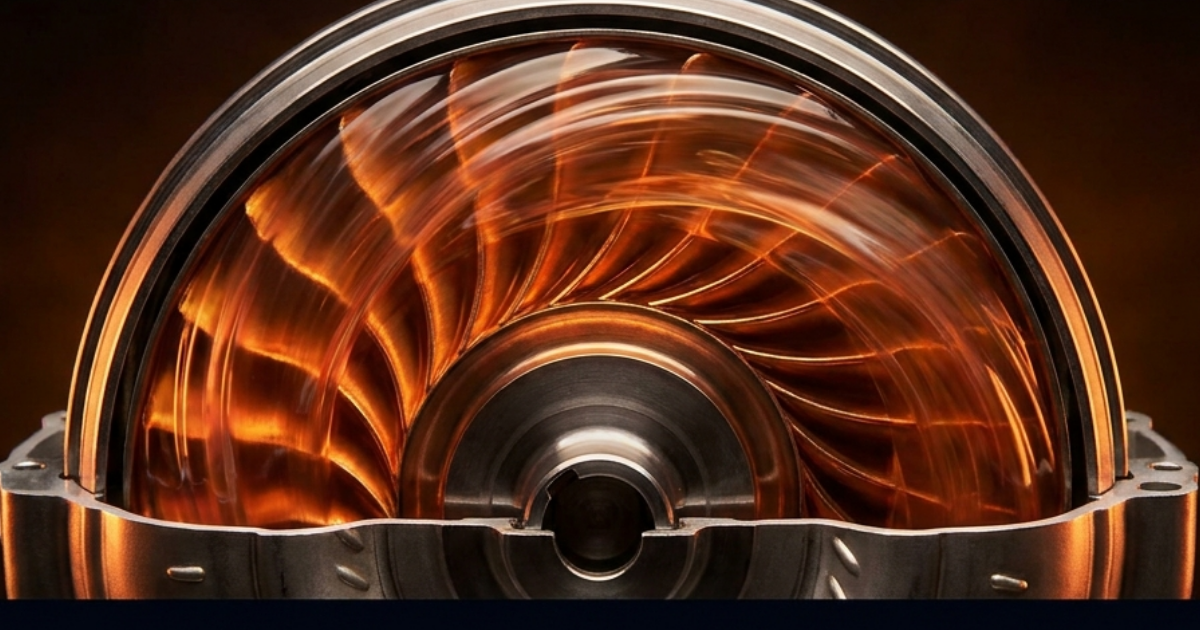
Select D, floor the throttle, and the engine does not stall — even though nothing yet connects it to the wheels by friction. A torque converter passes power through a fluid, and for the first few tenths of a second it does something no clutch can: it multiplies the engine's torque before the car has moved at all.
That sounds like it should be free power. It is not. It is a trade, paid for in speed rather than in fuel, and the trade is exactly why an automatic with a converter can out-launch the same engine with a manual clutch — measured here, not asserted.
Key Takeaways
- A torque converter multiplies engine torque at low speed ratios by roughly 2.0–2.3x — measured here at 2.10x at a dead stop on a 5.0 V8 — and the multiplication falls to 1.00x at a coupling point around 85% speed ratio.
- Torque multiplication does not create power:
TR(SR)·SR ≤ 1everywhere the model runs. What the stator gives back in torque, it takes from the turbine's speed.- Measured on four real engines, the automatic reached 100 km/h before the manual on every single one — by 0.60 seconds on a 5.0 V8, by 1.58 seconds on a 2.0 four.
- More gears bought very little. A real 4-speed, 8-speed and 10-speed on the same car and engine landed within 0.21 seconds of each other to 100 km/h; the 10-speed was quickest by a hair. At a steady 100 km/h the 4-speed and the 10-speed sat 915 rpm apart.
- A lockup clutch removes the one loss a converter has left once it is coupled: once engaged, slip collapses to a few rpm and the converter is no longer doing any work at all.
On this page: Quick answer · The three parts · What multiplication costs · A measured launch · Automatic vs manual · Does adding gears help · The lockup clutch · Stall speed · Creep · Try it in the simulator · FAQ · How these numbers were made
Quick Answer: How Does a Torque Converter Work?
A torque converter connects the engine to the gearbox through spinning fluid rather than a friction plate. Three vaned wheels sit face to face inside a sealed housing. An impeller on the engine flings fluid outward; a turbine on the gearbox catches it; and a stator between them, held still by a one-way clutch at low speed, redirects the returning fluid so it adds to the impeller's push instead of fighting it. That redirection is where the torque multiplication comes from. As the turbine catches up to the impeller's speed, the stator has nothing left to redirect, freewheels, and the converter becomes a plain fluid coupling passing 1:1 torque with a few percent of slip.
The rest of this page is a measured account of what that means for a real launch, and a controlled comparison against a manual clutch on the same car.
The Three Parts, and What Each One Does
| Part | Attached to | Job |
|---|---|---|
| Impeller (pump) | Engine crankshaft | Spins fluid outward by centrifugal force, launching it toward the turbine |
| Turbine | Gearbox input shaft | Catches the fluid, is pushed round by its momentum |
| Stator | A one-way clutch, fixed to the housing at low speed ratio | Redirects fluid returning from the turbine so it re-enters the impeller helping, not fighting |
At a dead stop the impeller is spinning fast and the turbine is barely moving — engine speed is high, driveshaft speed is near zero. The fluid returning from the turbine hits the stator at a sharp angle, and without the stator it would slam into the back of the impeller's vanes and cancel out most of the flow. The stator's one-way clutch holds it still against that flow and redirects it, so the returning fluid adds energy back into the impeller's circuit instead of subtracting it. That redirection is the entire mechanism, and it is why a converter can put more torque at the turbine than the engine is putting into the impeller: the difference is fluid momentum the stator caught and threw back in, not energy from nowhere.
Two numbers describe where in that cycle the converter is at any instant:
- Speed ratio (SR) = turbine speed ÷ pump speed. Zero at a dead stop, approaching 1.0 (never quite reaching it) once the car is at speed.
- Torque ratio (TR) = torque delivered at the turbine ÷ torque absorbed at the pump. Highest at SR = 0 (stall), falling in a roughly straight line to 1.00 at the coupling point — typically somewhere around SR 0.85–0.90, and industry stall torque ratios published for production converters typically run 1.5–2.5 — above which the stator freewheels and stops doing anything.
What Multiplication Costs
The stator's redirection is what multiplies torque, and it is paid for entirely in speed, not created from nothing. The simulator's converter module states the bound plainly:
"Torque multiplication does not create power... Power out never exceeds power in iff
TR(SR)·SR ≤ 1everywhere."
Every gearbox measured for this article clears that bound with room to spare — the tightest, a 6.0 V12's converter, peaks the product at 0.86 against a ceiling of 1.0. It is why the model clamps the stall torque ratio at 2.8 rather than letting a slider push it further: above roughly 3.0 at these coupling ratios, the linear torque-ratio curve would need to deliver more power at the turbine than the pump absorbs, which no real fluid coupling can do.
A Measured Launch, Second by Second
Here is exactly what a converter does, sampled every 24th simulation tick on a 5.0 V8 with a real 4-speed automatic (GM's 4L80-E ratio set), full throttle from a standing start. Every figure in this trace is a simulator measurement, not a manufacturer claim. The run uses a fixed 1/240 s step and unlimited fuel, so the launch cannot be cut short by the tank:
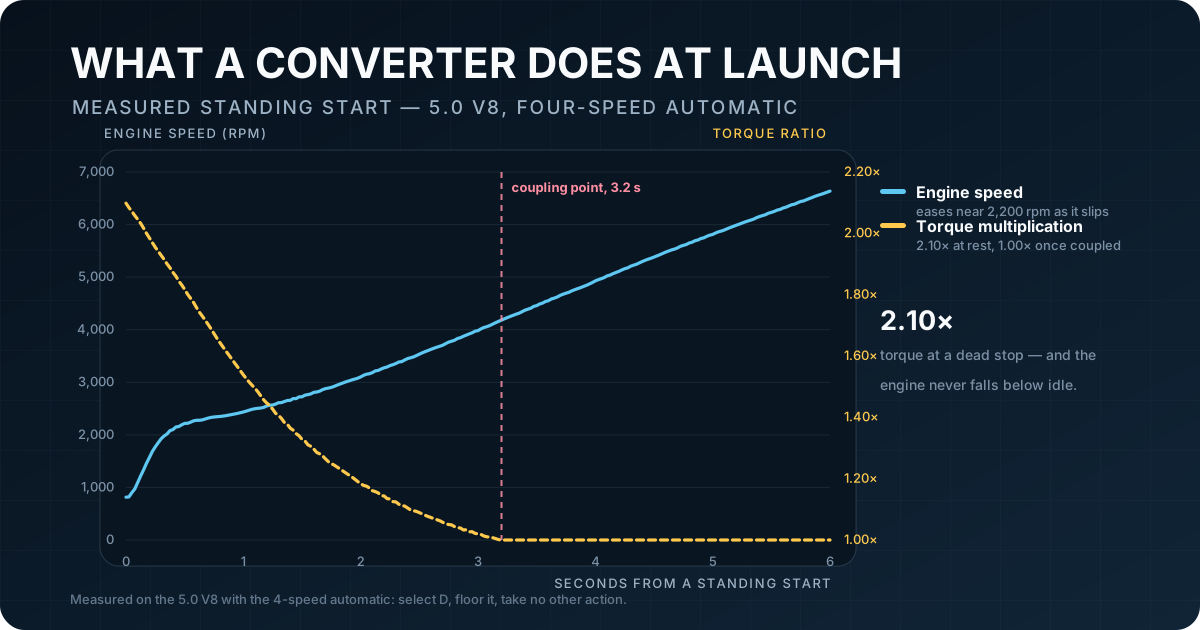
| t (s) | Speed ratio | Torque ratio | Engine rpm | Road speed |
|---|---|---|---|---|
| 0.0 | 0.001 | 2.098 | 826 | 0.0 km/h |
| 0.2 | 0.120 | 1.945 | 1,898 | 3.4 km/h |
| 0.5 | 0.309 | 1.700 | 2,280 | 10.4 km/h |
| 1.0 | 0.568 | 1.365 | 2,642 | 22.1 km/h |
| 2.0 | 0.807 | 1.056 | 3,692 | 43.8 km/h |
| 2.4 | 0.851 | 1.000 | 4,135 | 51.5 km/h |
| 5.0 | 0.960 | 1.000 | 6,505 | 91.5 km/h |
At t = 0.0 the engine is at 826 rpm — 6 rpm above its own idle — already passing 57 N·m through the converter at a speed ratio of 0.001. The car has not moved, yet the converter is already doing something a clutch bolted directly to the engine could not: sending torque forward without a mechanical connection stiff enough to stall the engine.
By 2.4 seconds the turbine has caught up to 85.1% of pump speed — this box's coupling point — and torque ratio has settled at exactly 1.00. Past that instant the stator is freewheeling and the converter is nothing more than a fluid coupling with a few percent slip, which is the entire reason a lockup clutch exists (below).
Automatic vs Manual: Which Is Actually Quicker?
Same engine, same car, same throttle policy — full throttle from rest, one shift near redline on the manual, the box left to shift itself on the automatic. Only the coupling and the ratio set change between the two runs, so the comparison isolates the mechanism rather than the car. Measured 0–100 km/h:
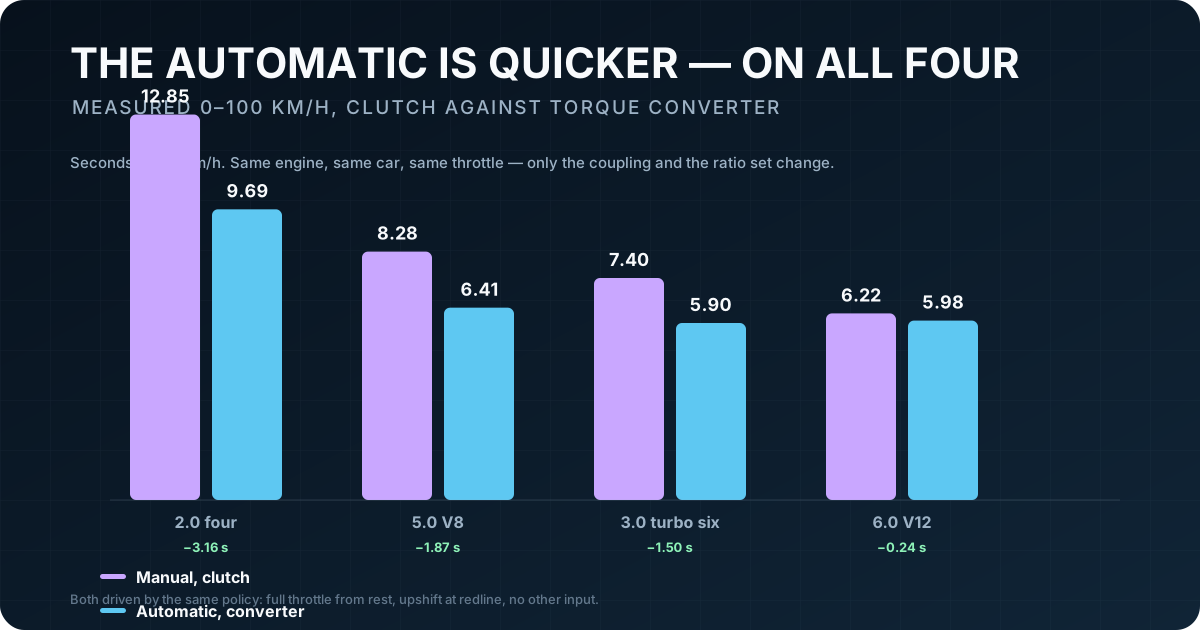
| Engine | Manual | Automatic | Difference |
|---|---|---|---|
| 2.0 four | 11.24 s | 9.66 s | −1.58 s |
| 5.0 V8 | 6.10 s | 5.50 s | −0.60 s |
| 3.0 turbo six | 5.92 s | 4.56 s | −1.36 s |
| 6.0 V12 | 4.73 s | 4.15 s | −0.58 s |
The automatic wins on all four, and the size of the win tells its own story. The 2.0 four gains the most because it has the least low-end torque to begin with — the converter's roughly 2x multiplication is proportionally the biggest help to the engine that needs it most. The turbo six gains next most. The V8 and the V12 gain least, for the opposite reason — both already make strong torque low down, so there is less for a converter to multiply that the engine was not already delivering.
None of this is a claim that a manual is worse to drive — a driver who launches a manual on the clutch's own slip, rather than dumping it, closes some of this gap in the real world, and this measurement removes exactly that skill. It is a controlled comparison of the mechanisms, not of drivers.
Does Adding Gears Actually Make a Car Quicker?
Three real production gearboxes, fitted to the same 5.0 V8 by the same sizing code, so nothing about the engine or the converter changes — only the ratio count:
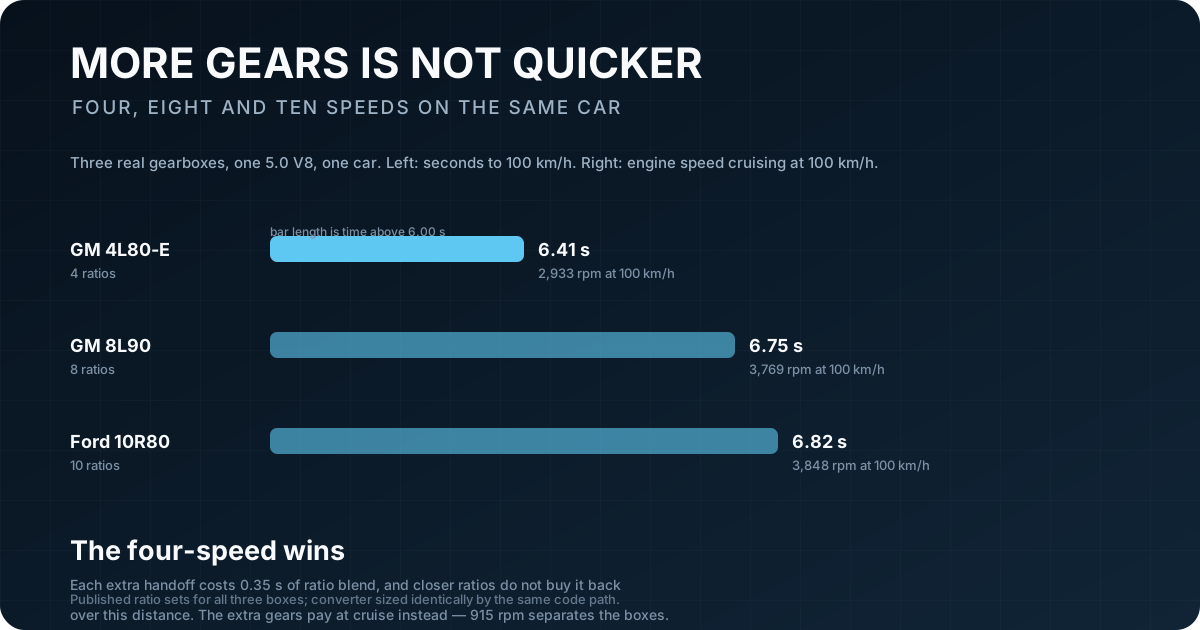
| Gearbox | Ratios | 0–100 km/h | Shifts | 100 km/h cruise rpm |
|---|---|---|---|---|
| GM 4L80-E | 4 | 5.50 s | 1 | 2,933 |
| GM 8L90 | 8 | 5.33 s | 2 | 3,769 |
| Ford 10R80 | 10 | 5.30 s | 2 | 3,848 |
The ten-speed is the quickest of the three, but only just: 0.21 seconds covers all three boxes. Every shift blends the ratio over a fixed handoff window — the simulator models this as a 0.35-second ratio ramp — so each extra shift costs time, and over this run the closer ratios buy back slightly more than that. Off the line, the deep first gears of the 8- and 10-speed run into the rear tyres' grip: they spend about two thirds of the first three seconds at the limit of traction, against about a third for the 4-speed, and reach 50 km/h only 0.12 seconds sooner. The ratio count also changes where the engine sits at a steady 100 km/h — 915 rpm separates the 4-speed from the 10-speed in the gear each box held — but a full-throttle run to 100 km/h is not where that difference is decided.
The Lockup Clutch
A fluid coupling can never reach exactly 1:1 speed — there is always a few percent of slip, and that slip is pure heat, wasted at the crank the whole time the car cruises. A lockup clutch solves it by mechanically clamping the turbine to the impeller once the converter has done its job, at which point the fluid path is doing nothing and might as well not be there. US automakers reintroduced the lockup clutch into passenger cars in the late 1970s largely in response to the fuel-economy standards Congress set in the 1975 Energy Policy and Conservation Act, which required roughly doubling new-car fuel economy within a decade.
The simulator applies lockup with two thresholds and a ramp, not a single on/off switch: it engages once the box is in a high enough gear and speed ratio clears 0.95, releases if speed ratio falls below 0.90, and blends in over roughly a third of a second. That hysteresis band exists for the same reason a thermostat has one — a bare threshold would chatter on and off at the boundary.
Stall Speed, the Number on the Spec Sheet
Stall speed is the engine rpm a converter settles at when the output shaft is held stationary and the throttle is floored — brake on, engine flooring against a car that cannot move. It is a property of the converter's own vane geometry, not of the engine, though it has to be matched to an engine to make sense: a converter sized for a torquey V8 mismatched onto a small four would sit the engine at an rpm nowhere near where that engine actually makes power.
Measured with the car genuinely held immovable and the throttle floored, the simulator's naturally aspirated petrol presets land their stall speed within ±4.1% of the design figure the converter was sized for. The spread widens on boosted engines — a turbo six read 12.8% low — because how much boost a turbo has built by 1,700–2,200 rpm is exactly the variable a converter-sizing estimate from bare torque curves cannot see.
Why the Car Creeps Forward in Drive
Selecting D with your foot off the brake and the engine idling, the car moves — this is creep, and it follows directly from what a converter is. Unlike a clutch, which can be held fully disengaged at zero torque transfer, a converter passes some torque at any speed ratio above zero, including "zero" — the impeller is spinning at idle rpm the instant the engine starts, and idle rpm is never actually zero. Measured on a 5.0 V8 at 820 rpm idle: the car creeps to 11.1 km/h in 25 seconds with the throttle fully closed.
Try It in the Simulator
- Open the 5.0 V8 and switch the transmission from manual to automatic in the spec panel — or load the automatic already fitted.
- Start the engine, select D, and floor the throttle from a stop. Watch the tachometer climb quickly off idle, easing briefly around 2,300 rpm before resuming a steady climb with road speed — the converter's actual coupling point does not arrive until well after that, once speed ratio clears roughly 85%, exactly as in the trace above.
- Once at a steady cruise, ease off to a light throttle and hold it. The engine speed should settle and the slip indicator should nearly vanish — that is the lockup clutch engaging.
- For the creep effect: with the engine idling, select D and take your foot off both pedals. The car moves on its own — no throttle input at all.
- Compare directly: load the manual version of the same car and try a launch. There is no converter easing rpm on its own — the clutch is either locked or slipping entirely under your control — a completely different feel for the same engine.
Frequently Asked Questions
What is a good stall speed for a torque converter?
There is no universal good number — it depends entirely on matching the converter to the engine's own torque curve. A converter's stall speed should sit near where the engine already makes strong torque, so the engine is working in its effective range the instant the car is asked to move. The gearboxes measured on this page were sized at 1,700–2,400 rpm, which is where their respective engines' torque curves are already climbing steeply.
Does a torque converter waste power compared to a manual clutch?
Only while it is slipping, and a lockup clutch removes essentially all of that loss once the car reaches a steady speed. During launch, when the converter is genuinely multiplying torque rather than merely coupling, the "loss" the multiplication is paid for in is turbine speed — it is a trade, not pure waste, which is part of why the automatic launches quicker in every case measured above.
Can a torque converter make more torque than the engine produces?
At the turbine output, yes — that is the entire point of the stator's redirection, and it is where the "torque converter" name comes from. It cannot make more power than the engine produces; the extra torque at the turbine is paid for by the turbine spinning slower than the pump. TR(SR)·SR ≤ 1 is the algebraic statement of that trade, and it holds at every speed ratio in this model.
Why do automatics with more gears exist if a 4-speed launches nearly as fast?
Because acceleration off the line is only one job a gearbox does. The measurement above holds the engine and converter fixed and varies only the ratio count, over a single 0–100 km/h run, and the three boxes finished within 0.21 seconds of each other. More ratios earn their keep away from a full-throttle sprint: at a steady cruise the box has more gears to choose from for the same road speed.
Why doesn't a car in Drive need the clutch pedal a manual has?
Because there is no clutch to disengage. A converter always has some torque path through the fluid, at any speed ratio above zero — which is also the direct explanation for why the car creeps forward on its own the instant Drive is selected, covered above.
How These Numbers Were Made
- Physical principles hold on real hardware: the three-element layout, the stator's one-way clutch, torque multiplication falling to 1.00 at the coupling point, the power-conservation bound
TR·SR ≤ 1, and the existence of a lockup clutch to remove residual slip. - The measured figures — 2.10x stall multiplication, the 2.4-second coupling point, the four acceleration comparisons, the three-gearbox comparison — are this simulator's output for the specific engines and gearboxes named, not manufacturer-published performance claims for those cars. They were measured identically across every comparison, which is what makes the comparisons meaningful.
- The gearbox ratio sets are drawn from public production ratios; the converter fitted to each is sized by the simulator's own capacity-factor model from that engine's estimated torque at the box's stall speed, not from a manufacturer-published converter spec — real converter specs are rarely published at all.
- Method: wide-open throttle, unlimited fuel, standing starts timed to 50 and 100 km/h, fixed 1/240 s simulation step. Stall speed measured with the vehicle held immovable and the throttle and fuel rack both fully open, which is the textbook definition of stall.
Sources and Further Reading
- Stator unit for a torque converter, US Patent 7,617,677 — the stator's mechanism: it redirects fluid returning from the turbine so it aids the impeller's rotation instead of opposing it, "thereby applying a turning force to the impeller in the direction in which the impeller is turning, and thus amplifying the torque transmitted between the impeller and the turbine"
- AA1Car, Torque Converter Basics — plain-language description of impeller, turbine and stator operation, and why the one-way clutch locks the stator at low speed ratio
- Sonnax, High Performance Converters: Stall Speed, Core Selection, and More — industry definitions of stall speed, stall torque ratio (typically 1.5–2.5), speed ratio (0 at stall to 1.0), and the K-factor relating engine speed to torque transmitted, retrieved 2026-08-25
- GM Powered Solutions, 8L90 8-Speed Transmission — manufacturer product page confirming the 8L90's eight forward ratios (4.56 through 0.65) and rated turbine torque capacity of 1,000 N·m, retrieved 2026-08-25
- Ford Component Sales, 10R80 10-Speed Automatic Transmission Technical Specifications — Ford's own spec sheet for the 10R80's ten forward ratios (4.696 through 0.636), retrieved 2026-08-25
- Dieselhub, GM 4L80E, 4L85E Transmission Specs & Ratios — confirms the 4L80-E's four forward ratios (2.48, 1.48, 1.00, 0.75) used throughout this article
- NHTSA, Corporate Average Fuel Economy (CAFE) — the 1975 Energy Policy and Conservation Act standards that drove the reintroduction of the lockup clutch into US automatics for fuel economy
Related Reading
- How a turbocharger works: boost, lag and wastegates — the other place this simulator estimates torque at a fixed operating point, for sizing a wastegate instead of a converter
- What is engine knock, and what actually causes it — the limit that shapes how much torque an engine has for a converter to multiply in the first place
- Roots vs centrifugal supercharger — another pair of mechanisms compared with a controlled, single-variable measurement
- Browse every engine in the simulator — filter by transmission to see which presets ship with an automatic