Horsepower vs Torque: The Difference, Measured on a Dyno
Torque is the twist, horsepower is torque times speed, and the curves cross at 5,252 rpm. Measured on a turbo-diesel, a pushrod V8 and an F1 V8.
A pickup with a 5.9 L turbo-diesel makes 440 lb·ft of torque and 215 horsepower. A 7.0 L Corvette V8 makes 470 lb·ft and 505 horsepower. A 2.4 L Formula 1 V8 makes about 214 lb·ft and 755 horsepower. Three engines, torque figures within a factor of about two, power figures spread by a factor of three and a half. The reason is one equation, and once you have it the whole horsepower-versus-torque argument turns out to be an argument about rpm.
We ran the roster's versions of all three on the simulator's dyno and pulled one number off the V8's curve that settles it: at exactly 5,252 rpm it reads 473 horsepower and 473 lb·ft, equal to the decimal, because at that speed the equation says they have to be.
Key Takeaways
- Torque is the twisting force the crankshaft delivers, in newton-metres or pound-feet. Power is how fast that twist does work: torque multiplied by rotational speed. Neither is more real than the other; power is torque with the clock running.
- In US units, hp = lb·ft × rpm ÷ 5,252, so horsepower and pound-feet are equal at 5,252 rpm on every engine, torque is the larger number below that speed, and power is the larger number above it. In SI, kW = N·m × rpm ÷ 9,549.
- Peak torque always comes at a lower rpm than peak power. On the measured 7.0 L V8 the torque peak is at 4,620 rpm and the power peak at 5,740, by which point torque has fallen only 3.6%; on a 5.0 L V8 with a wider spread the gap is 3,159 rpm and torque is down 32% at the power peak.
- The diesel makes big torque and modest power because its torque arrives at 1,650 rpm and it cannot rev past 3,000. The F1 engine makes modest torque and huge power because it holds its torque to 19,250 rpm. Torque per litre is within about 30% across all three.
- At the wheels, power decides acceleration. Gearing multiplies engine torque and divides engine speed by the same ratio, so the product, power, is what reaches the road. A high-torque engine and a high-power engine with the right gearbox do the same work per second.
On this page: Quick answer · What torque is · What horsepower is · The 5,252 crossing · Three engines · Diesel vs F1 · At the wheels · Electric motors · Try it · FAQ · Method
Quick Answer: What Is the Difference Between Horsepower and Torque
Torque is the turning force an engine produces at its crankshaft, measured in pound-feet or newton-metres. Horsepower is the rate at which that torque does work, which is torque multiplied by how fast the crankshaft is turning. The two are not separate properties of an engine: the power curve is the torque curve multiplied by rpm, point by point. An engine with a lot of torque at low rpm feels strong from a standstill; an engine that keeps its torque up to high rpm makes a lot of horsepower and is fast at the top of each gear. With the right gearing, what reaches the road is power.
What Torque Is
Push on a wrench and the bolt feels a torque: the force you apply multiplied by the length of the handle. One pound of force on a one-foot handle is one pound-foot; one newton on a one-metre handle is one newton-metre. An engine's torque is the same quantity at the crankshaft, produced by combustion pressure on the pistons acting through the crank throws. Car and Driver's explainer defines it in one line: "Torque is a rotating force produced by an engine's crankshaft."
Torque on its own says nothing about time. A torque wrench holding a bolt at 100 lb·ft is doing no work at all, because the bolt is not moving. Power adds the clock.
What Horsepower Is, and Where 33,000 Came From
Power is work per unit time, or equivalently force times speed. For rotation, that becomes torque times angular speed: OpenStax's university physics text writes it as P = τω. A given torque delivered twice as fast is twice the power.
The unit is older than the engine. James Watt, selling steam engines to people who owned horses, timed a horse turning a mill wheel and, with Matthew Boulton, standardized the result in 1783 at 33,000 foot-pounds of work per minute. That is 550 foot-pounds per second, which is how NIST's conversion tables still label the unit, and it converts to 745.6999 watts. The metric horsepower, PS in German and CV in French, is defined slightly differently and comes to 735.4988 W, about 1.4% smaller, which is why a European brochure's 300 PS is 296 hp.
| Unit | Definition | Watts |
|---|---|---|
| Mechanical horsepower (hp, bhp) | 550 ft·lbf/s | 745.6999 |
| Metric horsepower (PS, CV, ch) | 75 kgf·m/s | 735.4988 |
| Kilowatt (kW) | 1,000 J/s | 1,000 |
Which horsepower is being quoted matters less than how it was measured. Since the 1972 model year, US manufacturers quote SAE net power, measured with the engine's accessories and exhaust fitted, under the test code now called SAE J1349; the earlier gross ratings, taken without them, ran higher for the same engine. Our dyno correction calculator covers what "standard conditions" means in that code.
Why Horsepower and Torque Cross at 5,252 rpm
Put Watt's constant and the rotational power law together. Torque in pound-feet is work per radian of rotation. Multiply by rpm and by 2π radians per revolution to get foot-pounds per minute, then divide by 33,000 to get horsepower:
hp = lb·ft × rpm × 2π ÷ 33,000 = lb·ft × rpm ÷ 5,252
Wikipedia's torque article gives the constant to more places, 5252.113, and it is exactly 33,000 divided by 2π. The SI version uses 60,000 ÷ 2π instead:
kW = N·m × rpm ÷ 9,549
So at 5,252 rpm, horsepower and pound-feet are the same number. Below it, the torque figure is larger; above it, the power figure is. That is why a dyno chart in US units always shows the two curves crossing at the same place, and why an engine that never reaches 5,252 rpm, like most diesels, always shows a torque figure bigger than its horsepower figure. The crossing belongs to the units, not to the engine. Our horsepower calculator does the conversion in either direction.
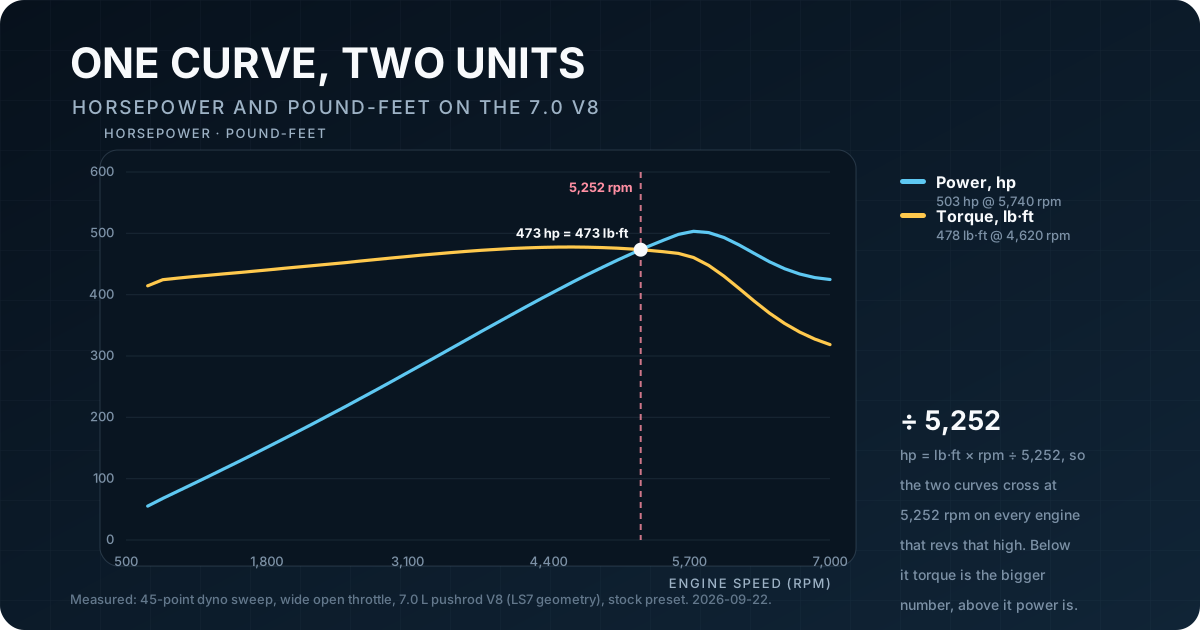
The chart is the simulator's 7.0 L pushrod V8, the roster engine built to the LS7's geometry, on a 45-point wide-open dyno sweep. Interpolating the curve at 5,252 rpm gives 473.3 hp and 473.3 lb·ft. The equation is not a model assumption here; the dyno measures torque, and the power column is computed from it, so the crossing has to land there. What the chart adds is the shape: the torque curve is nearly flat from 3,500 to 5,700 rpm, so the power curve keeps climbing until the torque finally drops off past the peak.
Three Engines Measured: a Diesel, a V8 and an F1 Engine
We swept three roster engines that were each calibrated against a published rating (the diesel's 12-valve started at 160 hp and 400 lb·ft in 1989 and reached 215 and 440 by 1998; the preset is built to the 1998 figures): the 5.9 L turbo-diesel six built to the Cummins 12-valve's geometry, the 7.0 L V8 built to the LS7's, and the 2.4 L V8 built to the Cosworth CA2006's. The published figures are the manufacturers'; the measured ones are the simulator's.
| Engine | Published rating | Measured peak power | Torque at that point | Measured peak torque | Power at that point |
|---|---|---|---|---|---|
| 5.9 L turbo-diesel six | 215 hp @ 2,700; 440 lb·ft @ 1,600 (1998 rating) | 211.9 hp @ 3,000 | 371.0 lb·ft (−17.0%) | 446.8 lb·ft @ 1,650 | 140.4 hp |
| 7.0 L pushrod V8 | 505 hp @ 6,300; 470 lb·ft @ 4,800 | 503.3 hp @ 5,740 | 460.5 lb·ft (−3.6%) | 477.7 lb·ft @ 4,620 | 420.2 hp |
| 2.4 L F1 V8 | 755 bhp @ 19,250; 214.4 lb·ft @ 17,000 | 733.3 hp @ 19,250 | 200.1 lb·ft (−5.2%) | 211.0 lb·ft @ 16,878 | 678.0 hp |
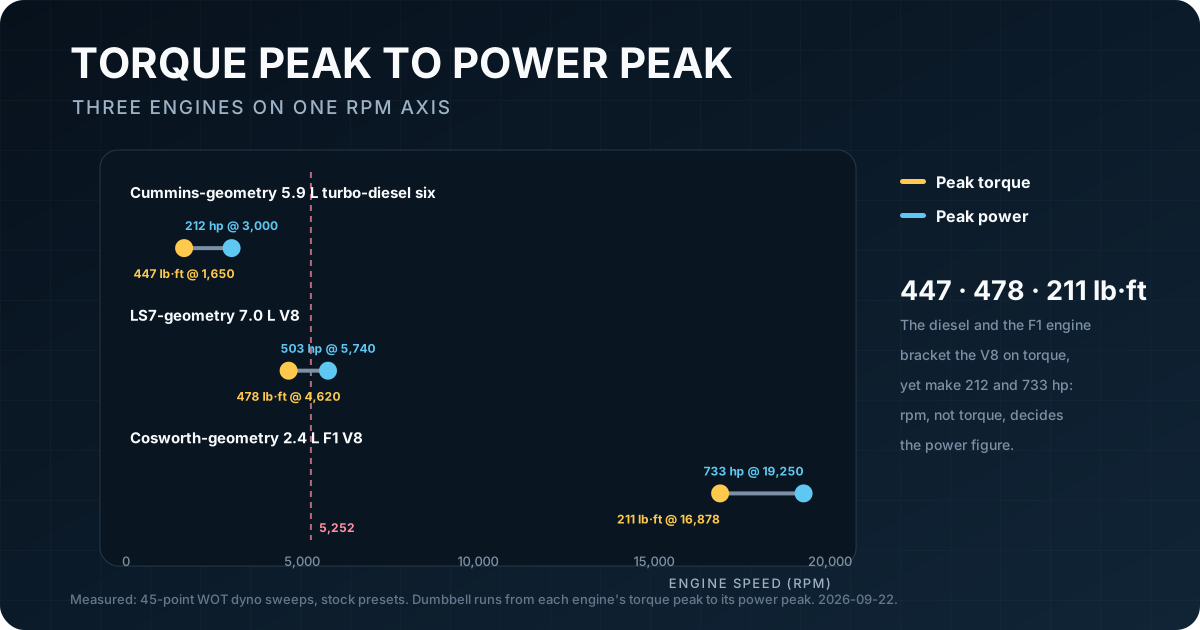
Peak torque comes first, peak power later, on every engine. Power is torque times speed, so as long as torque is falling more slowly than rpm is rising, power keeps going up. The power peak is where the torque curve's slope finally outruns the speed gain. On the 7.0 L V8 the two peaks are 1,120 rpm apart and torque is still 96% of its peak at the power peak; on the diesel they are 1,350 rpm apart and torque is down 17%. The roster's 5.0 L V8, the one our classroom experiments article uses for this, has a wider spread still: 445 N·m at 3,841 rpm, 298 hp at 7,000, a gap of 3,159 rpm with torque down 32% at the power peak.
You can check any published pair with the equation. The Cummins's 440 lb·ft at 1,600 rpm is 440 × 1,600 ÷ 5,252 = 134 hp at that speed, well under its 215 hp peak because 1,600 rpm is a low speed. The LS7's 470 lb·ft at 4,800 rpm is 430 hp there, and its 505 hp at 6,300 rpm means the torque had only fallen to 421 lb·ft, 90% of peak. The Cosworth's 214.4 lb·ft at 17,000 rpm is 694 hp, which is the figure Cosworth's published power curve prints at 17,000.
The diesel never reaches 5,252 rpm, so its torque number is always the bigger one. Its redline is 3,000. Every point on its curve has lb·ft above hp, and its 447 lb·ft against 212 hp is a fact about the units and the rev range, not evidence that torque and power are different kinds of strength. The roster's F1 engine idles at 4,000 rpm and crosses 5,252 with 169 of each, then spends the whole of its working range with horsepower far above pound-feet.
Why the Diesel Has Torque and the F1 Engine Has Power
Torque per litre of displacement is closer than the headline numbers suggest: 76 lb·ft per litre for the turbo-diesel, 68 for the V8, 88 for the F1 engine. What separates them is where in the rev range the torque lives and how far the engine can rev.
The diesel gets its torque from cylinder pressure. It is turbocharged, so its manifold sits above atmospheric pressure under load, and it has a long 120 mm stroke, so each combustion event pushes hard on a long lever. But the same long stroke and heavy parts limit how fast it can turn: the stroke ratio that gives a long-stroke engine its low-rpm torque also gives it a high piston speed at modest rpm, and diesel combustion, which burns as the fuel is injected, takes time the engine cannot compress by revving faster. Our diesel torque article takes the turbo off and measures each of these levers separately.
The F1 engine has a 39.75 mm stroke, less than a third of the diesel's, and pneumatic valve springs, so it can hold its torque to 19,250 rpm; our F1 rpm article is about why that is possible and why a road engine cannot do it. Its torque figure is small because 2.4 L is small. Its power figure is enormous because it delivers that torque more than six times as often per minute as the diesel does: the same equation, read from the other end.
Which Matters More at the Wheels
Engine torque is not what the tyre feels. Between the crankshaft and the road are a gearbox and a final drive, and a gear ratio multiplies torque and divides speed by the same number. A vehicle dynamics course at UC San Diego writes the gearbox as τ_out = g·τ_in with ω_out = ω_in ÷ g, and multiplying those two together cancels the ratio: power in equals power out, less friction. The force at the tyre is the wheel torque divided by the tyre radius, and the road speed is the wheel's angular speed times that radius, so force times speed at the road is torque times angular speed at the crank. Wikipedia's tractive effort article states the consequence: "Tractive effort inversely varies with speed at any given level of available power."
That is why power decides acceleration once gearing is free to choose. At any road speed the most force a car can put down is its power divided by that speed, whatever the engine's torque figure, and a gearbox exists to keep the engine near its power peak so that limit is reached. A 215 hp diesel truck in the right gear and a 215 hp gasoline car in the right gear can push with the same force at the same speed. The diesel's torque number means its gearbox can be geared taller and shifted less often, which is convenient for towing and pleasant to drive, and it means the truck pulls hard from idle without a downshift. It does not mean the truck has more strength available; it means the strength is available at lower rpm.
The one place torque wins outright is when gearing is fixed: a rev-limited class, a single-speed transmission, or the moment before a downshift. Then the engine with more torque at the rpm you happen to be at accelerates harder. That is the situation in which "torque is what you feel" is true.
What an Electric Motor Does Differently
An electric motor makes its rated torque from zero rpm and holds it flat up to a base speed, above which its power is constant and torque falls as 1/rpm. An Oak Ridge National Laboratory design study of a traction motor for a hybrid car specifies exactly that shape: 300 N·m from a standstill up to 1,040 rpm, then constant power out to about 5,400 rpm. A combustion engine has a hump instead: little torque at idle, a peak somewhere in the middle, and a fall-off before the redline. The motor's flat torque from zero is why an electric car pulls away hard without a clutch or a downshift and why most of them manage with a single gear ratio; the constant-power region above base speed is the same power-limited regime the gasoline car reaches only after it has shifted into the right gear.
Try It in the Simulator
Open the 7.0 L pushrod V8 and run the dyno. The chart draws both curves; find where they cross and read the rpm axis. Then open the 5.9 L turbo-diesel: the curves never meet, because the sweep stops at 3,000 rpm, and the torque curve sits above the power curve the whole way. Finish with the 2.4 L F1 V8, whose idle is already near 4,000 rpm and whose power curve climbs away from its torque curve for the next 14,000 rpm.
For the drivetrain half of the argument, put the V8 in gear and drive it. At any speed, note the gear that gives the hardest pull and the rpm the engine is at when you feel it: it will be near the power peak, not the torque peak. Then downshift one gear early and hold it; the engine is at higher rpm and lower torque, and if you were below the power peak before the shift the car accelerates harder, because power went up.
Frequently Asked Questions
What is the difference between horsepower and torque?
Torque is the twisting force at the crankshaft, in pound-feet or newton-metres. Horsepower is the rate at which that torque does work: torque multiplied by rotational speed. An engine's power curve is its torque curve multiplied by rpm at every point, so they are one measurement expressed two ways, not two independent properties.
Why do horsepower and torque always cross at 5,252 rpm?
Because of the units. Horsepower equals pound-feet times rpm divided by 5,252, and 5,252 is 33,000 (Watt's foot-pounds per minute in one horsepower) divided by 2π. At 5,252 rpm the division gives exactly 1, so the two numbers are equal. On our measured 7.0 L V8 the curve reads 473 hp and 473 lb·ft at that speed. In kilowatts and newton-metres the crossing is at 9,549 rpm instead.
Is torque or horsepower more important for acceleration?
Power, once the car can choose its gear. Gearing multiplies torque and divides speed by the same ratio, so the force at the tyre at any road speed is limited by power divided by speed, not by engine torque. Torque matters when the gear is fixed: at a given rpm in a given gear, more torque means more push, which is why a high-torque engine feels strong without a downshift.
Can an engine have high horsepower but low torque?
Yes, if it makes its torque at high rpm. The 2.4 L F1 V8 in this article makes about 211 lb·ft, less than half the 7.0 L V8's 478, and 733 hp, because it holds that torque to 19,250 rpm. The reverse also exists: the 5.9 L turbo-diesel makes 447 lb·ft and only 212 hp, because its torque peaks at 1,650 rpm and it cannot rev past 3,000.
Why do diesels have more torque than horsepower?
Two reasons stacked. Diesels make high cylinder pressure from boost and a long stroke, so their torque per litre is high, and they cannot rev much past 3,000 to 4,000 rpm. Below 5,252 rpm the pound-feet figure is always numerically larger than the horsepower figure, so a diesel's brochure shows a big torque number and a modest power number. The same engine quoted in kilowatts and newton-metres shows an even bigger gap, because that crossing is at 9,549 rpm.
What is the formula for horsepower from torque?
hp = torque in lb·ft × rpm ÷ 5,252. In SI units, kW = torque in N·m × rpm ÷ 9,549. Both come from power equals torque times angular speed, with the constants converting revolutions per minute to radians per second and the result into the chosen power unit.
What is the difference between hp, bhp, PS and kW?
Mechanical horsepower (hp) is 550 ft·lbf per second, 745.7 W. Brake horsepower (bhp) is the same unit, named for the brake dynamometer that measures it at the crankshaft. Metric horsepower (PS, CV, ch) is 735.5 W, about 1.4% smaller, so 300 PS is 296 hp. A kilowatt is 1,000 W, so 1 kW is 1.341 hp. Whether a figure is SAE net, SAE gross, or DIN matters more than which of these units it is in.
How These Numbers Were Made
Every simulator figure in this article comes from one headless run of the simulator on 2026-09-22. Each of the three engines ran the standard 45-point wide-open dyno sweep, the same sweep the on-screen dyno button runs, with the intake charge allowed to settle at each point before a 0.15 s averaging window. The dyno records brake torque; power is torque times angular speed, converted at 745.6999 W per horsepower. Pound-feet are newton-metres times 0.7376. The 5,252 rpm figure for the 7.0 L V8 is a linear interpolation between the two sweep points either side of it. The 5.0 L V8 figures are the classroom article's, re-measured and unchanged.
The published ratings in the comparison table are the manufacturers': the 1998 high-output rating of the Cummins 12-valve, GM's published rating of the LS7, and Cosworth's data for the CA2006 as reproduced in a specialist engineering note. Each roster preset was calibrated to its published torque and power pair and the F1 engine to Cosworth's nine-point published curve, so the simulator's peaks land within a few percent of the ratings by construction; the shape of each curve between the peaks is the model's.
About this article
Written by the team that builds the simulator and calibrates its presets against published engine data, with the physics and unit definitions drawn from NIST, OpenStax, and the sources listed below.
Sources and Further Reading
- NIST Special Publication 811, Appendix B.9: Factors for units listed by kind of quantity (retrieved 2026-09-22): horsepower to watts
- OpenStax University Physics Volume 1, 10.8: Work and Power for Rotational Motion (retrieved 2026-09-22): P = τω
- Wikipedia: Horsepower (retrieved 2026-09-22): Watt's 33,000 ft·lbf/min, SAE gross and net
- Wikipedia: Torque (retrieved 2026-09-22): the 5,252 constant
- SAE J1349: Engine Power Test Code, Spark Ignition and Compression Ignition, As Installed Net Power Rating (retrieved 2026-09-22)
- Cummins: Follow the Liter, the evolution of the 5.9 L and 6.7 L pickup engines (retrieved 2026-09-22): 12-valve ratings and rpm
- Stellantis: Ram Truck and Cummins Celebrate 25 Years of Diesel Powertrain Leadership (retrieved 2026-09-22): the 1989 160 hp / 400 lb·ft rating
- Wikipedia: LS based GM small-block engine (retrieved 2026-09-22): LS7 505 hp @ 6,300, 470 lb·ft @ 4,800
- Ian Bamsey, Note 108: Cosworth 2006 Type CA (PDF, retrieved 2026-09-22): 755 bhp @ 19,250, 214.4 lb·ft @ 17,000, from Cosworth data
- Car and Driver: Horsepower vs. Torque: What's the Difference? (retrieved 2026-09-22)
- UC San Diego CSE 291, Vehicle Dynamics lecture notes (PDF, retrieved 2026-09-22): gearbox torque and speed
- Wikipedia: Tractive effort (retrieved 2026-09-22)
- Wikipedia: Stroke ratio (retrieved 2026-09-22)
- Oak Ridge National Laboratory, ORNL/TM-2004/217: PM Motor Parametric Design Analyses for a Hybrid Electric Vehicle Traction Drive Application (PDF, retrieved 2026-09-22): the flat-torque, constant-power motor curve
Related Reading
- Why Do Diesel Engines Make So Much Torque? We Took the Turbo Off to Find Out
- Why F1 Engines Could Rev to 20,000 rpm (and Why Yours Can't)
- 8 Engine Experiments for the Classroom (No Dyno Required)
- How a Torque Converter Works (And Why It Can Be Quicker Than a Clutch)
- Horsepower calculator
- Dyno correction calculator