Cross-Plane vs Flat-Plane Crank: Why V8s Sound Different
Cross-plane V8s burble and flat-plane V8s scream, yet both fire every 90°. What a flat-plane crank is, what each exhaust bank hears, and whether it costs power.
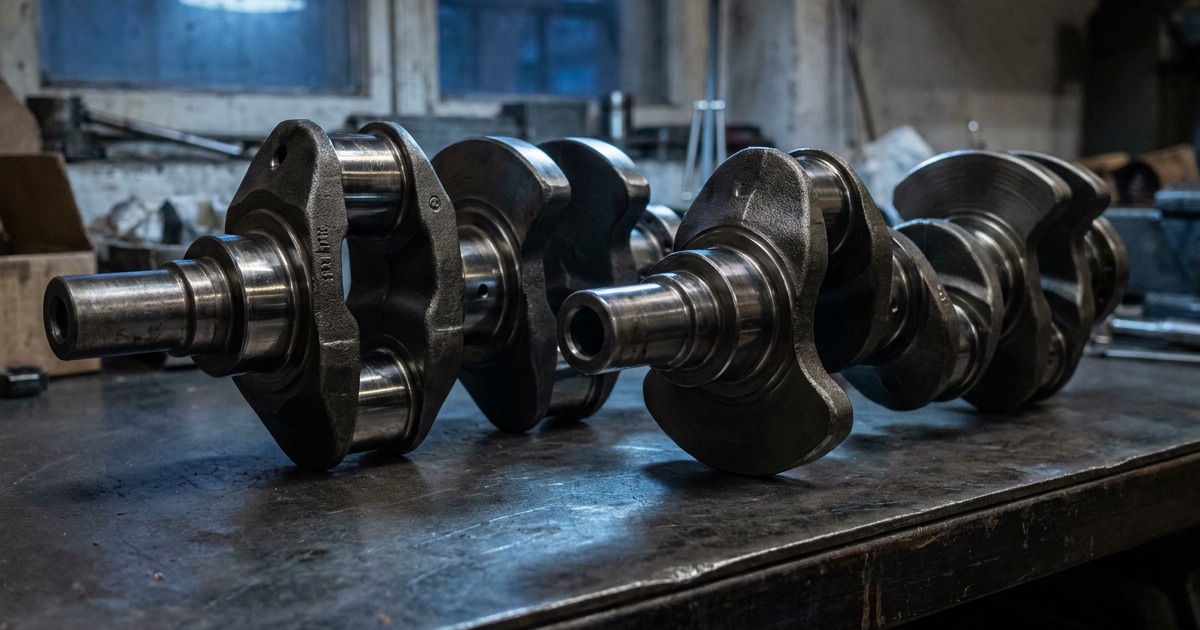
A Mustang GT and a Ferrari V8 have the same headline spec: eight cylinders, two banks, 90° between them, eight combustion events every two turns of the crank, spaced perfectly evenly. Same count. Same spacing. Same arithmetic.
One of them burbles like a gravel truck idling outside a diner. The other one screams.
The difference is not when the cylinders fire. It is which pipe each bang goes down.
Key Takeaways
- Every V8 in our simulator fires at even 90° intervals, cross-plane or flat-plane alike. Crank plane changes which exhaust bank hears each fire, and nothing else.
- Measured on our 5.0 V8: a cross-plane bank hears gaps of 180/270/180/90 crank degrees, a flat-plane bank 180/180/180/180.
- At 7,000 rpm that is 4.286 / 6.429 / 4.286 / 2.143 ms against a flat 4.286 ms. The cross-plane bank's shortest gap is a quarter of its longest, and that ratio is the burble.
- One geometry, built twice, routing changed and nothing else: 297.605129 hp both ways, a delta of 0.000000.
- That zero is a fact about our code, not about engines. Real crank planes change counterweight mass, scavenging and bearing loads. We model none of it, and say so rather than dress the null up as a discovery.
On this page: Quick answer · Both fire every 90 degrees · What the bank hears · The same gaps in milliseconds · What is a flat-plane crank · Flat-plane is two fields · The power test · What we do not model · Who uses which · Try it in the simulator · FAQ · How these numbers were made
Quick Answer: Why They Sound Different
A 90° V8 fires every 90° of crank rotation whatever crank it has. What the crank plane decides is how those eight fires are shared between the two exhaust banks. A flat-plane crank alternates them perfectly — left, right, left, right — so each header hears an evenly spaced pulse every 180°. A cross-plane crank does not: two cylinders on one bank fire back to back, and that bank's train comes out lumpy, at 180/270/180/90 crank degrees.
Your ear never hears the crank. It hears two exhaust pipes, one playing a metronome and the other playing a stumble that repeats once per cycle.
Both Engines Fire at Even 90-Degree Intervals
"Uneven firing" is the phrase everyone reaches for here, and it is the wrong one. A 90° V8 is even-firing on either crank: eight cylinders over a 720° cycle is one event every 90°, and both designs deliver exactly that. In our simulator the fire phases are the set {0, 90, 180, 270, 360, 450, 540, 630} in every V8 configuration we measured — nine of them, cross-plane and flat-plane alike.
Genuinely uneven firing exists and sounds nothing like this: a 45° V-twin fires 405° after one cylinder and 315° after the other, and that lopsided pair is the potato-potato. In our roster it only happens when a preset declares those phases outright; it never falls out of a crank choice. The cycle those 90° intervals are counting through is in how a four-stroke engine works.
So the difference lives in the split, not the total.
What One Exhaust Bank Actually Hears
Each bank has its own header, its own collector and, on most cars, its own pipe most of the way back. Four of the eight events go down each side. The question is which four. Our audio layer routes every cylinder to one of two exhaust buses by its physical bank, so the train per bus is the sorted list of that bank's fire phases. Reading around one 720° cycle:
| Config | Firing order | Bank sequence | Bank gaps (crank degrees) |
|---|---|---|---|
v8_5L stock, cross-plane | 1-8-4-3-6-5-7-2 | L R R L R L L R | 180 / 270 / 180 / 90 |
v8_5L rebuilt flat-plane | 1-5-4-8-3-7-2-6 | L R L R L R L R | 180 / 180 / 180 / 180 |
f1_v8_2L4 (Cosworth CA2006) | 1-5-4-8-3-7-2-6 | L R L R L R L R | 180 / 180 / 180 / 180 |
v8_7L0 (LS7) stock | 1-8-7-2-6-5-4-3 | L R L R R L R L | 90 / 180 / 270 / 180 |
sohc_v8_4L6 (Modular 4.6) stock | 1-3-7-2-6-5-4-8 | L L R L R R L R | 180 / 90 / 180 / 270 |
Read the bank-sequence column. The flat-plane row alternates without exception. Every cross-plane row has a doubled letter somewhere — two fires on the same side back to back, 90° apart, then a long wait while the other bank catches up. The bottom two rows are controls: two real cross-plane V8s, two published firing orders, two numbering conventions, and neither produces an even bank train.
That 180/270/180/90 is not ours, either. Wikipedia's crossplane article states the general result independently: "The actual intervals in each bank are 180-90-180-270 crankshaft degrees, in various orders depending on the engine" (Wikipedia, Crossplane, retrieved 2026-09-01). Same four numbers from a different starting cylinder, and our L R R L R L L R is a rotation of the LRLLRLRR pattern that article gives. Getting a textbook result out of code never written to reproduce it is the good kind of surprise.
The Same Gaps in Milliseconds
Nobody hears in crank degrees. One degree takes 1/(6·rpm) seconds; at the 5.0's 7,000 rpm redline that is 23.81 µs, so 90° is 2.143 ms and the whole two-revolution cycle is 17.143 ms.
| Config | Gaps down one bank, at 7,000 rpm | Per-bank pattern |
|---|---|---|
v8_5L stock, cross-plane | 4.286 / 6.429 / 4.286 / 2.143 ms | uneven, repeating at the 58.3 Hz cycle rate |
v8_5L rebuilt flat-plane | 4.286 / 4.286 / 4.286 / 4.286 ms | even, 233.3 Hz |
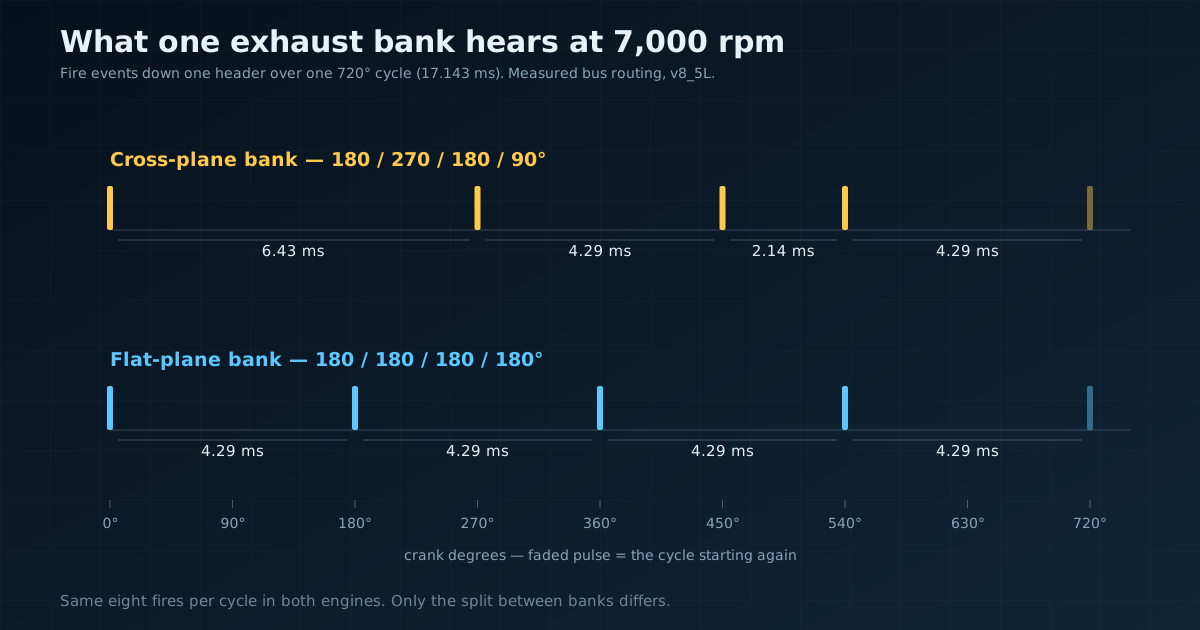
Total firing rate is 466.7 Hz both ways — the same eight events per cycle. But the flat-plane header delivers a clean 233.3 Hz tone and its harmonics, while the cross-plane header delivers a four-pulse figure that repeats only once every 17.143 ms, at 58.3 Hz. A pattern repeating at 58 Hz puts energy at 58 Hz and every multiple of it; one repeating at 233 Hz does not. Same engine, same rpm, same number of bangs, different spectrum.
That is the burble, described without adjectives. The popular explanations get the mechanism right if less precisely: Jalopnik gives the cross-plane sequence as "Left, right, left, left, right, left, right, right" against the flat-plane's "Left, right, left, right, forever" (Jalopnik, retrieved 2026-09-01), and CarBuzz puts the "deep burble" down to that timing and its "low-frequency pressure overlap" (CarBuzz, retrieved 2026-09-01).
What Is a Flat-Plane Crank
A flat-plane crank is a V8 crankshaft whose four throws all lie in one plane, 180° apart, so viewed end-on it is a flat bar. A cross-plane crank sets its throws 90° apart in two planes, so end-on it is a cross. Both fire a 90° V8 every 90° of rotation, as the section above measured. What the plane changes is which bank each fire lands in: with the throws at 180° the fires alternate left, right, left, right, and each exhaust header hears one pulse every 180°. With the throws at 90° two cylinders on the same bank fire back to back, and that bank's header hears the 180/270/180/90 stumble.
The plane also sets what the crank weighs. A flat-plane crank needs less counterweight, so it is lighter and revs faster, and it pays with a second-order vibration that a cross-plane crank's staggered throws cancel; the section on who uses which cites the source for both claims. The evenly spaced exhaust, the higher redline and the harsher idle all come from that one geometric choice.
Flat-Plane Is Two Decisions, Not One
There is no crank-throw model in this simulator, and "flat-plane" is not a checkbox. It emerges from two declared fields working together: how the cylinders are numbered across the banks, and the firing order that runs through that numbering. Change one without the other and you get neither pattern:
What changed on v8_5L | Bank gaps, bus 0 | Bank gaps, bus 1 |
|---|---|---|
| Nothing (stock cross-plane) | 180 / 270 / 180 / 90 | 180 / 90 / 180 / 270 |
| Numbering only | 90 / 180 / 90 / 360 | 270 / 270 / 90 / 90 |
| Firing order only | 270 / 90 / 270 / 90 | 270 / 90 / 270 / 90 |
| Both (the flat-plane build) | 180 / 180 / 180 / 180 | 180 / 180 / 180 / 180 |
The numbering-only row is the interesting failure: a 360° gap is an entire crank revolution of silence down one pipe, then two events almost on top of each other. Not a real engine, and certainly not a flat-plane one. Only the last row alternates — which is why the A/B below is honest. We did not flip a label; we rebuilt the routing until the bank sequence actually alternated, then measured what that cost.
The Controlled Test: Routing Changed, Power Unchanged
One engine, built twice. Bore 94.0 mm, stroke 90.0 mm, 155 mm rods, 10.8:1 compression, eight cylinders at 90°, idle 820, redline 7,000, one friction figure and one volumetric-efficiency curve — byte-identical between the builds. The only difference is the two fields that turn a cross-plane bank train into a flat-plane one. Then a 29-point wide-open-throttle sweep from idle to redline on each.
| Build | Peak power | Peak torque |
|---|---|---|
| Cross-plane routing (stock) | 297.605129 hp @ 7,000 | 445.145290 N·m @ 3,689.3 |
| Flat-plane routing | 297.605129 hp @ 7,000 | 445.145290 N·m @ 3,689.3 |
| Difference | 0.000000 hp | 0.000000 N·m |
Not "within measurement noise". Identical to six decimal places, and the reason is structural rather than lucky: nothing on the combustion, breathing or friction path reads which bank a cylinder sits in. Our crank kinematics ignore cylinder index entirely, so bank angle, splay and numbering cannot reach torque. Bank routing is imported by the audio layer and the 3D mesh, by nothing else.
Split by which field moved, over all 29 sweep points:
| Edit | Points differing | Max |Δ hp| |
|---|---|---|
| Cylinder numbering only | 0 / 29 | 0 |
| Firing order only | 4 / 29 | 5.68e-14 |
| Both | 4 / 29 | 5.68e-14 |
The numbering change is bit-identical across the entire curve. The firing-order change is not, and that gap is worth naming because it looks like a result: permuting the cylinders adds the same eight torques in a different sequence, and floating-point addition is not associative. Five hundredths of a femto-horsepower on a 297 hp engine is summation order, not physics.
Same test on the shipping flat-plane preset: flip its numbering and the Cosworth CA2006 still reads 743.133660 hp @ 19,250 and 289.531374 N·m @ 17,071.4, bit-identical at 0 of 29 points.
A zero delta is the easy result to get by accident — an override that silently never reached the simulator also reads zero. Two things say ours reached. The bank-gap tables above move under exactly these edits, from the same mutated configs in the same process. And a third edit on the same harness, raising the friction figure from 1.3 to 1.5 and touching nothing else, moved peak power to 289.7935 hp (−2.62%) and peak torque to 437.1784 N·m (−1.79%). The harness moves when the physics moves. It did not move here.
What This Simulator Does Not Model
That zero describes our code's structure, not engines. Reading it as a finding about engines would be wrong in four specific ways:
- Crankshaft balance. There is no shaking-force model here at all, so the cross-plane crank's balance advantage and the flat-plane's vibration are both absent — to this simulator the two cranks are literally the same kinematics object. That advantage is the whole reason the cross-plane crank exists: it "was developed to produce a smoother engine than possible with a flatplane design," each bank's four distinct piston phases cancelling the second-order free forces (Wikipedia, Crossplane, retrieved 2026-09-01). We cannot measure it. It is real anyway.
- Counterweight mass. A cross-plane crank needs heavy counterweights to cancel its primary forces, and that mass is why it revs more slowly. Our flywheel inertia is a number you set by hand, not one that follows from the crank.
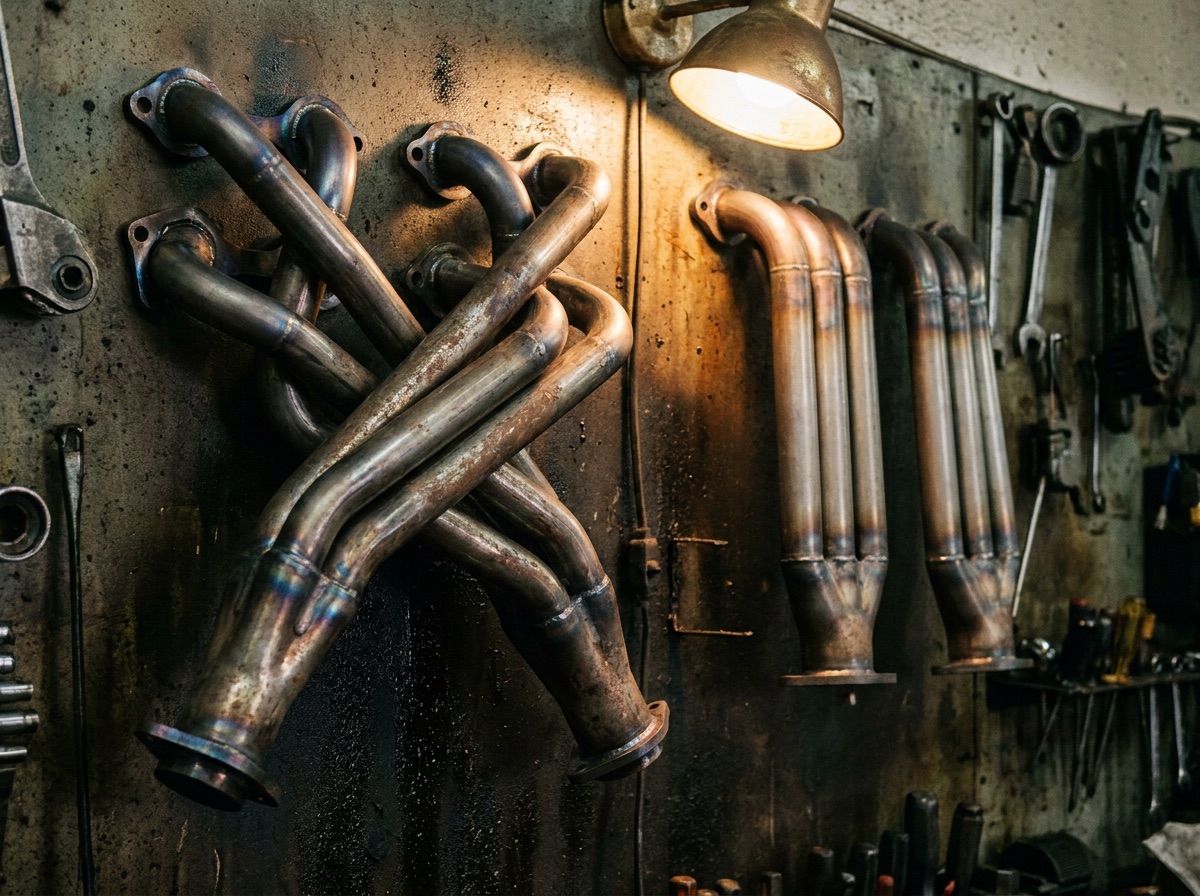
- Exhaust gas dynamics. Our audio is a synthesized pulse train summed on two buses: no gas wave, no reflection timing, no scavenging between adjacent cylinders on a bank. On a real cross-plane V8 the uneven train hurts breathing, not only sound, which is why 180° equal-length headers exist — the ones made famous by the Ford GT40's "elaborate arrangement of long exhaust pipes nicknamed 'Bundle of Snakes'" (Wikipedia, Crossplane, retrieved 2026-09-01). Header geometry is not on our breathing path, so we cannot show that fix working.
- Any real power difference from crank plane. A real flat-plane crank changes scavenging, bearing loads and rotating mass. None of it is modelled. Our zero says the model has no opinion, which is not the same as the answer being zero.
The full scope, and the rest of what we get wrong, is in how we build the simulator.
Who Uses Which, and Why
Cross-plane cranks dominate "just about every other American V8," while flat-planes appear in European sports cars and a few American exceptions — the C8 Corvette Z06 and ZR1, and the discontinued Mustang Shelby GT350 (Jalopnik, retrieved 2026-09-01). Ferrari is the name most attached to the flat-plane V8; the GT350's Voodoo 5.2 is the famous case going the other way, which is exactly why it does not sound like a Mustang.
The trade behind that split is not about sound at all. A flat-plane crank needs "less counterweight," letting the engine "rev much faster, making it more suitable for racing engines," and it is "more prone to vibration and is inherently much louder than a crossplane crankshaft" (Wikipedia, Flat-plane crankshaft, retrieved 2026-09-01). Cross-plane buys smoothness and pays in crank mass; flat-plane buys revs and pays in vibration. The noise is a side effect of a decision made about something else.
Formula One sat firmly on the second side. Our f1_v8_2L4 preset models the Cosworth CA2006, a 2.4 L V8 revving past 19,000 rpm, and we build it flat-plane — contemporary accounts describe the real engine that way, though Cosworth never published its crank design. Worth stating precisely: the 2006 regulations fixed capacity, cylinder count, vee angle, bore and valve count, and said nothing about crank design. Flat-plane was the choice everyone made, not a rule anyone wrote.
Try It in the Simulator
Three engines, five minutes, the whole article by ear:
- Run the 5.0 V8 — the cross-plane reference. Idle it at 820 rpm, then hold it near the 7,000 redline. Idle is where the lumpy bank train is clearest, because the pattern repeats slowly enough to follow.
- Run the LS7 — a second cross-plane V8 on a different firing order (1-8-7-2-6-5-4-3) and a different bank pattern. Different engine, same family of lumpiness.
- Run the Cosworth CA2006 — the flat-plane. The character differs well before you approach its 19,250 redline, because the bank train is a metronome.
The audio is synthesized from the firing events the physics produced rather than from recordings, which is why routing is audible at all. To lay out an eight of your own, use the build wizard.
Run the cross-plane 5.0 · Run the flat-plane CA2006 · Browse the full roster
Frequently Asked Questions
Does a flat-plane crank make more power?
Not by being flat-plane. In our controlled test — one engine, only the bank routing changed — peak power was 297.605129 hp both ways, a difference of exactly zero, because nothing on our combustion or breathing path reads bank membership. In the real world flat-plane V8s often do make more, for indirect reasons: a lighter crank with fewer counterweights revs higher, and even bank spacing lets a simple equal-length header scavenge properly. Those follow from the crank; neither is modelled here.
Why do American V8s use cross-plane cranks?
Smoothness. The cross-plane crank was developed specifically to run more smoothly than a flat-plane one, its four distinct piston phases cancelling the second-order free forces that shake a flat-plane V8 (Wikipedia, Crossplane, retrieved 2026-09-01). In a large road-car engine, refinement at low rpm is worth more than the last five hundred revs, and heavy counterweights are an acceptable bill.
Why does Ferrari use a flat-plane crank?
The same trade decided the other way. Less counterweight is less rotating mass, so the engine accelerates and revs harder, which is what a sports-car V8 is for. The vibration a road-car engineer would call a defect is, in that context, the product.
What is the firing order of each?
It varies by engine — there is no single cross-plane or flat-plane order. Our 5.0 runs 1-8-4-3-6-5-7-2, the LS7 runs 1-8-7-2-6-5-4-3, the Modular 4.6 runs 1-3-7-2-6-5-4-8; all three are cross-plane and none of their bank patterns match. Our CA2006 preset runs 1-5-4-8-3-7-2-6, a published flat-plane order, because the real Cosworth's was never published — and in this simulator that choice is indistinguishable from any other order alternating banks the same way.
Is a flat-plane V8 just two inline-fours sharing a crank?
A good intuition rather than a fact. The throws sit 180° apart exactly like an inline-four's and each bank fires evenly every 180°, so each side does behave like a four with its own exhaust. Where it breaks: the banks share one crankshaft and one set of mains, the rods pair on shared crankpins, and the vee angle puts the two "fours" 90° out of step rather than independent. Useful for the exhaust, useless for balance.
How These Numbers Were Made
It matters which kind of claim each figure is:
- Physical principles that hold on real hardware: 90° firing intervals on any 90° V8, the 180/90/180/270 bank pattern, the balance and counterweight trade. Corroborated by the cited sources, not derived from our code.
- Simulator calibration: 297.605129 hp, the 4.286/6.429/4.286/2.143 ms train, 233.3 Hz. These describe a 5.0 L, 10.8:1 V8 as this model calibrates it, measured identically for both builds — which is what makes the comparison mean anything, and what stops it meaning anything about a real car.
- Method: 29-point wide-open-throttle sweeps from idle to redline, each point settled before sampling, roughly 12° of crank per substep, in fixed reference air of 1.000 bar and 293 K with no correction applied. The bank gaps come from the same routing function the audio worklet uses, on the same config objects the sweeps ran, in the same process.
- Reference peaks of the four V8s named here, from our generated peaks file:
v8_5L297.63 hp @ 7,000;v8_7L0502.29 hp @ 5,688;sohc_v8_4L6269.27 hp @ 5,117;f1_v8_2L4743.19 hp @ 19,250. Four different engines, not an A/B — none of the spread is attributable to crank plane. - No real-engine power, torque or sound-pressure figure appears above. Where we describe what a real crank does, it carries a citation.
Every run reproduces from shipped presets: load one, open the dyno, and you should land on the same curve. If you do not, send it to us. The dyno correction calculator explains how to compare our reference-day figures against a real dyno sheet.
About this article
Written by the Engine Simulator Team, who build and calibrate the physics engine behind these numbers. We publish the model's limits beside its results, because a simulated figure is worth nothing without them. Found an error? Contact the team.
Sources and Further Reading
- Wikipedia, Crossplane — throw geometry, the 180-90-180-270 per-bank intervals, second-order balance, the GT40 "bundle of snakes" (retrieved 2026-09-01)
- Wikipedia, Flat-plane crankshaft — 180° throws, reduced counterweighting, the revs-for-vibration trade (retrieved 2026-09-01)
- Jalopnik, Cross vs flat-plane cranks — which manufacturers use which, and why counterweight mass limits revs (retrieved 2026-09-01)
- Jalopnik, Why flat-plane crank V8s sound different — the left-right bank sequences stated plainly (retrieved 2026-09-01)
- CarBuzz, Flat-plane vs cross-plane V8 explained — alternating versus consecutive same-bank firing, and the header consequence (retrieved 2026-09-01)
Related Reading
- How a four-stroke engine works — the cycle those 90° intervals count through
- The Otto cycle explained — the thermodynamics behind each of the eight bangs
- What engine knock is — the limit on how hard any of these V8s can be run
- Two-stroke vs four-stroke — the pulse train when every cylinder fires twice as often
- Roots vs centrifugal superchargers — the same one-engine-two-builds method, applied to induction
- Browse every engine in the simulator — filter by layout to find the V8s named here