Engine Sounds by Cylinder Count: Hear 1 to 16 Cylinders Live
Play a single, a V-twin, an inline-four, a V8, a V12, a W16 and a rotary in your browser, and see why each sounds the way it does. Headphones help.
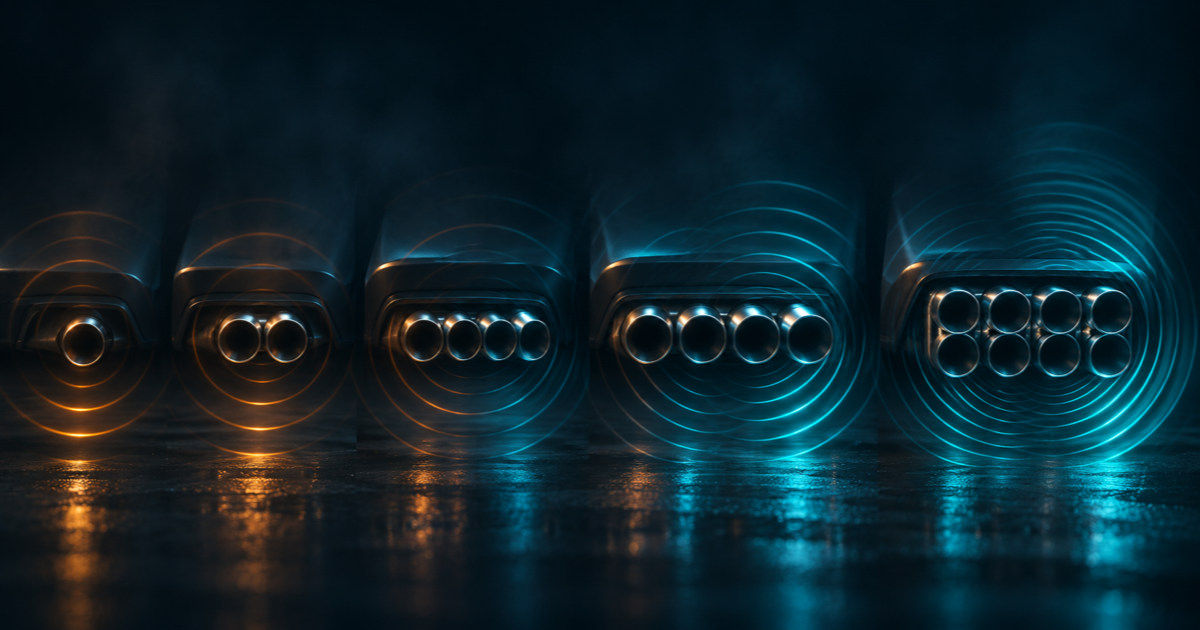
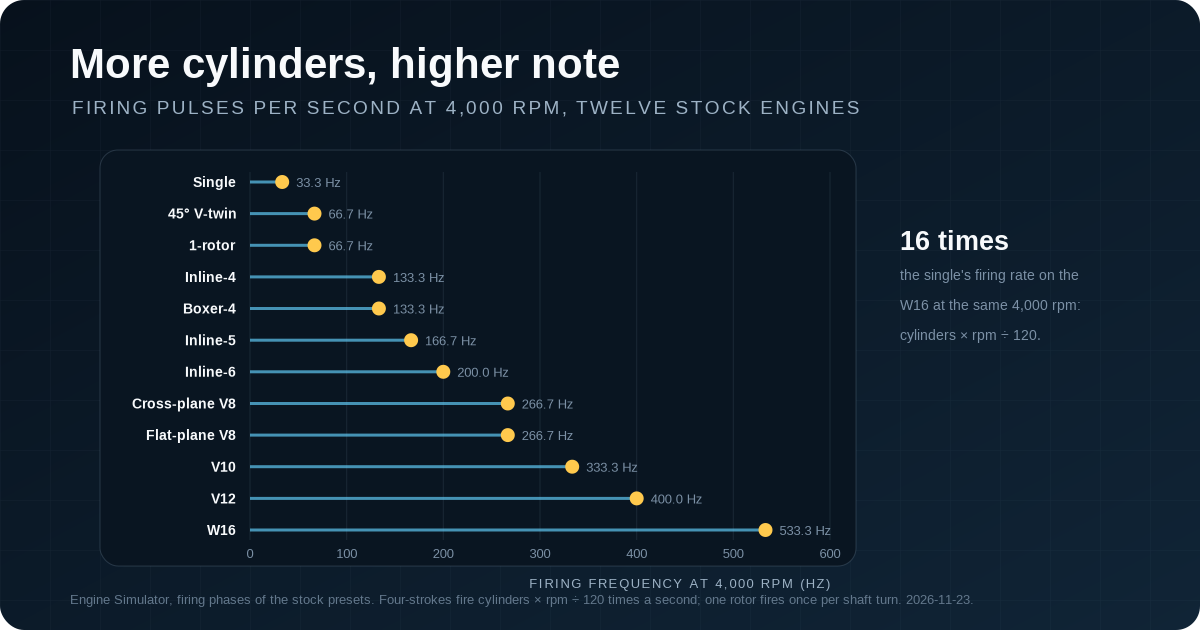
Most of what makes engines sound different comes down to two things: how many firing pulses leave the exhaust each second, and how evenly those pulses are spaced. A four-stroke fires each cylinder once every two crank turns, so the firing rate in pulses per second is cylinders × rpm ÷ 120. More cylinders at the same rpm means a higher note. Uneven spacing, or two banks heard through two different pipes, adds a slower rhythm on top: the lope of a V-twin, the burble of an American V8.
You can hear all of it in our simulator, which runs in a browser and works on Chromebooks, with no account. Below are twelve stock engines from one cylinder to sixteen, each with a link, the firing numbers, and what to listen for, checked against a spectrum of the sound the simulator actually plays.
Use headphones. Laptop and Chromebook speakers are small and struggle with low frequencies, and a single-cylinder idle or a V8 burble lives down there. On built-in speakers the low engines lose most of their character.
Key Takeaways
- Firing frequency sets the pitch. At 4,000 rpm a single fires 33.3 times a second, an inline-four 133.3, a V8 266.7, a V12 400 and a W16 533.3.
- At idle, the cross-plane V8 carries the strongest off-beat rhythm of the twelve: energy between its firing pulses sits 8.1 dB above the energy on them. The inline-four sits at −18.5 dB, the smooth end.
- In this model, most of the V8's burble comes from hearing its two banks through pipes of different length (2.5 m and 4.4 m). With both pipes set to 2.5 m it drops from +11.4 to −9.9 dB at 4,000 rpm.
- The 45° V-twin's lope comes from its firing alone, 405° then 315°: equal pipes leave it in place (+4.8 dB stock, +5.8 dB with equal pipes).
- The flat-plane F1 V8 is the smoothest-sounding engine here at 4,000 rpm full load (−20.5 dB) and the highest: at 18,793 rpm it fires 1,253 times a second.
On this page: Quick answer · How to listen · Twelve engines · Cross-plane against flat-plane · Why more cylinders sound smoother · Where the model parts ways · FAQ · How these numbers were made
Quick Answer: What Makes Engines Sound Different
Three things, in order of how much they matter:
- Firing frequency. Cylinders × rpm ÷ 120 for a four-stroke. It sets the basic pitch, and it is why a V12 at 4,000 rpm sings at 400 pulses a second while a single at the same speed thumps at 33.
- Spacing. An even-firing engine puts the same gap between every pulse, so the sound is one steady tone and its harmonics. An uneven one, like a 45° V-twin, repeats a long gap and a short gap, which you hear as a rhythm at half the firing rate.
- What the exhaust does with the pulses. Which cylinders share a pipe, and how long each pipe is, decides whether two banks blend into one even stream or stay audible as two uneven ones. Our cross-plane vs flat-plane article shows that a cross-plane V8 fires every 90° overall but each bank's pipe hears a lumpy 180, 90, 180, 270 pattern.
How to Listen
- Open an engine from the list below. If the speaker button at the top of the left panel shows the sound off, click it once.
- Press START, then leave the throttle at zero and listen to the idle for ten seconds.
- Drag the THROTTLE slider to about 30%, then back to zero. Do it two or three times.
- Turn your volume up slowly. The simulator can get loud at full throttle.
Settings → Sound has controls for voice, mic, tone and room. Every measurement below uses their default centre positions.
Twelve Engines, From One Cylinder to Sixteen
Each entry gives the firing interval, the firing frequency at idle and at 4,000 rpm, and one thing to listen for. "Off-beat" is our measure of rhythm: how much of the sound's energy falls between the firing pulses' harmonics, compared with the energy on them, in decibels. Higher means more lope; strongly negative means one smooth tone.
Single: a Royal Enfield-type 500
Open the Thumper 500. One cylinder, one firing every 720°. At its 800 rpm idle it fires 6.7 times a second, slow enough to count along with. Its idle sound has a spectral centroid (the balance point of its energy across frequency) of 79 Hz, the joint lowest here, which is why it nearly vanishes on laptop speakers. At 4,000 rpm it fires 33.3 times a second.
45° V-twin: a Harley-type twin
Open the V-Twin 1340 45°. Two cylinders fire 405° apart, then 315°. At its 1,000 rpm idle that is 16.7 pulses a second, arriving in uneven pairs. Listen for the two-beat lope. Its off-beat reading is +2.0 dB at idle and +4.8 dB at 4,000 rpm, and rendering it with equal-length pipes left it at +5.8 dB, so the rhythm is the firing itself.
Inline-four
Open the Inline-4 2.0L. Four cylinders, one every 180°, 28.3 pulses a second at an 850 rpm idle. Listen for a plain, even hum with no rhythm on top. Its idle off-beat is −18.5 dB, the smoothest idle among the piston engines here.
Inline-five: an Audi-type five
Open the Inline-5 2.5L Turbo. One firing every 144°: 33.3 a second at 800 rpm, 166.7 at 4,000. At 4,000 rpm its sound has the highest centroid of the twelve, 491 Hz, a bright, rasping note.
Inline-six
Open the Inline-6 3.0L. One firing every 120°, 40 a second at idle and 200 at 4,000 rpm. Idle off-beat −16.2 dB: smooth, like the four, a little deeper in rhythm and a little higher in pitch. Our inline-6 vs V6 article compares it with a V6 of the same size.
Cross-plane V8
Open the V8 5.0L 90°. Eight cylinders, one every 90°, 54.7 a second at its 820 rpm idle. Listen for the burble under the hum. Its idle off-beat is +8.1 dB, the highest of all twelve at idle. The next section takes it apart.
Flat-plane V8: an F1-type V8
Open the F1 V8 2.4L. Also one firing every 90°, but each bank fires evenly every 180°. It idles at 4,000 rpm, so its idle is already 266.7 pulses a second. At full load and 4,000 rpm its off-beat is −20.5 dB, the smoothest of the twelve. Rev it out: at 18,793 rpm it fires 1,253 times a second and its centroid reaches 1,104 Hz, the highest note in this set.
V10: a Viper-type V10
Open the V10 8.4L. One firing every 72°, 62.5 a second at a 750 rpm idle and 333.3 at 4,000. Idle off-beat −11.4 dB. At 4,000 rpm full load it reads +10.7 dB, but that comes from this model's two bank pipes of different length (2.5 m and 3.1 m): with equal pipes it falls to −1.4 dB. A real V10 with a different exhaust may not do this.
V12: a Ferrari-type V12
Open the V12 5.0L 60°. One firing every 60°: 80 a second at idle, 400 at 4,000 rpm. Near its redline, at 7,978 rpm, its centroid is 711 Hz; only the F1 V8 and the W16 reach higher near their redlines. Its 4,000 rpm off-beat of +16.8 dB is the same pipe effect as the V10's (0.9 dB with equal pipes), so treat that number as the model's exhaust, not as a V12 trait.
Boxer-four: a Subaru-type boxer
Open the Boxer-4 2.0L. It fires every 180°, exactly like the inline-four, at 28.3 a second at idle. Its idle off-beat is −11.5 dB, rougher than the inline-four's −18.5. Be clear about why: this model gives each bank its own pipe (2.5 m and 3.1 m), and that alone makes the difference. Set both pipes equal and the boxer reads −24 dB at idle. The model does not carry the unequal-length headers that give many real Subaru boxers their rumble, so this boxer does not have it.
W16: a Bugatti-type W16
Open the W16 8.0L Quad-Turbo. Sixteen cylinders, one firing every 45°, four turbochargers. At its 700 rpm idle it already fires 93.3 times a second, and its idle centroid of 164 Hz is the highest of the engines that idle below 1,000 rpm. At 4,000 rpm it fires 533.3 times a second.
Rotary: a one-rotor Wankel
Open the 1-Rotor 654cc. A rotor has three faces, and one of them fires for every turn of the output shaft: 15.8 pulses a second at a 950 rpm idle, 66.7 at 4,000, the same as the V-twin. At 4,000 rpm its level is −26.7 dB, the quietest here. Our rotary engine article explains the cycle.
Cross-Plane Against Flat-Plane V8: the Burble, Measured
Both V8s fire every 90°, so at the same rpm they have the same firing frequency, 266.7 a second at 4,000. The difference is in what each bank's exhaust hears. A cross-plane crank gives each bank an uneven pattern; a flat-plane crank gives each bank an even 180° spacing.
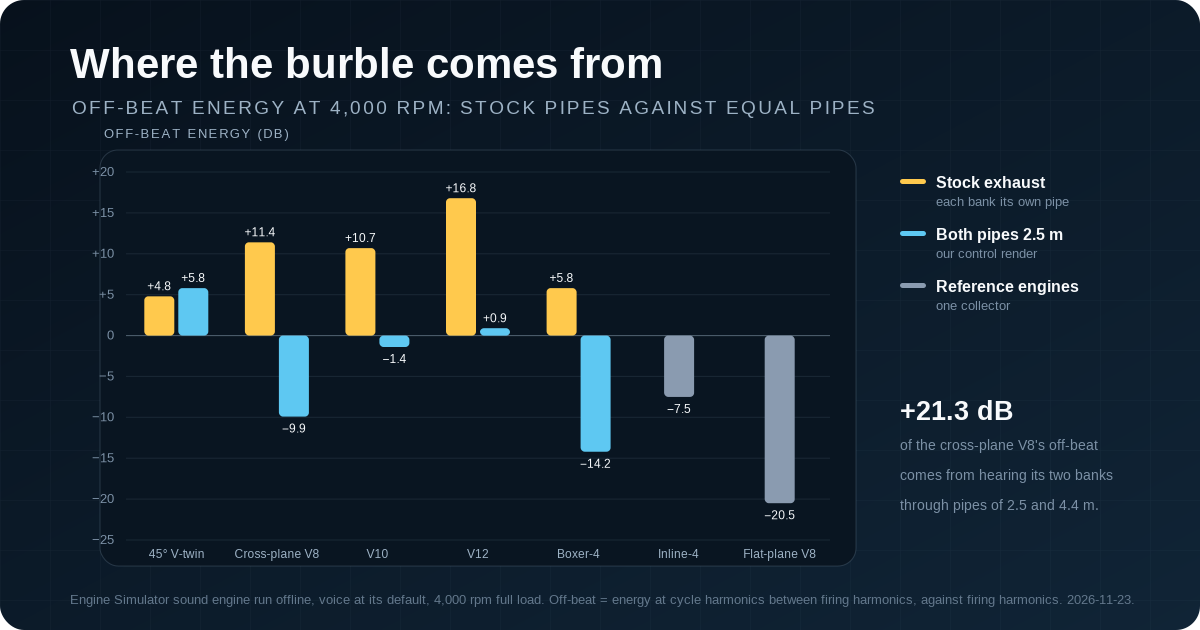
On stock settings the cross-plane V8 reads +11.4 dB of off-beat energy at 4,000 rpm and the flat-plane reads −20.5 dB. We then re-rendered the cross-plane V8 with both bank pipes set to 2.5 m, changing nothing else. Its off-beat fell to −9.9 dB.
So in this model, the burble needs the two banks to stay separate on the way to your ear. If both banks' uneven pulse trains travel the same distance, they add back up into an even 90° stream and most of the lope cancels. With different path lengths, each bank's lumpy pattern survives.
The two V8s here are different engines, with different exhaust layouts and different idle speeds, so the 32 dB gap between them is not a controlled test of the crank alone. The controlled test is the pipe change on the same engine, and it says the pipes do most of the work.
Why More Cylinders Sound Smoother and Higher
At a fixed rpm, every extra cylinder adds pulses per second. Twice the cylinders, twice the firing frequency, one octave higher. That is the whole of the first chart: from 33.3 pulses a second for the single to 533.3 for the W16 at the same 4,000 rpm, four octaves.
More pulses per second also means each pulse is a smaller share of the sound, so the gaps between them fill in. A single at idle is a string of separate thumps 150 ms apart; a W16 at idle is 93 pulses a second, already a continuous tone. Small engines that rev high, like the F1 V8, reach the same high pitch by turning faster instead.
Where the Simulator's Sound and a Real Car Part Ways
- It is synthesized. The sound is built in real time from the simulator's own physics, pulse by pulse, and passed through an exhaust model. It is not a recording of any car.
- No mechanical noise. There is no valvetrain clatter, gear whine, injector tick or fan.
- Simplified exhaust and intake. The exhaust is a set of pipe lengths and a collector, not a gas-dynamics model, and intake roar is simplified. Header design, mufflers and resonators on a real car change the sound a great deal.
- Your speakers and room. Small speakers remove the lowest octave, and a room adds its own reflections. Headphones give the fairest comparison between engines.
Frequently Asked Questions
Why do V8 engines sound so different?
A cross-plane V8 fires evenly overall, but each bank fires unevenly, and the two banks usually leave through separate pipes. You hear each bank's uneven rhythm as the burble. In our model, setting both pipes to the same length removed most of it: the off-beat reading fell from +11.4 to −9.9 dB.
How do you calculate engine firing frequency?
For a four-stroke, multiply cylinders by rpm and divide by 120. A V8 at 3,000 rpm fires 200 times a second. For a two-stroke, divide by 60 instead. A rotary fires once per output shaft turn per rotor.
Why do flat-plane V8s scream?
Each bank of a flat-plane V8 fires evenly every 180°, like two inline-fours, so there is no off-beat rhythm. They are also usually built to rev high, which pushes the firing frequency up. Our flat-plane F1 V8 reads −20.5 dB of off-beat at 4,000 rpm and fires 1,253 times a second near its redline.
Does a boxer engine sound different from an inline-four?
They fire at the same 180° spacing. The famous Subaru rumble comes from unequal-length exhaust headers, which our model does not have. Our boxer sounds rougher than the inline-four at idle only because each bank has its own pipe.
Why does the engine sound weak on my laptop?
Laptop and Chromebook speakers struggle with low frequencies. A single-cylinder idle has its energy centred near 79 Hz, so much of it never reaches you. Use headphones.
How These Numbers Were Made
Firing intervals and firing frequencies come from the stock presets' firing phases on 2026-11-23. Spectra come from the simulator's own audio processor, run offline on the same code the browser plays, with the voice at its default centre and through the same exhaust model, rendered for 1.6 s at each point. The idle render uses each engine's idle speed at light load; the 4,000 rpm render uses full load. These load inputs are fixed values given to the sound processor, not taken from a running engine.
The off-beat figure takes the spectrum at multiples of the cycle rate (rpm ÷ 120 for a four-stroke) up to eight times the firing frequency, and compares the energy at those that are not firing harmonics with the energy at those that are. A single and a one-rotor fire once per cycle, so they have no off-beat figure. The spectral centroid is the energy-weighted mean frequency.
The equal-pipe control renders the same engine with both bank pipe lengths set to 2.5 m. It is a measurement setting only; the exhaust rows in the simulator sit behind a free sign-in, and nothing on this page needs them.
About this article
Written by the team that builds the simulator and maintains its audio model. Real cars are named by type only. Each number says whether it comes from the model or from published sources.
Sources and Further Reading
- Notebookcheck: Laptops 101, designing a capable laptop audio subsystem (retrieved 2026-11-23)
- SAE 2011-01-0337: paper listing on blowdown interference from uneven firing in cross-plane V8s (retrieved 2026-11-23)
- John B. Heywood, Internal Combustion Engine Fundamentals, McGraw-Hill, chapter 2 (engine operating cycles)
Related Reading
- Cross-Plane vs Flat-Plane Crank: Why V8s Sound Different
- Firing Order Explained: SBC, LS, Ford, Hemi and Diesel Orders
- Inline-6 vs V6: We Built Both at 3.0 Litres and Measured Them
- How Does a Rotary Engine Work? The Wankel Cycle, Measured
- How to Read a Dyno Chart: Run Five Engines and Read Them Yourself