How Does a Rotary Engine Work? The Wankel Cycle, Measured
One triangular rotor, three chambers, one power pulse per rotor per shaft turn. How a Wankel works, why it burns oil, and how its torque compares to a piston.
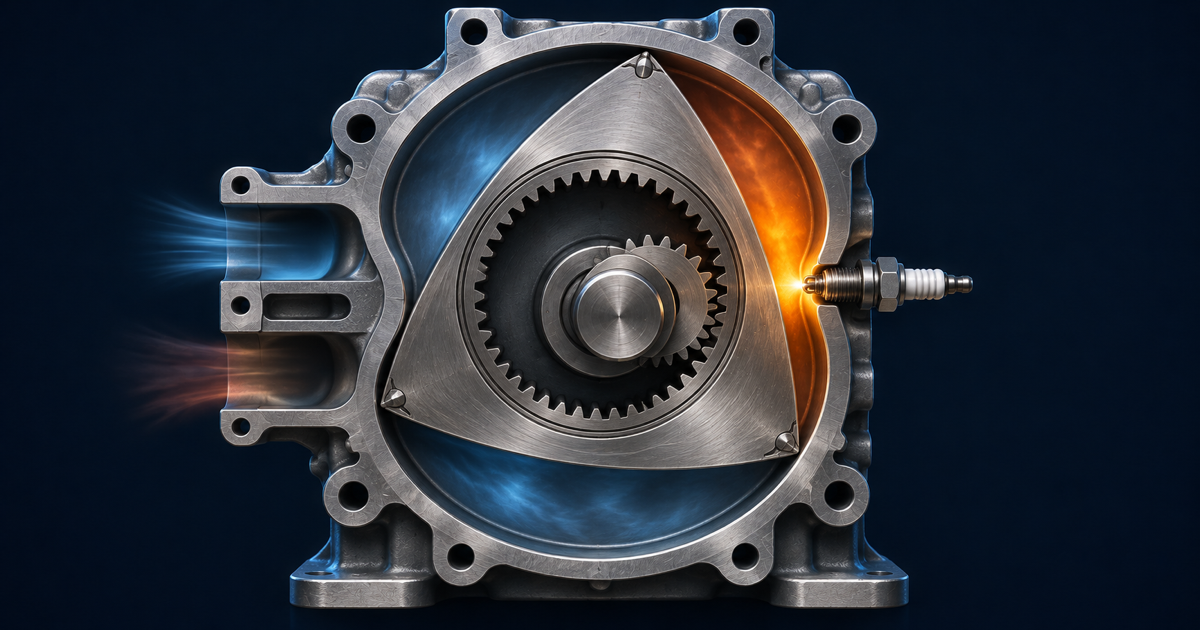
A rotary engine has no pistons, no connecting rods and no poppet valves. A triangular rotor turns inside a two-lobed housing with its three tips sealing against the wall, and the three spaces between rotor and wall do the work of cylinders. Each space grows and shrinks as the rotor turns, and mixture, spark and exhaust pass through it in order.
That shape gives the Wankel its defining piece of arithmetic: one power pulse per rotor per turn of the shaft. This article explains the mechanism, then tests what it buys. At the same two pulses per shaft turn and 4,000 rpm, the simulator's 1.3 L two-rotor swings between 18 and 445 N·m over a turn, while the 2.0 L inline-four swings between −153 and 675 N·m. The story of why the engine left the market and returned is in why the rotary engine is coming back; this post covers the mechanism.
Key Takeaways
- A Wankel is one triangular rotor in a two-lobed housing, forming three chambers. Each chamber takes in, compresses, burns and exhausts a charge as it travels round.
- The output shaft turns three times per rotor revolution, with three power pulses in that revolution. That works out to one pulse per rotor per shaft turn, against one per two turns for a four-stroke cylinder.
- At equal pulses per turn the rotary's torque is far smoother in our model: peak torque is 2.31× the mean on the two-rotor against 3.75× on the inline-four. Swapping the engines' burns barely moves that, which points to stroke length, 270° of shaft per process against 180°. The finding covers torque only; the model has no vibration output.
- Porting changes the idle far more than the power in the model: side port to peripheral lifts peak power 2.3% while complete idle burns fall from 100% to 41%.
- Oil burn, apex seal wear, emissions and quench come from published sources here. The simulator models none of them.
On this page: Quick answer · What is a rotary engine · The three chambers · Rotary vs piston · Porting · Oil and apex seals · Try it in the simulator · FAQ · How these numbers were made
Quick Answer: How Does a Rotary Engine Work
A rotary engine turns burning fuel into shaft rotation with a spinning rotor in place of pistons. The rotor is a rounded triangle riding on an eccentric lobe of the output shaft, inside a housing whose epitrochoid shape defines two lobes. Its tips stay against the wall, which divides the housing into three working chambers. As the rotor turns, each chamber swells to draw in mixture, shrinks to compress it, takes a spark near its smallest volume, swells again under combustion pressure, and shrinks to push the exhaust out through a port.
The rotor's rotation completes all phases of the combustion cycle, and the three chambers run that sequence a third of a rotor turn apart, so one fills while another fires. DieselNet's engineering summary gives the two numbers that matter: the output shaft turns three times for each revolution of the rotor, and there are three power pulses per rotor revolution. Dividing one by the other gives one power pulse per rotor per shaft turn. That last step is our arithmetic on the sourced figures. A four-stroke cylinder fires once every two shaft turns, so each rotor pulses twice as often as a cylinder.
What Is a Rotary Engine
In a car, "rotary engine" means the Wankel: an internal combustion engine whose main moving parts turn in one direction and never reverse. It uses ports in the housing where a four-stroke uses poppet valves, and the rotor itself opens and closes them as it passes.
The design first ran at NSU on February 1, 1957, and the NSU Spider became the first production car with a single-rotor Wankel. Mazda signed its licence with NSU in 1961 and carried the engine furthest. Its Cosmo Sport launched in May 1967 as the first dual-rotor car, the RX-7 followed in March 1978 and the RX-8 in April 2003, and a rotary won Le Mans in 1991.
The RX-8's engine shows the scale of a production rotary: two rotors of 654 cc, rated in its Type S form at 184 kW at 8,500 rpm and 216 N·m at 5,500 rpm. RX-8 production ended in June 2012.
The newest Mazda rotary, the 8C, is an 830 cc single rotor with a 120 mm radius and 76 mm width. It generates electricity in the MX-30 R-EV with no mechanical connection to the wheels, and Mazda rates it at 53 kW and 112 N·m at 4,500 rpm. Its market position has since shrunk: electrive reported in January 2026 that the car was being phased out in Europe, with Japanese production temporarily suspended. Mazda's Vision X-Coupe carries a two-rotor rotary turbo, as a concept.
How the Three Chambers Share One Rotor
Follow one rotor face through one rotor revolution, the span the diagram below covers. The shaft turns three times while that happens, so a single face needs 1,080° of shaft to repeat its cycle, and each of the four processes gets 270°. A piston stroke gets 180° of crank. The torque measurements later in this article point to that extra 90°.
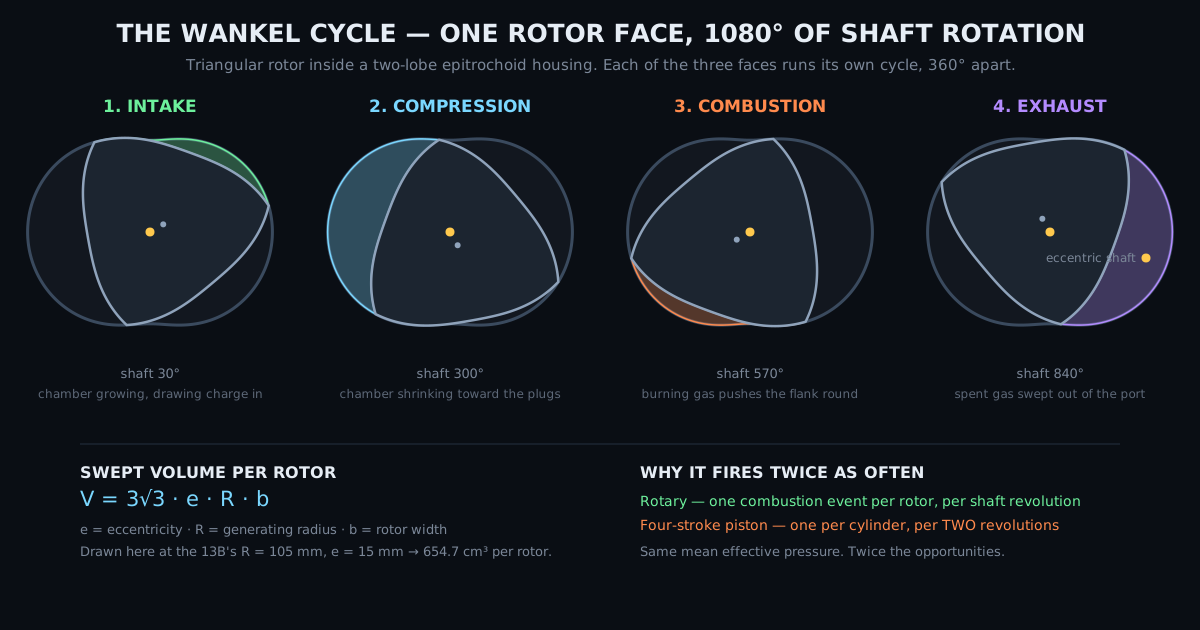
Drawn from the same epitrochoid and rotor-flank functions the simulator uses, at the 13B's dimensions.
Three faces run that cycle a third of a rotor turn apart, which is why every shaft turn brings one firing per rotor. On the two-rotor preset, each chamber swings between 727.5 and 72.7 cc in the model, a ratio of 10.00.
The simulator is built on the 3:1 shaft-to-rotor relationship. The ratio is a definition in the model, so the count below confirms its bookkeeping and cannot test the ratio itself. We counted fire events over 90 shaft turns at a held 4,000 rpm, wide open:
| Rotors | Fire events in 90 shaft turns | Per shaft turn | Spacing between firings |
|---|---|---|---|
| 1 | 90 | 1.000 | 360° |
| 2 | 180 | 2.000 | 180° |
| 3 | 270 | 3.000 | 120° |
| 4 | 360 | 4.000 | 90° |
That pulse rate explains the confusing displacement figures. Two rotors of 654 cc give 1.3 L of geometry, and a Jalopnik breakdown of rotary displacement gives 2.6 L as the four-stroke equivalent, because a two-rotor sweeps its 1.3 L every shaft turn where a four-stroke sweeps its displacement every two. The pulse rate also picks the fair opponent: a two-rotor against an inline-four, and a three-rotor against an inline-six. The order those pulses arrive in is the subject of our guide to firing order.
Rotary Engine vs Piston Engine
A rotary makes more power per nominal litre and less pressure per unit of swept volume. These are the model's figures, with engines paired by pulses per shaft turn. BMEP, the mean effective pressure, uses T·2π/Vd for the rotary and T·4π/Vd for the four-stroke, and peak rpm is approximate because the curves are flat there.
| Engine | Displacement | Peak power | Peak torque | BMEP | hp per nominal litre |
|---|---|---|---|---|---|
| 2-rotor | 1,309 cc | 159.1 hp at about 6,917 rpm | 193.1 N·m at about 4,067 rpm | 9.26 bar | 121.5 |
| 2.0 L inline-four | 1,998 cc | 116.4 hp at about 7,200 rpm | 179.4 N·m at about 4,025 rpm | 11.28 bar | 58.3 |
| 3-rotor | 1,964 cc | 237.6 hp at about 6,817 rpm | 289.3 N·m at about 4,154 rpm | 9.25 bar | 120.9 |
| 3.0 L inline-six | 2,993 cc | 193.5 hp at about 5,200 rpm | 280.1 N·m at about 4,375 rpm | 11.76 bar | 64.7 |
Most of the per-litre gap is the pulse rate. Rate the two-rotor at doubled displacement and its 159.1 hp over 2.62 L is 60.7 hp per litre, inside the range of the piston engines at 58.3 to 64.8. At near-equal nominal displacement the three-rotor makes 289.3 N·m against the four's 179.4, which is 61% more, and it does so from the same swept volume used more often.
Torque over one shaft turn
The rotary's measured edge shows up inside a single turn. At 4,000 rpm and wide open, the two engines deliver almost the same mean torque from the same two pulses, and the shapes differ sharply.
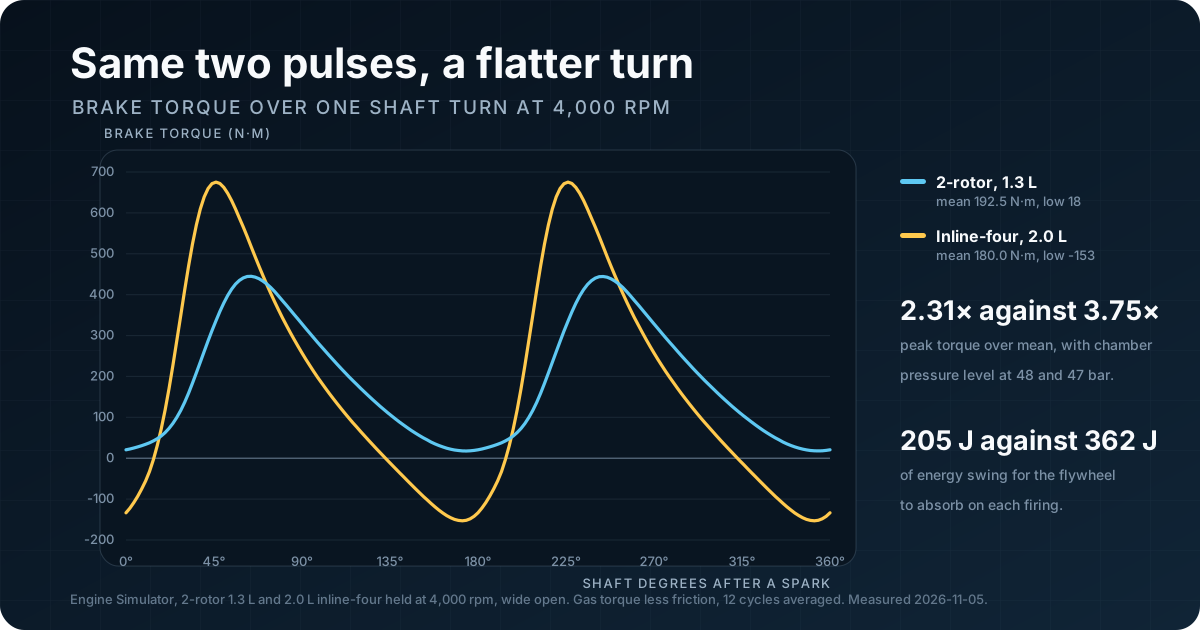
| Engine at 4,000 rpm, wide open | Pulses per turn | Mean N·m | Peak N·m | Lowest N·m | Peak ÷ mean | Degrees below zero | Flywheel swing J |
|---|---|---|---|---|---|---|---|
| 2-rotor | 2 | 192.5 | 445 | 18 | 2.31 | 0% | 205 |
| 2.0 L inline-four | 2 | 180.0 | 675 | −153 | 3.75 | 34% | 362 |
| 3-rotor | 3 | 288.3 | 469 | 143 | 1.63 | 0% | 109 |
| 3.0 L inline-six | 3 | 279.9 | 696 | −29 | 2.49 | 15% | 230 |
| 5.0 L V8 | 4 | 444.7 | 832 | 137 | 1.87 | 0% | 174 |
Flywheel swing is the energy a flywheel has to absorb and give back over the cycle: the two-rotor asks for 0.57 of the four's. A rotary reaches a piston engine's peak-to-mean with one pulse fewer per turn: the two-rotor's 2.31 sits with the sixes at 2.42 to 2.49, and the three-rotor's 1.63 beats the V8's 1.87.
Is it the burn or the geometry?
The rotary burns over 75° of shaft from 15° before top dead centre, and the four over 60° from 12° before, so a softer burn could have explained the whole result. We swapped the burns both ways:
| Arm, 4,000 rpm wide open | Mean N·m | Peak ÷ mean | Degrees below zero | Peak chamber bar |
|---|---|---|---|---|
| 2-rotor, stock burn | 192.5 | 2.31 | 0% | 48.3 |
| 2-rotor on the four's burn | 197.1 | 2.35 | 0% | 55.2 |
| 2.0 L four, stock burn | 180.0 | 3.75 | 34% | 47.3 |
| 2.0 L four on the rotary's burn | 163.5 | 3.62 | 34% | 39.0 |
The burn moves peak ÷ mean by 0.04 on the rotary and 0.13 on the four, a fraction of the gap between the engines. Stock peak chamber pressures are level at 48.3 and 47.3 bar, so the rotary's torque smoothness has nothing to do with burning gently. The same pair throttled to about 95 N·m at 3,000 rpm keeps the order, 2.61 against 4.18.
What remains points to stroke length. When the next rotor nears peak compression, the last still has 90° of expansion left. A four's expansion ends as the next cylinder reaches top of compression, and its torque spends a third of the cycle below zero.
All of this is torque. Neither family in the model carries reciprocating inertia torque, so the piston numbers leave out the very thing a rotor lacks, and the simulator has no vibration or balance output. These figures say nothing about how either engine shakes.
Fuel, in the model and in the world
Real rotaries are the thirstier engines. The EPA comparison in why the rotary died the first time has the RX-8 using more fuel than a 3.5-litre V6. A 2025 SAE study investigates how the chamber's surface-to-volume ratio feeds heat transfer and losses, though we would not hang the whole efficiency gap on that one ratio.
The model leans the same way at part load, and these figures are the model's only. At the same output and 3,000 rpm, the two-rotor's specific fuel consumption reads 3.6% above the four's at 30 kW and 10% above at 15 kW. It idles on 1.59 L/h against 0.75 L/h, which is 2.1×. Read those for direction only: the two families' combustion models differ, and neither sees the crescent chamber's quench or unburned fuel.
How Porting Changes a Rotary Engine
Ports are a rotary's valve timing, and in the model their placement changes the idle far more than the power. The preset's side ports, in the end plates, barely overlap intake with exhaust. A peripheral port, in the rotor housing, overlaps them for a long stretch. A Kawasaki patent describes the same trade: side ports for low-speed stability, peripheral ports for high power at high speed, with exhaust overlap at low speed as the cost. Japan's mechanical engineering society records combustion stability at idle as a rotary issue in its own right.
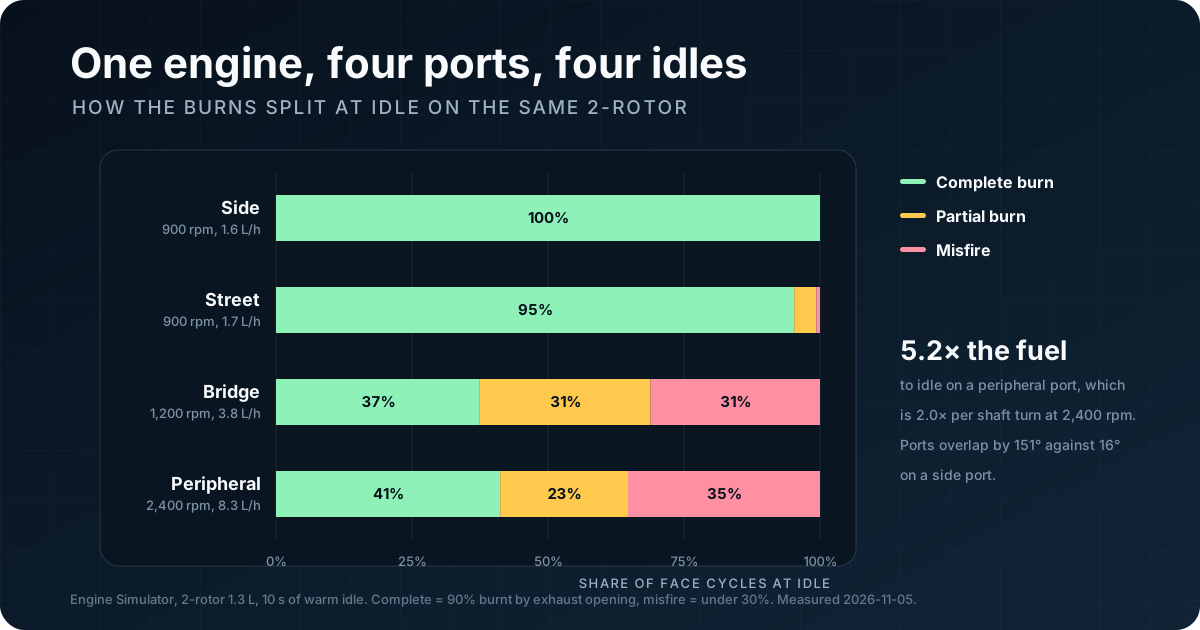
The model's numbers on the same two-rotor follow. Idle rpm is a set point the port pick writes, taken from published idles; the burn split, residual, scatter and fuel are measured at it. Peak power here is the on-screen dyno's reading, so the side port shows 159.2 hp where the table above prints 159.1.
| Port | Overlap | Idle rpm | Idle rpm range | Complete / partial / misfire | Residual gas | Idle L/h | Peak hp | N·m at 2,000 rpm |
|---|---|---|---|---|---|---|---|---|
| Side | 16° | 900 | 886–913 | 100% / 0% / 0% | 29% | 1.59 | 159.2 | 173.3 |
| Street | 23° | 900 | 842–941 | 95% / 4% / 1% | 35% | 1.73 | 160.2 | 168.1 |
| Bridge | 172° | 1,198 | 1,054–1,332 | 37% / 31% / 31% | 43% | 3.82 | 162.6 | 160.9 |
| Peripheral | 151° | 2,400 | 2,278–2,504 | 41% / 23% / 35% | 44% | 8.32 | 162.9 | 157.2 |
From side to peripheral, at idle set points of 900 and 2,400 rpm, complete burns fall from 100% to 41%, and torque at 2,000 rpm drops 9.3%. Torque at 7,000 rpm rises 2.3%, and so does peak power. Idle fuel multiplies by 5.2, of which 2.67× follows from the higher set point; per shaft turn the fuel is 1.96×, which follows from the higher idle MAP set point the pick also writes.
Treat that 2.3% as a limit of the model. All four options share the same port areas; the pick moves the angles and writes the idle target and MAP set point. Rotary residual gas does not displace charge at full throttle, so the power gain is timing alone with no bigger hole. It says nothing about what porting buys on a real engine. We found no primary source for bridge port figures, so that row is the model's result alone.
Why Do Rotary Engines Burn Oil and Wear Apex Seals
Everything in this section comes from published sources, because the simulator models none of it. Its seals are a fixed leakage area with no wear, chatter or failure, and it has no oil, no emissions and no quench.
An apex seal sits at each rotor tip and slides along the housing wall. That wall is also the wall the flame crosses, so whatever lubricates the seal shares the chamber with the charge. That path is our reading of the geometry; the sources confirm the outcomes. SAE's modelling of apex seal lubrication treats wear of the seal's running face as the problem to predict, and MIT's account of later rotary research names increased emissions and oil consumption among the costs of the classic layout.
The same MIT piece describes the combustion chamber as long and thin, like a crescent moon. That shape feeds the emissions side. SAE paper 780419, reported through TRID, attributes 22% of hydrocarbon emissions to apex seal leakage and also points to quench at the chamber surfaces, where the wall cools the mixture below the point it will burn. For the history of seal failures and Mazda's fixes, see the seal section of the comeback story.
Try It in the Simulator
Open the 2-rotor 1.3 L and press START. The spec panel's Working chambers row reads 6 faces. Set TIME SCALE to 0.1× to watch the rotor walk round its shaft, then press RUN DYNO and compare the curve with the 2.0 L inline-four. The on-screen dyno shows about 159.2 hp against 116.4 hp. The ripple figures came from a headless probe, so the dyno will not show them.
Step up the pulses with the 1-rotor and the 3-rotor, and listen to the note change at each firing rate. The 4-rotor has the pulse count of the 5.0 L V8, but it is calibrated to a Le Mans race engine and idles at 2,400 rpm, so keep it out of per-litre comparisons.
The port links below carry an edited spec:
- Street port on the 2-rotor (needs a free sign-in): the idle starts to lope at 900 rpm.
- Bridge port on the 2-rotor (needs a free sign-in): a lumpy idle near 1,200 rpm.
- Peripheral port on the 2-rotor (needs a free sign-in): the port pick sets a 2,400 rpm idle.
Frequently Asked Questions
Does a rotary engine have pistons or valves?
No. A triangular rotor replaces the pistons, and ports in the housing replace poppet valves. The rotor uncovers and covers the ports as it turns, so port position sets the timing.
How many power pulses does a rotary engine make?
One per rotor per shaft turn. The shaft turns three times per rotor revolution and there are three power pulses in that revolution. A two-rotor therefore pulses twice per shaft turn, the same as a four-cylinder four-stroke. The simulator counted 180 fire events in 90 turns on its two-rotor.
Is a rotary engine a two-stroke?
No. Each chamber runs four separate processes, intake, compression, combustion and exhaust, at 270° of shaft each. It shares a two-stroke's ports and its pulse rate of one per turn, which is where the comparison comes from.
Are rotary engines smoother than piston engines?
In torque, yes, in our model. At two pulses per turn and 4,000 rpm, peak torque is 2.31× the mean on the two-rotor against 3.75× on the inline-four. The model has no reciprocating inertia or vibration output, so it cannot measure how much either engine shakes.
Does Mazda still make rotary engines?
Its most recent rotary is the 8C, an 830 cc single rotor used as a generator in the MX-30 R-EV. In January 2026 electrive reported that car being phased out in Europe, with Japanese production temporarily suspended. Mazda's Vision X-Coupe with a two-rotor rotary turbo is a concept.
How These Numbers Were Made
Every simulator figure comes from one headless run on 2026-11-05, repeated with byte-identical results. Peak figures are the 24-point dyno sweep the engine roster prints, and the port table uses the 40-point sweep the on-screen dyno runs. Ripple was measured at a held rpm, wide open, once the charge had settled: 1° steps over 12 full cycles folded onto one, with the display smoothing removed per step. As a control, the folded mean sits within 0.4% of a separately held average on every rotary and within 0.8% on the pistons printed here. Port idles ran for 10 seconds after a 10-second settle, and a burn counts as complete at 90% burnt by exhaust opening, misfire under 30%.
The model has limits. Chamber volume is one cosine harmonic of the true trochoid, and wall heat is one lumped coefficient. Combustion is a flat 0.75 of the fuel's heat, the spark is fixed at 15° before top dead centre at every rpm and load, and fuel is always stoichiometric gasoline, with no flame travel across the crescent. Ripple is gas torque less friction before any flywheel. We leave the model's full-throttle fuel figures out of this article because they run against the real engines. The 4-rotor's output comes from its race calibration, so it stays out of the per-litre comparisons.
About this article
Written by the team that builds the simulator and maintains its rotary model. The simulator numbers are the model's and are stated as such; the history, oil, seal and emissions material comes from the sources below, and each section says which is which.
Sources and Further Reading
- US patent 8985085B2 (housing shape and working chambers, retrieved 2026-11-05)
- US patent 8720898B2 (shaft and rotor speed, retrieved 2026-11-05)
- DieselNet: alternative engines (retrieved 2026-11-05)
- Audi (2023): The NSU Wankel Spider (retrieved 2026-11-05)
- Mazda UK (2020): A century of defying convention (retrieved 2026-11-05)
- Mazda: Cosmo Sport history (retrieved 2026-11-05)
- Mazda (2007): press release on the Cosmo Sport (retrieved 2026-11-05)
- Mazda (2023): Rotary engine vehicle total production surpasses two million units (retrieved 2026-11-05)
- Mazda (2003): Begins production of RENESIS (retrieved 2026-11-05)
- JSAE: 13B-MSP engine specification (retrieved 2026-11-05)
- Jalopnik (2026): rotary displacement against piston engines (retrieved 2026-11-05)
- SAE 780419, via TRID: rotary engine hydrocarbon emission sources (retrieved 2026-11-05)
- MIT News (2014): LiquidPiston's small, efficient rotary engine (retrieved 2026-11-05)
- SAE 2015-01-2035: Modeling Rotary Engine Apex Seal Lubrication (retrieved 2026-11-05)
- SAE 2025-01-8357: Surface area to volume ratio and heat losses in Wankel rotary engines (retrieved 2026-11-05)
- US patent 3991722A (Kawasaki): side and peripheral porting (retrieved 2026-11-05)
- JSME: rotary engine award record (retrieved 2026-11-05)
- Mazda UK (2023): MX-30 e-Skyactiv R-EV revealed (retrieved 2026-11-05)
- Mazda Japan (2023): MX-30 Rotary-EV release (retrieved 2026-11-05)
- electrive (2026): Mazda discontinues the MX-30 R-EV from the market (retrieved 2026-11-05)
- Mazda (2025): Vision X-Coupe at Japan Mobility Show (retrieved 2026-11-05)