Why the Rotary Engine Is Coming Back (and Why It Left)
Mazda stopped building rotary engines in 2012 and restarted in 2023. Why the Wankel returned as a generator, what killed it, and what the numbers show.
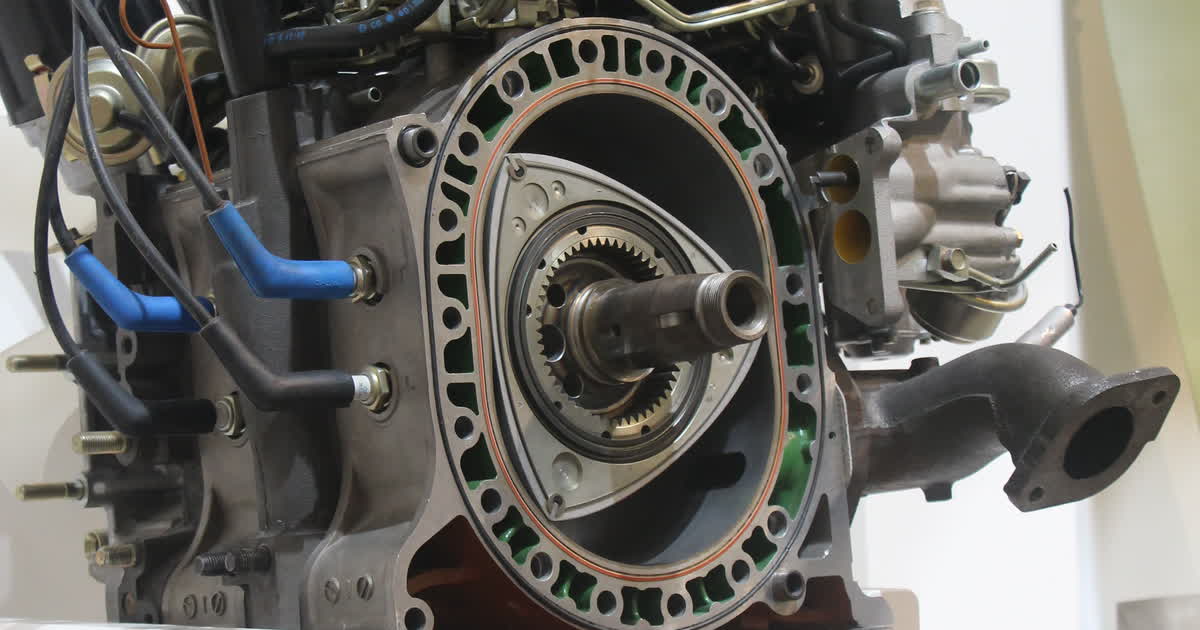
Above: a Mazda 13B sectioned through one rotor housing, at the Deutsches Museum. The rotor has been removed, so you are looking at the empty two-lobe bore, its orange sealing bead, the green coolant passages in the housing wall, and, at the centre, the eccentric shaft and the fixed stationary gear the rotor would mesh with. (Photo: Wikisympathisant, CC BY-SA 4.0, cropped)

In June 2012 Mazda built the last RX-8 and the rotary engine stopped. Eleven years later, in June 2023, it started again, as a generator bolted to an electric motor rather than in a sports car.
Then it kept going. In February 2024 Mazda put a dedicated rotary development group back together. In October 2025 it showed a concept with two rotors and a turbocharger.
This is a good moment to ask what the rotary is good at, what killed it the first time, and whether any of that has changed.
Quick Answer: Why Is the Rotary Engine Coming Back?
Because it is small. A rotary makes a lot of power for its size and weight, and it runs smoothly at whatever speed the control system picks for it, which is what a range-extender generator wants. The things that killed it in a car (fuel consumption, emissions, a narrow efficient operating band) matter less when the engine drives a generator rather than the wheels, and when the system can hold it near its best operating point instead of following a driver's foot.
Mazda's returning rotary is a generator first. The sports car is a concept.
How a Rotary Engine Works
A piston engine does four jobs (intake, compression, combustion, exhaust) in one place, one after another, with the piston reversing direction twice per stroke. A four-stroke piston engine spends most of its life converting reciprocating motion into rotation and cancelling out the vibration that creates.
A Wankel does the same four jobs in four different places, continuously, with no major moving mass reversing direction.
A triangular rotor turns inside a housing shaped like a two-lobed curve called an epitrochoid. The three tips of the rotor stay in contact with the housing wall, so the rotor divides the housing into three separate chambers. As it turns, each chamber grows and shrinks. One chamber is drawing in air while another is compressing, a third is burning, and the first is exhausting, all at once, in fixed locations around the housing.
Look again at the cutaway at the top of this page. The rotor is missing from it, which helps: the toothed gear around the eccentric shaft is the stationary gear, bolted to the side housing and going nowhere. The rotor carries an internal ring gear that meshes with it, and walking around that fixed gear holds the rotor to one third of shaft speed.
The same geometry as a cycle, with one rotor face highlighted through all four phases:
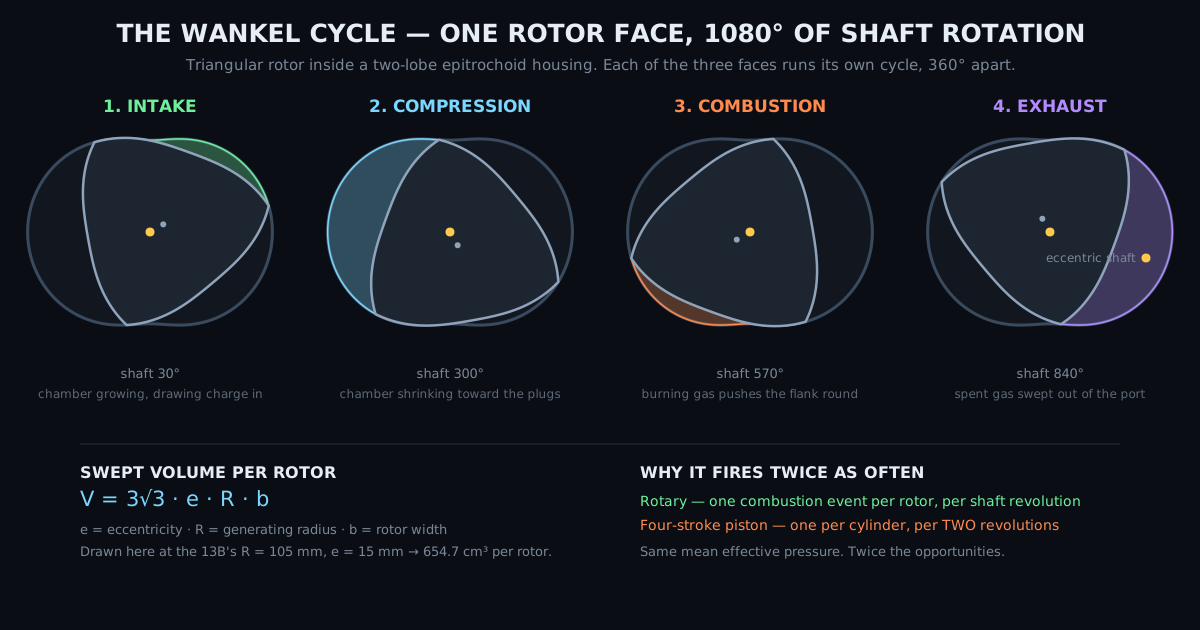
Drawn from the same epitrochoid and rotor-flank functions the simulator on this site uses, at the 13B's dimensions.
Two consequences fall out of that geometry, and they explain nearly everything else about the engine.
One: there are few major moving parts. A two-rotor engine has three: two rotors and the eccentric shaft they turn. No valves, no camshafts, no timing belt, no connecting rods, no reciprocating mass to balance. (Three is the count of major parts, not of everything that moves: the seals move too, and apex seals do reciprocate radially in their grooves, which is why their springs matter. No major mass reverses direction, though. There is no piston to stop dead and send back the other way twice per revolution.)
Two: each rotor fires once per shaft revolution. Follow one face: it completes its whole four-phase cycle in one rotor revolution, and since the rotor turns at a third of shaft speed, that face fires once every three shaft revolutions. There are three faces, evenly spaced. Three faces firing once per rotor revolution is three combustion events per three shaft revolutions, one per shaft revolution, per rotor. A four-stroke piston engine fires once every two revolutions. That difference carries the whole displacement argument below.
A rotary's cycle is therefore described as 1080 degrees of eccentric-shaft rotation rather than the piston engine's 720, and that is what the simulator on this site integrates: three chambers per rotor, each tracked separately around a 1080° cycle.
The Dimension Mazda Did Not Publish
You can check this one yourself.
Three dimensions fix the swept volume of one rotor chamber: the eccentricity e (how far the rotor's centre is offset from the shaft), the generating radius R (rotor centre to tip), and the rotor width b:
V = 3 · √3 · e · R · b
Mazda's press material for the new 8C engine in the MX-30 e-Skyactiv R-EV says it is "a 830cc single rotor with a 120mm rotor radius and 76mm rotor width." Two of the three dimensions, and the answer.
It does not give the eccentricity.
So solve for it. At exactly 830 cc, e comes out at 17.515 mm. If "830 cc" is a rounded figure covering 825–835 cc, e lies between 17.41 and 17.62 mm.
There is a way to test whether that is trustworthy. The RX-8's RENESIS is commonly quoted at e = 15 mm, R = 105 mm, b = 80 mm, dimensions Mazda does not publish either, so treat them as unverified inputs. Put them into the formula:
3 · √3 · 0.015 · 0.105 · 0.080 = 654.7 cm³ per rotor
Mazda's own release for RENESIS states "each with a displacement of 654cc."
Three unofficial dimensions, pushed through the formula, land on the one number Mazda does publish, to about a tenth of a percent. (654.7 against 654: close, though it rounds to 655, so Mazda's figure looks truncated rather than rounded.)
One caveat about that check, because it is the kind of thing that is easy to wave through. Those three dimensions are widely repeated but their provenance is not established here. If whoever first published them had themselves worked backwards from Mazda's 654 cc through this same formula, then the agreement is circular and demonstrates nothing. The check is worth something only to the extent that the dimensions came from measurement rather than from arithmetic, and this article cannot prove that. Treat it as supporting evidence rather than validation.
That derived 17.5 mm is not a Mazda figure. It is what Mazda's two published dimensions require, given the geometry.
Why a 1.3-Litre Makes the Power of a 3.0
The RX-8 was sold as a 1.3-litre. It made, in Mazda's Japanese-market figures for the 2003 launch, 154 kW (210 PS) at 7,200 rpm in standard form and 184 kW (250 PS) at 8,500 rpm in high-power form.
That looks like a violation of something. It is a bookkeeping question, and the answer is the firing rate.
Brake mean effective pressure (BMEP) is the fair way to compare engines of different sizes: it is the average pressure that would have to act on the working volume to produce the observed torque. For a four-stroke piston engine, which fires once every two revolutions, that is T · 4π / Vd. For a rotary, which fires once per shaft revolution per rotor, it is T · 2π / Vd.
For reference against that 154 kW: the simulator's two-rotor makes 159.0 hp, or 118.6 kW, about 23% under Mazda's standard-output RENESIS. The preset is calibrated to an older engine, the naturally aspirated 13B in the 1989–91 RX-7, rated at 160 hp, so the gap is fourteen years of development, and it is worth keeping in mind while reading the table. These are the model's numbers, not manufacturer data:
| Engine | Displacement | Peak power | Peak torque | BMEP |
|---|---|---|---|---|
| 2-rotor rotary | 1,309 cc | 159.0 hp @ 7000 | 193.0 N·m @ 4250 | 9.26 bar |
| Inline-4 piston | 1,998 cc | 115.7 hp @ 5000 | 179.6 N·m @ 4000 | 11.30 bar |
| V6 piston | 2,986 cc | 193.6 hp @ 7500 | 283.0 N·m @ 4250 | 11.91 bar |
| Inline-6 piston | 2,993 cc | 193.4 hp @ 5250 | 280.2 N·m @ 4250 | 11.77 bar |
The BMEP column does not favour the rotary. It extracts less from each unit of working volume than a piston engine does: 9.26 bar against 11.30 to 11.91, about a fifth less, which is what calibrating to Mazda's published 13B figures carries in. It uses that volume twice as often.
Read the power column instead. The 1.3-litre rotary makes 82% of the inline-six's power from 44% of its displacement. That is the rotary proposition. It is also the reasoning behind the long-standing motorsport convention of rating a rotary at twice its nominal displacement: a 1.3 rotary is put in with 2.6-litre four-strokes because it fires as often as one. (No primary rulebook citation is offered for that convention here, so treat the equivalence factor as the widely-used rule of thumb it is rather than a sourced regulation.)
Beware of anyone quoting a rotary's BMEP as double a piston's. That number appears only when the rotary's 2π convention is applied to a four-stroke engine. Using the wrong convention, the inline-four above would read 5.65 bar instead of 11.30, a units mistake.
Why It Died
Four reasons, and apex seals alone are not one of them.
It used too much fuel. This one is easy to verify and hard to argue with. From the US EPA's own database, both cars on premium fuel, both six-speed manuals, both 2004 model year:
| Car | Engine | Combined | City | Highway |
|---|---|---|---|---|
| Mazda RX-8 | 1.3 L rotary | 18 mpg | 16 | 22 |
| Nissan 350Z | 3.5 L V6 | 20 mpg | 18 | 24 |
A 1.3-litre burning more fuel than a 3.5-litre. The geometry does that, not the tuning.
The combustion chamber is the wrong shape. A piston engine burns its charge in a compact space with a spark roughly in the middle. A rotary's chamber is a long, thin crescent that is also moving, and the flame has to travel from one end of it to the other. A long thin chamber has far more wall area per unit of volume than a compact one, so more heat leaks into the housing, and the mixture nearest the walls is chilled below the temperature it needs to burn. What does not burn leaves as unburned hydrocarbons. Mazda's Le Mans R26B ran three spark plugs per rotor. Mazda states that as a fact and gives no reason for it; tying it to the flame-travel problem above is this article's inference, not Mazda's claim. That the combustion geometry is hard is not in doubt: NASA funded work on stratified-charge rotary combustion and on three-dimensional modelling of the combustion process, both reported at the end of the 1980s.
Seals. The part most people have an opinion about, a 13B apex seal next to its key:
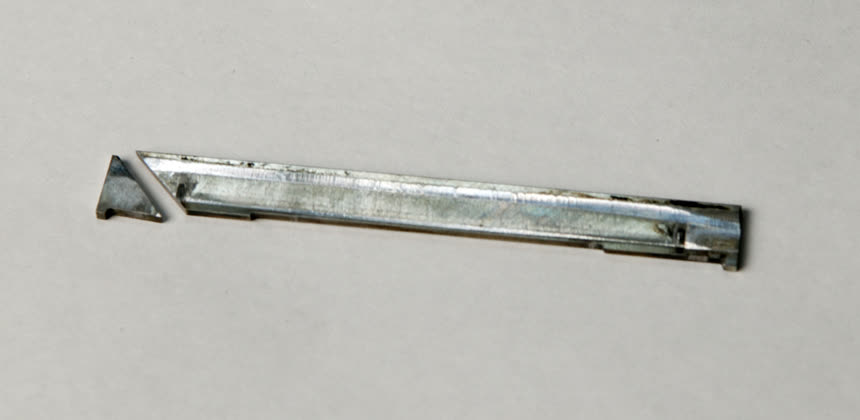
A 13B apex seal and key. Three of these, one per rotor tip, do the job a piston engine gives to a set of circular rings. (Photo: 天然ガス, CC BY-SA 3.0)

The rotor tips have to seal against the housing across the whole face, at every position, while sliding. Mazda's early production engines developed wear scars on the housing surface, known as "chatter marks", and solving them, through changes to apex-seal material and design under the rotary programme Kenichi Yamamoto led, made the engine saleable. The standard account attributes the marks to a seal resonance within the operating range; that detail is recorded in Yamamoto's Rotary Engine (1981), the primary reference for this period, but the scan is borrow-only and could not be opened to verify it for this article. The reputation outlived the problem by decades, but the underlying difficulty is real: a piston engine's rings seal a circle that never changes shape, and a rotary's seals do not have that luxury.
Emissions rules tightened faster than the fixes arrived. Unburned hydrocarbons are what emissions regulations target, and the rotary starts with a structural disadvantage there. Production ended in June 2012, and nothing replaced it for eleven years.
Why It Is Back
A generator is a different job.
June 2023: production restarts. Mazda began mass production of the MX-30 e-Skyactiv R-EV at Ujina Plant No. 1, its "first mass-production rotary engine vehicle in 11 years since the Mazda RX-8 was discontinued in June 2012." The car is an electric vehicle with a 17.8 kWh battery and 85 km of WLTP electric range, plus a 50-litre fuel tank and the 8C rotary turning a generator.
The 8C is where the packaging argument shows up as hardware. Mazda's press material describes it as aluminium and "over 15kg lighter than the twin-rotor Renesis engine used in the RX-8," with the engine, motor, generator and reduction gear on one axis inside a unit "less than 840mm" wide, narrow enough to fit under the existing bonnet without changing the body frame. Direct injection and exhaust gas recirculation are both fitted.
The job changed. A range-extender engine runs where the control system puts it rather than where a driver's right foot puts it, and it only runs when the system asks for charge. It spends far less of its life at the throttle openings and transients where a rotary is worst. You get the compactness and avoid much of the penalty.
February 2024: the engineers come back. Mazda reinstated its RE Development Group inside the Powertrain Technology Development Department after nearly six years, staffed with 36 engineers, to work on rotaries as generators, on meeting regulations, and on carbon-neutral fuels. Chief technology officer Ichiro Hirose: "In Mazda's history, the rotary engine is a special symbol of our 'challenger spirit.'"
October 2023: the sports car concept. The Iconic SP is a two-rotor rotary EV system: 370 PS, 1,450 kg, roughly 50:50 weight distribution, with the rotary generating electricity rather than driving the wheels. Mazda notes the engine "can burn various fuels such as hydrogen." It is a concept. Mazda has issued no production announcement for it. The motoring press has quoted company executives expressing intent to build it, which is a statement of ambition rather than a commitment, and not the same thing as a product Mazda has announced.
October 2025: two rotors and a turbo. The Vision X-Coupe, also a concept, uses "a plug-in hybrid system integrating a two-rotor rotary turbo engine with a motor and battery": 510 PS, 160 km on the motor alone, up to 800 km combined, running carbon-neutral fuel derived from microalgae alongside Mazda's Mobile Carbon Capture technology.
For scale on what the architecture can do when nobody is worrying about fuel bills: the R26B that won Le Mans outright in 1991 was four rotors of the same 654 cc, making 700 PS at 9,000 rpm with three plugs per rotor and peripheral fuel injection.
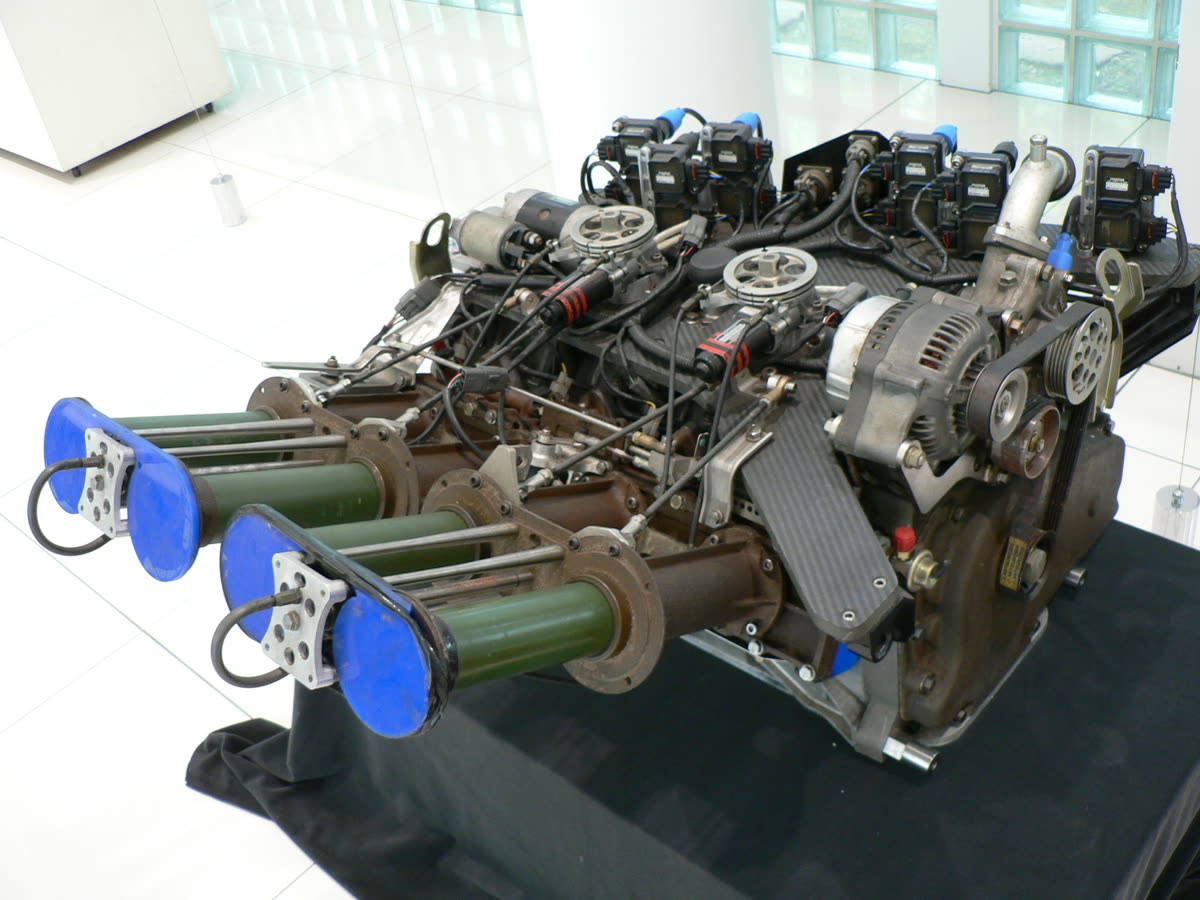
The R26B. The four blue-capped tubes on the left are its variable-length intake trumpets; the row of coils along the top is what three spark plugs per rotor looks like. (Photo: 160SX, CC BY-SA 3.0)

Try It in the Simulator
Everything below runs in the browser, on this site, with no download. The simulator models the Wankel cycle directly: three chambers per rotor, tracked around a 1080° eccentric-shaft cycle.
Build the 8C from Mazda's own dimensions. Open the single-rotor Wankel. That link is already set to a 120 mm generating radius, 76 mm rotor width and the 17.5 mm eccentricity derived above. The spec panel reads 829.3 cc against Mazda's published 830. Nothing else about the preset was changed, so its compression ratio is the simulator's default 10:1, not Mazda's (which they do not publish).
That engine makes 91.4 hp (68.2 kW) at 6,750 rpm on the dyno here. Do not read that as the 8C's output. No power figure for the 8C appears on any Mazda page consulted for this article (the kW and PS figures in Mazda's MX-30 material describe the electric motor and the system, not the rotary), while figures circulating in the motoring press put the engine nearer 55 kW. If that press figure is right, the simulator reads about 1.2× high, and the direction is no surprise, because these are not the same measurement. This is a wide-open-throttle sweep of a generic single-rotor model; Mazda rates the real engine where a generator runs it, with direct injection and exhaust gas recirculation this model does not simulate. The sign of that gap is defensible, its size is not, and the meaningful number here is 829.3 cc.
Watch the firing rate argument. Run the dyno on the 2-rotor 1.3 L and then on the inline-six 3.0 L. 159.0 hp against 193.4 hp, from less than half the displacement. Then compare their BMEP: the rotary's is about a fifth lower.
Add rotors. The 1-rotor, 2-rotor and 3-rotor presets step 80.4 → 159.0 → 237.5 hp, three times the power from three times the rotors, while BMEP stays within 0.05 bar across the three. Power scales; specific output barely moves. The 4-rotor stays out of that ladder, for the reason below. The sound changes in character: a two-rotor fires twice per shaft revolution, a three-rotor three times.
The 4-rotor is the same 654 cc × 4 architecture as the Le Mans R26B, and it is calibrated to that engine: 689.5 hp at 9,000 rpm against the race engine's 700 PS, which is 690 hp, and 603 N·m against the 608 that SAE paper 920309 gives. It runs Mazda's factory peripheral-port timing, since the R26B's was never published, and idles rough at 2,400 rpm. It does not model three-plug ignition or the variable-length intake; the calibration stands in for both.
Look at the seal leakage row. The rotary spec panel has a Seal leakage control, expressed as an equivalent leakage area past the apex and side seals. It models efficiency loss. It is not a wear model, and it will not simulate an engine destroying its seals over time. The seal model has no memory: set it and it stays there.
What This Model Does and Does Not Do
The rotary here is a reduced-order teaching model, not manufacturer data. Where a number in this article comes from the simulator, the text says so; where it is a real-world figure, we cite it.
Four limits, stated plainly:
- Seal leakage is a fixed equivalent area, not wear. It relaxes chamber pressure toward housing pressure at a rate you set. Across the range the panel allows, its effect on peak power is well under one percent. It cannot show you a failing engine.
- Forced induction is sized, not calibrated. A turbo or blower can be fitted to the rotary, sized by the same law as the piston engines', but no preset is checked against a real turbocharged rotary. The Vision X-Coupe's two-rotor rotary turbo, the newest engine in this article, is outside what the model can claim to represent.
- No hydrogen. The fuels available are gasoline, diesel and LPG. Mazda's hydrogen rotary work is cited here, not simulated.
- Emissions are not modelled. The unburned-hydrocarbon problem described above is the reason the rotary struggled with regulation, and this simulator has nothing to say about it quantitatively.
Rotary Engine FAQs
Why is a 13B called 1.3 litres if it makes the power of a 2.6?
Because displacement counts swept volume, and rating conventions count firing opportunities. A two-rotor 13B sweeps 654 cc per rotor, 1,308 cc total. (The simulator computes 1,309 cc from the geometry rather than from Mazda's rounded 654; the difference is rounding.) Each rotor fires once per shaft revolution where a four-stroke piston fires once per two, so the engine gets through its working volume twice as often as a piston engine of the same nominal size. The motorsport rule of thumb of rating a rotary at doubled displacement follows from that, though no primary rulebook citation is offered for it here. Measured properly, the rotary's mean effective pressure is, if anything, below a piston engine's; its firing rate is what doubles.
Do rotary engines really blow their apex seals?
The reputation dates from a real problem that Mazda solved a long time ago. Its early production rotaries developed wear scars called chatter marks, traced to apex seals hitting a resonance within the operating range, and fixed with changes to seal material and design. Sealing a rotary is harder than sealing a piston, because the seals slide across the whole housing wall rather than riding in a cylinder of constant shape, but "they all blow their seals" is folklore rather than a specification. Mazda has built over two million rotary vehicles.
Why do rotary engines use so much fuel?
Chamber shape, mostly. The combustion chamber is a long thin crescent with a lot of wall area relative to its volume, so it loses more heat to the housing and quenches the mixture near the walls, leaving unburned fuel. The flame also has a long way to travel. The EPA rated the 2004 RX-8 at 18 mpg combined against 20 mpg for a 3.5-litre Nissan 350Z of the same year: a 1.3-litre using more fuel than a 3.5-litre.
Is the rotary engine coming back in a sports car?
Mazda has not confirmed one. It has shown two rotary sports-car concepts, the Iconic SP in 2023 and the Vision X-Coupe in 2025, and has restarted rotary engineering with a dedicated 36-person group. The engine in production is the MX-30 e-Skyactiv R-EV's, where the rotary drives a generator. Mazda has announced no production sports car. Executives have been quoted expressing intent, which is not the same as a committed model.
What is the 8C rotary engine?
Mazda's current production rotary, used in the MX-30 e-Skyactiv R-EV as a range-extender generator. It is a single rotor of 830 cc with a 120 mm rotor radius and 76 mm rotor width, built with aluminium to come in over 15 kg lighter than the RX-8's two-rotor Renesis, with direct injection and exhaust gas recirculation. It sits on one axis with the motor and generator in an assembly under 840 mm wide.
Sources and Further Reading
- Mazda: MX-30 e-Skyactiv R-EV mass production launched (first rotary in 11 years; Ujina Plant No. 1)
- Mazda UK press: Mazda starts mass production of the MX-30 e-Skyactiv R-EV (8C: 830 cc, 120 mm rotor radius, 76 mm width, aluminium, DI and EGR)
- Mazda: MX-30 e-Skyactiv R-EV revealed in Europe (17.8 kWh battery, 50 L tank, 85 km EV range)
- Mazda: Accelerates R&D of Rotary Engines Adapted to New Era (RE Development Group, 36 engineers, Hirose quote)
- Mazda: Releases All-New Four-Door Four-Seater Sports Car (RENESIS output, Japanese-market figures; side intake and exhaust ports)
- Mazda: Begins production of RENESIS ("each with a displacement of 654cc")
- Mazda: unveils MAZDA ICONIC SP compact sports car concept (two-rotor rotary EV system, 370 PS, 1,450 kg, hydrogen capability)
- Mazda: Presents World Premiere of Two Vision Models at Japan Mobility Show 2025 (Vision X-Coupe, two-rotor rotary turbo, 510 PS)
- Mazda: Transformation of the racing rotary engine (R26B) (654 cc × 4 rotors, 700 PS @ 9,000 rpm, 1991 Le Mans)
- Mazda: Rotary engine vehicle total production surpasses two million units
- US EPA / DOE: Fuel economy of the 2004 Mazda RX-8 (18 combined / 16 city / 22 highway)
- US EPA / DOE: Fuel economy of the 2004 Nissan 350Z (20 combined / 18 city / 24 highway)
- NASA CR-197985: Stratified charge rotary engine combustion studies
- NASA TM-102469: Analysis of rotary engine combustion processes
- Kenichi Yamamoto, Rotary Engine (1981) (chatter marks, apex seal development, peritrochoid geometry)
Image credits
- Sectioned 13B at the Deutsches Museum: Wikisympathisant, CC BY-SA 4.0, cropped to 1200×630
- 13B apex seal and key: 天然ガス, CC BY-SA 3.0
- Mazda R26B engine: 160SX, CC BY-SA 3.0, resized
- Wankel cycle diagram: generated for this article from the epitrochoid and rotor-flank functions in this site's simulator