ROTARY · Wankel Rotary
Naturally Aspirated 1-Rotor 654cc
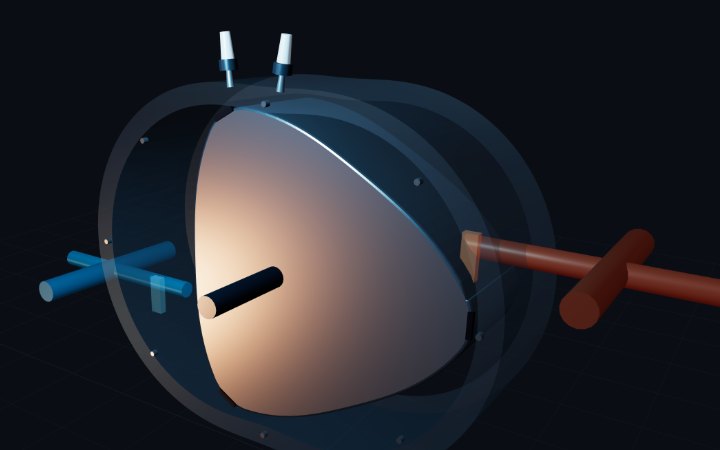
One rotor, three chambers, the smallest and revviest thing in the lineup.
The real engine
Same layout as the Mazda single-rotor test engines.
1 rotor · 655 cc · 9,000 rpm
 80hp
80hpPeak power
80hp
@ 6,988 rpm
Peak torque
97N·m
@ 3,969 rpm
Displacement
655cc
Nominal swept volume
Redline
9,000rpm
Specifications
- Rotors
- 1
- Chamber volume
- 655 cc
- One face of one rotor; three faces sweep per rotor
- Displacement
- 655 cc
- Nominal swept volume
- Generating radius
- 105.0 mm
- Eccentricity
- 15.0 mm
- Rotor width
- 80.0 mm
- Compression ratio
- 10.0:1
- Fuel
- Gasoline, 95 octane
- Induction
- Naturally aspirated
- Idle
- 950 rpm
- Redline
- 9,000 rpm
Measured on the dyno
Every point is a full sweep of this engine in the simulator, not a figure copied off a spec sheet.
What it is
The rotor radius is 105 mm, the eccentricity 15 mm, the rotor 80 mm wide, and those three dimensions give one chamber 654.7 cc on a compression ratio of 10:1. That chamber size sits about a tenth of a percent off the 654 cc Mazda publishes for one 13B rotor. Rotor count is where the two part company: one housing here, not two. The torque on the dyno comes out of a Wiebe heat release solved across a 1080 degree eccentric-shaft cycle, three chamber faces to the rotor, each face taking a 270 degree stroke.
One rotor fires once per turn of the eccentric shaft. The two-rotor fires twice and the four-rotor four times, and the gap between events is what your ear picks up first. This preset carries a 0.08 kg·m² flywheel, the lightest of the four rotaries; the two-rotor runs 0.12 and the four-rotor 0.2. It idles at 950 rpm where the two- and three-rotor idle at 900 and the peripheral-ported four-rotor at 2,400, and it runs to 9,000. With that little stored inertia the shaft answers the throttle at once and holds an idle less easily.
Nothing here opens a valve. The intake port is a hole in the side housing that a rotor face uncovers at 32 degrees of shaft angle and covers again at 320, and the exhaust port runs 738 round to 48, so you edit port timing in shaft degrees rather than camshaft duration. The two ports carry 5.5 and 6.5 square centimetres of flow area. You pay for the long thin chamber sweeping past them twice over: three quarters of the fuel's heating value resolves as gas heat, with quench and an unfinished trailing edge taking the rest, and the housing pulls another 6 watts per kelvin back out of the burn.
Things to try
- Set Generating radius to 120 mm, Rotor width to 76 and Eccentricity to 17.5. Displacement reads 829.3 cc against the 830 Mazda publishes for the 8C in the MX-30 range extender. Mazda gives the first two dimensions and no compression ratio, so leave Compression where it sits.
- Take Rotors from 1 to 2. The chamber keeps its size, displacement doubles to the 13B's 1.3 litres, and the shaft goes from one firing event per revolution to two. You hear the second one before you read the new number.
- Drag Seal leakage the full width of its slider, 0.01 to 20 mm². Almost nothing moves. The term models an efficiency loss rather than accumulating apex seal wear, and it only bites well past the top of that range.
Seen in
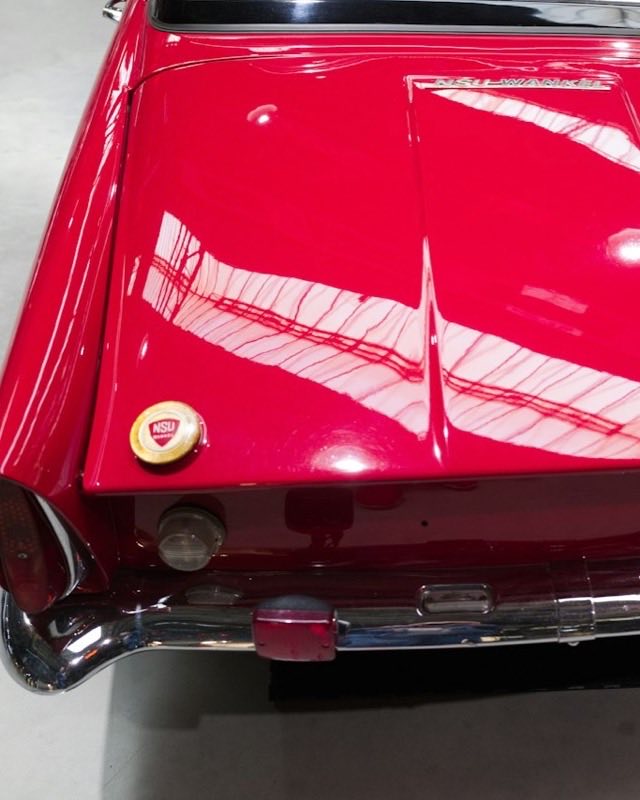
NSU Wankel Spider
Same layout1964–1967. The first Wankel-engined car sold to the public, and a single rotor at that, mounted behind the rear axle. Same layout, a different engine.
Photo: Georg Eiermann · Unsplash
Variants
Other Wankel Rotary engines in the simulator.
Two inline rotors, six moving chambers, and no pistons at all.
2 rotors · 1.3 L · 8,500 rpm
Three rotors stacked for a howl no piston engine can fake.
3 rotors · 2.0 L · 8,000 rpm
Four rotors, Le Mans pedigree, and a redline that keeps climbing.
4 rotors · 2.6 L · 9,000 rpm
More like this
Hear it run
It cranks, idles, revs and knocks in the browser. Nothing to download, nothing to install.