PISTON · W18
W18 6.3L
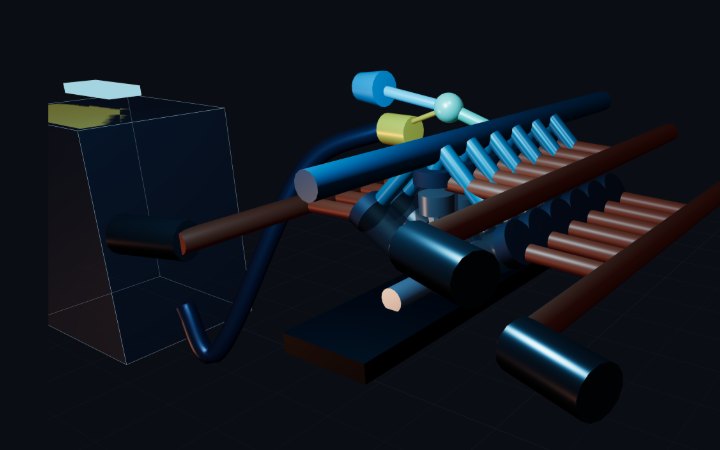
Three banks of six on one crank, the broad-arrow Bugatti drew before the W16.
The real engine
Same layout as the Bugatti 18/3 Chiron concept.
18 cyl · 6.3 L · gasoline
 493hp
493hpPeak power
493hp
@ 5,688 rpm
Peak torque
626N·m
@ 4,900 rpm
Displacement
6,255cc
6.3 litres
Redline
7,000rpm
Specifications
- Cylinders
- 18
- Layout
- W
- 120° between banks
- Bore × stroke
- 76.5 × 75.6 mm
- Displacement
- 6,255 cc
- 6.3 litres
- Compression ratio
- 11.0:1
- Conrod length
- 132.0 mm
- Firing order
- 1-8-15-4-11-18-7-14-3-10-17-6-13-2-9-16-5-12
- Cycle
- Four-stroke
- Fuel
- Gasoline, 95 octane
- Induction
- Naturally aspirated
- Idle
- 700 rpm
- Redline
- 7,000 rpm
Check these numbers in the engine displacement calculator, the bore and stroke calculator or the compression ratio calculator, with this engine already filled in.
Measured on the dyno
Every point is a full sweep of this engine in the simulator, not a figure copied off a spec sheet.
What it is
The bore is 76.5 mm, the stroke 75.6 mm and the compression ratio 11.0:1, which comes to 6,255 cc across eighteen cylinders. Bugatti's 18/3 Chiron concept of 1999 was a three-bank W18 of about 6.3 litres, and that is as far as the association goes: nobody has published a bore and stroke pair for the concept that holds up, so the geometry here answers the displacement and a sane rod ratio instead. The torque on the dyno comes out of a Wiebe heat release solved against crank-slider geometry, with the plenum, the runners and the collector filling and emptying around it.
The W in a Volkswagen W12 or a Bugatti W16 is two narrow-angle banks set at a wide vee: four cylinder rows, two heads, two exhaust manifolds. This is the other W. Three rows of six hang off one crankshaft with 120 degrees between the outer two, which puts the rows at minus 60, zero and plus 60 degrees, and eighteen power strokes arrive one every 40 degrees of crank rotation. Three rows, three banks, three heads. The middle one stands upright, over the crank, and the exhaust mix has to answer for it: the note comes out of two buses, one per side of the block, and a centreline head sits on neither side. Those six cylinders reach both buses at 0.7071 of full amplitude, an equal-power split rather than a level drop, and that rule went into the audio model for this layout alone.
11.0:1 is high, and on the 95 octane petrol the preset takes by default it costs this engine any chance of boost. Run the knock chain backwards from the fuel's threshold and an 11:1 engine holds about twelve kelvin of end-gas margin before it detonates, with no compressor anywhere near it. The ceiling here works out at 1.000 bar absolute, which is ambient air, so both FIT buttons in the spec panel sit greyed out reading TOO MUCH COMPRESSION FOR BOOST. The turbocharged straight-six on this roster runs 8.5:1 and the quad-turbo W16 9.0:1, and both gave that compression up to leave room for a compressor.
Things to try
- Take Compression down from 11.0:1 toward the 9.0:1 the quad-turbo W16 runs. The boost ceiling under the FIT buttons climbs as you go, and somewhere on the way down the buttons come back to life.
- Drag Cylinders and the three rows rebuild in the render, six stations to a row at eighteen. That count is past the stock spec editor's ceiling of sixteen, which is why this engine gets the wider table, and the wider table runs on to twenty-four.
- Push Stroke past the 75.6 mm it shares with a 76.5 mm bore. Displacement climbs, mean piston speed climbs with it, and friction gets charged on piston speed rather than rpm, so the top of the rev range hands back more of the gain than the bottom does.
More like this
Hear it run
It cranks, idles, revs and knocks in the browser. Nothing to download, nothing to install.