PISTON · Bugatti Type 45
U-16 3.8L Blown
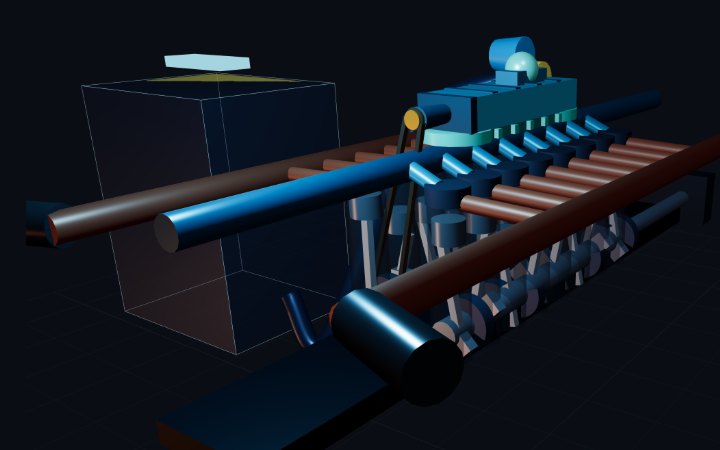
Two straight-eights side by side on their own crankshafts, geared together. Bugatti built two.
The real engine
Same bore, stroke and displacement as the Bugatti Type 45.
Output is quoted as approximately 250 bhp by a single source and compression was never published; the preset's 6.0:1 is a period-plausible choice, and the crank-to-crank phasing that decides how a U-16 fires is unrecorded — see the preset comment.
Same layout as the Bugatti U-16 aero and the Bugatti Type 47.
U-16 · 3.8 L · gasoline · supercharged
 199hp
199hpPeak power
199hp
@ 4,317 rpm
Peak torque
343N·m
@ 3,463 rpm
Displacement
3,800cc
3.8 litres
Redline
5,000rpm
Specifications
- Cylinders
- 16
- Layout
- U
- Bore × stroke
- 60.0 × 84.0 mm
- Displacement
- 3,800 cc
- 3.8 litres
- Compression ratio
- 6.0:1
- Conrod length
- 150.0 mm
- Firing order
- 1-9-3-11-4-12-2-10-8-16-6-14-5-13-7-15
- Cycle
- Four-stroke
- Fuel
- Gasoline, 110 octane
- Induction
- Roots supercharger
- 1.76:1 at its rated speed
- Idle
- 900 rpm
- Redline
- 5,000 rpm
Check these numbers in the engine displacement calculator, the bore and stroke calculator or the compression ratio calculator, with this engine already filled in.
Measured on the dyno
Every point is a full sweep of this engine in the simulator, not a figure copied off a spec sheet.
What it is
The bore measures 60 mm, the stroke 84 mm, and sixteen cylinders of that come to 3,801 cc. Those figures match the Bugatti Type 45, of which two were built in 1929 and 1930. Nothing else here was copied from one. The sixteen stand as two upright straight-eights side by side, each on its own crankshaft, the two geared together at the back. The torque on the dyno comes out of a Wiebe heat release solved against crank-slider geometry, with the plenum, the runners and the collector filling and emptying around it.
Each bank on its own is an ordinary cross-plane straight-eight, firing every 90 degrees. The angle the coupling gears hold between the two cranks decides what the pair does together, and nobody wrote that angle down. Leave the cranks in step and the banks fire as one: eight double pulses 90 degrees apart, a straight-eight with every beat doubled. Offset them by 45 degrees and the two eights interleave into an even 45 degree train, which is what the Firing intervals row in the spec panel prints. This preset assumes the 45, and states it as one angle rather than sixteen.
Compression is 6.0:1, a period-plausible choice rather than a figure Bugatti published. Blown Bugattis of that decade ran between 5.5 and 6.5. The preset sets the fuel to 110 octane, standing in for the alcohol and benzol blend the Grand Prix cars ran, and that one number decides what the blower can do. No boost target is pinned here, so the knock chain derives the ceiling from the fuel and the compression ratio: 1.756 bar absolute, 0.76 bar over atmosphere. A Type 45 blower is credited with 0.75. The car carried two of them, one behind each bank, where this runs a single pump. Manifold pressure holds 1.564 bar at 1,500 rpm and 1.756 at 5,000, flat the way a Roots is, and the top of that costs 18.6 kW off the crank. Nothing cools the charge, because the car carried no cooler.
Things to try
- Take Compression up from 6.0:1. Nothing pins the boost here, so the Manifold cap row falls as you climb. You are trading boost for compression, and the 110 octane fuel sets the exchange rate.
- Pull Manifold cap down to 1.20 bar. That is what 1929 pump petrol at 75 octane allowed at this compression ratio, and at that ceiling the blower is worth 2.4 percent over having none at all. It is the engine this preset shipped as before the fuel changed.
- Open ADVANCED and pull Flywheel down from 0.40. At 0.12 kg·m² this engine covers idle to its 5,000 rpm limiter in 0.31 seconds. That is quicker than the plenum fills, so a free rev reads lower than the dyno holding the same speeds.
Hear it run
It cranks, idles, revs and knocks in the browser. Nothing to download, nothing to install.