PISTON · Detroit Diesel 6-71
Two-Stroke Diesel I6 7.0L
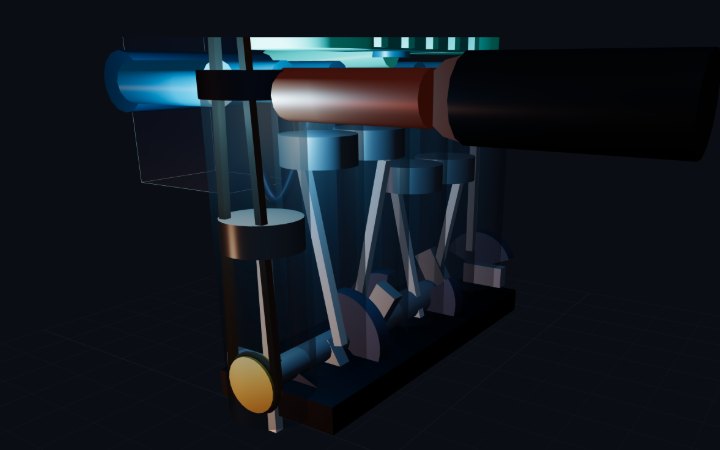
The Screamin' Jimmy, a uniflow two-stroke diesel whose Roots blower the dragsters borrowed.
The real engine
Same bore, stroke, displacement and compression ratio as the Detroit Diesel 6-71.
Ratings ranged 165–238 hp across trims and decades; this one carries the 230 hp industrial N plate.
Same layout as the EMD 645 and the Fairbanks-Morse 38D.
6 cyl · 7.0 L · diesel · supercharged
 229hp
229hpPeak power
229hp
@ 2,100 rpm
Peak torque
897N·m
@ 1,454 rpm
Displacement
6,974cc
7.0 litres
Redline
2,100rpm
Specifications
- Cylinders
- 6
- Layout
- Inline
- Bore × stroke
- 108.0 × 127.0 mm
- Displacement
- 6,974 cc
- 7.0 litres
- Compression ratio
- 18.7:1
- Conrod length
- 254.0 mm
- Firing order
- 1-5-3-6-2-4
- Cycle
- Two-stroke
- Fuel
- Diesel, 50 cetane
- Induction
- Roots supercharger
- 1.20:1 at its rated speed
- Idle
- 550 rpm
- Redline
- 2,100 rpm
Check these numbers in the engine displacement calculator, the bore and stroke calculator or the compression ratio calculator, with this engine already filled in.
Measured on the dyno
Every point is a full sweep of this engine in the simulator, not a figure copied off a spec sheet.
What it is
Bore is 107.95 mm, stroke 127 mm, compression 18.7:1, and six cylinders of that size come to 6,974 cc. Those figures match the Detroit Diesel 6-71. Nothing else here was copied from one. The name reads the same arithmetic backwards: six cylinders of roughly 71 cubic inches. The plate this preset is calibrated to gives 230 bhp at 2,100 rpm and 609 lb-ft at 1,600. Firing every revolution, it lays down six power strokes per crank turn, 60 degrees apart where a four-stroke six spaces them 120, so 2,100 rpm beats like a four-stroke six at 4,200. That is where the Screamin' Jimmy got its name.
The 18.7:1 is geometric, measured from bottom dead centre, and the charge in this cylinder never sees it. Compression starts when the exhaust port shuts, partway up the stroke, so the piston has already given away some of its travel. Referenced to the volume at port closure the ratio is 14.88:1, and the spec panel prints both figures on one row. The Wiebe heat release that makes the torque is normalised to that trapped charge rather than to the swept volume. Read a two-stroke's spec-sheet compression ratio next to a four-stroke's and you are comparing two different measurements.
The Roots blower on top is the engine's only air supply. Uniflow scavenging puts the intake ports in the cylinder liner and the exhaust valves in the head, which leaves the piston no way to draw a breath of its own. So the blower is a scavenge pump, geared at 1.95 turns per crank turn to hold 1.20 bar absolute in the plenum, and the simulator gives you no way to take it off. A 6-71 badge on a dragster's scoop names this engine because that is where the part came from: a truck's air pump, geared up and asked to make power instead of just moving air.
Things to try
- Drag Exh port opens from 118 degrees down toward its floor of 75. The Trapped CR row underneath falls away from 14.88:1 as you go, taking the heat that lights the fuel with it, and a compression-ignition engine has no spark to fall back on.
- Pull Trapping eff below 0.85 and less of the delivered charge is still aboard when the ports close. What goes overboard here is air, because the injector fires after port closure. A premix two-stroke loses fuel instead, which is why that one drinks and this one does not.
- Take Manifold cap down toward 1.05 bar and scavenge pressure follows it. This is the one engine on the roster with no REMOVE SUPERCHARGER button, and the panel prints the reason where the button would be.
Seen in
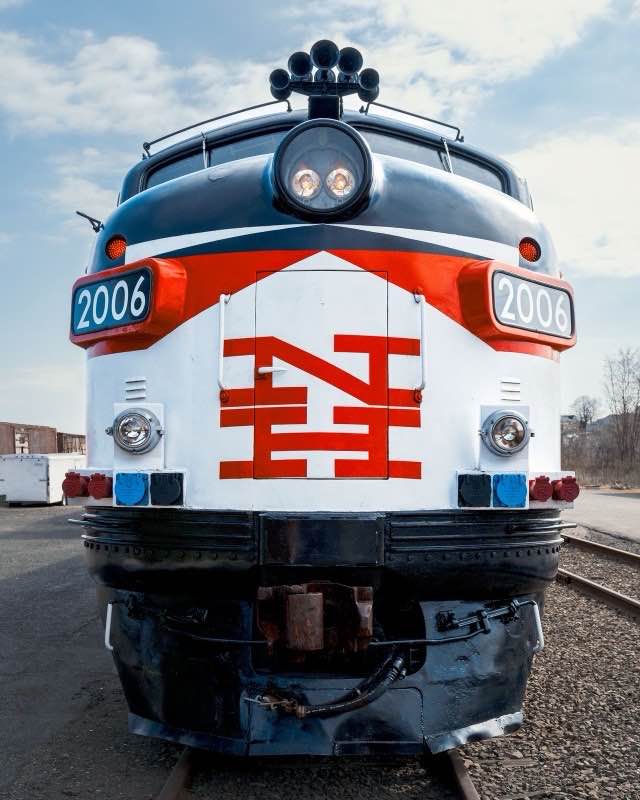
EMD FL9 (New Haven)
Same layout1956–1960. EMD built the 6-71's cycle at locomotive scale: ports in the liner, a crank-driven blower to fill them, one firing stroke per revolution. This one's 16-cylinder 567 is the engine EMD later bored out into the 645.
Photo: James Mirakian · Pexels
Hear it run
It cranks, idles, revs and knocks in the browser. Nothing to download, nothing to install.