PISTON · INNengine e-REX
Axial Opposed-Piston 500
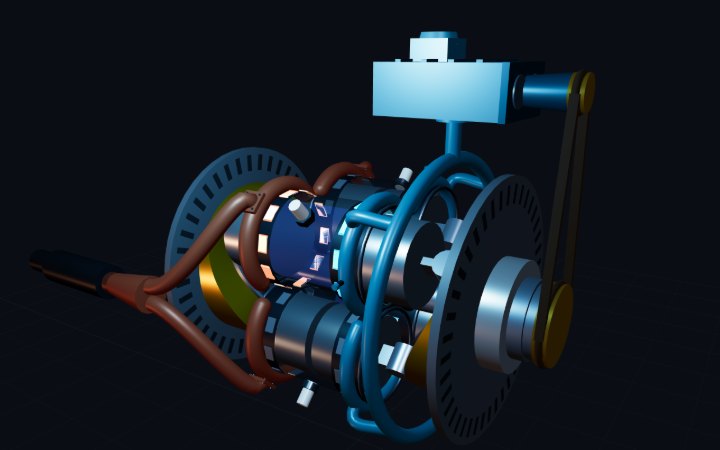
No crankshaft: eight pistons ride two wavy face cams, so a 500 cc four-barrel fires eight times a turn.
The real engine
Same bore, stroke, displacement and four barrels of two opposed pistons as the INNengine e-REX.
Output is calibrated to the tested prototype's measured 45 hp; the 120 hp is the maker's figure, not a published measurement. Port timing and idle are fitted, not published.
4 cyl · 500 cc · gasoline · supercharged
 44hp
Peak power
44hp
@ 3,333 rpm
Peak torque
96N·m
@ 3,188 rpm
Displacement
500cc
Redline
4,500rpm
Specifications
- Barrels
- 4 × 2 opposed pistons
- Layout
- Axial, opposed-piston
- 2-wave face cams, no crankshaft
- Bore × stroke
- 52.4 × 29.0 mm
- Stroke of each piston
- Displacement
- 500 cc
- Compression ratio
- 12.1:1
- 9.5:1 trapped at port closure
- Firing order
- 1+3 / 2+4
- A pair every 90° of shaft
- Cycle
- Two-stroke
- 2 cycles per barrel per shaft revolution
- Fuel
- Gasoline, 95 octane
- Induction
- Roots supercharger
- 1.15:1 at its rated speed
- Idle
- 1,000 rpm
- Redline
- 4,500 rpm
Measured on the dyno
Every point is a full sweep of this engine in the simulator, not a figure copied off a spec sheet.
What it is
Bore is 52.4 mm and each piston strokes 29 mm, with two opposed pistons in each of four barrels, which comes to 500 cc. Those figures match the INNengine e-REX as tested at CMT-Motores Térmicos (Universitat Politècnica de València) in two 2021 Applied Energy papers. Nothing else here was copied from it. That test cell measured 33 kW (45 hp) at 3,500 rpm and a best of 240 g/kWh, and the preset is calibrated against those two figures. The 120 hp often quoted is the maker's figure, not a published measurement, and the preset does not aim at it.
INNengine calls it a one-stroke engine. It runs a two-stroke cycle, and the name counts how often it fires. There is no crankshaft and there are no rods: the barrels sit parallel to the shaft like the chambers of a revolver, and each piston rides a face cam with two waves on it. One turn of the shaft runs every barrel through its cycle twice. Barrels 1 and 3 fire together, then 2 and 4, so a pair goes off every 90 degrees of shaft and the shaft takes eight power strokes per turn. At 3,500 rpm that is 233 paired firings a second, which is the note you hear.
The two pistons in a barrel each open their own ports, so the charge flows one way through the cylinder: in at the intake end, out at the exhaust end. That is uniflow scavenging, and it leaves the engine no way to pump its own air. A blower holds 1.15 bar absolute at the intake ports. The spec panel prints the compression ratio twice. The 12.1:1 is geometric. The charge only starts compressing when the last port shuts, so it sees 9.5:1.
Things to try
- Raise Compression and watch the Trapped CR row above it follow: the geometric figure counts stroke above the ports that the charge never feels.
- Pull Trapping eff down toward what the test cell measured at 1,000 rpm, where 39 to 45 percent of the fresh charge went straight out the exhaust. The fuel goes with it, and the power and the economy fall together.
- Take Manifold cap down toward ambient. The blower is the only air supply, so scavenging weakens with every step and the power falls with it.
Hear it run
It cranks, idles, revs and knocks in the browser. Nothing to download, nothing to install.