PISTON · Honda GX160
Utility Single 163cc
The 163 cc overhead-valve single that runs generators, mowers and go-karts.
The real engine
Same bore, stroke and displacement as the Honda GX160.
Same layout as the Briggs & Stratton 550 Series.
1 cyl · 163 cc · gasoline
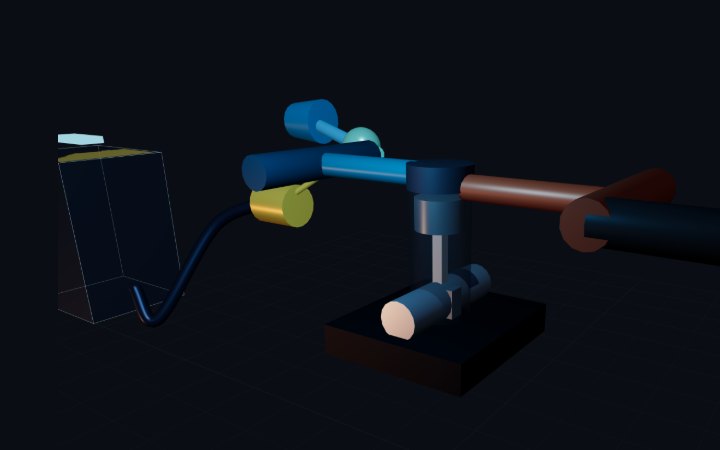 4.9hp
4.9hpPeak power
4.9hp
@ 4,000 rpm
Peak torque
10N·m
@ 2,917 rpm
Displacement
163cc
Redline
4,000rpm
Specifications
- Cylinders
- 1
- Layout
- Single cylinder
- Bore × stroke
- 68.0 × 45.0 mm
- Displacement
- 163 cc
- Compression ratio
- 8.5:1
- Conrod length
- 90.0 mm
- Firing order
- 1
- Cycle
- Four-stroke
- Fuel
- Gasoline, 95 octane
- Induction
- Naturally aspirated
- Idle
- 1,400 rpm
- Redline
- 4,000 rpm
Check these numbers in the engine displacement calculator, the bore and stroke calculator or the compression ratio calculator, with this engine already filled in.
Measured on the dyno
Every point is a full sweep of this engine in the simulator, not a figure copied off a spec sheet.
What it is
The bore is 68 mm and the stroke 45 mm, which comes to 163 cc in a single cylinder. Those figures match the Honda GX160, rated 4.8 hp at 3,600 rpm and 10.3 N·m at 2,500. Nothing else here was copied from one. Compression is 8.5:1, and the torque on the dyno comes out of a Wiebe heat release solved against crank-slider geometry, with the plenum, the runners and the collector filling and emptying around it.
A single fires once every two turns of the crank and coasts through the other three strokes. Carrying it through those is the flywheel's job, and on most singles that means a heavy one. This engine gets away with 0.08 kg·m², roughly a real utility engine's cast iron, because the idle sits at 1,400 rpm: speed fluctuation falls as one over inertia times speed squared, so idling fast buys what mass would have bought. Measured from 0.08 to 0.55, idle irregularity never leaves 1.2 to 2.0 percent. Extra inertia changes one thing, the time the engine takes to run down, and it changes it a long way: 5.2 seconds at 0.08, 12.6 at 0.18.
The intake and exhaust sizes the model derives from displacement all hit their floors on an engine this small. The plenum lands at a litre, six times the swept volume, where a real GX160 has a carburettor bolted to the head, and the 12 cm² throttle floor is a 39 mm plate standing in for something closer to 19 mm. None of that costs much at wide open throttle, which is where the calibration was taken, but part-throttle manifold behaviour is not this engine's. The breathing numbers are the smallest on the roster: VE peak reads 0.74, under every other four-stroke here, and it holds a flat 0.85 of that away from the peak where the default is 0.78.
Things to try
- Open ADVANCED and take Flywheel from 0.08 up toward 0.5. The idle hardly changes, because at 1,400 rpm the speed is doing the smoothing that mass would. What moves instead is the run-down: 5.2 seconds at 0.08, 12.6 at 0.18.
- Drop Idle from 1,400 toward the 800 rpm the 500 cc single runs. Fluctuation goes as one over speed squared, so the term 0.08 kg·m² has to absorb is three times larger down there, and you hear it arrive.
- Take VE peak up from 0.74 toward the 0.95 the 500 cc single runs. It scales the whole torque curve, which is the short version of what a bigger carburettor and a straighter port would be worth.
Seen in
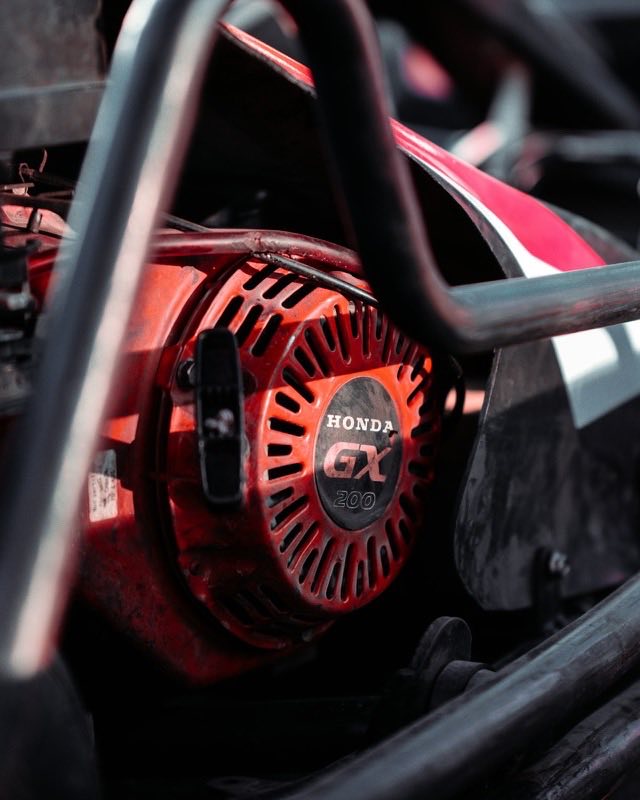
Honda GX200 in a kart frame
Same layoutThe next size up in the same family, in the tubular frame a 163 cc utility single gets bought for: karts, generators and pressure washers.
Photo: kuaileqie RE · Unsplash
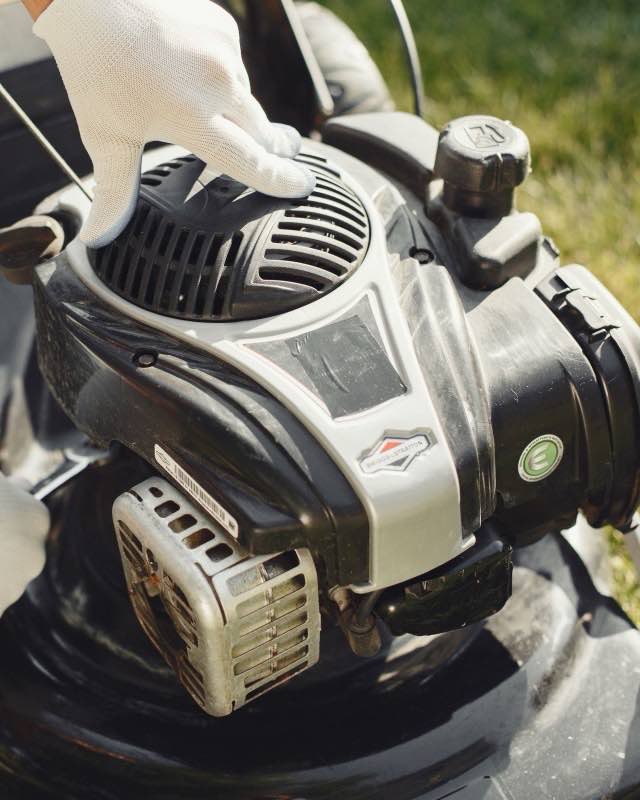
Briggs & Stratton walk-behind mower
Same layoutSame layout, different engine: one cylinder, a recoil cord and a flywheel. The Briggs & Stratton 550 Series sits in this class.
Photo: Gustavo Fring · Pexels
More like this
Hear it run
It cranks, idles, revs and knocks in the browser. Nothing to download, nothing to install.