PISTON · Royal Enfield Bullet 500
Thumper 500
One long-stroke pushrod cylinder. The thump a dirt bike is named for.
The real engine
Same bore, stroke, compression and displacement as the Royal Enfield Bullet 500.
Same layout as the Yamaha SR500 and the Suzuki DR500.
1 cyl · 499 cc · gasoline
 28hp
28hpPeak power
28hp
@ 4,917 rpm
Peak torque
41N·m
@ 4,267 rpm
Displacement
499cc
Redline
6,000rpm
Specifications
- Cylinders
- 1
- Layout
- Single cylinder
- Bore × stroke
- 84.0 × 90.0 mm
- Displacement
- 499 cc
- Compression ratio
- 8.5:1
- Conrod length
- 150.0 mm
- Firing order
- 1
- Cycle
- Four-stroke
- Fuel
- Gasoline, 95 octane
- Induction
- Naturally aspirated
- Idle
- 800 rpm
- Redline
- 6,000 rpm
Check these numbers in the engine displacement calculator, the bore and stroke calculator or the compression ratio calculator, with this engine already filled in.
Measured on the dyno
Every point is a full sweep of this engine in the simulator, not a figure copied off a spec sheet.
What it is
The bore is 84 mm, the stroke 90 mm and the compression ratio 8.5:1, which comes to 499 cc in one cylinder. Those four figures match the Royal Enfield Bullet 500, which Royal Enfield published at 27.2 hp at 5,250 rpm and 41.3 N·m at 4,500. Nothing else here was copied from one. The torque on the dyno is a Wiebe heat release solved against crank-slider geometry, with the plenum, the runner and the collector filling and emptying around it.
One cylinder fires once every two turns and coasts through the other three strokes, and the flywheel carries it across the gap. This one holds 0.25 kg·m². That figure comes from the textbook coefficient of fluctuation for a single-cylinder four-stroke, 0.06, which is a total speed swing of three percent either side. At the 800 rpm idle it measures 5.6 percent irregularity, against 15.8 on the inertia the model derives for an engine this size and 3.2 on the roster's two-litre four.
The stroke is longer than the bore, 90 against 84, and that sets how the engine pulls. The model charges friction on mean piston speed rather than on rpm, because rubbing follows how far the rings travel, and 90 mm has the piston covering 18 metres a second at the 6,000 limit. The intake breathes best at 4,800, eight tenths of redline and right on the cap the curve generator holds a four-stroke to. It is out of breath by 5,000, so the redline stops where it does.
Things to try
- Open ADVANCED and take Flywheel from 0.25 up to 0.55. Idle irregularity falls from 5.6 percent to 2.5, smoother than the roster's two-litre four. The lope that makes this a thumper goes with it.
- Walk VE peak rpm up from 4,800 and watch nothing happen. The curve generator clamps a four-stroke's breathing peak at eight tenths of redline, so the peak only follows if you raise Redline first.
- Take Compression up from 8.5:1 toward the 10.5:1 the roster's two-litre four runs. Torque comes up across the range and the KNOCK chip decides how far you get.
Seen in
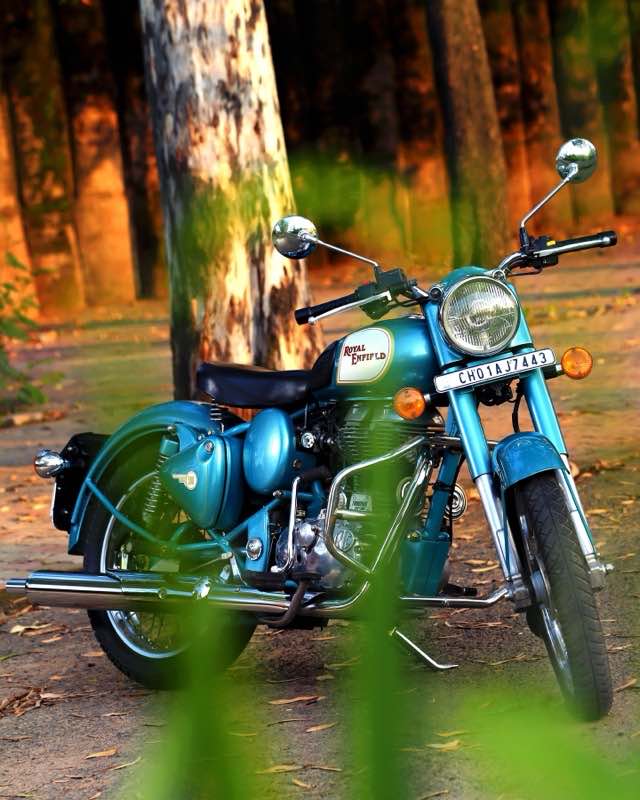
Royal Enfield Classic 500
Runs this engineThe 499 cc unit-construction single, badged 500 on the toolbox. It is the engine the Bullet 500 carries, and bore, stroke, compression and displacement are the four figures this preset matches.
Photo: Nishant Aneja · Pexels
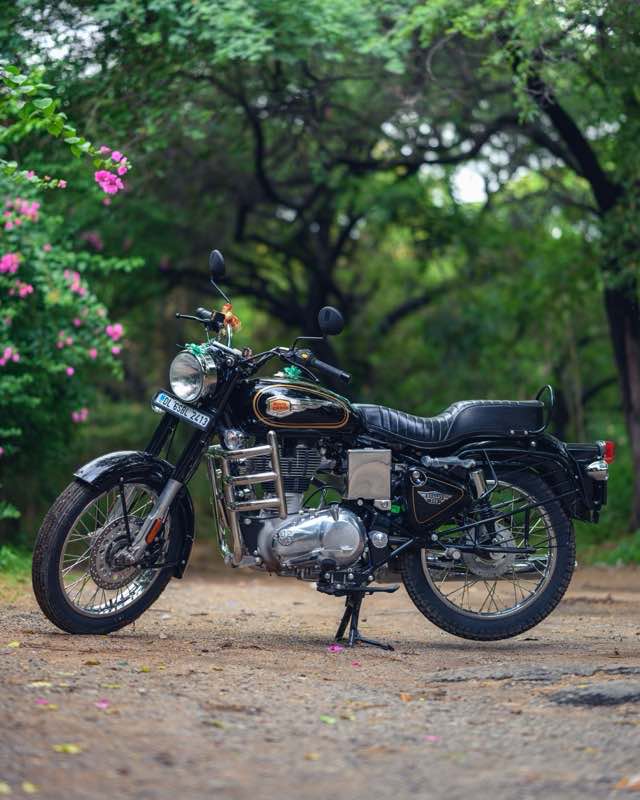
Royal Enfield Bullet 350
Same layoutSame layout, smaller engine: the same long-stroke pushrod single with less bore. The Bullet has been built in India since the 1950s.
Photo: framesbypc · Pexels
More like this
Hear it run
It cranks, idles, revs and knocks in the browser. Nothing to download, nothing to install.