PISTON · Harley-Davidson Evolution 1340
V-Twin 1340 45°
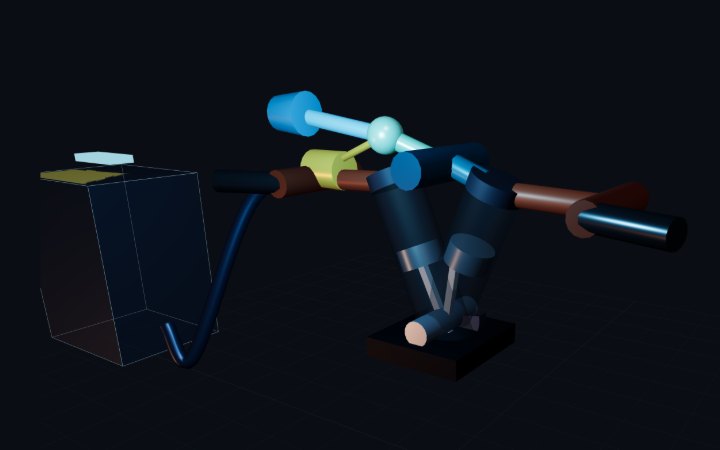
Both rods on one crankpin, 45° apart: it fires 405° then 315°, and that limp is the sound.
The real engine
Same bore, stroke, compression ratio and displacement as the Harley-Davidson Evolution 1340.
Published power varies by year and market between 58 and 70 hp; the sim reads 58.9 hp at its own peak, and 24% high on torque — see the preset comment.
Same layout as the Harley-Davidson Panhead FL, the Harley-Davidson Shovelhead and the Harley-Davidson Sportster 1200.
V-twin 45° · 1.3 L · gasoline
 59hp
59hpPeak power
59hp
@ 5,500 rpm
Peak torque
118N·m
@ 2,313 rpm
Displacement
1,338cc
1.3 litres
Redline
5,500rpm
Specifications
- Cylinders
- 2
- Layout
- V
- 45° between banks
- Bore × stroke
- 88.8 × 108.0 mm
- Displacement
- 1,338 cc
- 1.3 litres
- Compression ratio
- 8.5:1
- Conrod length
- 185.0 mm
- Firing order
- 1-2
- Cycle
- Four-stroke
- Fuel
- Gasoline, 95 octane
- Induction
- Naturally aspirated
- Idle
- 1,000 rpm
- Redline
- 5,500 rpm
Check these numbers in the engine displacement calculator, the bore and stroke calculator or the compression ratio calculator, with this engine already filled in.
Measured on the dyno
Every point is a full sweep of this engine in the simulator, not a figure copied off a spec sheet.
What it is
The bore is 88.8 mm, the stroke 108 mm and the compression ratio 8.5:1, which comes to 1,338 cc across two cylinders in a 45 degree vee. Those figures match the Harley-Davidson Evolution 1340, the Big Twin engine Harley built from 1984 to 1999. Nothing else here was copied from one. The torque on the dyno is a Wiebe heat release solved against crank-slider geometry, with the plenum, the runners and the collector filling and emptying around it.
Both connecting rods run on one crankpin. The rear cylinder stands 45 degrees around from the front one, so it reaches top dead centre 45 degrees of crank rotation later, and on a four-stroke only every second top dead centre is a firing one. The rear cylinder fires a revolution further round, at 405 degrees, and the gap back to the front is whatever the cycle has left: 315. The spec panel prints that pair in its Firing intervals row. No rearrangement of a firing order produces those angles, so this preset carries a table of two of them where the rest of the roster spaces its cylinders by position in the order.
Those two numbers are the sound. At a held 3,000 rpm the crank covers 405 degrees in 22.5 milliseconds and 315 in 17.5, so the fires land long, short, long, short. The beat riders write down as potato-potato is that asymmetry. At the 1,000 rpm idle the long gap stretches to 52.5 milliseconds with no power stroke anywhere inside it, the longest wait on this roster outside the single-cylinder engines. The flywheel carries the crank across, and its 0.31 kg·m² is what the build wizard's own displacement law returns for 1,338 cc rather than a figure someone picked to calm the idle down.
Things to try
- Take Compression up from 8.5:1. At the stock ratio the KNOCK chip stays dark all the way to the 5,500 redline, which is what 8.5:1 on pump gasoline buys. Keep raising it and you will find where that stops being true.
- Take Cylinders from 2 to 3. The Firing intervals row is replaced by a firing order and the engine falls back to even spacing, because a table of two angles cannot describe three cylinders. It is the quickest way to hear what the uneven pair was doing.
- Open ADVANCED and pull Flywheel down from 0.31. The crank has 52.5 milliseconds to coast through at idle, and with less inertia to do it the idle starts to lope where it used to settle.
Seen in
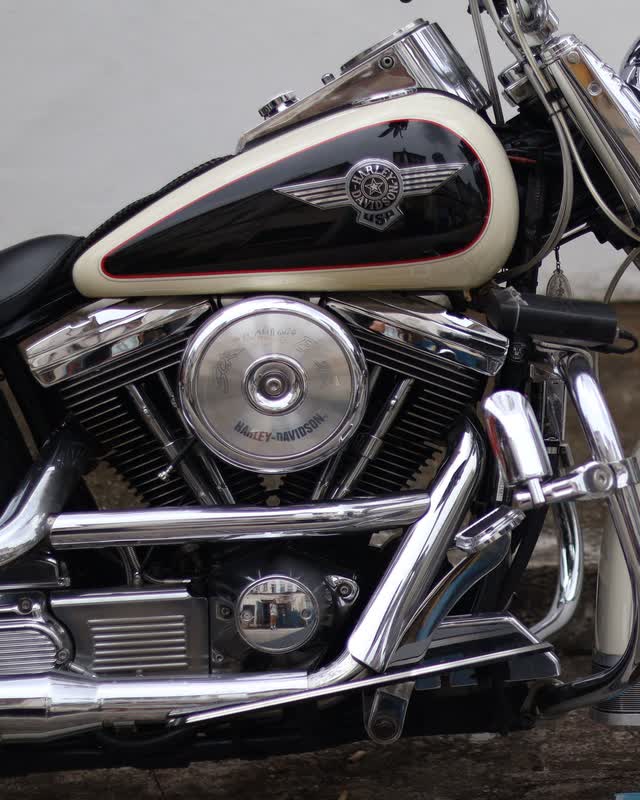
Harley-Davidson Heritage Softail
Runs this engine1986–1999. One of the Big Twin frames the Evolution 1340 shipped in, and Softails carried the Evo until the Twin Cam took over for 2000.
Photo: Elizabeth K. · Pexels
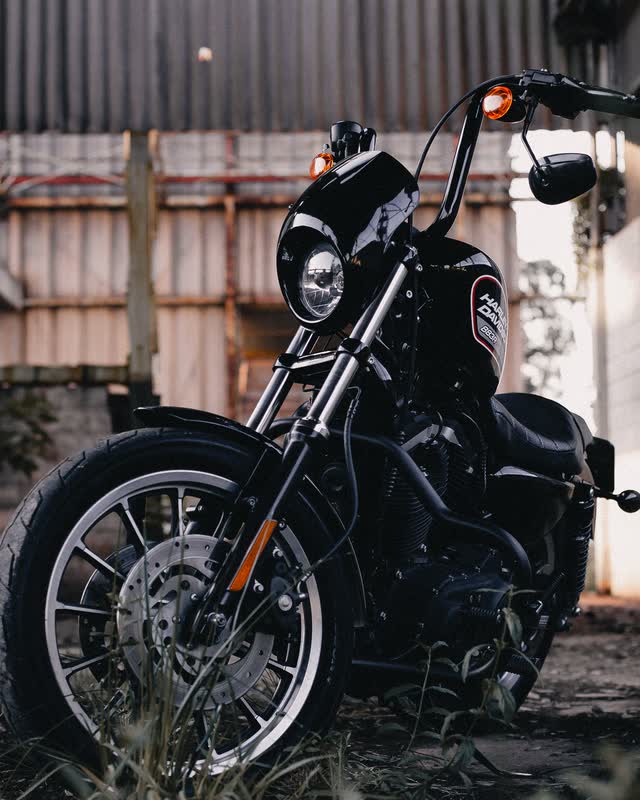
Harley-Davidson Sportster 883R
Same layout2002 on. Same layout, smaller engine: the Sportster's own Evolution is a 45 degree twin with both rods on one crankpin, at 883 cc rather than 1,338.
Photo: Fabio Luiz · Pexels
More like this
Hear it run
It cranks, idles, revs and knocks in the browser. Nothing to download, nothing to install.