RADIAL · Vedeneyev M-14P
Vedeneyev M-14P (9-cyl radial)
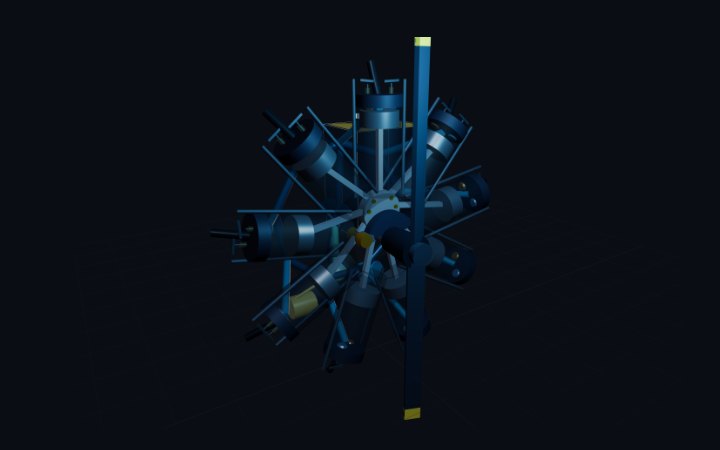
Nine cylinders in a star, one master rod carrying eight. Still flying aerobatics.
9 cyl · 10.1 L · avgas · supercharged
 340hp
340hpPeak power
340hp
@ 3,100 rpm
Peak torque
843N·m
@ 2,600 rpm
Displacement
10,131cc
10.1 litres
Redline
3,100rpm
Specifications
- Cylinders
- 9
- Layout
- Radial
- Bore × stroke
- 105.0 × 130.0 mm
- Displacement
- 10,131 cc
- 10.1 litres
- Compression ratio
- 6.3:1
- Conrod length
- 245.0 mm
- Firing order
- 1-3-5-7-9-2-4-6-8
- Cycle
- Four-stroke
- Fuel
- Gasoline, 130 octane
- Induction
- Centrifugal supercharger
- 1.26:1 at its rated speed
- Idle
- 700 rpm
- Redline
- 3,100 rpm
Check these numbers in the engine displacement calculator, the bore and stroke calculator or the compression ratio calculator, with this engine already filled in.
Measured on the dyno
Every point is a full sweep of this engine in the simulator, not a figure copied off a spec sheet.
What it is
Bore is 105 mm, stroke is 130 mm, and nine cylinders stand in one ring around a single crank throw. The machined compression ratio is 6.3:1. Those are the figures of the Vedeneyev M-14P, the Russian aerobatic engine published at 360 hp at 2,900 rpm. The curve here is not that rating copied back. A Wiebe heat release solves against the articulated rod linkage, cylinder by cylinder, while the plenum, the runners and nine open stacks fill and empty around it.
One rod runs straight to the crankpin. The other eight pin to knuckles on that rod's big-end flange, 44 mm out from its centre, so they swing with the rod instead of about the crank. The master rod measures 245 mm and each link rod 201, and 201 plus the 44 mm knuckle circle is what keeps those eight pistons inside their barrels. No two cylinders come out alike after that. Link strokes run up to 0.8 percent long, top dead centre wanders by as much as 5.2 degrees, and one clearance volume machined for all nine leaves every barrel with its own effective compression ratio. The spec panel lists that spread read only, because the geometry sets it.
A gear-driven centrifugal blower turns at eight times crank speed, rated 1.26:1 at 2,900 rpm, with the manifold capped at 1.22 bar. Nothing cools the charge between blower and cylinder, so some of the pressure comes back as heat. The fuel is 130 octane avgas. Load comes from a two-blade propeller through a 0.658 reduction gear, and the 5 kg·m² that prop carries about its own axis reflects to about 2.2 at the crank, more than the rest of the rotating mass together.
Things to try
- Set Knuckle circle to zero. The eight link rods collapse onto the crankpin, nine identical crank-sliders replace the linkage, and the per-cylinder table flattens to one stroke and one compression ratio.
- Pull Fuel grade down from 130 toward pump petrol. The knock model cuts heat release at rated boost by a third, and the engine stops reaching the numbers it was built to.
- Drop Prop pitch / load below 100 percent. Full throttle no longer settles at rated rpm. It runs the engine into the limiter instead, which is what a runaway propeller does.
Seen in
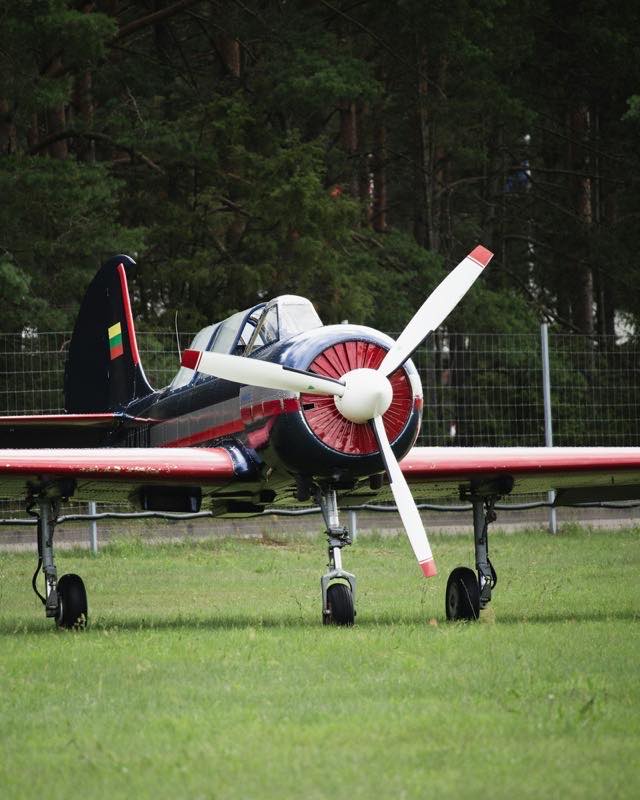
Yakovlev Yak-52
Same layoutFirst flown 1976 and built in Romania into the 1990s. Nine cylinders sit in one row behind those red cooling gills, turning the two-blade propeller the model loads the crank with.
Photo: Daniel Kuleszo · Unsplash
More like this
Hear it run
It cranks, idles, revs and knocks in the browser. Nothing to download, nothing to install.