PISTON · Napier Sabre IIB
H-24 36.8L Supercharged
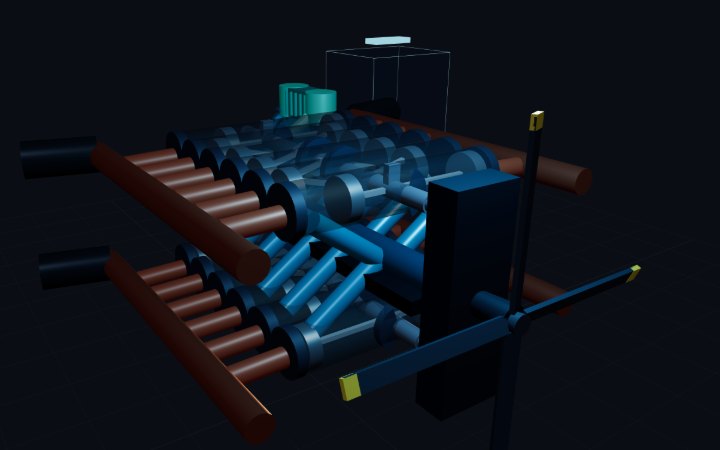
Two flat-twelves on two crankshafts, geared onto one propeller. Twelve double beats per cycle.
The real engine
Same bore, stroke, compression ratio and displacement as the Napier Sabre IIB.
Rated 2,400 hp at 3,850 rpm on +11 psi, Sabre IIB military. This one reads 1,728 hp (−28%) — the IIB had no aftercooler and sleeve valves are not modelled; the preset comment attributes the shortfall rather than tuning the breathing to hide it.
Same layout as the Napier Sabre I, the Napier Sabre IIA and the Napier Sabre VA.
H-24 · 36.8 L · avgas · supercharged
 1,718hp
Peak power
1,718hp
@ 3,850 rpm
Peak torque
3,482N·m
@ 3,194 rpm
Displacement
36,787cc
36.8 litres
Redline
3,850rpm
Specifications
- Cylinders
- 24
- Layout
- H
- Bore × stroke
- 127.0 × 121.0 mm
- Displacement
- 36,787 cc
- 36.8 litres
- Compression ratio
- 7.0:1
- Conrod length
- 212.0 mm
- Firing order
- 1-2-3-4-5-6-7-8-9-10-11-12-13-14-15-16-17-18-19-20-21-22-23-24
- Cycle
- Four-stroke
- Fuel
- Gasoline, 130 octane
- Induction
- Centrifugal supercharger
- 1.76:1 at its rated speed
- Idle
- 700 rpm
- Redline
- 3,850 rpm
Check these numbers in the engine displacement calculator, the bore and stroke calculator or the compression ratio calculator, with this engine already filled in.
Measured on the dyno
Every point is a full sweep of this engine in the simulator, not a figure copied off a spec sheet.
What it is
Bore is 127 mm, stroke is 121 mm, and the compression ratio is 7.0:1. Those figures and the 36.8 litres they multiply out to match the Napier Sabre IIB. Nothing else here was copied from one. Twenty-four cylinders sit as two flat-twelves stacked one above the other, each on its own six-throw crankshaft, and the two cranks gear together at the nose onto one four-blade propeller through a 0.2742 reduction. What that propeller absorbs is what decides where full throttle settles.
Napier phased the two cranks 180 degrees apart. Each carries six throws at 0, 120, 240, 240, 120 and 0 degrees, an opposed pair of cylinders shares every throw, and the twenty-four fires come out as twelve simultaneous pairs 60 degrees apart. An even twenty-four every 30 degrees is the Napier Dagger, which phased its cranks 30 degrees instead. Half a turn of one crank leaves the intervals alone, so what the 180 degrees settles is which two cylinders share a beat: one from each bank, and an exhaust bus takes a single pulse every 60 degrees. In step, both halves land on one side and that bus gets a doubled beat, then 120 degrees of nothing.
A single-stage centrifugal blower holds 1.76 bar absolute, the +11 psi of the IIB's sea-level military rating, and nothing cools the charge behind it because the real engine had no aftercooler. Air arrives near 366 K, heat release scales with density, and that costs a fifth of the air. Knock has room to spare: at 7.0:1 on 100/130 grade avgas the end-gas chain allows 2.126 bar, leaving the rating 0.37 bar inside the ceiling. Napier rated the IIB at 2,400 hp at 3,850 rpm and this preset lands under it. Four sleeve ports per cylinder, no poppet valve and no hot exhaust valve, are most of why the real engine made what it made, and the model has nowhere to put them but the breathing figure.
Things to try
- Intercooler, in the SUPERCHARGER block, reads 0 percent. Wind it up: charge temperature falls, density rises, and the torque curve lifts with it.
- Manifold cap holds 1.76 bar against the 2.126 printed under it. There is room above the IIB's rating, and the later Sabre marks used it.
- VE peak, in the ADVANCED drawer, sits at the 0.95 poppet-valve default. It is the one lever standing in for sleeve valves, and it scales the whole curve rather than reshaping it.
Hear it run
It cranks, idles, revs and knocks in the browser. Nothing to download, nothing to install.