PISTON · LPG / Autogas Four
LPG I4 2.0L (Autogas)
Runs on autogas. 110 octane lets you push compression where petrol knocks.
The real engine
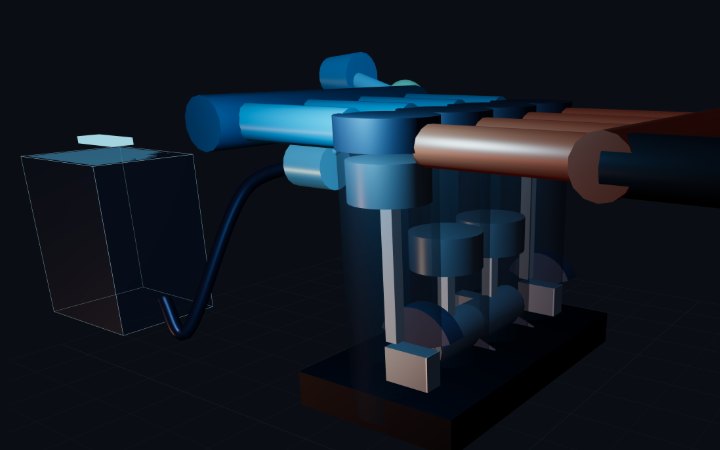
Same layout as the Autogas-converted road fours.
4 cyl · 2.0 L · autogas
 104hp
104hpPeak power
104hp
@ 7,000 rpm
Peak torque
167N·m
@ 3,925 rpm
Displacement
1,998cc
2.0 litres
Redline
7,000rpm
Specifications
- Cylinders
- 4
- Layout
- Inline
- Bore × stroke
- 86.0 × 86.0 mm
- Displacement
- 1,998 cc
- 2.0 litres
- Compression ratio
- 11.5:1
- Conrod length
- 144.0 mm
- Firing order
- 1-3-4-2
- Cycle
- Four-stroke
- Fuel
- Autogas (LPG), 110 octane
- Induction
- Naturally aspirated
- Idle
- 850 rpm
- Redline
- 7,000 rpm
Check these numbers in the engine displacement calculator, the bore and stroke calculator or the compression ratio calculator, with this engine already filled in.
Measured on the dyno
Every point is a full sweep of this engine in the simulator, not a figure copied off a spec sheet.
What it is
Bore and stroke both measure 86 mm, the rod is 144 mm, and four cylinders come to 1,998 cc at 11.5:1. Nobody copied those figures off a real engine's drawing. The autogas conversions on the road share the fuel with this preset and nothing else. Set it beside the roster's petrol four and you find the same bore, the same stroke, the same rod, the same 1-3-4-2 firing order and the same 850 rpm idle, with one more point of compression and a different fuel. The torque on the dyno comes out of a Wiebe heat release solved against crank-slider geometry, with the plenum, the runners and the collector filling and emptying around it.
Octane pays for that extra point. The knock model sets its end-gas threshold at 735 K plus 3.5 K for every RON above 95, so autogas at 110 sits at 788 K against pump petrol's 735. The same model's anchors put end-gas temperature near 714 K at 10.5:1 and 744 K at 13:1. Read those two columns together and 11.5:1 on autogas has room to spare where the petrol four has already spent its margin. The line under the spec list prints the boost that compression and that octane will carry, and the octane it quotes here reads 110.
Autogas charges for that margin elsewhere. It holds more energy per kilogram than petrol, 46 MJ against 44, and it wants more air to burn, 15.5 parts against 14.7. An engine meters by air, so per kilogram of charge the two fuels land under one percent apart with petrol in front, and the burn model takes a further cut: it sets the heat release ratio over the motoring line at 3.3 for autogas and 3.5 for petrol. Breathing sits at 0.92 instead of the 0.95 the model hands a petrol preset that states none of its own, because the fuel arrives as a vapour and fills intake volume air would otherwise have. Downstream the tank holds 5 litres at 0.510 kg per litre against the petrol four's 6 at 0.745, the rail runs at 8 bar rather than 3.5, and autogas clears both of the fuel system's temperature gates, since the model checks vapour lock on the gasoline tank above 313 K and cold gel on diesel below 263 K.
Things to try
- Switch Fuel to GASOLINE and touch nothing else. Compression, breathing and friction hold their values, since the preset states all three, so only the fuel table moves: 95 RON for 110, 14.7 to one for 15.5, and the petrol burn ratio. Walk Compression up from 11.5 afterwards and see which fuel runs out of room first.
- Take Compression up toward the 22:1 the slider allows. Held at 5,000 rpm on this geometry, petrol reads 0.030 knock at 13:1 and 0.119 at 14:1, where autogas reads 0.000 at both. Torque here keeps climbing past the point where the petrol four stops getting paid for compression.
- Press FIT TURBOCHARGER. It is live at 11.5:1 on autogas, and on the naturally aspirated 3.0-litre six at 11.0:1 on 95 octane the same button greys out and reads TOO MUCH COMPRESSION FOR BOOST. The higher-compression engine is the one that gets the turbo.
Seen in
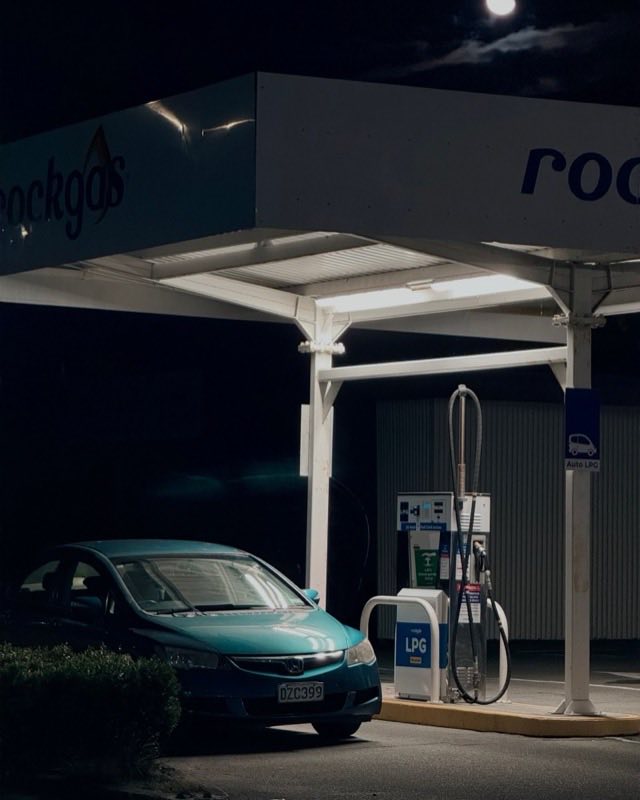
Autogas-converted road four
Same layoutA road four at an Auto LPG pump in Christchurch, New Zealand. Autogas hands an engine like this one 110 RON where petrol gives it 95, and that octane is what the conversion buys.
Photo: Jose Paul Nambadan · Pexels
More like this
Hear it run
It cranks, idles, revs and knocks in the browser. Nothing to download, nothing to install.