What Is a CVT Transmission? How It Works, Pros and Cons
A CVT swaps fixed gears for two cone pulleys and a steel belt. How it works, why it drones, and a measured CVT vs automatic test on the same two cars.
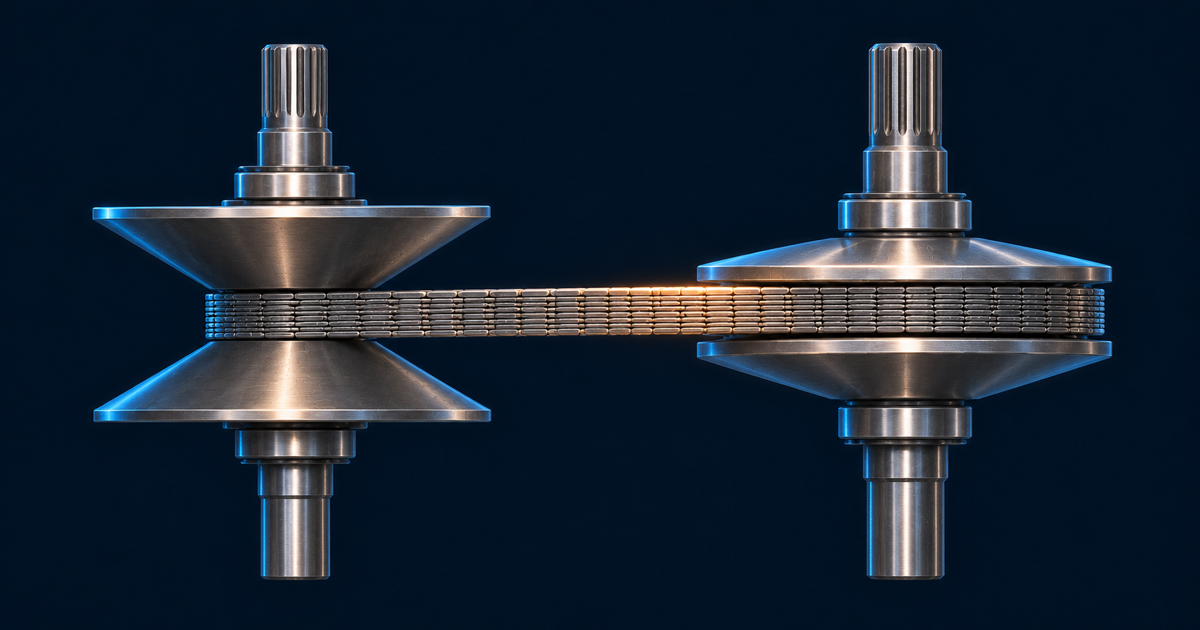
Floor a car with a CVT and the engine note climbs once, then stays where it is while the speedometer keeps rising. A continuously variable transmission changes its ratio smoothly, with no fixed gears to step between, so engine speed and road speed stop being tied together. That single property explains both the praise (no shift shock) and the complaints (drone and a rubber-band feel).
We put the same two cars through a manual, a torque-converter automatic and a CVT in our simulator. The model's CVT posted the quickest times on both, and much of this article explains why that gives you no grounds to say CVTs are faster than automatics.
Key Takeaways
- A CVT links the engine to the wheels through two cone-shaped pulleys and a steel belt. The pulley halves slide to change the belt's radius, giving any ratio between the lowest and the highest.
- In our model the CVT reached 100 km/h first on both cars: 5.33 s against 5.50 s for the automatic on a 5.0 V8, 9.09 s against 9.66 s on a 2.0 four. The lead comes from the setup: a deeper low ratio, plus earlier lockup on the four to 100 km/h and on both over the quarter.
- With the setup matched, the quarter mile ties within 0.03 s and the automatic leads to 100 km/h, so the stepless ratio buys nothing measurable on these two cars.
- The model charges no belt or pump loss. About 5 to 8 percent of extra loss spends the lead, and National Academies figures from 2015 put a CVT near 89 percent efficient against 90 to 96 percent for an automatic.
- The model does show the feel: a flat 6,661 to 6,674 rpm from 90 to 244 km/h, rpm set by the pedal, and a kickdown from 1,548 to 6,663 rpm in half a second with no gain in speed.
On this page: Quick answer · How it works · CVT vs automatic · Is a CVT good · Pros and cons · Try it in the simulator · FAQ · How these numbers were made
Quick Answer: What Is a CVT Transmission
A CVT, or continuously variable transmission, is an automatic gearbox with no fixed gear ratios. The National Academies' 2015 report describes it as two cone-shaped pulleys linked by a belt. The box can settle on any ratio between its lowest and its highest, where a stepped automatic chooses from a fixed list. To the driver it behaves like any automatic: no clutch pedal, select D and go.
The idea is old. DAF's Variomatic reached the road in the Daf 600 in 1958, and the steel push belt entered series production in 1985, with Bosch counting 100 million belts by 2024. The US Department of Energy counted CVTs in about one quarter of the light-duty vehicles produced in 2022.
How Does a CVT Work
Two pulleys and a steel belt
Each pulley is a pair of facing cones. Squeeze the cones together and the belt rides outward to a larger radius; let them part and it sinks toward the shaft. Both pulleys move at once, one closing as the other opens, so the belt stays tight while the ratio changes. A small radius on the engine side and a large one on the wheel side gives a low ratio for pulling away, and swapping them gives a high ratio for cruising.
Bosch describes its belt as hundreds of punched steel elements stacked on a high-alloy steel ring package. Hydraulic pressure clamps the pulleys onto it, and the National Academies report names the hydraulic pump and the belt as the major power losses, in roughly equal shares. A CVT also needs a way to pull away from rest: our model borrows the torque converter from the class's automatic, and Toyota's design adds a physical launch gear.
What the rpm does at full throttle
The flat line starts later than most descriptions suggest. The model's 5.0 V8 sits on its lowest ratio until 82 km/h, and the rpm climbs with road speed as it would in a first gear. The 2.0 four leaves its lowest ratio at 54 km/h.
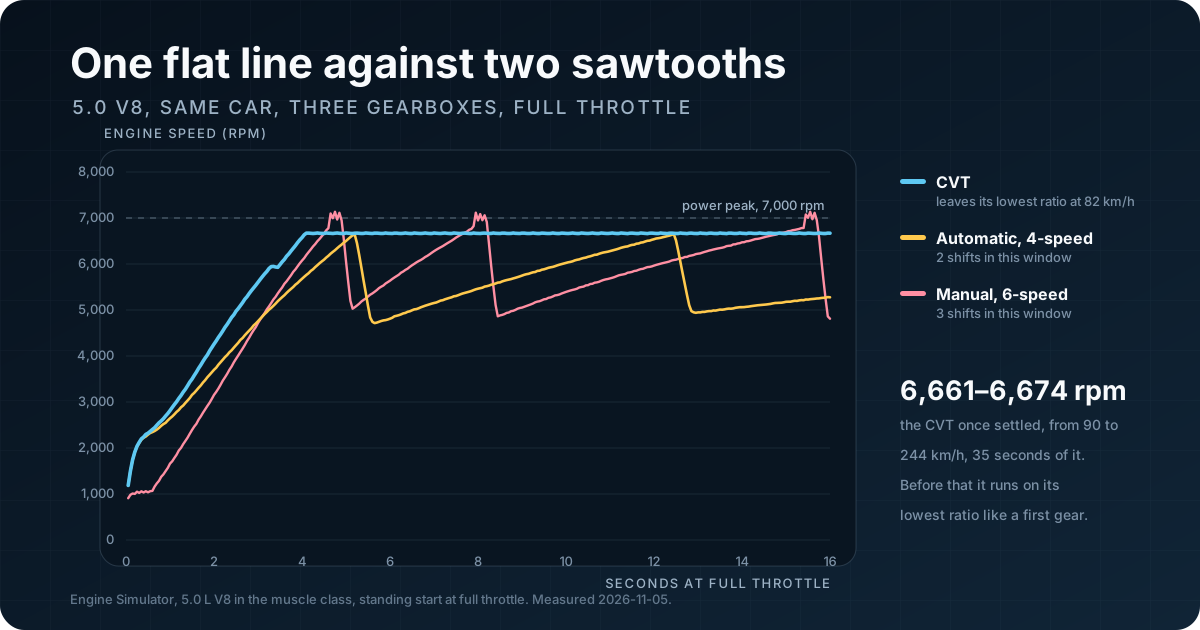
From there the ratio falls as the car gathers speed and the engine stops moving. The V8 held 6,661 to 6,674 rpm from 90 to 244 km/h, and the four held 6,838 to 6,865 rpm from 60 to 182 km/h. Those bands end where our 40-second run ended, with the V8's ratio down to 3.39 on a span that reaches 1.92.
The model targets 95 percent of redline, about 6,650 rpm on the V8, which is 5 percent under the power peak. That costs about nothing: holding at the peak changed the time to 100 km/h by 0.01 s on the V8 and 0.04 s on the four. The power curve explains why, since from about 4,700 rpm upward the V8 stays between 93 and 100 percent of its peak.
On a CVT the pedal picks the rpm
At part throttle each pedal position gets its own engine speed, and the ratio does the rest. At a constant 30 percent pedal the model's V8 holds about 2,320 rpm from 40 to 120 km/h while the overall ratio falls from 7.02 to 2.38. At 90 km/h, 15 percent pedal reads 1,620 rpm, 50 percent reads 3,398 and 75 percent reads 4,956.
This is where the drone and the rubber band come from. From a steady 100 km/h on the V8, flooring the pedal took the engine from 1,548 to 6,663 rpm in 0.5 s while the car went from 100.0 to 99.6 km/h, because the drivetrain has to drag the engine up to speed. The automatic went from 2,753 to 4,722 rpm and was already doing 103.0 km/h. The CVT caught up by about 2 s and led from 3 s.
The noise arrives first and the speed follows. The National Academies report uses the rubber-band comparison, and Consumer Reports' 2021 Corolla overview noted CVT drone on hills and when merging. Some makers add simulated steps: Subaru's 2018 WRX shifts in steps above 30 percent throttle in Sport. Our model has no such mode, and its kickdown rate is an assumed constant.
CVT vs Automatic
The model's CVT is the quickest box on both test cars, and the lead belongs to how the model sets the box up. These are model figures, with the same engine and car in every row and only the box changed:
| Car | Box | 0 to 100 km/h | Quarter mile | Shifts to 100 |
|---|---|---|---|---|
| 5.0 V8 | Manual | 6.10 s | 14.26 s | 1 |
| 5.0 V8 | Automatic | 5.50 s | 13.91 s | 1 |
| 5.0 V8 | CVT | 5.33 s | 13.56 s | 0 |
| 2.0 four | Manual | 11.23 s | 18.26 s | 2 |
| 2.0 four | Automatic | 9.66 s | 17.14 s | 1 |
| 2.0 four | CVT | 9.09 s | 16.72 s | 0 |
Where the lead comes from
Two setup choices make the lead. The model's CVT copies the span of the class's manual, so it starts deeper than the automatic's first gear: 10.16:1 overall against 8.48:1 on the V8, and 14.94:1 against 10.66:1 on the four. Its converter also locks at 75 km/h on the V8 and 45 km/h on the four, while the stock automatics may lock only from third gear, at 215 and 131 km/h under full throttle.
We removed both differences, giving the CVT the automatic's low ratio and letting the automatic lock from first gear.
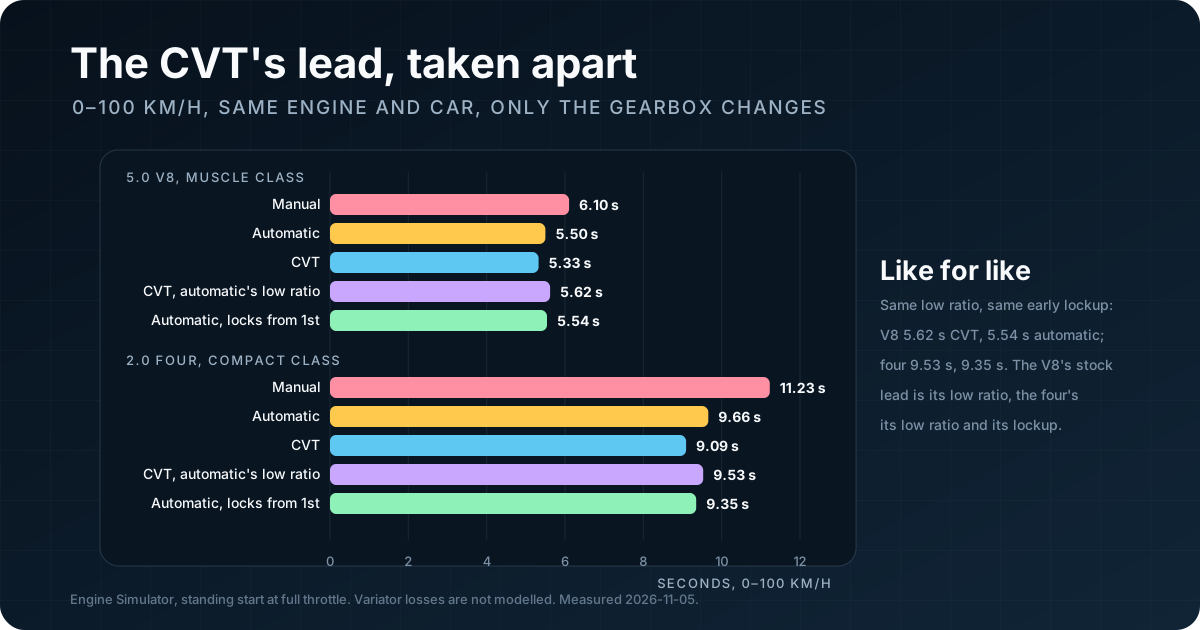
The stock lead differs by car. To 100 km/h the V8's is the low ratio alone (early lockup made its automatic 0.04 s slower, 5.50 s to 5.54 s), while the four's is 0.44 s of ratio and 0.31 s of lockup.
Like for like, the automatic leads to 100 km/h by 0.08 s on the V8 and 0.18 s on the four, and the quarter mile ties within 0.03 s (CVT 13.74 s, automatic 13.76 s on the V8; 17.02 s and 16.99 s on the four). In this model the stepless ratio buys nothing measurable on these two cars, because their power curves are so flat above about 4,700 rpm that landing there after a shift costs almost nothing. An engine with a sharp power peak could behave differently, and we did not test one.
The loss the model leaves out
The model carries no variator loss. Every box pays the vehicle class's same fixed driveline efficiency, so all three send the same power: 17.4 kW at a locked 100 km/h on the V8. Scaling efficiency down on the CVT alone, about 5 percent (V8) to 7 percent (four) of extra loss gives back the lead to 100 km/h, and about 8 percent gives back the quarter mile on both cars.
The world's figures overlap that range. The National Academies report (2015, retrieved 2026-11-05) puts a CVT at about 89 percent efficient and an automatic at 90 to 96 percent, a gap of 1 to 7 points. At its widest the gap covers the lead to 100 km/h and falls just short of the quarter mile, and at its narrowest it spends little of either. We did not measure a real variator, so the run shows how little lead there is to spend, and it leaves open which real car would win.
Across the presets that run both boxes, the CVT was quicker to 100 km/h by more than 0.05 s on 18 of 28 piston presets, within 0.05 s on 4 and slower on 6, and every one of those runs inherits the same setup and the same missing loss. The biggest gains are weak engines on a much deeper low ratio. Real-world evidence is thin. The one comparison we found is a 1996 Car and Driver test relayed by Jalopnik, with a Civic HX CVT at 10.2 s to 60 mph against an automatic LX at 10.5 s: different trims in a secondary source, so it carries little weight.
Cruise rpm depends on the shift style
At the default Normal style the model's CVT cruises lower: at 100 km/h the V8 turns 1,545 rpm against 2,752 for the automatic, and the four turns 2,429 against 2,769. That flatters the CVT, because the automatic's Normal line keeps it in a low gear. In Eco the four's automatic drops to 1,689 rpm, under the CVT's 2,429, though the V8's stays above its CVT at 2,066 rpm. These are engine speeds only, and we make no efficiency or fuel-economy claim from them.
Is a CVT Good
A CVT suits a low-torque car driven gently, where the smooth ratio changes are what you notice. It suits heavy loads and high torque less well, and one maker's warranty history is worth reading before you buy used.
Fuel economy
The National Academies report carries one NHTSA estimate of a 2.2 to 4.5 percent reduction in fuel consumption, alongside other figures, and Bosch claimed as much as 7 percent, a vendor figure, mainly in stop-and-go driving. Our model gives every box the same efficiency, so it holds no evidence either way.
Torque capacity
Bosch's 2014 range for its belts ran from 60 to 450 N·m, a JATCO unit announced in 2023 is quoted at 280 N·m, and Nissan's CEO said in a Motor1 interview on CVTs that a CVT is probably not ideal for heavier applications. Our model has no torque ceiling or belt slip: the V8 peaks at 635 N·m into the variator at 11 km/h, through the converter's multiplication, stays over 400 N·m for about 1.5 s, and nothing refuses it. Its engine alone peaks at 445 N·m, just inside Bosch's 450. The ratings as we found them don't state where in the driveline they apply, so read that comparison as a matter of scale.
Reliability
The record we found comes mostly from Nissan, which extended the warranty on 2003 to 2010 CVTs to 10 years or 120,000 miles; a class-action program covered Sentra, Versa, Note and Altima models. Consumer Reports' 2015 reliability article named slipping CVT belts. We found no citable figure for how long a CVT lasts. Warranty terms are coverage periods, and they are the evidence available, so we give no life expectancy.
CVT Pros and Cons
The table below marks each point as the model's or the world's. Speed sits in neither column, because the model's lead disappears once the setup is matched and the real-world comparison is one weak data point.
| Point | Evidence | |
|---|---|---|
| Pro | No shift shock | Model: 0 shifts to 100 km/h on both cars |
| Pro | Engine held near a chosen rpm | Model: 6,661 to 6,674 rpm from 90 to 244 km/h |
| Pro | Possible fuel saving | World: one NHTSA estimate, 2.2 to 4.5 percent |
| Con | Drone and a rubber-band feel | Model: 1,548 to 6,663 rpm in 0.5 s with no gain in speed |
| Con | Belt and pump losses | World: about 89 percent against 90 to 96 percent |
| Con | Torque ceiling | World: Bosch's 2014 range, up to 450 N·m |
| Con | Warranty history | World: Nissan's extensions |
Try It in the Simulator
Open the 2.0 four on its stock manual, which anyone can run. Start it, pull away, and watch the rpm saw up and down as you change gear.
Then open the same 2.0 four with the CVT fitted (needs a free sign-in). Press Start, select D and floor it. The panel shows RATIO in place of GEAR. Watch the ratio sit still to about 54 km/h, then fall while the rpm stays near 6,850. The same car on the automatic (also needs a free sign-in) gives you the comparison, and the 5.0 V8 with the CVT (needs a free sign-in) is the headline car. Picking the CVT yourself in the Gearbox menu needs Pro; these links run it after a free sign-in.
The in-sim launch timer starts at 0.5 km/h, 0.03 to 0.08 s after the pedal goes down, so it reads that much under our table. A saved vehicle tune for that class moves the figures, and the Eco readings reproduce only by setting the shift style by hand in Customize vehicle.
The CVT in the simulator has no belt to slip. Our free 3D gearbox simulator page has a separate CVT that does model belt slip, which we did not measure for this article.
Frequently Asked Questions
Does a CVT have gears?
It has no fixed gears between its lowest and highest ratio. Some designs add parts that act like gears: Toyota's has a physical launch gear, and some cars add stepped modes, such as the 2018 WRX in Sport.
Is a CVT faster than an automatic?
Nothing we measured supports that as a general rule. In our Real Engine Simulator the CVT was quicker on both test cars because of a deeper low ratio, plus earlier lockup on the four to 100 km/h and on both over the quarter. With those matched, the quarter mile tied within 0.03 s and the automatic led to 100 km/h, and the model charges the CVT no variator loss.
Why does a CVT drone?
Under hard acceleration the box holds the engine at a near-constant high rpm while the car speeds up. In our model the V8 stayed within 13 rpm from 90 to 244 km/h. A stepped gearbox would climb and drop through that range, so the steady note is what you notice.
How long does a CVT last?
We found no citable mileage figure and give none here. The published evidence is warranty history, including Nissan's extensions on several models, which shows a known problem without giving a lifespan.
How These Numbers Were Made
Every simulator figure comes from headless runs on 2026-11-05. Each car kept its engine and vehicle class and only the box changed: the 5.0 V8 in the muscle class, the 2.0 four in the compact class. The step was a fixed 1/240 s with unlimited fuel, the throttle went to 100 percent at t = 0, and times run from the pedal going down. The manual changed up at 97 percent of redline. As a control, the same probe reproduced our torque converter figures of 5.50 s, 9.66 s and 6.10 s, and read 11.23 s against that post's 11.24 s for the four's manual. Cruise rows held speed for 90 s and averaged the last 20 s. The roster count ran 29 presets for 45 s each, and one truck never reached 100 km/h on the automatic. The matched runs and the loss sensitivity were probes that moved one thing at a time, so no link carries them.
Read the CVT's lead with its setup and its missing loss in view. It comes from a deeper low ratio, plus earlier lockup on the four to 100 km/h and on both over the quarter, and like for like the quarter mile ties within 0.03 s while the automatic leads to 100 km/h. All three boxes pay the same fixed driveline efficiency, 0.88 in the muscle class and 0.92 in the compact class. About 5 to 8 percent of extra CVT loss spends the lead, against the National Academies gap of about 89 percent and 90 to 96 percent.
The model has no belt, clamp force, torque ceiling or belt slip. Its span comes from the class's manual and its converter from the class's automatic, and the 95 percent hold, ratio rates and pedal law are assumed constants. It models no real CVT's calibration or stepped mode. All figures are simulator output for these presets, and none is the published performance of a real car.
About this article
Written by the team that builds the simulator and maintains its drivetrain model, with the real-world sections drawn from the sources below. The simulator numbers are the model's and are stated as such; the real-world figures are the sources', and several are dated or come from vendors.
Sources and Further Reading
- National Academies (2015): fuel economy technologies report, chapter 7 (retrieved 2026-11-05)
- Automotive World (2014): Bosch on the CVT push belt (retrieved 2026-11-05)
- Bosch Netherlands (2024): press release on the push belt (retrieved 2026-11-05)
- JATCO (2023): press release (retrieved 2026-11-05)
- Toyota: TNGA CVT (retrieved 2026-11-05)
- Subaru: 2018 WRX press kit (retrieved 2026-11-05)
- Consumer Reports: 2021 Toyota Corolla overview (retrieved 2026-11-05)
- Consumer Reports (2015): car reliability and new technologies (retrieved 2026-11-05)
- Nissan: extended warranty content (retrieved 2026-11-05)
- BBB Programs: Nissan CVT class action (retrieved 2026-11-05)
- Motor1: Nissan CEO interview on CVTs (retrieved 2026-11-05)
- Jalopnik: 1996 Honda Civic HX CVT against the automatic (retrieved 2026-11-05)
- DAF Club: Operation of the Variomatic transmission (retrieved 2026-11-05)
- US Department of Energy: Fact of the Week 1280 (retrieved 2026-11-05)