What Is a Camshaft? What It Does and What a Bigger Cam Costs
A camshaft decides when the valves open and close, so when the engine breathes. How lobes, lift, duration and overlap work, and what a bigger cam costs.
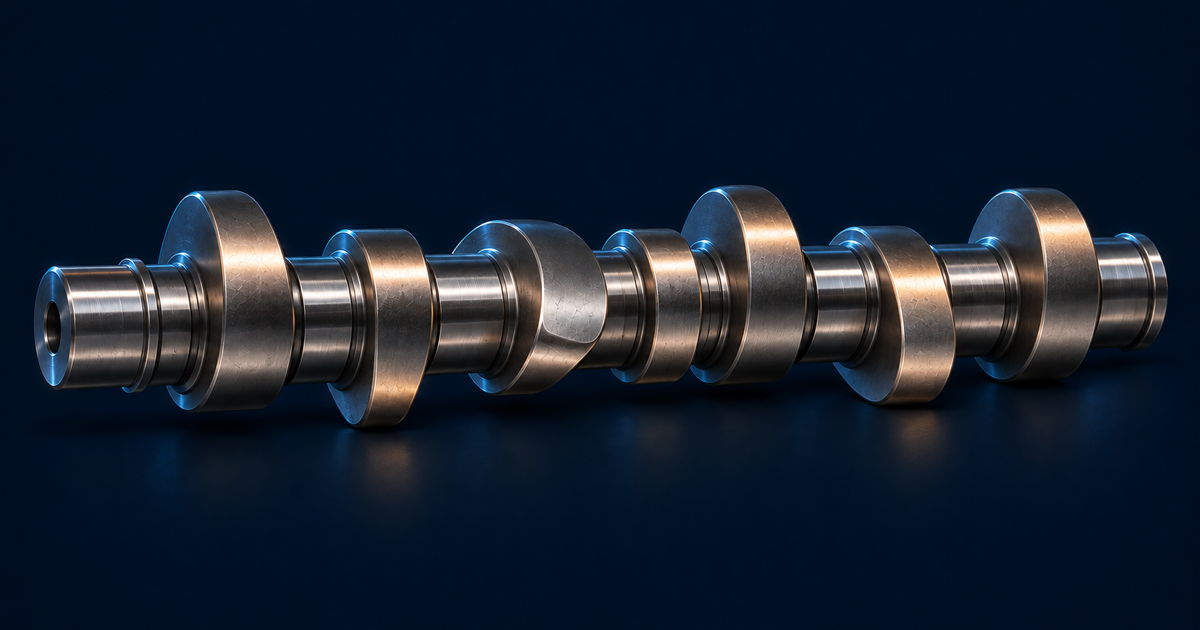
A camshaft is the rotating shaft that opens an engine's valves. Lobes ground along its length push each valve open and let a spring close it, so the shape of the steel decides when the cylinders breathe in and when they breathe out. That fixed shape has to serve every rpm the engine will ever see, which makes choosing a cam a trade: a longer one tends to move torque up the rev range and give away the bottom end.
You can see the trade in our simulator. Open the stock 5.0 L V8, press RUN DYNO, and you have the baseline for the curves below. This article covers what a camshaft is, what it does, how lobes, lift, duration and overlap work, and what a bigger cam does, with the model's duration sweep set beside a real cam test on a 408 cubic inch LS.
Key Takeaways
- A camshaft is a shaft of lobes, driven from the crankshaft, that opens the valves in step with the pistons. On a four-stroke it turns once for every two crank turns.
- Four terms describe a cam: lift (how far the valve opens), duration (how long it stays open), lobe separation (the angle between the intake and exhaust lobes) and overlap (how long both valves are open together).
- In our model of a 5.0 L V8, going from the stock 260° cam to 300° moves peak torque from 3,758 to 5,278 rpm. Torque at 2,500 rpm falls from 429.3 to 332.2 N·m, and torque at 6,500 rpm rises from 313.3 to 373.4 N·m.
- A real 408 cubic inch LS moved the same way: its torque peak went from 3,900 to 5,400 rpm across four cams. Lift rose with duration in that test, and a 5.3 L truck swap gained low-end torque with a longer cam, so the trade is a tendency with exceptions.
- Rough idle is a real-engine result: vacuum fell from 9 to 5.5 inHg across three cams on a 350. Our model has no lope. It shows only idle manifold pressure rising, from 0.188 to 0.234 bar at 300°, the right direction and far too small.
On this page: Quick answer · What it does · How it works · What a bigger cam does · A real engine · Rough idle · Try it · FAQ · How these numbers were made
Quick Answer: What Is a Camshaft
A camshaft, usually shortened to cam, is a shaft carrying egg-shaped lobes, one for each valve or set of valves it operates. As the shaft turns, the raised part of each lobe pushes its valve open, directly or through a lifter, pushrod or rocker arm, and the valve spring closes it again as the lobe rotates past. The crankshaft drives it through a chain, belt or gears, at half crank speed, as Summit Racing's own blog, OnAllCylinders, explains.
Where the cam sits depends on the layout. A pushrod (OHV) engine keeps it in the block and reaches the valves through pushrods. An overhead cam engine moves it to the cylinder head and drops the pushrods. A double overhead cam engine uses separate intake and exhaust camshafts. In the simulator the 5.0 L V8 has four camshafts and the 7.0 L pushrod V8 has one.
What Does a Camshaft Do
A camshaft decides when the engine breathes. It opens the intake valve to admit the charge, shuts it so the charge can be compressed, opens the exhaust valve to release the burned gas, and shuts that before the cycle repeats. The piston does the pumping and the cam sets when the way in and the way out are open.
The half-speed ratio comes from the four-stroke cycle. A cycle takes two crank turns and each valve opens once per cycle, so the cam needs one turn for every two of the crank. The lobes are spaced around the shaft so that each cylinder's valves work in firing order.
A lobe fixes the valve's opening in degrees of rotation, and the time those degrees take shrinks as rpm rises. This is arithmetic, true of any four-stroke:
| Crank rpm | Cam rpm | Valve openings per second | 260° open, ms | 300° open, ms |
|---|---|---|---|---|
| 800 | 400 | 6.7 | 54.2 | 62.5 |
| 3,000 | 1,500 | 25.0 | 14.4 | 16.7 |
| 6,000 | 3,000 | 50.0 | 7.2 | 8.3 |
| 7,000 | 3,500 | 58.3 | 6.2 | 7.1 |
At 6,000 rpm a 260° opening lasts 7.2 ms. Stretching it to 300° buys 1.1 ms there. A Mercedes-Benz paper on variable valve timing describes valve timing as usually a compromise, and our VTEC article measures one way out of it, a switch between two profiles.
How a Camshaft Works: Lobes, Lift, Duration and Overlap
OnAllCylinders' guide to cam terms defines these the way cam catalogues use them.
Lobes and lift
A cam lobe is a round base circle with a raised nose. While the follower rides the base circle, the valve stays shut. The ramp up the nose opens the valve, and lift is how far it opens at the top.
More lift gives the gas more area to flow through. In the simulator lift scales the whole torque curve and moves no rpm. On the 5.0 L V8 the torque peak stays at 3,758 rpm while its height runs from 407.1 N·m at 5 mm of lift to 471.1 N·m at 15.5 mm, with stock's 11.24 mm reading 445.1 N·m. That is about 6.1 N·m per millimetre. The gain stops at about 15.6 mm, and it costs nothing on the way there, because the model has no springs, lobe wear or valve float for a tall lobe to punish.
Duration
Duration is how many crank degrees a valve stays open, and it comes in two scales. Advertised duration counts from close to the seat, and it is what the simulator's Duration row shows. Duration at 0.050 inch of lift is the figure the tests below quote, and it reads far shorter for the same cam. Degrees from one scale cannot be compared with degrees from the other, so the 260° below and the 190° in the real test later in this article are different measures.
The simulator's stock cam is 260° advertised. The intake valve opens 20° before top dead centre and closes 60° after bottom dead centre. The exhaust valve opens 60° before bottom dead centre and closes 20° after top dead centre.
Lobe separation and overlap
Lobe separation is the angle between the centrelines of the intake and exhaust lobes, measured in camshaft degrees. Overlap is the stretch around top dead centre when the exhaust valve has yet to close and the intake valve has already opened. With the same duration on both lobes, as in the model, overlap is duration minus twice the separation: 260° on 110° gives 40°. A longer cam or a tighter separation raises it.
Separation does little in the model, and only low down, because on torque it acts through overlap alone and only once overlap passes 40°. It also shifts the knock margin, through where the intake valve closes. On the stock 260° cam, widening past 110° changes nothing on the dyno. On a 280° cam, going from 98° to 120° lifts torque at 2,500 rpm from 356.7 to 409.0 N·m, while 5,500 rpm reads 408.1 N·m throughout and peak power stays put.
The model has no midrange gain from tighter separation: tightening only costs here.
What Does a Bigger Cam Do
A bigger cam has longer duration, and usually more lift. It tends to move torque up the rev range and give away the bottom end, and on a real engine it also weakens idle vacuum and roughens the idle. The model's cam map was calibrated to this known trade, so the table shows what it was fitted to do. We changed duration alone on the 5.0 L V8, holding separation at 110° and lift at stock:
| Duration | Overlap | Peak torque | N·m at 2,500 rpm | N·m at 6,500 rpm | Stronger than stock |
|---|---|---|---|---|---|
| 230° | 10° | 456.0 N·m at 2,948 | 453.4 | 261.4 | below 3,560 rpm |
| 240° | 20° | 452.7 N·m at 3,150 | 446.9 | 278.0 | below 3,803 rpm |
| 260° (stock) | 40° | 445.1 N·m at 3,758 | 429.3 | 313.3 | |
| 280° | 60° | 434.7 N·m at 4,569 | 385.3 | 333.9 | above 4,522 rpm |
| 300° | 80° | 424.6 N·m at 5,278 | 332.2 | 373.4 | above 4,776 rpm |
| 310° | 90° | 424.4 N·m at 5,278 | 316.8 | 375.8 | above 4,794 rpm |
From stock to 300°, peak torque climbs 1,520 rpm and loses only 20.5 N·m (4.6%). Torque at 2,500 rpm falls 97.1 N·m (22.6%) and torque at 6,500 rpm rises 19.2%. Each longer cam beats stock only above its crossing point in the last column, so the useful question for any cam is how much of your driving happens above that rpm.
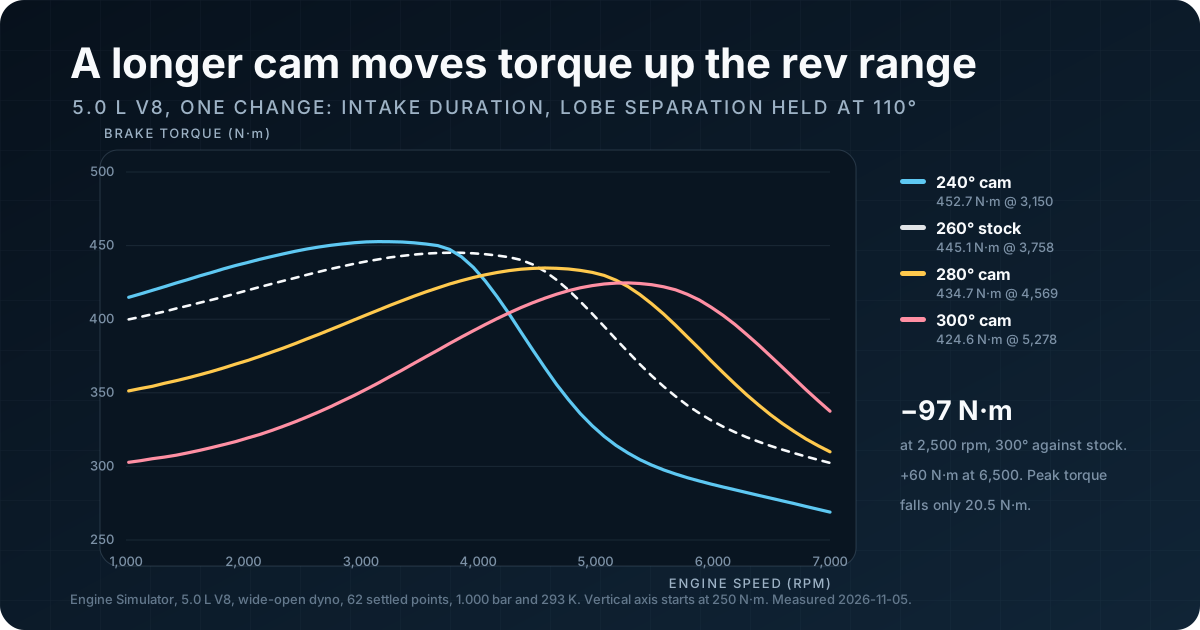
Stock's highest power reading is 297.2 hp at the 7,000 rpm redline, because past its breathing peak the model's stock cam settles on a floor, torque goes flat, and power climbs again with rpm. That makes a straight peak-to-peak comparison misleading, so compare the first hump in each power curve: 282.0 hp at 4,974 rpm on stock against 344.5 hp at 6,190 rpm on the 300° cam, a rise of 22.2%. Against stock's redline figure the rise is 15.9%.
A shorter cam pays too, and earlier than you might expect. The 230° cam adds 5.6% at 2,500 rpm and then reads 338.0 N·m at 4,400 rpm, 23.0% below stock, because its breathing peak falls to 3,365 rpm.
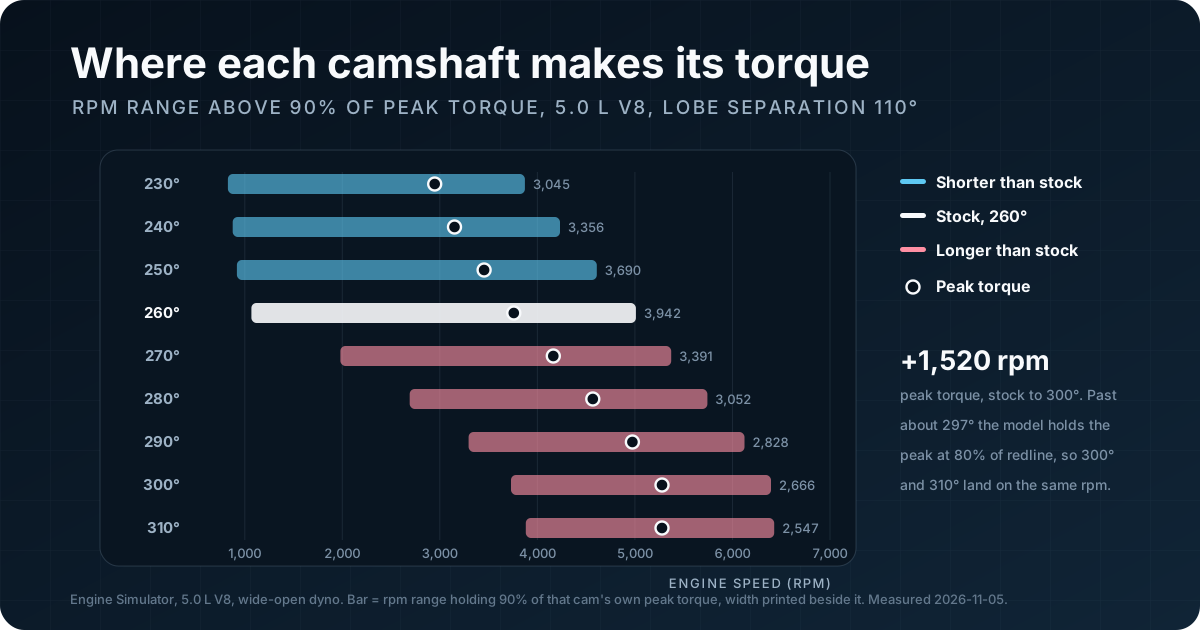
Each bar shows where a cam holds 90% of its own peak torque, and the bars move right as duration grows. Stock's bar is the widest at 3,942 rpm, which holds only in this model: its penalties for going shorter and for going longer both start exactly at 260°. The 300° and 310° cams share a torque peak because the model stops moving the breathing peak at 80% of redline, which this engine reaches at about 297°.
The Same Trade on a Real Engine
Holdener's cam test on a stroker 408 LS ran four cams on one engine and retuned it for each. These durations are intake duration at 0.050 inch, the shorter scale:
| Intake duration at 0.050 inch | Peak power | Peak torque |
|---|---|---|
| 190° (stock) | 449 hp at 5,100 rpm | 522 lb-ft at 3,900 rpm |
| 206° | 515 hp at 5,400 rpm | 556 lb-ft at 4,600 rpm |
| 224° | 584 hp at 5,800 rpm | 566 lb-ft at 4,700 rpm |
| 240° | 626 hp at 6,500 rpm | 580 lb-ft at 5,400 rpm |
Both peaks moved up the rev range, the torque peak by 1,500 rpm and the power peak by 1,400 rpm. The low end paid as well: the 240° cam made less low-speed torque than the 206° cam below 4,400 rpm.
This test does not isolate duration, because lift rose with it. That probably accounts for part of one clear difference from the model: peak torque here rose from 522 to 580 lb-ft, where the model's duration-only sweep lost 4.6%. Add lift in the model and the peak recovers. A 300° cam with 15 mm of lift and 106° of separation reads 447.1 N·m at 5,278 rpm, just above stock's peak, with 336.9 N·m left at 2,500 rpm.
Treat the direction as a tendency. A truck cam swap on a 5.3 L went from 191° to 202°, tightened separation from 114° to 111°, and gained about 20 lb-ft at 2,500 to 3,000 rpm. Duration and separation changed together, so that test cannot say which one did it. Our model cannot reproduce the result at all: torque at 2,500 rpm falls at every step up in duration, and tighter separation only costs.
Why a Big Cam Idles Rough
Overlap is the usual explanation. OnAllCylinders ties it directly to low vacuum and a rough idle, and Chevy Hardcore's test on a 350 small-block put numbers on the vacuum: it went from 9 to 7.5 to 5.5 inHg across cams of 279°, 287° and 295° advertised. Melling's tiers, as reported by EngineLabs, are one company's guide on the 0.050 inch scale: 200 to 215° for good idle, 215 to 230° for fair, 230 to 245° for rough, and 245° and up for racing.
Those are the world's numbers. The model reacts in one place: idle manifold pressure rises from 0.188 bar on stock to 0.234 bar on the 300° cam. That is the right direction, since higher manifold pressure means less vacuum, and far too small: against the model's 1.000 bar ambient it is about 24.0 falling to 22.6 inHg of vacuum, where the real 295° cam showed 5.5. Idle speed stays at 820 rpm across the duration sweep and its scatter barely changes, because the idle valve holds speed and the model has no dilution from overlap. There is no lope in the simulator, so a steady idle on a long cam there says nothing about how a real one would run.
Try It in the Simulator
Open the stock 5.0 L V8, no account needed. Start it, press RUN DYNO, and find the torque peak near 3,758 rpm. The 2.0 L four gives a second baseline with the same generic cam.
The links below change the cam, so each one needs a free sign-in. Run the dyno on each and compare it with stock:
- Short cam: the 230° cam pulls harder low down and fades by 4,400 rpm.
- Long cams: the 280° cam and the 300° cam show the climb. The 310° cam lands on the same torque peak as the 300°.
- Separation: the 280° cam at 98° and the 280° cam at 120° differ low down and match at 5,500 rpm.
- Lift: the 15.5 mm lift raises the whole curve and leaves the peak at 3,758 rpm.
- Whole grinds: the street 280/112 with 13 mm and the race 300/106 with 15 mm are our own round numbers and match no catalogue cam.
To build your own, open the CAMSHAFT group in the spec panel, also behind the free sign-in. Idle each cam and read the MAP gauge: it is the one idle number that moves.
Frequently Asked Questions
What is a camshaft in simple terms?
A camshaft is a spinning shaft with bumps on it. Each bump, called a lobe, pushes a valve open as it comes round and lets a spring close it. That sets when air and fuel enter each cylinder and when the burned gas leaves.
What is a cam lobe?
A cam lobe is the egg-shaped section of a camshaft that operates a valve. Its round base circle keeps the valve shut and its raised nose opens it. The height of the nose sets lift and its width sets duration.
What is the difference between a camshaft and a crankshaft?
The crankshaft turns the pistons' up-and-down motion into rotation and carries the engine's output. The camshaft is driven by the crankshaft at half its speed on a four-stroke and operates the valves.
What is valve overlap?
Valve overlap is the period around top dead centre when the exhaust valve is still open and the intake valve has already opened. A longer cam or a tighter lobe separation increases it. On a real engine more overlap means lower vacuum and a rougher idle.
Does a bigger cam add horsepower?
Usually at high rpm, at a cost lower down. A stroker 408 LS went from 449 to 626 hp between its stock cam and a cam of 240° at 0.050 inch, with lift rising alongside. In our model a 300° advertised cam raises the first power hump from 282.0 to 344.5 hp on duration alone and costs 97.1 N·m at 2,500 rpm.
What does a worn camshaft sound like?
A GM service bulletin describes a chirp or tick at camshaft speed from a worn lobe. That finding is specific to GM engines, and plenty of other faults tick. The simulator does not model cam wear.
How These Numbers Were Made
Every simulator figure in this article comes from one headless run of the simulator on 2026-11-05, with each cam set through the same inputs the spec panel writes. Each share link was decoded and rebuilt to confirm it carries the cam it names. Dyno curves are wide-open sweeps of 62 settled points from idle to redline, about 101 rpm apart, at 1.000 bar and 293 K. Torque at a named rpm is read from a sweep or from a 6 s average at held rpm, and the two agree to within 0.28 N·m at 2,500 rpm. Idle figures come from the last 6 s of a 12 s idle.
We used the 5.0 L V8 because it has about 1,300 rpm of room below the model's cap on the breathing peak, 80% of redline. The 7.0 L pushrod V8 already sits on that cap, so 310° adds 3.7 hp there and takes 82.0 N·m at 2,500 rpm, a result that belongs to the cap and says nothing about real engines of that size. The 2.0 L four repeats the 5.0 L's shape, losing 25.1% at 2,500 rpm on the 300° cam.
The cam in this model is a fitted map onto the engine's breathing curve. No valve-event flow calculation sits behind it, and its constants were calibrated to the known trade, so the tables show the behavior the model was fitted to and cannot confirm it independently, which is why the real test sits beside them.
Peak figures here come from our own sweep grid. The on-screen dyno and the engine page use different steps, so their last digits and peak rpm can differ slightly. Every stock engine in the simulator shares the same generic 260° on 110°, whatever its real cam is. One duration serves both lobes, and there is no phasing or installed advance; the only variable cam is the two-profile switch from the VTEC article. On torque, separation acts only through overlap, and overlap causes no dilution, so no lope appears at idle. There is no valve float, spring or lobe wear, so nothing breaks and the rev limit never moves. All tables are wide open except idle, and part throttle was not measured.
A run with knock taken out of the model (octane 200) left every peak figure unchanged.
About this article
Written by the team that builds the simulator and maintains its camshaft model. The real dyno, vacuum and duration figures come from the trade publications, retailer pages and technical paper listed below, and several of those sell or test cam parts. The article says which number is the model's and which is the world's at each point.
Sources and Further Reading
- OnAllCylinders: Camshaft basics for power and reliability (retrieved 2026-11-05)
- OnAllCylinders: Lift, duration, LSA, understanding common cam terms (retrieved 2026-11-05)
- OnAllCylinders: Stroker LS cam swaps, when is bigger not better (retrieved 2026-11-05)
- OnAllCylinders: Truck cam swap testing to add low-end torque (retrieved 2026-11-05)
- OnAllCylinders: Mailbag, explaining valve overlap for camshafts (retrieved 2026-11-05)
- OnAllCylinders: Parts bin, Summit Racing Pro LS cams (retrieved 2026-11-05)
- OnAllCylinders: Ask Away with Jeff Smith, how and why camshaft manufacturers grind advance into their camshafts (retrieved 2026-11-05)
- Summit Racing knowledge base: advertised duration (retrieved 2026-11-05)
- Summit Racing knowledge base: lobe separation angle (retrieved 2026-11-05)
- COMP Cams: Valve timing tutorial (retrieved 2026-11-05)
- Chevy Hardcore: Thumpin' power (retrieved 2026-11-05)
- EngineLabs: How Melling brings a camshaft from an idea to an engine (retrieved 2026-11-05)
- EngineLabs: Why don't pushrod engines rev as high as overhead cam designs (retrieved 2026-11-05)
- SAE 891990: paper on variable valve timing in the new Mercedes-Benz four-valve engines (retrieved 2026-11-05)
- Vehicle Service Pros: GM chirp, squeak, squeal or tick bulletin (retrieved 2026-11-05)