PISTON · Cummins 6BT 5.9
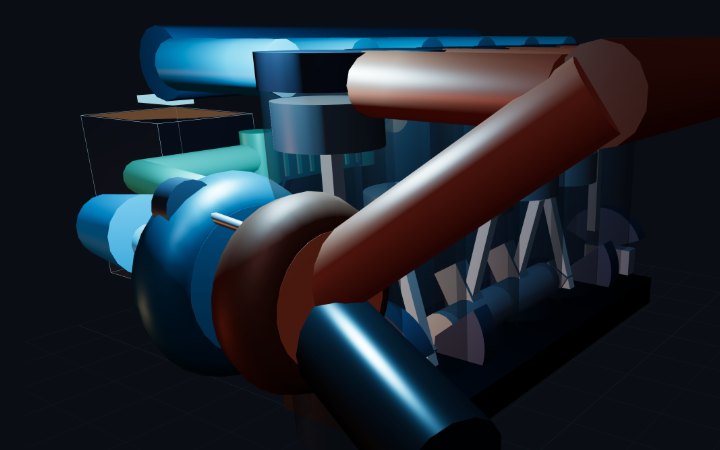
Diesel I6 5.9L Turbo
Twelve valves, one mechanical pump, and every bit of its torque in by sixteen hundred rpm.
The real engine
Same bore, stroke, compression ratio and displacement as the Cummins 6BT 5.9.
Figures are the 1998 high-output rating; the same engine shipped from 160 hp.
Same layout as the Caterpillar 3126 and the Mercedes OM606.
6 cyl · 5.9 L · diesel · turbo
 211hp
211hpPeak power
211hp
@ 3,000 rpm
Peak torque
609N·m
@ 1,594 rpm
Displacement
5,883cc
5.9 litres
Redline
3,000rpm
Specifications
- Cylinders
- 6
- Layout
- Inline
- Bore × stroke
- 102.0 × 120.0 mm
- Displacement
- 5,883 cc
- 5.9 litres
- Compression ratio
- 17.5:1
- Conrod length
- 192.0 mm
- Firing order
- 1-5-3-6-2-4
- Cycle
- Four-stroke
- Fuel
- Diesel, 50 cetane
- Induction
- Turbocharged
- 75 mm compressor wheel
- Boost target
- 1.27 bar absolute
- Wastegate spring pressure, so boost creeps above it as flow rises
- Intercooler
- 72% effectiveness
- Idle
- 750 rpm
- Redline
- 3,000 rpm
Check these numbers in the engine displacement calculator, the bore and stroke calculator or the compression ratio calculator, with this engine already filled in.
Measured on the dyno
Every point is a full sweep of this engine in the simulator, not a figure copied off a spec sheet.
What it is
Bore is 102 mm, stroke is 120 mm and the compression ratio is 17.5:1, which comes to 5,883 cc across six cylinders. Those four figures match the Cummins 6BT 5.9, the 12-valve Dodge sold in the Ram. Nothing else here was copied from one. The curve on the dyno comes out of a diesel burn in two parts, a sharp premixed spike near top dead centre and a slower diffusion tail behind it, solved against crank-slider geometry while the plenum, the runners and the collector fill and empty around it.
The stroke is 18 mm longer than the bore and the rest of the engine agrees with it. The intake breathes best at 1,500 rpm and the rev limit is 3,000, which is where the factory tachometer marks red. Cummins rated the 1998 high-output version at 597 N·m at 1,600 rpm, and the shape is the whole point: everything arrives before you have finished pulling away. Put it beside the 4.6 petrol V8 on this roster, which is still climbing at 4,000, and the two curves barely belong on the same chart.
The compressor wheel is 75 mm and the turbine housing is tight, a truck turbo lit by 1,400 rpm. A tight housing costs backpressure, which sits above manifold pressure across the range and keeps the pumping loop a loss. The wastegate is regulating the whole way, from 6 percent open at 1,000 rpm to 75 at the limit, so the boost target is a spring setting rather than a turbo at its ceiling. It still reads low against the 14 to 16 psi a real 12-valve runs, because it stands in for a cap the model does not have. Diesel fuel mass here is air mass over one global smoke limit of 28, so every extra kilogram of air buys proportional fuel and no injector runs out. A real 6BT runs into its pump long before it runs short of air, which is how 5.9 litres and a bar of boost come to be rated 215 hp.
Things to try
- Widen Housing A/R from 0.13, or take Compressor Ø past 75 mm. Either one takes torque out of the bottom of the range, where this engine earns its living: at 0.30 the peak falls by about a seventh and slides from 1,700 rpm toward 1,900.
- Take Boost target from 1.27 toward the 2 bar absolute a real 12-valve runs. Torque keeps climbing, because once the air is there nothing in the model caps the fuel.
- Raise Redline past 3,000. The dyno keeps drawing curve, but a real 12-valve is on its governor across that span and the sweep here ignores governors.
Seen in

Mercedes-Benz E-Class (W210)
Same layout1996–2002. Same layout, different engine: the E300 Turbodiesel's OM606 is a turbocharged inline-six diesel too, carrying a saloon rather than a ton of gravel.
Photo: miniperde · Pexels
Hear it run
It cranks, idles, revs and knocks in the browser. Nothing to download, nothing to install.