What Is a Carburetor? How It Works, and Carb vs Fuel Injection
A carburetor mixes fuel into air through a jet sized for one air density. How it works, why a good one can match EFI power, and what it cannot correct.
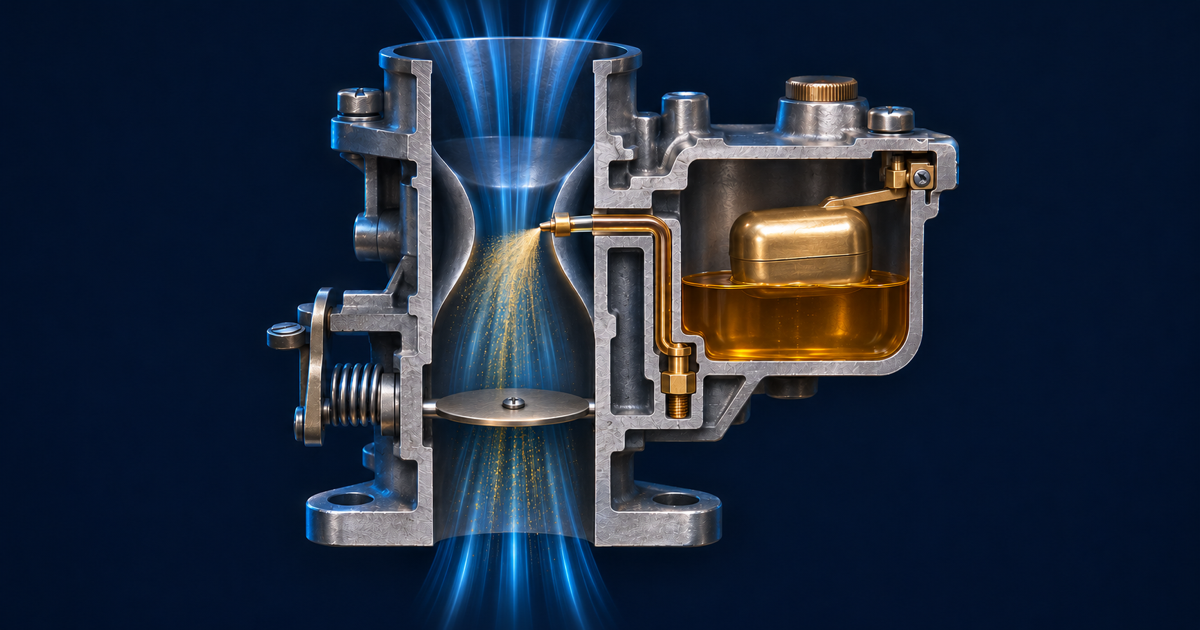
A carburetor and an electronic fuel-injection system, bolted in turn to the same 350 cubic inch LS engine, both made 873 hp in EngineLabs' same-engine dyno test (February 2022, retrieved 2026-11-05). The gap showed up in the tuning: the injected setup took two pulls, and the carburetor took about 15.
A carburetor is a set of fixed holes sized for one density of air. Sized well, it feeds an engine as fully as injection does. What a plain mechanical carburetor cannot do is notice that the air has changed and correct itself. In our simulator you can load a 5.0 L V8, switch it to a carburetor, and shrink the jet yourself.
Key Takeaways
- A carburetor mixes gasoline into the air entering an engine. Air speeding through a narrow throat, the venturi, drops in pressure, and that draws fuel from a float bowl through a calibrated jet. Separate circuits handle idle, sudden acceleration, and cold starts.
- Peak power can tie when the carburetor is tuned. EngineLabs measured 873 hp both ways on one real engine. Our model reads 297.25 hp both ways on its 5.0 L V8 at 20 °C, because its carburetor is built to meter perfectly up to a fixed limit.
- In our model, a jet that is too small starves only the top of the rev range. On that scale, 80% is what the engine asks for at peak and 100% is 125% of that. A 70% jet costs the V8 17.72% of its torque at 7,000 rpm and nothing below about 5,970 rpm.
- The lasting difference is feedback. A real carburetor richens in thin air until someone rejets it, while closed-loop injection reads the exhaust and trims itself.
On this page: Quick answer · What it does · How it works · A too-small jet · Carb vs EFI · Try it in the simulator · FAQ · How these numbers were made
Quick Answer: What Is a Carburetor
A carburetor (carburettor in British English, carb for short) is a mechanical device that meters liquid fuel into the air flowing into a gasoline engine. Air passing through a narrowed throat, the venturi, speeds up and drops in pressure, and GM's 1959 ABCs of Carburetion places the lowest pressure point right there. Fuel in a float bowl at atmospheric pressure is pushed through a calibrated jet into that stream and travels with the air to the cylinders. A throttle plate downstream sets how much mixture the engine gets.
The EPA's fuel-economy trends report records fuel injection replacing carburetors in the 1980s, with the carbureted share of new US cars at about 9.6% in 1989, about 1.4% in 1990, and about 0.1% in 1991 (retrieved 2026-11-05). They live on in small utility engines and light aircraft.
What Does a Carburetor Do
A carburetor keeps the ratio of fuel to air inside the range an engine can burn, at every throttle opening and engine speed, with no electronics. Too little fuel for the air is a lean mixture, too much is rich, and λ 1.00 is the chemically correct balance. Our guide to air-fuel ratio covers what each does to an engine.
The clever part is that the airflow does the metering. More air through the venturi means lower pressure there, which draws more fuel, so fuel follows air without anything measuring either one.
The weakness is that the calibration is fixed. The pressure drop tracks how fast air moves through the venturi, and the jet passes fuel according to that drop. The drop weakens with density, but fuel flow falls only with its square root while air mass falls directly, so the mixture richens in thin air. By the same reasoning, denser air leans it. A jet is a hole chosen for one density of air, and a plain mechanical carburetor has no way of knowing when the density has moved.
How Does a Carburetor Work
A carburetor is several small fuel circuits in one body, each taking over for part of the engine's range. GM's ABCs of Carburetion describes all of them.
- Float and bowl. A float works a needle valve that keeps fuel at the right level in the bowl, so the jets see a steady supply.
- Main circuit. At cruise and full throttle, the venturi's low pressure pulls fuel through the main jet and into the carburetor bore. The jet's size limits what this circuit can pass.
- Idle circuit. With the throttle nearly shut, air through the venturi is too slow to lift fuel, so a separate passage feeds mixture past the throttle plate, and an idle screw regulates it.
- Accelerator pump. Snap the throttle open and the air speeds up faster than the fuel can follow, so the pump squirts in extra fuel to prevent hesitation.
- Choke. In the cold, much of the fuel does not vaporize, so a plate restricts the air and more fuel is drawn in, giving the rich mixture needed for starting and warm-up.
What Our Model Has and Lacks
Everything above describes real carburetors. The one in our simulator is far simpler, and the rest of this article depends on knowing where.
| Real part | In the simulator |
|---|---|
| Venturi | None. Fuel follows inducted air mass exactly, by the same sum injection uses |
| Main jet | A fixed ceiling on fuel mass flow, the same at every rpm |
| Idle circuit | None. V8 idle matches injection: 819.0 rpm and 1.90 L/h on both |
| Accelerator pump | None. A snap of the throttle to 5,600 rpm takes 0.458 s on both |
| Float bowl | A display figure. Nothing runs dry, sloshes, or percolates |
| Choke | A start delay that adds no fuel |
| Atomization, mixture distribution | None. A V8 on one carburetor is perfectly even |
What a Too-Small Main Jet Does
A jet that is too small runs out of fuel at the top of the rev range and costs torque there, and nothing below that point changes. That is the model's behavior, and the scale needs explaining first. The Main jet row reads a percentage on the simulator's own scale, unrelated to the numbers stamped on real jets. 80% is exactly what the engine asks for at its peak at 20 °C. 100% is 125% of that, a quarter more than it uses on that day.
We held the 5.0 L V8 wide open at fixed speeds on metered fuel at 20 °C and stepped the jet down. Every figure in this table is the model's.
| Main jet | Fuel runs short from | LEAN flag from | Torque at 7,000 rpm | Torque lost | λ at 7,000 rpm |
|---|---|---|---|---|---|
| 100% | never | never | 302.2 N·m | 0 | 1.000 |
| 90% | never | never | 302.2 N·m | 0 | 1.000 |
| 85% | never | never | 302.2 N·m | 0 | 1.000 |
| 80% | never | about 6,630 rpm | 302.2 N·m | 0 | 1.000 |
| 75% | about 6,530 rpm | about 6,130 rpm | 275.9 N·m | 8.7% | 1.066 |
| 70% | about 5,970 rpm | about 5,250 rpm | 248.7 N·m | 17.7% | 1.142 |
| 65% | about 4,850 rpm | about 4,430 rpm | 221.5 N·m | 26.7% | 1.229 |
| 60% | about 4,290 rpm | about 4,070 rpm | 194.2 N·m | 35.7% | 1.332 |
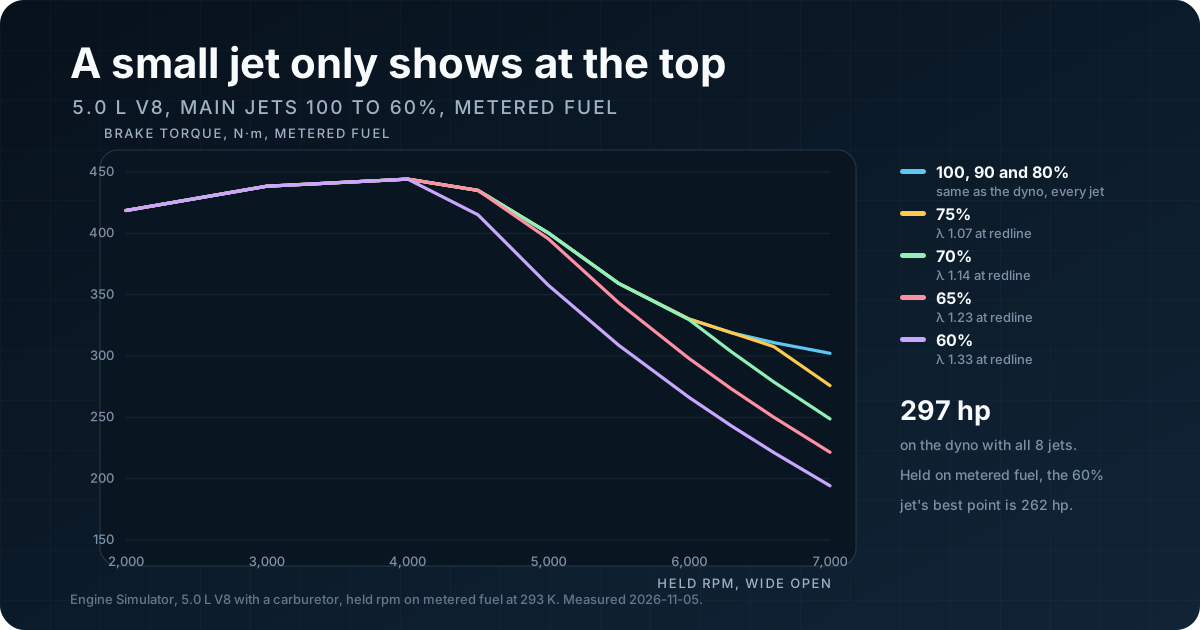
Fuel demand climbs with rpm, so the ceiling only arrives near the top. The 70% jet loses 4.90% of the V8's torque at 6,300 rpm and 17.72% at 7,000 rpm. On the 500 cc single the same jet loses 14.54% at 5,400 rpm. That engine's demand peaks near 5,100 rpm and then falls, so its lean-out is worst in the middle of the top end: λ 1.139 at 5,100 rpm against 1.114 at 6,000 rpm.
The shape belongs to the model. A real jet meters on the venturi's pressure signal, so a real undersized jet leans the mixture wherever the main circuit is working, while the model's mixture stays correct right up to its ceiling.
Why the Simulator's Dyno Cannot See the Jet
Run the simulator's dyno and all eight jets read 297.25 hp and 445.16 N·m, the same 45-point curve number for number, because the sweep measures the engine with the fuel system removed. Held on metered fuel, the 60% jet's best point on our ten-point grid is 262.3 hp at 4,500 rpm, a floor on its true peak. That blind spot is a property of our tool: a real dyno pull runs on the real carburetor, and a jet change shows on the graph.
The panel has no mixture readout either. It shows Jet duty, the share of the ceiling in use, and adds LEAN above 95%. That flag lights before fuel runs short: the 80% jet flags LEAN from about 6,630 rpm and loses nothing.
Carburetor vs Fuel Injection (Carb vs EFI)
A tuned carburetor can tie fuel injection on peak power, and injection wins on correcting itself once conditions change.
| Carburetor | Fuel injection | |
|---|---|---|
| Metering | Venturi pressure draws fuel through fixed jets | A controller times the injectors |
| Peak power, EngineLabs test | 873 hp at 8,640 rpm | 873 hp at 8,760 rpm |
| Peak torque, EngineLabs test | 560 lb-ft at 7,800 rpm | 558 lb-ft at 7,860 rpm |
| Pulls to tune, EngineLabs test | about 15 | two |
| Mixture feedback | None on a plain mechanical carburetor | Oxygen sensor, closed loop |
| Thin air | Richens until rejetted | Trimmed by the controller |
Peak Power: a Tie
The EngineLabs test (retrieved 2026-11-05) ran a 1,150 cfm Dominator and a Terminator X Stealth 4500 system on one 350 cubic inch LS. That is one engine at full throttle, and it shows what a carburetor can do when someone spends the dyno time.
Our model agrees for a weaker reason. With a 100% jet at 20 °C, the V8 reads 297.25 hp and 445.16 N·m on either system and the 500 cc single 27.67 hp and 40.89 N·m, bit-identical at all 20 held points. The match is built in, because below its ceiling the model's carburetor computes the same fuel demand as injection, so the real test is the evidence. It also holds at 20 °C only. In hard cold the model's injectors reach their duty limit, a sizing choice that says nothing about real injection, so we draw no cold-weather comparison between the two.
Why Injection Replaced the Carburetor
Injection closes the loop. An oxygen sensor in the exhaust reports the mixture and a controller trims the fuel to suit, an approach Rivard of Bendix set out in SAE paper 730005 in 1973. A carburetor runs on the calibration it left the factory with, and The Christian Science Monitor reported in 1980 that production variation between units was a problem against tightening emission limits.
Altitude and Thin Air
Climb a mountain and a real carburetor runs rich. A carburetor patent from ACF says the mixture "tends to become richer unless a correction is made", and Holley's manual for its 0-7448 carburetor tells owners to drop one jet size, primary and secondary, for every 2,000 ft (Holley's own numbering, retrieved 2026-11-05).
Our model cannot show this. Its ambient pressure is constant, so there is no altitude, and below the ceiling its fuel follows air mass, so thin air cannot richen anything.
Cold, Dense Air and a Fixed Jet
Temperature is the one way our model can change air density, and at the ceiling it shows the real direction, since the fuel is fixed and the air moves. Held at 6,600 rpm, the 70% jet burns the same 74.9 L/h at every temperature, while its λ climbs from 1.015 at 39 °C to 1.081 at 20 °C and 1.318 at −33 °C.
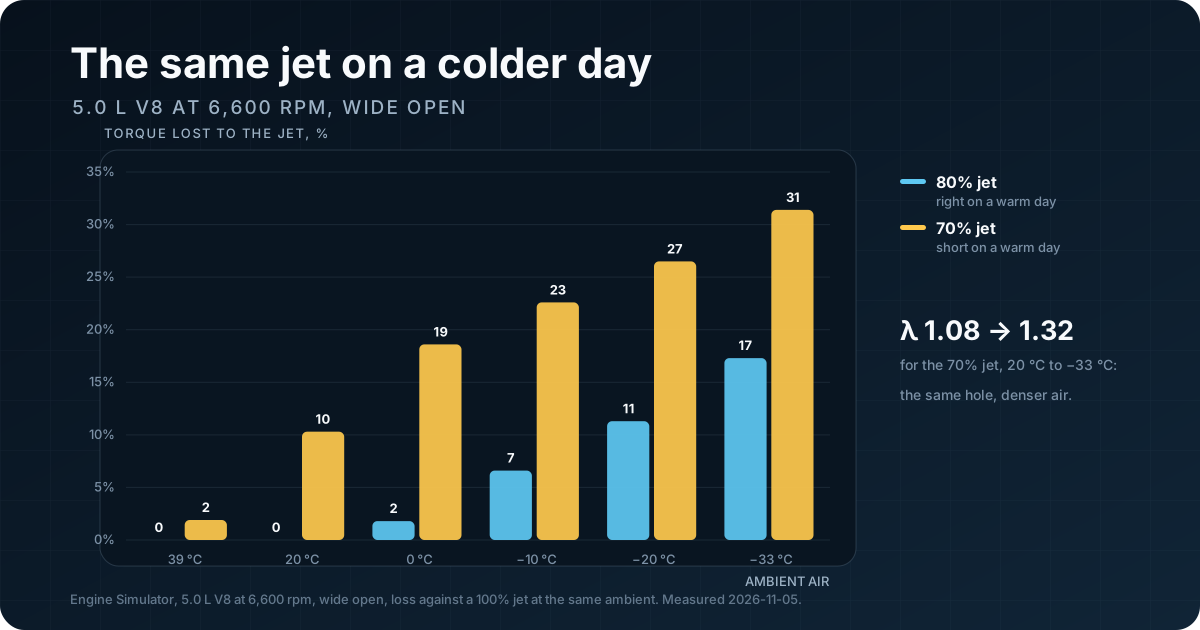
The 80% jet shows the argument best. It is exactly right at 20 °C, with no torque lost, and at −33 °C the same hole costs 17% against a 100% jet in the same air. The direction matches real carburetors. The size of the effect is the model's, and this model can lean a jet out but can never run richer than commanded.
Cold Starts and the Choke
A real choke enriches the mixture, as described above. The simulator's version is a delay. Below 288 K (15 °C) the starter waits 1 + 0.12 × (288 − T) seconds, with T in kelvin, held between 1 and 6, while a CHOKE badge counts down: 1.12 s at 14 °C, 4.00 s at −10 °C, and 6.00 s from −27 °C down. Injected engines have no wait.
The delay adds no fuel and no fast idle, and it follows the weather instead of the engine, so the badge stays lit on a cold day and a restart waits the full time again. In a test build with the choke removed, the V8 started without the wait and idled at the same rpm on the same fuel.
Hot Fuel and Icing
A vented float bowl is where hot fuel causes trouble, and an injected rail holds its fuel under pressure, as our article on vapor lock explains. Our model cannot show that difference: both systems share one gate at 313 K and 325 K, and they read the same at every whole kelvin we measured through 324 K.
Carburetors can also freeze, because fuel vaporizing and pressure falling in the venturi chill the throat (FAA handbook as quoted by AOPA). AOPA's accident analysis gives it as possible at up to 100 °F (38 °C), with humidity as low as 50% (retrieved 2026-11-05). Our model has no icing, so the icing figures are the world's.
Try It in the Simulator
Open the 5.0 L V8. This route needs no sign-in, because the Delivery and Main jet rows sit outside the sign-in wall. In the spec panel, set Delivery to CARBURETTOR, and the Main jet and Jet duty rows appear. Start the engine and open the throttle: at 100%, our held runs reached 80% duty at 7,000 rpm.
Now drag Main jet to 70 and rev it again. In our held runs the panel flagged LEAN from about 5,250 rpm. Free-revving hides the torque cost: the V8 reached 5,600 rpm in 0.458 s on both the 100% and 70% jets, and in 0.475 s at 60%. Run the dyno on each jet and the curve will not move. The torque table needs fuel metered under load, so try it on the road, which we did not measure for this article.
For the cold start, open the V8 at −10 °C. As delivered it is injected and has no wait. Set Delivery to CARBURETTOR, press START, and CHOKE counts down its 4.00 s before the crank turns.
These one-click versions open the same setups, and each needs a free sign-in:
- V8 on a carburetor, 100% jet
- V8 on a 70% jet
- V8 on a 60% jet
- V8 on an 80% jet at −10 °C, lean only in the cold
- V8 carburetor cold start at −10 °C
- 500 cc single on a 70% jet
Frequently Asked Questions
Is a carburetor better than fuel injection?
For peak power a well-tuned carburetor can match injection: EngineLabs measured 873 hp from both on one 350 cubic inch LS engine, though the carburetor took about 15 pulls to tune against two (EngineLabs' same-engine test, retrieved 2026-11-05). Injection is better when conditions change, because closed-loop control reads the exhaust and corrects the mixture, and a plain mechanical carburetor cannot.
Why did cars stop using carburetors?
Emission limits called for a mixture held tighter than a fixed calibration could manage, and closed-loop injection with an oxygen sensor could hold it. The EPA's trends report (retrieved 2026-11-05) has the carbureted share of new US cars at about 0.1% by 1991.
What happens if a carburetor jet is too small?
The engine runs lean and loses power. In our model, on a scale where 80% is peak demand, a 70% jet costs the 5.0 L V8 17.72% of its torque at 7,000 rpm. A real undersized jet leans the mixture wherever the main circuit is working.
Does a carburetor need adjusting for altitude?
Yes. Thin air richens a carburetor's mixture unless it is corrected, and Holley's manual for the 0-7448 (retrieved 2026-11-05) advises one jet size smaller, by its own numbering, for every 2,000 ft. Our simulator has no altitude, so this is a real-world answer only.
Do new engines still use carburetors?
Yes, on small utility engines and light aircraft. Honda's GX100 lists a float-type carburetor, Briggs & Stratton publishes carburetor care for its engines, the Rotax 912 UL runs two carburetors, and KitPlanes' 2020 maintenance guide covers Marvel-Schebler units on Lycoming engines.
How These Numbers Were Made
Peak figures here come from our own sweep grid. The on-screen dyno and the engine page use different steps, so their last digits and peak rpm can differ slightly. Every simulator figure here comes from one headless run on 2026-11-05, on the 5.0 L V8 and the 500 cc single, each edited the way the panel edits it so the jet and intake were re-derived. The probe started the engine, idled it for 3 s, opened the throttle, waited for manifold pressure to settle, then averaged torque, fuel flow, jet duty, and supply factor at each held rpm. Eight jets from 100% to 60% ran across ten speeds per engine, with a 45-point dyno sweep per jet as the control. The engine has no λ readout, so λ here is the commanded 1.00 divided by the fuel supply factor. Temperature ran from 240 to 324 K. The link parameters were decoded to confirm each carries the carburetor and the jet it names. The sign-in-free panel route was checked against the code and has not been driven in a browser.
The model's limits go beyond the table above. It has no transfer circuit, tip-in bog, power valve, metering rods, or wall film. Its jet lean-out scales heat release straight on fuel supply, so it costs more than the same λ set on the mixture row: at 6,600 rpm the 70% jet gives λ 1.081 and 278.9 N·m where the mixture row gives 297.9 N·m. Do not read jet figures against the λ table in our air-fuel ratio guide. Lean has no effect on engine knock in this model and lowers its exhaust temperature, so nothing here says what lean running does to a real engine.
About this article
Written by the team that builds the simulator and maintains its fuel-system model, with the real-world sections drawn from the manufacturer, regulator, and test sources below. Simulator numbers are the model's and are stated as such.
Sources and Further Reading
- GM, ABCs of Carburetion (1959): venturi, main circuit, accelerator pump (retrieved 2026-11-05)
- GM, ABCs of Carburetion: float and idle (retrieved 2026-11-05)
- GM, ABCs of Carburetion: choke (retrieved 2026-11-05)
- GM, ABCs of Carburetion: cold-engine fuel needs (retrieved 2026-11-05)
- US EPA: fuel-economy trends report, 1975 through 2011 (retrieved 2026-11-05)
- The Christian Science Monitor, 28 April 1980: production variation and emission limits (retrieved 2026-11-05)
- SAE 730005 (Rivard, Bendix, 1973): closed-loop electronic fuel injection control (retrieved 2026-11-05)
- EngineLabs (February 2022): carburetor and EFI on one 350ci LS (retrieved 2026-11-05)
- US patent 4187814 (ACF): altitude and carburetor mixture (retrieved 2026-11-05)
- Holley 0-7448 manual, altitude jetting (retrieved 2026-11-05)
- AOPA (2010): carburetor ice, quoting the FAA handbook (retrieved 2026-11-05)
- AOPA Flight Training (October 2009): accident analysis on carburetor ice (retrieved 2026-11-05)
- Honda Engines: GX100 (retrieved 2026-11-05)
- Rotax: 912 UL (retrieved 2026-11-05)
- KitPlanes (2020): carburetor maintenance (retrieved 2026-11-05)
- Briggs & Stratton: carburetor repair and maintenance guide (retrieved 2026-11-05)