Air-Fuel Ratio Explained: Stoichiometric, Lean vs Rich, and a Good AFR
What air-fuel ratio means, why 14.7:1 is gasoline's number only, what lean and rich do to power and fuel, and a simulator where you drag lambda and watch.
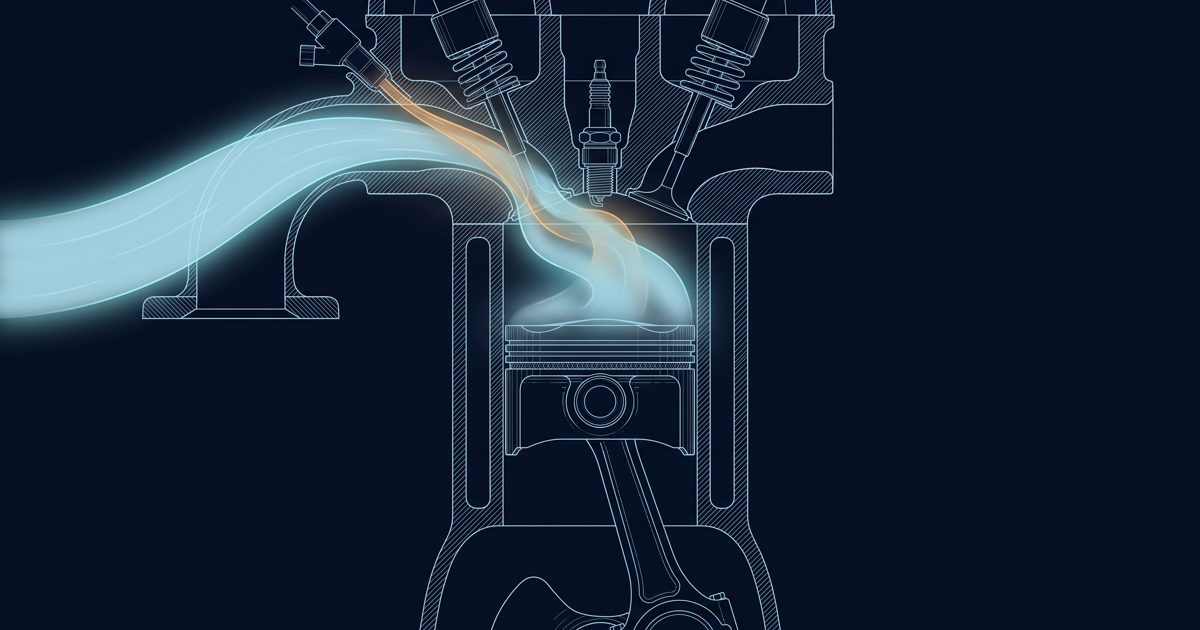
An engine burns air. Fuel is the part you pay for, but by mass the cylinder is nearly all air: about 14.7 kg of it for every kilogram of gasoline if the two are to use each other up completely. Shift that balance a little toward fuel and the engine makes a few percent more power while burning noticeably more per kilowatt-hour. Shift it toward air and the opposite happens, until the flame stops propagating and the engine misfires. That balance is the air-fuel ratio, and this article is about where the useful settings are, what happens on either side of them, and why gasoline's 14.7 is not a universal constant.
You can move it yourself. Load the 5.0 L V8 at λ 0.90, run it on the dyno, then load the same engine at λ 1.20 and run it again. The first reads 310 hp, the second 246. The article explains the 64 hp between them.
Key Takeaways
- Air-fuel ratio (AFR) is the mass of air divided by the mass of fuel in the charge. The stoichiometric ratio is the one that leaves no fuel and no oxygen over, and it is a property of the fuel: 14.7:1 for gasoline, 14.4:1 for diesel, 15.6:1 for propane, 34:1 for hydrogen, 6.4:1 for methanol.
- Lambda (λ) is the actual AFR divided by the stoichiometric one, so λ = 1 is stoichiometric for any fuel, λ < 1 is rich and λ > 1 is lean. Tuners quote λ because it means the same thing whatever is in the tank.
- Best power is rich of stoichiometric and best economy is lean of it. The FAA's powerplant handbook puts best power at 12.5 to 13.8:1 and best economy at 15.4 to 16.7:1 for a gasoline engine; in our simulator the same V8 makes +3.6% power at λ 0.90 and burns 4.6% less per kWh at λ 1.10, and past λ 1.15 it loses both.
- A three-way catalytic converter only works in a narrow band around λ = 1, which is why every modern road car idles and cruises at stoichiometric and goes rich only under full load.
- Diesels do not run at stoichiometric. They take in a full charge of air at every throttle position and meter power with fuel alone, so their overall AFR sits above 25:1 at full torque and above 160:1 at idle on a turbocharged diesel.
On this page: Quick answer · Stoichiometric · Lambda · Lean vs rich · A good AFR · The catalyst · Diesel · Sensors · Try it · FAQ · Method
Quick Answer: What Is the Air-Fuel Ratio
The air-fuel ratio is the mass of air in the cylinder divided by the mass of fuel, written as a ratio to one. Gasoline's chemically complete mixture, the stoichiometric ratio, is about 14.7 kg of air per kilogram of fuel, so 14.7:1. A mixture with more fuel than that is rich; one with less fuel is lean. Rich mixtures make slightly more power and run cooler at the cost of fuel; lean mixtures use less fuel per unit of work until they become too lean to burn. Modern gasoline cars hold the mixture at stoichiometric most of the time because the catalytic converter needs it there, and go rich under hard acceleration.
What Stoichiometric Means and Why Gasoline Is 14.7
Burning a hydrocarbon is a chemical reaction with fixed proportions. Each carbon atom wants one oxygen molecule to become CO₂, each pair of hydrogen atoms wants half an oxygen molecule to become water, and air is only 21% oxygen by volume. Do the arithmetic for a typical gasoline blend and it comes out near 14.7 kg of air per kilogram of fuel. The FAA's powerplant handbook rounds it to 15:1 ("0.067 pounds of fuel to 1 pound of air") and gives the definition: "With this mixture (given sufficient time and turbulence), all the fuel and all the oxygen in the air is completely used in the combustion process."
The number belongs to the fuel, not to the engine. The US Department of Energy's hydrogen engine module works the same sum for hydrogen and gets 34.33:1, "much higher than the 14.7:1 A/F ratio required for gasoline", because hydrogen has no carbon and its molecules are light. Diesel is about 14.4:1 by DieselNet's figure, propane 15.58:1, and methanol, which already carries an oxygen atom in every molecule, only 6.4:1.
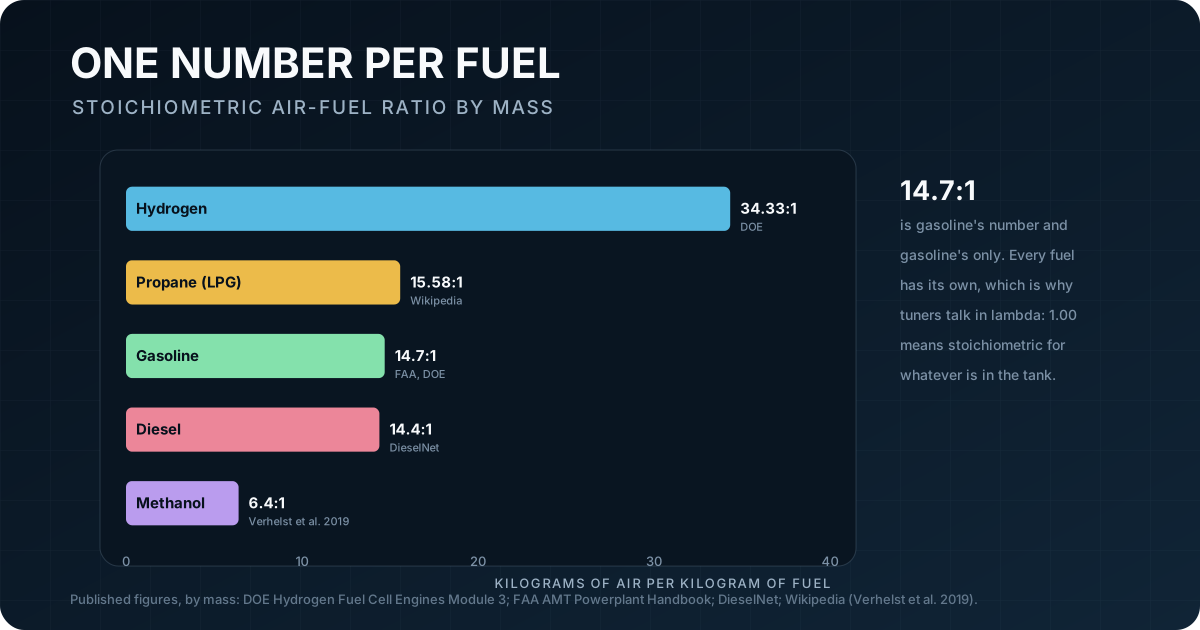
| Fuel | Stoichiometric AFR by mass | Source |
|---|---|---|
| Hydrogen | 34.33:1 | US DOE, Hydrogen Fuel Cell Engines Module 3 |
| Propane (LPG) | 15.58:1 | Wikipedia, Air–fuel ratio (worked example) |
| Gasoline | 14.7:1 (the FAA rounds to 15:1) | FAA AMT Powerplant Handbook; US DOE |
| Diesel | about 14.4:1 | DieselNet |
| Methanol | 6.4:1 | Verhelst et al. 2019, via Wikipedia |
Our simulator carries three of these: gasoline engines run on 14.7, the LPG four on 15.5, and the diesels on 14.5, DieselNet's 14.4 rounded. The "AFR now" readout in the piston spec panel is that number multiplied by whatever λ you set.
Lambda: the Number That Works for Every Fuel
Because 14.7 is gasoline's number only, engineers divide it out. Lambda, written λ, is the actual air-fuel ratio divided by the stoichiometric ratio for the fuel in use. λ = 1.00 is stoichiometric for gasoline, for propane, for hydrogen, for anything. λ = 0.90 is 10% less air than the chemistry wants, so rich; λ = 1.10 is 10% more air, so lean. The Wikipedia article on air–fuel ratio states it as "λ = 1.0 is at stoichiometry, rich mixtures λ < 1.0, and lean mixtures λ > 1.0."
Some textbooks and the DOE module above use the inverse, the equivalence ratio φ = 1/λ, so that rich is above 1 and lean below. Same information, opposite direction. Wideband lambda gauges in a tuner's car read λ directly; the same gauge switched to gasoline AFR just multiplies by 14.7.
Lean vs Rich: What Each Does to the Engine
The mixture changes three things at once: how much power a given lungful of air makes, how much fuel that power costs, and how hot the cylinder runs. The FAA handbook describes the shape from the rich side in: add fuel to a lean engine and "the power output of the engine increases rapidly at first, then gradually until maximum power is reached. With a further increase in the amount of fuel, the power output drops gradually at first," then faster.
Rich (λ below 1). More fuel than the oxygen can burn. Power rises a few percent, because the extra fuel vapor cools the charge and the flame runs faster, and then falls again as unburned fuel starts displacing air. Combustion temperature drops, so full-throttle enrichment is the standard protection against overheating and knock: the FAA handbook says "an engine running near full power requires a rich mixture to prevent overheating and detonation." The cost is fuel. Everything past the point of complete combustion goes out the exhaust as carbon monoxide and unburned hydrocarbons, and on the rich side of stoichiometric the three-way catalyst cannot oxidize them. The handbook's other rich symptom is fouling: "Excessively rich idle mixtures and the resultant incomplete combustion are responsible for more spark plug fouling than any other single cause."
Lean (λ above 1). More air than the fuel needs. Fuel per unit of work falls, which is what economy tuning chases, and the exhaust carries less CO and HC. Exhaust temperature peaks at or just lean of stoichiometric, and NOx formation peaks a little lean too, where heat and spare oxygen coincide; the hottest metal, as Lycoming's leaning guide notes, sits slightly rich of that. Lean further and the flame slows down, the engine loses power, and finally it misfires: "If the mixture is excessively lean, the engine may backfire through the induction system or stop completely." Lycoming's leaning guide for its aircraft engines describes the same edge as "misfiring due to a lean fuel/air mixture which will not support combustion."
What the simulator shows. We held the roster's 5.0 L V8 at 4,000 rpm, wide open, and stepped λ from 0.80 to 1.20 in 0.05 increments, reading brake power and fuel flow over a six-second window at each. Both series below are a percentage of the stoichiometric reading.
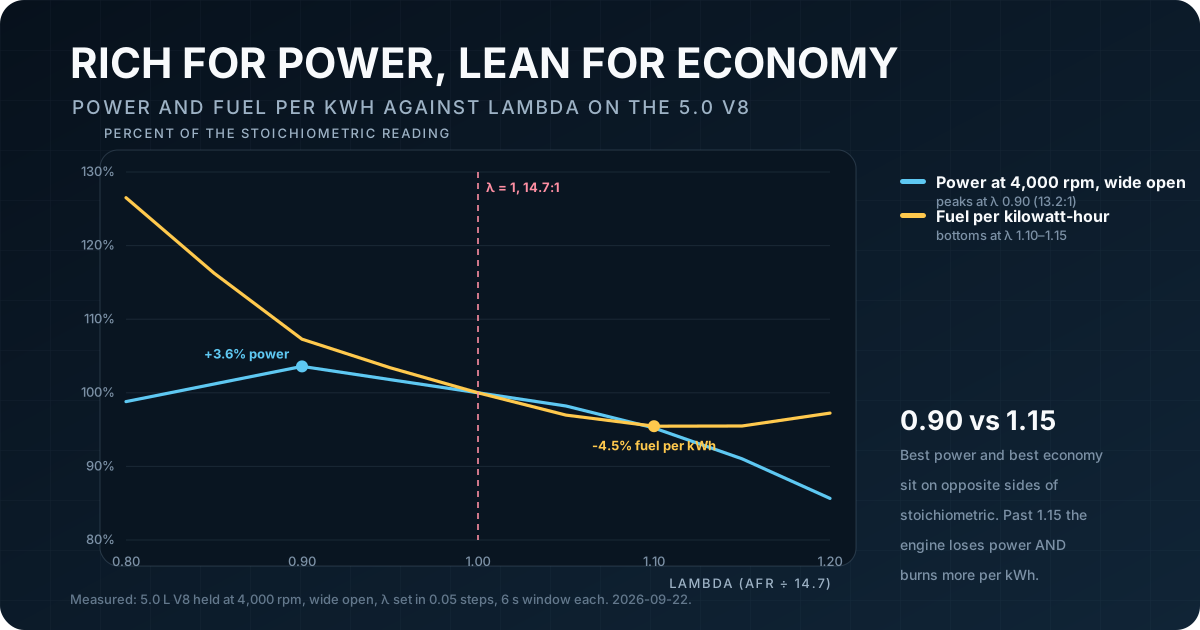
| λ | AFR | Power at 4,000 rpm | Fuel flow | Fuel per kWh | vs λ 1 |
|---|---|---|---|---|---|
| 0.80 | 11.8:1 | 246.6 hp | 75.8 L/h | 307 g/kWh | −1.2% power, +26.5% fuel per kWh |
| 0.85 | 12.5:1 | 252.6 hp | 71.3 L/h | 282 g/kWh | +1.2%, +16.2% |
| 0.90 | 13.2:1 | 258.6 hp | 67.4 L/h | 260 g/kWh | +3.6%, +7.3% |
| 0.95 | 14.0:1 | 254.1 hp | 63.8 L/h | 251 g/kWh | +1.8%, +3.4% |
| 1.00 | 14.7:1 | 249.6 hp | 60.6 L/h | 243 g/kWh | 0 |
| 1.05 | 15.4:1 | 245.1 hp | 57.7 L/h | 235 g/kWh | −1.8%, −3.0% |
| 1.10 | 16.2:1 | 237.7 hp | 55.1 L/h | 232 g/kWh | −4.8%, −4.6% |
| 1.15 | 16.9:1 | 227.2 hp | 52.7 L/h | 232 g/kWh | −9.0%, −4.5% |
| 1.20 | 17.6:1 | 213.8 hp | 50.5 L/h | 236 g/kWh | −14.3%, −2.8% |
Read the two bold rows together. Best power is at λ 0.90, and it costs 11% more fuel per hour for 3.6% more power. Best economy is at λ 1.10 to 1.15, and it costs 5% of the power at 1.10 and 9% at 1.15. Beyond 1.15 the engine gives up power and starts burning more per kilowatt-hour again, because the slowing flame wastes more of the fuel than the extra air saves. The full dyno sweep tells the same story at the top end: the same V8's peak reads 310.4 hp at λ 0.90, 297.6 at λ 1.00 and 246.1 at λ 1.20, and the roster's 2.0 L four goes 121.5, 116.5, 98.8.
The simulator's mixture model is a fitted table, not a flame-speed calculation, and the section on method says exactly what it does and does not include. The shape it reproduces is the textbook one, and the FAA's numbers land inside it.
What Is a Good Air-Fuel Ratio
There is no single good number, because the engine wants different things at different times. The gasoline figures below are the FAA handbook's, converted from its fuel-to-air fractions, with our measured λ alongside.
| Condition | What the engine wants | FAA handbook | λ | In the simulator |
|---|---|---|---|---|
| Idle and cruise on a modern road car | Catalyst efficiency | stoichiometric, 14.7:1 (15:1 as rounded) | 1.00 | the default on every gasoline preset |
| Best power (full throttle) | Most power from a given airflow, cooler charge | 12.5 to 13.8:1 ("best power mixtures" 0.0725 to 0.080 fuel/air) | 0.85 to 0.94 | power peaks at λ 0.90, 13.2:1 |
| Best economy (part-throttle cruise, no catalyst constraint) | Least fuel for a given power | 15.4 to 16.7:1 (0.060 to 0.065 fuel/air) | 1.05 to 1.13 | fuel per kWh bottoms at λ 1.10 to 1.15 |
| Lean limit of a conventional engine | Still burns | "too lean" backfires or stops | above about 1.2 | power down 14% at 1.20, the slider's limit |
Take the best-power row with two cautions. First, "maximum power at approximately 12 parts of air and 1 part of gasoline", as the FAA puts it, is a naturally aspirated, port-mixed figure; turbocharged and supercharged engines run richer than that at full boost, deliberately, because the extra fuel is the cheapest way to cool a compressed charge and hold off knock. Our supercharger vs turbocharger article covers the charge-temperature side of that, and MIT's lecture on mixture preparation draws the same strategy map: enrichment at high load, lean for fuel economy. Second, aviation practice measures the mixture by exhaust temperature rather than by ratio: Lycoming's guide says to "lean the mixture to 100 °F on the rich side of peak EGT for best power operation" and to run at peak EGT for best economy, and warns that the hottest cylinder heads and highest pressures sit about 50 °F rich of peak, the one place to avoid.
Lean-burn engines push past the conventional limit with stratified charges, a rich pocket around the spark plug inside an overall lean cylinder. Honda's lean-burn VTEC-E engines of the early 1990s ran as lean as 22:1, Mitsubishi's MVV to 25:1, and Honda's later i-VTEC I direct-injection engine to 65:1 at light load, per Wikipedia's lean-burn article. The catch is the next section.
Why Modern Cars Hold Lambda at Exactly 1
A three-way catalytic converter does three jobs in one brick: it oxidizes carbon monoxide and unburned hydrocarbons, which needs spare oxygen, and it reduces nitrogen oxides, which needs the opposite. The Wikipedia article on catalytic converters states it directly: "These three reactions occur most efficiently when the engine runs within a narrow band of air-fuel ratios near the stoichiometric point." Lean, and "the efficiency of the catalyst at reducing NOx falls off rapidly"; rich, and "the efficiency of the catalyst for oxidizing CO and HC decreases significantly." DieselNet gives the same window from the other side: CO conversion near 100% lean of stoichiometric, NOx conversion near 100% rich of it, both only at the crossover.
So a closed-loop gasoline engine oscillates its mixture a fraction either side of λ = 1, many times a second, steered by an oxygen sensor in the exhaust. That is the whole reason a modern road car does not cruise at the economy mixture the FAA describes: the fuel it would save is worth less than the NOx the catalyst would stop cleaning. Lean-burn engines that ran 22:1 needed separate NOx traps and mostly disappeared when emissions rules tightened. The exception is full throttle, where the engine control unit goes open-loop and rich to protect the engine, and the catalyst's efficiency is sacrificed for a few seconds.
The Air-Fuel Ratio of a Diesel
A diesel has no throttle plate. It takes in a full charge of air at every pedal position and controls power by how much fuel it injects, so its mixture is lean almost all the time and very lean at idle. DieselNet puts the numbers on it: "To avoid excessive smoke formation, A/F ratio at peak torque is usually maintained above 25:1, well above the stoichiometric (chemically correct) equivalence ratio of about 14.4:1. In turbocharged diesel engines the A/F ratio at idle may exceed 160:1." In λ terms, a diesel at full torque is at about 1.7 and at idle above 11.
That is why the mixture slider in our simulator only appears on spark-ignition engines. A diesel preset meters on its fuel rack and is capped by a smoke limit instead; the diesel torque article explains why that arrangement produces so much torque, and why the roster's diesels never trip the vapor-lock or knock warnings a gasoline engine can.
How the Engine Knows Its Own Mixture
The oxygen sensor in the exhaust is what closes the loop. A narrowband sensor, factory-fitted since the late 1970s and early 1980s, is a switch: its output swings to about 0.2 V when the exhaust is lean and 0.8 V when it is rich, and the control unit steers the mixture to keep it flicking across 0.45 V. It cannot say how lean or how rich, only which side of stoichiometric it is on, which is all a catalyst-equipped engine needs at cruise. A wideband sensor, first produced by NTK in 1992, measures λ across a range, and it is what a tuner reads from when setting full-throttle enrichment. The gauge on a modified car labelled "AFR" is a wideband λ sensor with the reading multiplied by 14.7.
Try It in the Simulator
Open the 5.0 L V8, start it, and find the Mixture λ row in the spec panel. It reads 1.00, and the "AFR now" line under it reads 14.7:1. Run the dyno: 297.6 hp.
Now set λ to 0.90, or open the V8 at λ 0.90, which does it for you. AFR now reads 13.2:1 and the dyno gives 310.4 hp, up 4.3%. Watch the fuel schematic while it runs: the consumption readout is up by about a tenth. Then set λ to 1.20 (the V8 at λ 1.20): 17.6:1 and 246.1 hp, down 17%, with the fuel flow a sixth lower than stoichiometric. The slider stops at 0.80 and 1.20, because the model's table is only fitted inside that band.
For the economy side, hold a steady load rather than sweeping the dyno: put the engine in gear, hold a fixed speed, and compare the litres-per-hour reading at λ 1.00 and 1.10. The 2.0 L four at λ 0.90 and at λ 1.20 show the same pattern on a small engine: 121.5 hp against 98.8. A diesel preset has no λ row at all, for the reason above.
What you will not see is the two effects the model leaves out. Enrichment does not lower the knock index, so the simulator cannot show you the reason real engines go rich under boost; use the engine knock article's compression and octane levers for that. And the exhaust temperature readout does not move with mixture, so the "rich of peak" and "lean of peak" that pilots lean by is not reproduced here.
Frequently Asked Questions
Is 14.7 AFR lean or rich?
Neither. 14.7:1 is the stoichiometric ratio for gasoline, the mixture with exactly enough air to burn all the fuel, and it is λ = 1.00. Anything with a larger number, such as 15.5:1, has more air and is lean; anything with a smaller number, such as 13:1, has more fuel and is rich. Other fuels have other stoichiometric numbers, so tuners use λ instead.
What AFR is best for power?
A little rich of stoichiometric. The FAA's powerplant handbook puts the best-power range for a gasoline engine at about 12.5 to 13.8:1, and says maximum power arrives at "approximately 12 parts of air and 1 part of gasoline by weight." In our simulator the 5.0 L V8's power peaks at λ 0.90, which is 13.2:1, at 3.6% above stoichiometric at 4,000 rpm and 4.3% above at its 7,000 rpm peak. Boosted engines run richer still at full throttle to cool the charge.
What is a good air-fuel ratio at idle?
On a modern car with a catalytic converter, stoichiometric: 14.7:1 for gasoline, λ = 1.00. The catalyst cleans all three regulated pollutants only in a narrow band around that point, and idle is where the engine spends a great deal of its life. A carbureted engine without a catalyst is usually set slightly rich at idle for smoothness, and the FAA handbook warns that an idle set too rich fouls spark plugs faster than any other single fault.
Is running lean or rich worse for an engine?
Lean is the more dangerous fault at high load. A lean mixture burns hotter, raises exhaust and cylinder-head temperatures, and takes away the knock margin that enrichment provides, so a lean engine under full throttle can overheat or detonate. Rich running wastes fuel, fouls plugs, and washes oil from the cylinder walls if it is severe, but it does not usually damage an engine quickly. Neither is acceptable as a steady state; the fix is to find out why the mixture is off.
What is lambda in an engine?
Lambda (λ) is the actual air-fuel ratio divided by the stoichiometric ratio for the fuel in use. λ = 1.00 is stoichiometric whatever the fuel, λ = 0.90 is 10% rich, λ = 1.10 is 10% lean. Its inverse, the equivalence ratio φ, is used in some textbooks and puts rich above 1 instead. A wideband oxygen sensor measures λ directly.
What does an AFR gauge actually measure?
Oxygen in the exhaust, not the fuel going in. A narrowband sensor switches between about 0.2 V (lean) and 0.8 V (rich) as the mixture crosses stoichiometric, which is enough for a catalyst-equipped engine to hold λ = 1. A wideband sensor measures λ across a range, and an AFR gauge is a wideband λ reading multiplied by the stoichiometric ratio of the fuel, 14.7 for gasoline.
Does a diesel engine have an air-fuel ratio?
Yes, but it is not held at stoichiometric and it changes with load rather than being controlled to a target. A diesel takes in a full charge of air at every pedal position and controls power by fuel quantity, so the overall ratio is lean everywhere: above 25:1 at peak torque to stay under the smoke limit, and above 160:1 at idle on a turbocharged engine, by DieselNet's figures. Diesel's stoichiometric ratio itself is about 14.4:1.
Why do turbocharged engines run rich at full throttle?
To cool the charge and hold off knock. Compressing the intake air heats it, a hotter charge detonates more readily, and extra fuel vaporizing in the cylinder absorbs heat. Rich mixtures also lower combustion temperature, which protects pistons, exhaust valves and the turbine. The cost is fuel and catalyst efficiency, which is why the enrichment is limited to full load.
How These Numbers Were Made
Every simulator figure in this article comes from one headless run of the simulator on 2026-09-22. For each λ from 0.80 to 1.20 in steps of 0.05, the probe built the preset with that mixture, ran the standard 45-point wide-open dyno sweep for the peak figures, then started the engine, held it at 4,000 rpm wide open on the dyno until the intake charge settled, and averaged brake torque and fuel flow over the following six seconds. Fuel per kilowatt-hour is fuel flow times the preset's fuel density (0.745 kg/L) divided by brake power. Two presets ran: the 5.0 L V8 and the 2.0 L four. The deep links in this article carry only the mixture setting and were checked to load with the stated λ.
The model itself is deliberately simple. Fuel demand scales as 1/λ, and the heat released per cycle is multiplied by a nine-point table fitted so that λ = 1 returns exactly 1, power peaks near 0.90, and the lean side falls away steeply enough that work per unit of fuel turns over around 1.15. Three things a real engine does with mixture are not in it: the knock model does not read λ, so enrichment gives no detonation margin; exhaust temperature does not respond to mixture; and there is no separate cylinder-to-cylinder distribution. The slider is limited to 0.80 to 1.20 because that is the band the table was fitted over.
About this article
Written by the team that builds the simulator and its mixture model, with the real-world figures drawn from the FAA, the US Department of Energy, Lycoming, DieselNet and the encyclopedia sources listed below. The simulator numbers are the model's and are stated as such throughout.
Sources and Further Reading
- FAA Aviation Maintenance Technician Handbook, Powerplant, Chapter 2: Engine Fuel and Fuel Metering Systems (PDF, retrieved 2026-09-22): the 15:1 stoichiometric definition, the best-power and best-economy fuel/air ranges, the rich and lean symptoms
- US DOE, Hydrogen Fuel Cell Engines and Related Technologies, Module 3: Hydrogen Use in Internal Combustion Engines (PDF, retrieved 2026-09-22): the worked stoichiometric sum for hydrogen (34.33:1), gasoline's 14.7:1, the equivalence ratio
- DieselNet: Combustion in Diesel Engines (retrieved 2026-09-22): diesel's 14.4:1, the 25:1 smoke limit at peak torque, 160:1 at idle
- DieselNet: Three Way Catalysts (retrieved 2026-09-22): the stoichiometric window
- Lycoming: Leaning Lycoming Engines (retrieved 2026-09-22): rich of peak and peak EGT practice
- MIT OpenCourseWare 2.61 Internal Combustion Engines, Lecture 7: Mixture Preparation in SI Engines (PDF, retrieved 2026-09-22): enrichment at high load, lean for economy
- Wikipedia: Air–fuel ratio (retrieved 2026-09-22)
- Wikipedia: Catalytic converter (retrieved 2026-09-22)
- Wikipedia: Oxygen sensor (retrieved 2026-09-22)
- Wikipedia: Lean-burn (retrieved 2026-09-22)
- Wikipedia: Methanol fuel (retrieved 2026-09-22), citing Verhelst, Turner, Sileghem and Vancoillie (2019) for methanol's 6.4:1
Related Reading
- What Is Engine Knock? Causes, Sounds, and How to Stop It
- What Is Vapor Lock? Symptoms, Causes, Temperature, and Fixes
- Supercharger vs Turbocharger: Which Makes More Power? We Fitted Both to One V8
- Why Do Diesel Engines Make So Much Torque? We Took the Turbo Off to Find Out
- How Much Horsepower Does One Point of Compression Add? We Measured It