Does a Diesel Engine Have Spark Plugs? No, and What Replaces Them
Diesels have no spark plugs, coils or distributor: compressed air lights the fuel on contact. What glow plugs are for, why 17.5:1 matters, and a simulator to try.
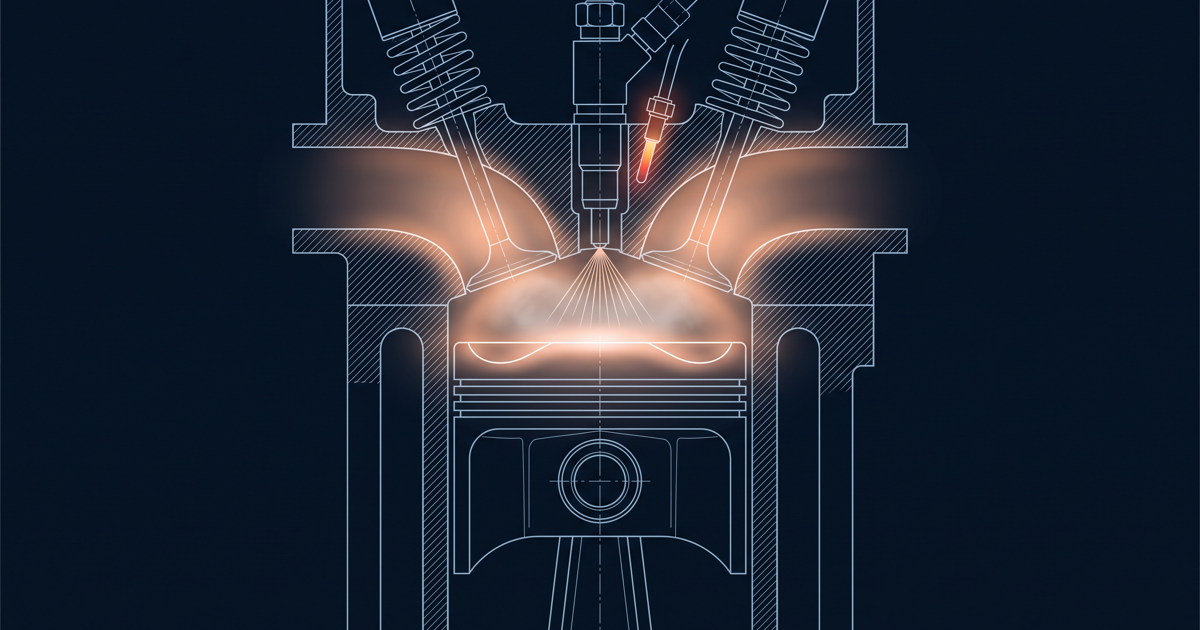
No. A diesel engine has no spark plugs, and nothing else that makes a spark either: no ignition coil, no distributor, no plug leads. It lights its fuel by squeezing air until the air is hot enough to ignite diesel on contact, then spraying the fuel in at the moment it should burn. The part people see when they open a diesel's hood and expect spark plugs is usually a glow plug, which heats the chamber for cold starts and does nothing once the engine is running.
You can watch the difference in our simulator. Press START on the 2.0 L diesel and the readout says GLOW for a second and a half before the starter turns; press START on the 2.0 L gasoline four and it fires on the first compression. While the diesel cranks, its cylinder pressure gauge reads nearly twice the gasoline engine's. This article explains both.
Key Takeaways
- A diesel is a compression-ignition engine. It draws in air only, compresses it 14 to 23 times, and injects fuel near the top of the stroke into air already hot enough to light it. There is no spark and no ignition system.
- The temperature comes from the compression ratio. From 20 °C air, a 17.5:1 squeeze reaches about 525 to 650 °C by the textbook relation before any heat from the engine is added; NGK, which makes both spark plugs and glow plugs, puts a warm diesel's compressed air at around 900 °C. Diesel fuel self-ignites at about 254 to 285 °C.
- Glow plugs are a cold-start aid, not an ignition system. A cold block steals heat from the compressed air, so a glow plug tip heats to about 1,000 °C for a few seconds before cranking, then switches off once the engine is warm.
- A gasoline engine cannot work this way because its fuel is mixed with the air before compression and would ignite early; that is knock, and it is why gasoline compression ratios stop near 12:1 in most cars. Diesel fuel is graded by cetane number, its readiness to ignite, the opposite of gasoline's octane.
- In the simulator the 2.0 L diesel cranks at 39.6 bar against the gasoline engine's 20.9, waits 1.5 s of glow before it turns, and starts unchanged down to −18 °C, well inside the band where its modelled fuel is already gelling, and not at −23 °C.
On this page: Quick answer · Compression ignition · How hot · Why gasoline cannot · Glow plugs · Other cold-start aids · Exceptions · Try it · FAQ · Method
Quick Answer: Do Diesel Engines Have Spark Plugs
No. Diesel engines ignite their fuel by compression, not by a spark. The piston compresses air alone to a high enough temperature that diesel fuel ignites the instant it is injected, so there is no spark plug, no ignition coil and no distributor. Most car and light-truck diesels have glow plugs instead: electric heaters that warm the combustion chamber for a few seconds before a cold start and then switch off. A diesel with a failed glow plug still runs; it just starts badly on a cold morning.
How a Diesel Ignites Without a Spark
The four strokes are the same as a gasoline engine's, and our four-stroke article walks through them. The difference is what is in the cylinder during the compression stroke and when the fuel arrives.
A gasoline engine compresses a mixture of air and fuel vapor, then fires a spark to start the burn. A diesel compresses air only. MIT's engineering notes on the diesel cycle put the sequence in one sentence: "Fuel is sprayed into the cylinder at P2 (high pressure) when the compression is complete, and there is ignition without a spark." The injector opens a few degrees before top dead center, fuel meets air that is already several hundred degrees hot, and after a short delay it lights. Combustion then proceeds as fast as the injector can deliver fuel and the fuel can find oxygen, which is why a diesel's burn is called a diffusion flame and why it meters power with fuel quantity rather than a throttle plate. The US Department of Energy describes it the same way: "only air is inducted into the engine and then compressed," and diesel engines "spray the fuel into the hot compressed air at a suitable, measured rate, causing it to ignite."
Rudolf Diesel applied for his patent in 1892, and the first engine that worked was tested at Maschinenfabrik Augsburg in 1897, a 25-horsepower single cylinder. The idea has not changed: heat from compression, fuel on demand.
How Hot the Air Gets
Compress a gas quickly and its temperature rises with the volume ratio. The textbook relation, from Georgia State University's HyperPhysics, is T₂ = T₁ × r^(γ−1), where r is the compression ratio and γ is about 1.4 for air. HyperPhysics adds the line that matters: "The diesel cycle depends upon this temperature being high enough to ignite the fuel when it is injected."
| Compression ratio | Typical of | Air at TDC from 20 °C, γ = 1.35 | γ = 1.4 (ideal) |
|---|---|---|---|
| 10.5:1 | gasoline engine | 394 °C | 477 °C |
| 14.5:1 | large diesel (the 60 L V16 below); Mazda's Skyactiv-D launched at 14.0:1 | 474 °C | 581 °C |
| 17.5:1 | passenger-car and pickup diesel | 525 °C | 648 °C |
| 18.7:1 | two-stroke Detroit Diesel | 544 °C | 672 °C |
Real engines run hotter than the ideal sum from 20 °C, because the intake air is warmer than ambient, the cylinder walls are warm, and a turbocharger has already heated the charge. NGK's glow plug page says a running diesel's air is "compressed to reach around 900 °C. When the fuel is then injected, it ignites spontaneously," and the German-language Wikipedia article on the diesel engine gives 700 to 900 °C for a 16:1 to 24:1 four-stroke. Any of those numbers is far above what diesel fuel needs: the WHO and ILO's chemical safety card for No. 2 diesel gives an auto-ignition temperature of 254 to 285 °C.
The chart below is what our simulator measures while the starter turns, before the first firing stroke. The pressure is the model's; the temperature above each bar is the textbook figure from the table, not a simulator reading.
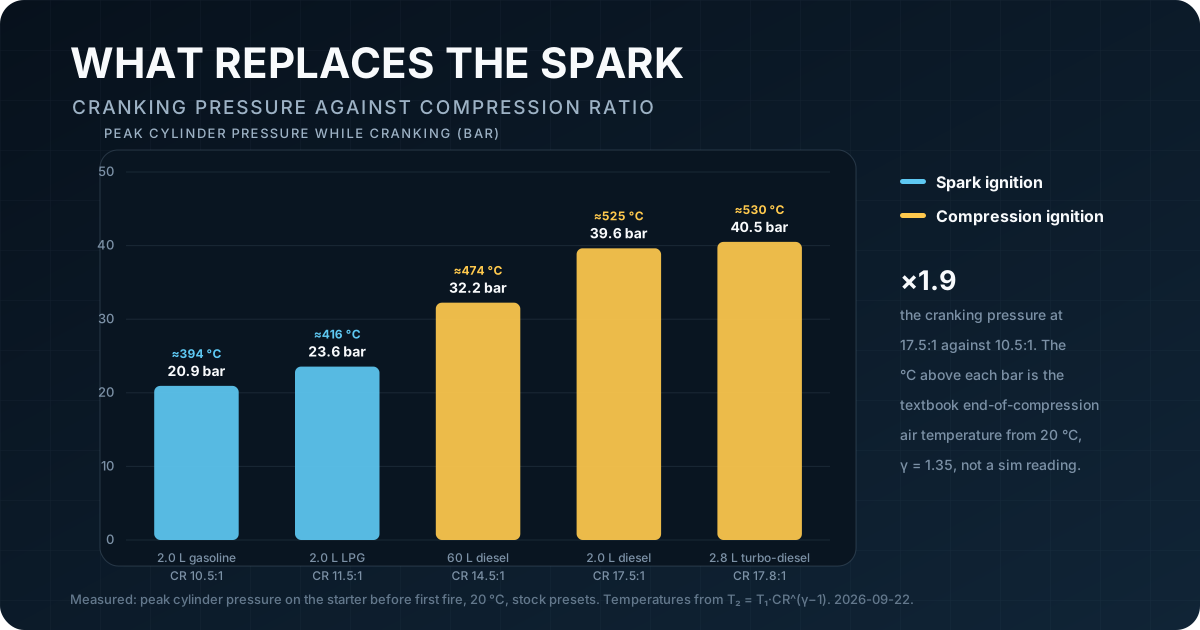
The 2.0 L diesel cranks at 39.6 bar, 1.9 times the 2.0 L gasoline engine's 20.9 bar, from an almost identical displacement. That ratio is the cranking half of the reason a diesel needs a heavier block, a bigger starter and a bigger battery (peak firing pressure is the other half), and it is the reason it does not need a spark.
Why a Gasoline Engine Cannot Do the Same
The tempting explanation is that diesel ignites at a lower temperature than gasoline. The safety data does not support it: the same chemical safety card series gives gasoline an auto-ignition temperature of about 250 °C, in the same band as diesel. Compress gasoline vapor to 500 °C and it lights too, and that is the problem. A gasoline engine carries its fuel through the whole compression stroke, premixed with the air, so if the compression ratio were high enough to reach diesel temperatures the mixture would ignite on its own before the spark, and at the wrong time. That is engine knock, and the need to avoid it is why passenger-car gasoline compression ratios have sat between about 8:1 and 12:1 for decades, with Mazda's 14:1 Skyactiv-G the highest of any mass-production gasoline engine when it launched in 2010. A diesel avoids the problem by keeping fuel out of the cylinder until the moment it should burn. MIT's note again: the diesel cycle "can operate with a higher compression ratio than the Otto cycle because only air is compressed and there is no risk of auto-ignition of the fuel."
The two fuels are then graded in opposite directions. Gasoline's octane number measures its resistance to igniting under compression; a higher number tolerates more compression before it knocks. Diesel's cetane number measures its readiness to ignite; the US Department of Energy puts it as "a higher cetane number means the engine is easier to start and reduces ignition delay." US road diesel must reach a cetane number of 40 under ASTM D975, European diesel 51 under EN 590. A fuel that resists ignition in one engine is a fuel that starts badly in the other, and the flash points show the same split: diesel's is 52 to 96 °C, so it will not form an ignitable vapor at room temperature and is unsuitable for spark ignition, while gasoline's is below −21 °C.
| Gasoline (spark ignition) | Diesel (compression ignition) | |
|---|---|---|
| What is compressed | air and fuel, premixed | air only |
| Ignition source | spark plug, every power stroke | heat of compression; fuel injected at the top of the stroke |
| Compression ratio | about 8:1 to 12:1, 14:1 at most | about 14:1 to 23:1 |
| Fuel grading | octane: resistance to ignition | cetane: readiness to ignite |
| Power control | throttle plate limits air | fuel quantity; air is never throttled |
| Cold-start aid | none needed | glow plugs or an intake heater |
Our compression ratio article measures what each extra point of compression is worth on a gasoline engine and where knock stops it; the diesel torque article runs the same lever on a diesel with knock switched off, because a diesel has no premixed charge to knock.
What Glow Plugs Are For
On a cold morning the sum in the temperature table goes wrong. The intake air starts below freezing, and the cold cylinder walls, piston and valves take heat out of it during compression. NGK explains that "the cold cylinder walls, pistons and valves try to extract heat from the cold intake air, and as a result the necessary combustion temperature is not achieved. Extra heat is needed – and that is where the glow plug comes into play."
A glow plug is a pencil-shaped heater with an electric element at its tip, screwed into each combustion chamber or pre-chamber where a spark plug would sit in a gasoline engine. Switch the ignition on and it heats for a few seconds before the starter is allowed to turn; NGK's current ceramic plugs reach 1,000 °C in under two seconds and can run to 1,350 °C. When the fuel spray touches the hot tip it lights even though the air alone would not have lit it. Once the engine is warm the control unit switches the plugs off; on a warm day, or an engine that has just been running, they may never come on at all. The engineering rule of thumb is that a direct-injection diesel needs help below about 0 °C and an old-style pre-chamber diesel below about 40 °C, which is why the pre-chamber engines of the 1980s glowed for twenty seconds before every start and a modern one barely pauses.
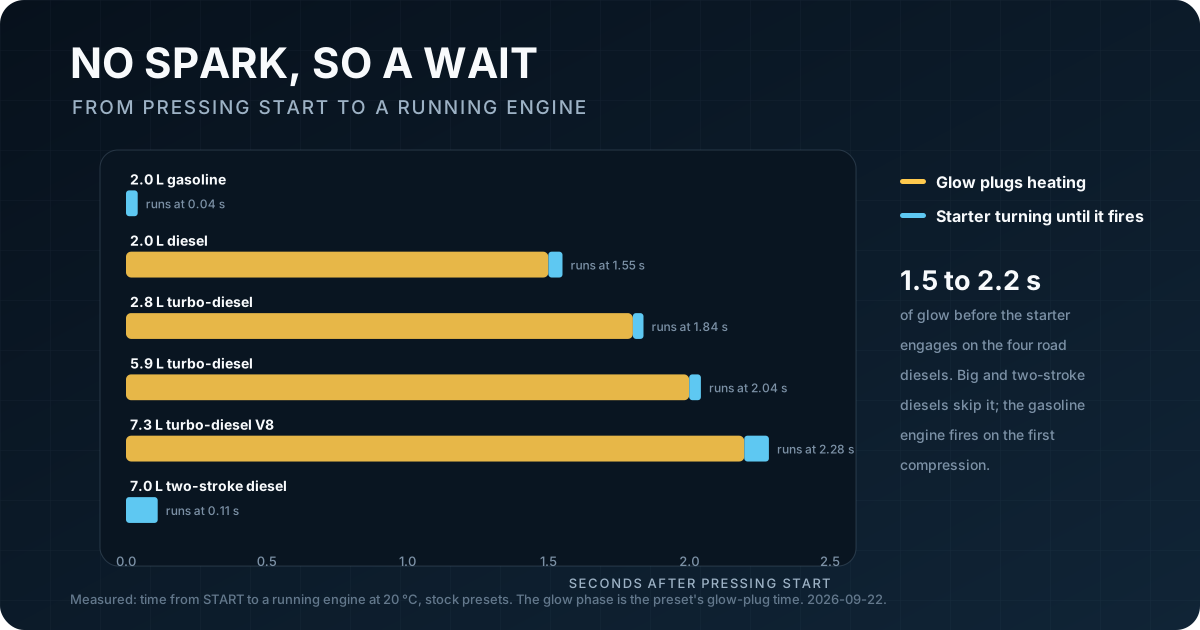
The chart is the simulator's start sequence at 20 °C. The four road diesels glow for 1.5 to 2.2 seconds before the starter engages and fire within a tenth of a second once it does; the gasoline four fires on its first compression stroke. The 7.0 L two-stroke diesel, built to the Detroit 6-71's geometry, has no glow phase in the model, and neither does the 60 L V16 (not on the chart), which matches the real engines: large direct-injection diesels use intake-air heaters or, on the biggest engines, flame-start systems, and the Cummins 12-valve in a 1990s pickup never had glow plugs at all.
A diesel with failed glow plugs still runs. It starts badly when cold, with white smoke of unburned fuel until the block warms, and on a very cold morning it may not start; in warm weather the driver may not notice for months. The spark plugs on a gasoline engine are needed on every stroke; the glow plugs on a diesel are needed for a few seconds.
Other Cold-Start Aids
Glow plugs are one of several ways to put heat back into a cold diesel.
- Intake air heaters. An electric grid in the intake manifold warms the air before it enters the cylinder. Common on larger direct-injection engines, and used instead of glow plugs on some pickup diesels.
- Block heaters. A mains-powered element in the coolant jacket keeps the whole engine warm overnight; standard equipment where winters are cold.
- Winter fuel. Diesel fuel itself clouds and then gels as paraffin wax crystallizes out of it; European EN 590 grades run from a cold-filter plugging point of +5 °C for the mildest summer class to −44 °C for the harshest arctic one, and North American suppliers blend in kerosene for winter. The simulator models this as a single threshold: below 263 K (−10 °C) the fuel system flags COLD GEL and the supply falls away, reaching zero at 251 K (−22 °C).
- Starting fluid. Ether sprayed into the intake ignites at a much lower temperature than diesel. It is a last resort, and the standard warning is not to use it on an engine with glow plugs or an intake heater, because the ether can light on the heater before the piston has finished compressing.
The Exceptions: a Spark Plug in a Compression-Ignition Engine
Two kinds of engine blur the line, and they are where the "diesel with a spark plug" question comes from.
Mazda's Skyactiv-X, sold from 2019, is a gasoline engine that runs on compression ignition most of the time. Mazda's announcement calls it "the world's first commercial gasoline engine to use compression ignition" and describes the spark plug's role as a trigger: a small extra squirt of fuel is lit by the plug, the pressure rise from that flame pushes the rest of the lean charge past its ignition point, and the whole cylinder burns by compression. Mazda calls it Spark Controlled Compression Ignition. It has a spark plug because gasoline's ignition timing under pure compression is too hard to control; it is not a diesel.
The other is homogeneous charge compression ignition research, HCCI, where a premixed charge is compressed until it lights everywhere at once, with no spark and no injector timing to control the moment. It gives diesel-like efficiency with very low NOx and has stayed a laboratory engine for decades because that moment is so hard to control across a full range of load and temperature. Skyactiv-X is the first production engine to solve enough of that problem to sell.
Neither changes the answer for the diesel in a truck or a car: no spark plugs, compression only.
Try It in the Simulator
Open the 2.0 L diesel and press START. The status shows the glow phase counting down for 1.5 seconds before the starter engages, and while it cranks, watch the cylinder pressure: it peaks near 40 bar before the first firing stroke. Once it runs, look at the manifold pressure gauge. It sits at 0.96 bar, near atmospheric, and it stays there when you press the pedal, because a diesel has no throttle plate and meters power by fuel; the pedal is a fuel rack. Now open the 2.0 L gasoline four and press START. It fires within a twentieth of a second, cranks at about 21 bar, and idles with the manifold at 0.18 bar behind a nearly closed throttle plate. At 2,500 rpm and part load the two read 0.96 and 0.42 bar; that gap is the throttle plate.
For the cold-start half of the story, open the same diesel at −18 °C. It starts exactly as it did at 20 °C: the model's glow time does not lengthen with cold and it has no compression-temperature threshold, which the method section explains. What it does model is the fuel. Drag the ambient slider below 263 K and COLD GEL lights on the fuel schematic; at 250 K, −23 °C, the glow phase runs, the starter turns, and the engine never catches, because the modelled supply has fallen to nothing. The gasoline four at the same −23 °C starts at once. Gasoline does not gel; its temperature fault sits at the other end of the scale, vapor lock in the heat.
Frequently Asked Questions
Do diesel engines have glow plugs instead of spark plugs?
Most car and light-truck diesels have glow plugs, but they are not a replacement for spark plugs in function. A spark plug fires on every power stroke and the engine cannot run without it. A glow plug heats the combustion chamber for a few seconds before a cold start and is switched off once the engine is warm; the engine runs without it. Large direct-injection diesels often have intake heaters or no cold-start heater at all.
What happens if a glow plug fails? Will the diesel still start?
Usually yes, once the weather is mild. A diesel with one or more failed glow plugs starts normally when warm, starts roughly with white smoke when cold, and may refuse to start on a very cold morning. It is a cold-start fault, not a running fault, which is why it often goes unnoticed through a summer.
Why does diesel not need a spark to ignite?
Because the air in the cylinder is already hotter than the fuel's ignition temperature when the fuel arrives. Compressing air 17:1 heats it to several hundred degrees, about 525 to 650 °C by the textbook sum from 20 °C and around 900 °C in a warm running engine by NGK's figure, and diesel fuel self-ignites at 254 to 285 °C. The injector adds the fuel at the top of the compression stroke and it lights on contact.
Can you put a spark plug in a diesel engine?
Not usefully. There is nothing to ignite: the cylinder holds only air during compression, and by the time fuel is injected the air is hot enough to light it without help. A spark plug in a diesel chamber would fire into empty air. Engines that do use a spark to start compression ignition, such as Mazda's Skyactiv-X, are gasoline engines running a lean premixed charge, not diesels.
Which diesel engines do not use glow plugs?
Many heavy-duty direct-injection diesels. The 5.9 L Cummins 12-valve in 1989-1998 Dodge pickups used direct injection and an intake grid heater and had no glow plugs; large truck, marine and generator diesels use intake heaters or flame-start systems. In our simulator the 7.0 L two-stroke diesel and the 60 L V16 have no glow phase for the same reason.
Does a diesel engine have an ignition coil or a distributor?
No. Both exist only to make a spark, and a diesel has no spark to make. Its equivalent of the ignition system is the injection system: the pump, rail and injectors that decide when and how much fuel enters the cylinder. On a modern common-rail diesel the injection timing is controlled electronically, in the same way spark timing is on a gasoline engine.
Why do diesels have such high compression ratios?
Because compression is the ignition source. A diesel needs its air hot enough to light injected fuel at the top of the stroke, and the temperature comes from the ratio: 14:1 to 23:1 in practice, against 8:1 to 12:1 for gasoline. A gasoline engine cannot follow because its fuel is in the cylinder during compression and would ignite early; that is knock.
How These Numbers Were Made
Every simulator figure in this article comes from one headless run of the simulator on 2026-09-22. For each of eight presets (the 2.0 L gasoline four, the 2.0 L LPG four, and six diesels from 2.0 to 60 L) the probe set the ambient temperature, switched on the ignition and the starter, and stepped the engine until it reported running or 15 seconds had passed, recording the length of the glow phase, the time to a running engine, the highest cylinder pressure sampled on any cylinder before it had fired, and the manifold pressure while cranking. It then idled each engine for six seconds and averaged the last two. The run was repeated at 293, 273, 264, 262, 255 and 250 K. A separate pass held each 2.0 L engine at 2,500 rpm on the dyno at 30% demand and read the manifold pressure.
The temperatures in the compression table are not simulator readings. They are the textbook relation T₂ = T₁ × r^(γ−1) evaluated from 293 K at γ = 1.35 and 1.4; the model itself compresses on a polytropic exponent of 1.3, which is why its cranking pressures come out at roughly the compression ratio to the power 1.3 times manifold pressure. The model has no compression-temperature ignition threshold: a diesel fires once its glow countdown has run and the crank is turning fast enough, at any ambient, and the cold behavior it does have lives in the fuel system, where diesel supply is derated below 263 K and cut off at 251 K. Every diesel preset started identically at 293, 273, 264, 262 and 255 K and none started at 250 K. The two-stroke's cranking pressure is lower than its 18.7:1 geometry suggests because its compression begins when the exhaust port closes, not at bottom dead centre.
About this article
Written by the team that builds the simulator and its combustion and fuel-system models, with the real-world figures drawn from MIT, Georgia State University, the US Department of Energy, the WHO/ILO chemical safety cards, NGK, Mazda and the encyclopedia sources listed below.
Sources and Further Reading
- MIT Unified Engineering thermodynamics notes, 3.6: Diesel Cycle (retrieved 2026-09-22)
- Georgia State University HyperPhysics: Diesel Cycle (retrieved 2026-09-22): T₂ = T₁ × r^(γ−1)
- US Department of Energy: Internal Combustion Engine Basics (retrieved 2026-09-22)
- US DOE Alternative Fuels Data Center: Diesel Vehicles (retrieved 2026-09-22): cetane number
- NGK Spark Plug Europe: Glow Plugs (retrieved 2026-09-22): 900 °C compressed air, 1,000 °C in under two seconds
- WHO/ILO International Chemical Safety Card 1561: Fuels, Diesel, No. 2 and Card 1400: Gasoline (retrieved 2026-09-22): auto-ignition temperatures and flash points
- Mazda: SKYACTIV-X announcement, 8 August 2017 and SKYACTIV-G 14.0:1, 20 October 2010 (retrieved 2026-09-22)
- Wikipedia: Diesel engine (retrieved 2026-09-22): compression ratios, injection, cold-start thresholds
- Wikipedia (German): Dieselmotor (retrieved 2026-09-22): 700 to 900 °C end-of-compression figure
- Wikipedia: Glow plug (retrieved 2026-09-22)
- Wikipedia: Cetane number and EN 590 (retrieved 2026-09-22)
- Wikipedia: Cummins B Series engine (retrieved 2026-09-22)
- Wikipedia: Rudolf Diesel (retrieved 2026-09-22)
Related Reading
- Why Do Diesel Engines Make So Much Torque? We Took the Turbo Off to Find Out
- How Much Horsepower Does One Point of Compression Add? We Measured It
- What Is Engine Knock? Causes, Sounds, and How to Stop It
- What Is Vapor Lock? Symptoms, Causes, Temperature, and Fixes
- How a Four-Stroke Engine Works (All 4 Strokes Explained)